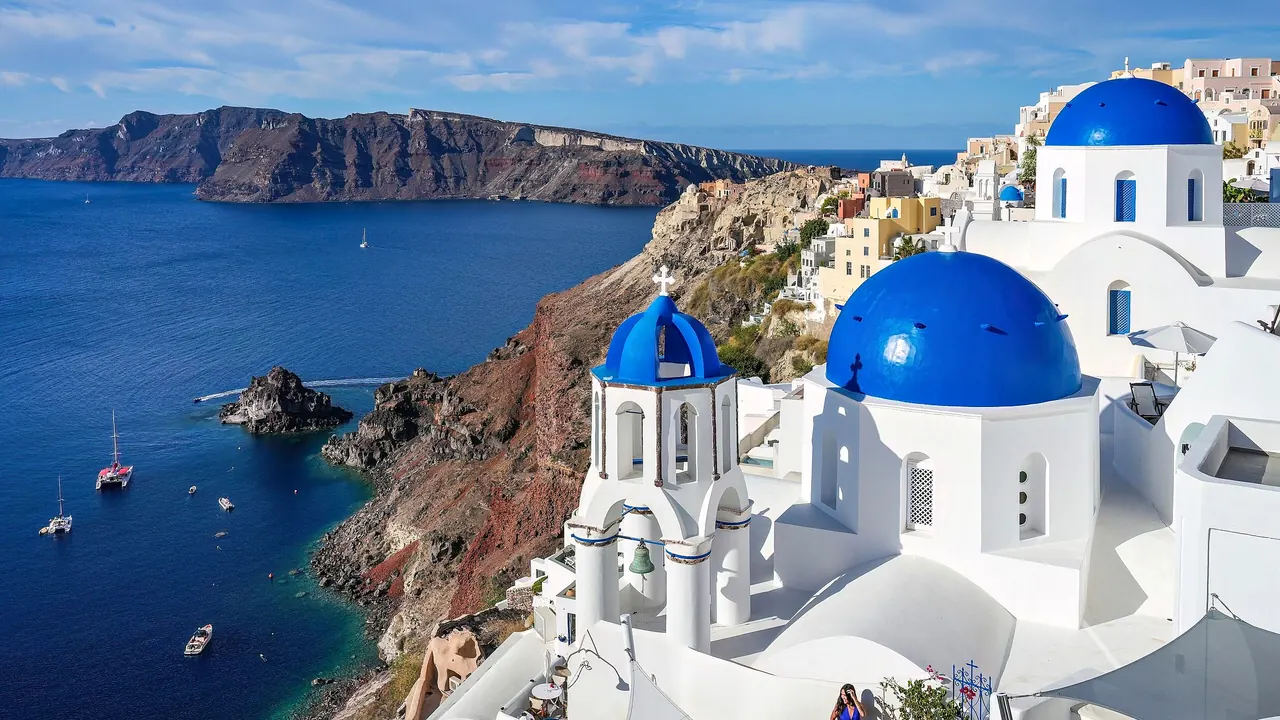
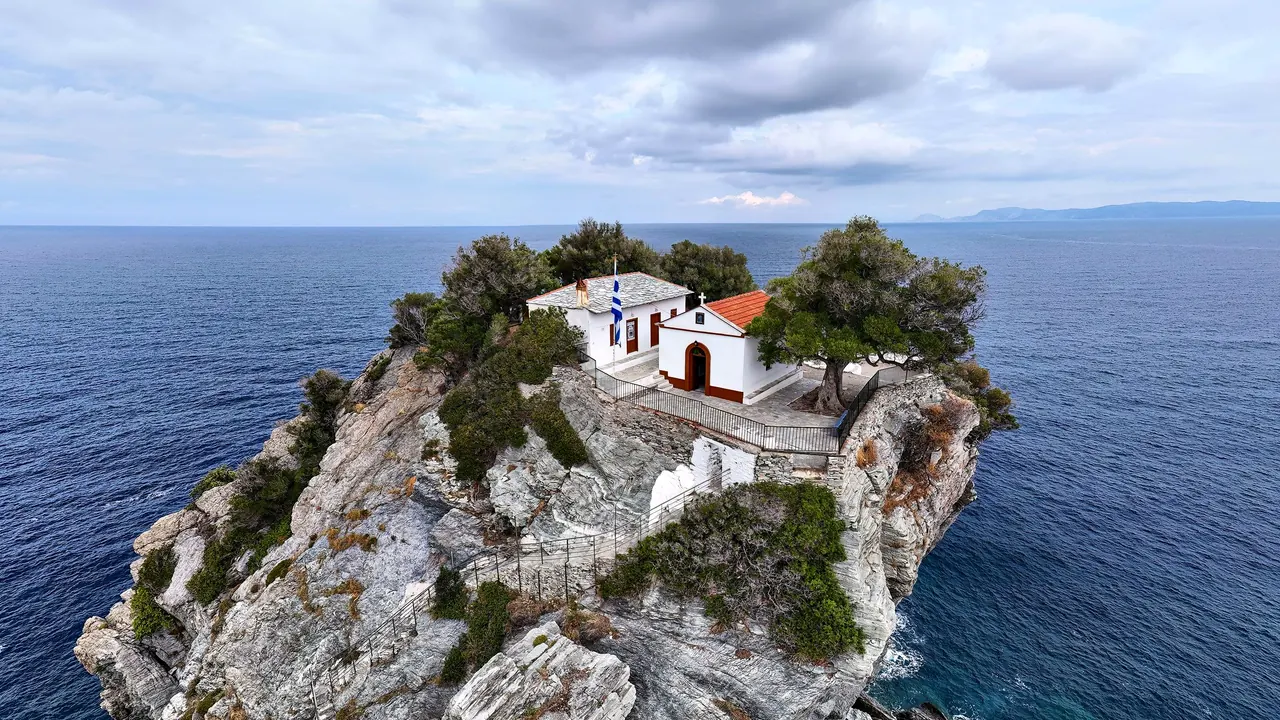
Photos: Santorini by Giles Laurent, CC BY-SA 4.0, cropped; Skopelos by Giles Laurent, CC BY-SA 4.0, cropped.
Santorini or Skopelos?
Our verdict in twelve categories, each scored against the same fixed benchmark cities, and the climate month by month, so you can choose for your trip.
Choose Santorini for
- culture and sights
- food and drink
- nightlife
Santorini is for travellers who want spectacle and substance packed into a short stay. It has the caldera cliffs, the buried Bronze Age town at Akrotiri, Assyrtiko tastings in the inland villages and an evening scene in Fira that runs past midnight. It suits couples who are happy to pay for the view, and it rewards a visit of a few days more than a long, lazy fortnight.
Choose Skopelos for
- prices
- beaches
- families
For a slower beach vacation, Skopelos makes more sense. Its pine-backed coves on the south and west coasts are better than Santorini's hot volcanic sand, rooms and taverna meals cost far less, and sheltered bays like Limnonari and Panormos make it the easier island with children. In return you give up the sightseeing, the food and wine, and any real nightlife.
Scoreboard
Twelve categories on one fixed scale from 0 to 100. The shaded stretch is the gap between the two.
Your match
Pick a travel style or drag the sliders, and both match scores follow your weighting.
Wins on culture and sights and food and drink with your weighting.
Wins on prices and beaches with your weighting.
What matters to you?
Category by category
What the scores mean for a trip.
Beaches & swimming
Skopelos has the stronger beaches by some way. Pine forest runs down to fine pebble and sand along its sheltered south and west coasts, from Stafylos near town to Agnontas, Panormos, Limnonari and Kastani. On a meltemi day the south shore stays calm.
Santorini's beaches are more unusual than beautiful: black sand and pebble below coloured cliffs at Kamari, Perissa and Perivolos, with Red Beach and Vlychada for scenery. They get very hot by midday, and from a base in Oia or Fira you need a bus or car to reach any of them.
Food & drink
Santorini eats and drinks better. Its volcanic soil grows the fava, cherry tomatoes, white aubergines and capers behind its local dishes. Its Assyrtiko and Vinsanto wines support a winery circuit around Pyrgos, Megalochori and Exo Gonia, though on the cliff edge you often pay for the sunset more than the cooking.
Skopelos offers honest taverna food with a narrower range: fish at Agnontas, goat in the hill villages, the fried coiled cheese pie and plum dishes from the old orchards. There is little fine dining and nothing to match Santorini's wine.
Culture & sights
Santorini has real archaeology. Akrotiri, a Bronze Age town preserved by the eruption around 1600 BC, is one of the great Aegean sites. Ancient Thera, the wall paintings in Fira and the medieval kastelli of Pyrgos and Emporio add depth.
Skopelos's heritage is more about atmosphere: the tiered, slate-roofed town under its Venetian castle, a folk museum, and monasteries such as Evangelistria on Mount Palouki. Agios Ioannis, the Mamma Mia chapel, is a fine view rather than a sight, and the whole island is seen in a day or two.
Nightlife
Neither island is a party destination, but Santorini at least has a late scene. A few lanes in Fira have cocktail bars and clubs that run into the early hours in July and August, and Kamari and Perissa add beach bars. Skopelos has no clubs, and nights end with a drink on the harbour or Greek music in a small bar in the town's lanes.
Nature & outdoors
Santorini's landscape is the more dramatic: a drowned volcano with cliffs dropping over 300m to the caldera, the 10km rim path from Fira to Oia, and a boat out to climb the lava cone of Nea Kameni. Away from the cliffs, though, the island is dry and treeless, and summer walks have no shade.
Skopelos is gentler and far greener, covered in pine up to Mount Delfi, with mule tracks linking monasteries and bays. Boat trips into the marine park, home to monk seals and dolphins, and sea kayaking along its indented coast give it a different kind of outdoors.
Day trips
Santorini has the wider choice by sea. Thirasia is just across the caldera, Ios, Folegandros and Anafi are an hour or two away, Naxos and Paros are further, and Knossos on Crete makes a long day. All of it depends on ferries from Athinios, which thin out outside summer.
From Skopelos the options stop at the neighbouring Sporades: lively Skiathos, and quieter Alonissos with its hilltop old village, often combined with swimming stops in the marine park. The mainland is too far for a day.
Good for families
Skopelos is the easier island with children. Sheltered, gently shelving bays such as Limnonari, Panormos and Agnontas have tavernas close by, and Greek families welcome children at any hour, though there is nothing built specially for them.
Santorini's caldera villages are steep steps and unfenced terraces, and many cliff hotels do not take young children. It works from the flat promenades of Kamari and Perissa, where the small water park and the volcano boat help, but the dark sand gets very hot.
Getting around
Santorini is easier to reach and has the more useful buses. It has its own airport, distances are short, and buses run out from Fira to Oia, the beaches, Akrotiri and the port. Changing in Fira, packed summer buses and scarce parking all test your patience.
Reaching Skopelos means a ferry or fast boat, usually via the airport on Skiathos. Once there, a single road with summer buses covers the main beaches, but for the smaller coves, the monasteries and the north coast you really need a car or scooter on narrow, sometimes unpaved roads.
Shopping & style
Santorini has more to browse, mainly in the cliff-top lanes of Oia and Fira, with jewellers near the cathedral, galleries of island painters and photographers, and linen and resort wear among many souvenir shops. Skopelos offers an hour of evening browsing behind the harbour for ceramics and summer clothes.
On both islands the best things to take home are edible: Assyrtiko, Vinsanto and capers from Santorini, and prunes, honey and almond sweets from Skopelos.
Affordability
Skopelos is markedly cheaper. Family-run studios and dinners of grilled fish with local wine are moderately priced. The costs that add up are the ferry, a hire car and boat excursions.
On Santorini you pay for the view: caldera cave suites and sunset dinners in Oia, Imerovigli and Fira cost more than almost anywhere in Greece. Staying in Kamari or Perissa, riding the bus and walking up to the rim for the sunset brings costs down, but not to Skopelos levels. On both islands the shoulder months are easier on the wallet than July and August.
Live music & performing arts
Neither island has theatre or a concert season, so the two are level, and there is not much on either. Santorini's highlight is a long-running classical music festival in Fira at the end of summer, plus occasional concerts in old mansions and wineries. Skopelos has folk music instead: rebetiko and island songs in town tavernas, and music and dancing at village saints' day festivals, especially in August.
Wellness & relaxation
Santorini is the better choice for a pampered stay. Its luxury cave hotels in Imerovigli and Oia have heated plunge pools and spa treatments, and boats stop at the warm volcanic spring cove off Palea Kameni. For quiet, stay in Imerovigli or the wine villages, away from the crowds in Oia and Fira.
Skopelos relaxes you through its pace alone, with only a few hotel spas and no springs. Its quiet villages and light traffic, especially in June and September, suit visitors who want nothing more than slow days.
When should you go?
Pick your month. The climate figures are measured averages, not a forecast.
Santorini in July
Skopelos in July
Daytime high, °C
Rainfall in the month, mm
Where the figures come from
Santorini's station stands 182 m below the place it is measured for, so that place is likely a little cooler than the figures say.
Santorini has no rain gauge within 25 km of the centre, so its rainfall comes from a gridded climate dataset read at the destination rather than from a gauge further away.
Skopelos's temperatures are measured 68 km from the centre, at Skyros Airport.
Skopelos has no rain gauge within 25 km of the centre, so its rainfall comes from a gridded climate dataset read at the destination rather than from a gauge further away.
Temperature and rainfall are climate normals, averaged over the years shown. Santorini: 2000-2025, 12 years observed (rainfall 1991-2020) normals, Santorini Island / Monólithos (5 km from centre). Skopelos: 1998-2025, 11 years observed (rainfall 1991-2020) normals, Skyros Airport (67.7 km from centre).
Both islands are summer places, with sea warm enough to swim from June into October. On Santorini the water holds at about 24°C from July to September, and July and August highs near 30°C feel harsher than the figure suggests, because the land has no shade and the dark sand burns. May and late September to October are better for walking the caldera path. From June to August there is almost no rain, and the wet season arrives in October.
Skopelos is slightly cooler on land all year but a little warmer in the sea in August, at about 26°C. Its rain is spread more evenly, and showers return in September rather than October, which keeps the pine forests green. April and May are mild and in flower, good months for walking. Both islands are cool and damp from November to March and too cold for a beach trip, with Santorini the wetter of the two in winter, close to 98mm in January.
Which traveller are you?
On a beach and sun trip, Skopelos is the better island. Its sheltered south and west coasts give you a different pine-shaded cove each day with very clear water. Santorini's beaches are dark volcanic strips on the east coast, pleasant but not the reason to go.
For a culture and arts trip, Santorini wins clearly. The buried Bronze Age streets of Akrotiri, the frescoes in Fira, Ancient Thera on its ridge and the fortified villages of Pyrgos and Emporio outweigh Skopelos's harbour town and monasteries.
On a tight budget, Skopelos goes much further. Family-run studios and simple taverna meals are moderately priced, while Santorini's caldera rooms and sunset dinners are among the dearest in Greece. Even its cheaper east coast does not close the gap.
Before you go
| Measure | Santorini | Skopelos |
|---|---|---|
| Official language | Greek | Greek |
| Currency | Euro (EUR) | Euro (EUR) |
| Sockets | CF230 V, 50 Hz | CF230 V, 50 Hz |
| Driving side | Right | Right |
| Time zone | UTC+2, UTC+3 in summer | UTC+2, UTC+3 in summer |
| Emergency number | 112 | 112 |
| Main airport | Santorini International Airport (JTR)60 non-stop destinations | Skiathos Island National Airport (JSI)37 non-stop destinations |
| Public holidays this year | 15 days | 15 days |
By the numbers
| Measure | Santorini | Skopelos |
|---|---|---|
| Population | 17,430 | - |
| People per km² | 220 | - |
| Swim season, months above 21 °C | 5 months | 5 months |
Where else could you go?
Every comparison below shares a destination with this one, so you can follow Santorini or Skopelos somewhere new.
- Skiathosvs Skopelos
- Iosvs Santorini
- Folegandrosvs Santorini
- Naxosvs Santorini
- Parosvs Santorini
- Sifnosvs Santorini