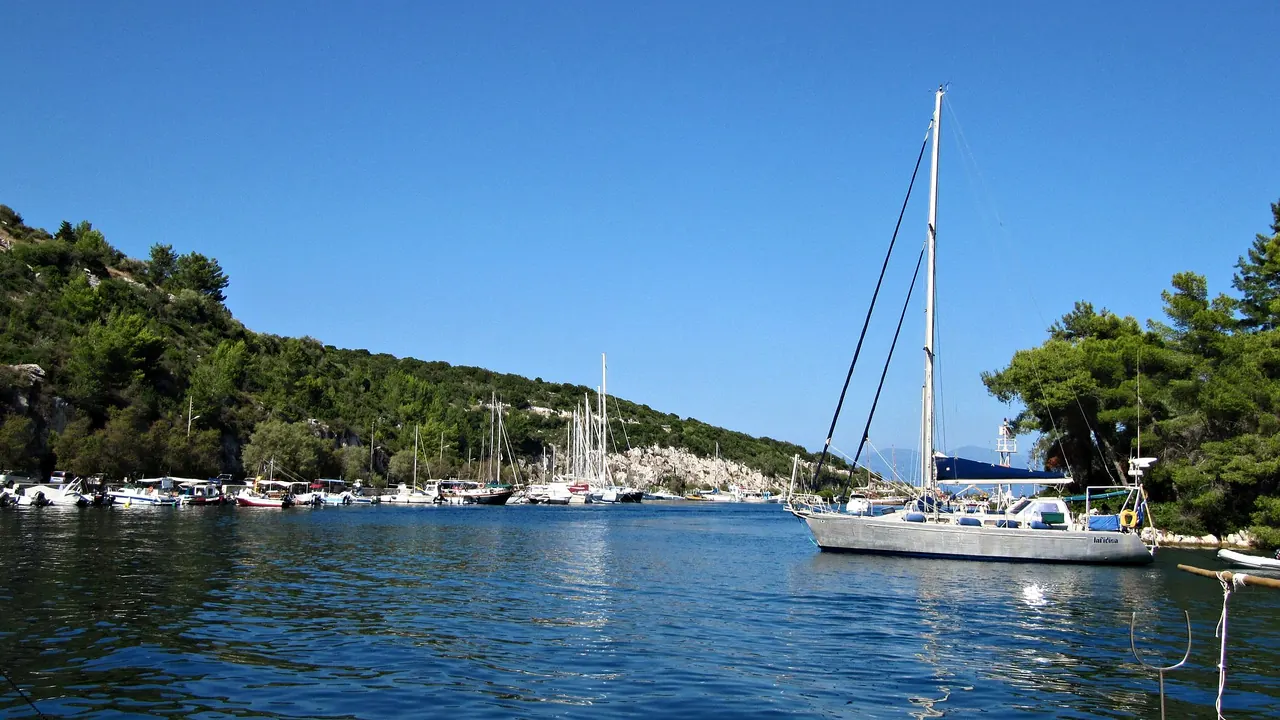
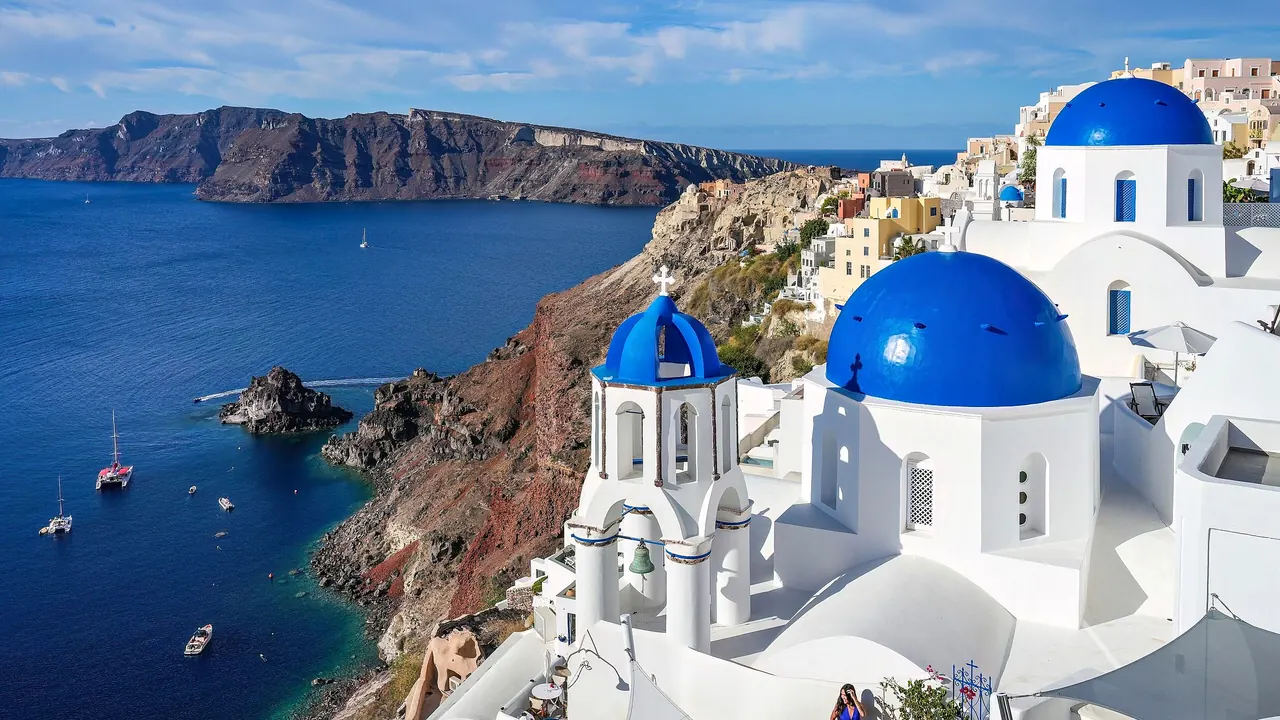
Photos: Paxos by Poiesia, CC BY-SA 4.0, cropped; Santorini by Giles Laurent, CC BY-SA 4.0, cropped.
Paxos or Santorini?
Our verdict in twelve categories, each scored against the same fixed benchmark cities, and the climate month by month, so you can choose for your trip.
Choose Paxos for
- beaches
- prices
- families
Paxos is for travellers whose ideal day is spent in the water. Its clear sea, sheltered pebble coves and the pale sand of Antipaxos a short boat ride away make it the better swimming island, and a small hired boat turns every day into a hunt for empty coves. Evenings are a slow harbour dinner, there is little to see and less to do at night, and that quiet is exactly the point. It also comes out a little easier on the budget and on families.
Choose Santorini for
- culture and sights
- nightlife
- food and drink
Santorini gives a richer trip on land. The caldera cliffs and the walk along their rim, the Bronze Age town at Akrotiri and the wineries growing Assyrtiko in volcanic soil give it far more to see, taste and do than Paxos. Fira adds some real nightlife in summer. The beaches are good rather than the main event, and the caldera views come at a high price, so it suits couples and sightseers more than swimmers on a budget.
Scoreboard
Twelve categories on one fixed scale from 0 to 100. The shaded stretch is the gap between the two.
Your match
Pick a travel style or drag the sliders, and both match scores follow your weighting.
Wins on beaches and prices with your weighting.
Wins on culture and sights and nightlife with your weighting.
What matters to you?
Category by category
What the scores mean for a trip.
Beaches & swimming
Paxos is the better island for swimming. The water along its sheltered east coast is exceptionally clear, and coves such as Kipiadi and Marmari are small and pebbly but calm, with sandy shallows in the round bay at Lakka. The real prize is Antipaxos next door, where Voutoumi and Vrika have pale sand and turquoise water. A hired motorboat lets you reach coves no road gets to.
Santorini's beaches are more about the look than the swim: black sand and fine pebble under red and ochre cliffs. The long strip at Perissa and Perivolos and the beach at Kamari have sunbeds and gently shelving water, but the sand burns underfoot by midday and the meltemi can churn up the open coast. Staying on the caldera rim means a bus or a drive down to any beach.
Food & drink
Santorini is far more rewarding to eat on. Its dry volcanic soil produces fava, cherry-tomato fritters, white aubergines and capers, and above all its wine: basket-trained Assyrtiko and the sweet Vinsanto, which you can taste at wineries in the inland villages. The best meals tend to be in village tavernas and at Ammoudi Bay rather than at the sunset tables on the rim.
Paxos eats well but narrowly. The harbour tavernas of Gaios, Lakka and Loggos serve grilled fish, bourdeto and sofrito with the island's own olive oil, often cooked with more care than at a typical resort, but the menus repeat from one place to the next.
Culture & sights
There is no real contest here. Santorini has Akrotiri, a Bronze Age town preserved by the eruption, with houses and stairways you can walk among. Its wall paintings are partly shown in the museum in Fira, and the ruins of Ancient Thera sit on a ridge above the sea. The cliff villages with their cave houses and blue domes, and the medieval kastelli of Pyrgos and Emporio, are sights in their own right.
On Paxos, culture is what you pass on the way to the water: the Venetian fort ruin and the Panagia monastery on the islets off Gaios, a small museum of island life and olive farming, and old olive presses along the inland lanes. For serious history you take the ferry to Corfu Town.
Nightlife
Santorini at least has somewhere to go out. A few lanes in Fira hold cocktail bars and a handful of clubs that run into the early hours in July and August, and Kamari and Perissa have beach bars with music. Even so, most evenings there are built around sunset and dinner.
Paxos is gentler still: a drink at the waterfront in Gaios or Lakka beside the moored yachts, and in high summer one or two spots to dance. Outside those weeks the island goes to bed after dinner.
Nature & outdoors
Santorini's landscape is far more dramatic. You are standing on the rim of a drowned volcano, with layered cliffs dropping more than 300m into the caldera. The rim path from Fira to Oia, the climb over the black lava of Nea Kameni, caldera sailing and wall dives make up its range, though the interior is bare and treeless.
Paxos is softer and greener: ancient olive groves crossed by stone-walled mule tracks and an end-to-end waymarked trail with some shade. Its best scenery is the white limestone of the west coast, with the Erimitis cliffs at sunset, the Tripitos arch and sea caves to explore by kayak. There is no high ground at all.
Day trips
Both islands rely on boats for every outing, but Santorini has more places to reach. Fast ferries go to Ios, Folegandros and Anafi, Naxos and Paros are within about two hours, and a long day can take in Knossos on Crete. Closer to home, Thirasia offers a quiet village on the far side of the caldera. Services thin out outside summer and the meltemi can cancel them.
From Paxos the choice is shorter but very good. Corfu Town and its old Venetian quarter are about an hour away, excursion boats cross to Parga and the Sivota coves, and Antipaxos is a beach hop. After those three or four trips there is little left.
Good for families
Paxos is a little easier with children, though neither island is built for them. It is safe and calm, the shallow bay at Lakka suits toddlers, and a day hopping between coves by boat delights most children. The catches are pebble beaches with steep paths down to them, villas up in the groves that need a car, and nothing to do on a wet day.
Santorini splits in two. The caldera villages, with their steps, unfenced terraces and adults-leaning cliff hotels, are hard going with small children. Kamari and Perissa work far better, with flat promenades, shelving water and a small water park. The volcano boat and Akrotiri appeal to older children, but dark sand in midsummer heat takes some managing.
Getting around
Neither island is effortless, but the problems differ. Paxos has no airport, so arrival is always a ferry that rough seas can stop. Once there, the island is only about 10km long, so a small car, a scooter or a hired boat covers it easily, with footpaths linking the villages.
Santorini has its own airport and frequent ferries to Athinios, but moving around in summer is slow. The buses all route through Fira and are packed, the roads fill with tour coaches, and parking in Oia is close to impossible. The caldera villages themselves are walked on steps.
Shopping & style
Santorini has more to browse. The cliff lanes of Oia and Fira hold galleries of island painters and photographers, jewellers clustered near Fira's cathedral, and linen and ceramics. Bottles of Assyrtiko and Vinsanto, capers and fava make the best souvenirs. Paxos offers only a few summer boutiques behind the harbours in Gaios and Lakka, and its best buy is olive oil and local honey.
Affordability
Both are among the pricier Greek islands, but Paxos is slightly easier on the wallet. Most stays there are in villas and guesthouses, and the extra costs come from ferry crossings and hiring a boat or car. Simple tavernas and self-catering help.
Santorini's cost is set by the caldera view: cave suites in Oia and Imerovigli and sunset dinners are priced at a premium. The way round it is a guesthouse in Kamari or Perissa, the public bus and a walk up to the rim for the sunset. On both islands the shoulder months cost noticeably less.
Live music & performing arts
Neither island has a regular stage, and both have a classical music festival at the end of summer. Paxos holds chamber concerts in churches and village squares and also has its saints' day feasts, with the August Panagia in Gaios bringing traditional music and dancing late into the night. Santorini's long-running festival is in Fira, with occasional summer concerts in old mansions and wineries.
Wellness & relaxation
Both islands are restful, in different ways. On Paxos the calm comes from the place itself: few cars, no tall buildings and villas among the olive trees, with yoga and retreat weeks on some estates rather than spas.
Santorini's version is the luxury cave hotel, with a heated plunge pool and treatments facing the caldera, plus a swim in the warm, rust-coloured springs off Palea Kameni. The peace depends on staying in Imerovigli or the wine villages rather than amid the summer crowds in Oia and Fira.
When should you go?
Pick your month. The climate figures are measured averages, not a forecast.
Paxos in July
Santorini in July
Daytime high, °C
Rainfall in the month, mm
Where the figures come from
Paxos's temperatures are measured 52 km from the centre, at Kerkyra Airport.
Paxos has no rain gauge within 25 km of the centre, so its rainfall comes from a gridded climate dataset read at the destination rather than from a gauge further away.
Santorini's station stands 182 m below the place it is measured for, so that place is likely a little cooler than the figures say.
Santorini has no rain gauge within 25 km of the centre, so its rainfall comes from a gridded climate dataset read at the destination rather than from a gauge further away.
Temperature and rainfall are climate normals, averaged over the years shown. Paxos: 1991-2020 normals, Kerkyra Airport (52.1 km from centre). Santorini: 2000-2025, 12 years observed (rainfall 1991-2020) normals, Santorini Island / Monólithos (5 km from centre).
Both islands have the same broad Greek pattern: the sea is warm enough for swimming from June to October and peaks in August, a little warmer around Paxos, in the mid-20s, than off Santorini. Paxos runs hotter in high summer, with afternoons around 32°C in July and August that make walking the olive-grove trails hard work, while Santorini stays a couple of degrees cooler, though its bare, shadeless landscape can feel just as harsh. May and late September to early October are the comfortable months for walking on both.
The real difference is rain. Paxos is green because it is wet, and the rain arrives early: September already brings about 91mm, and from October to December it is a rainy island. Santorini stays almost completely dry from May to September, with only 9mm in September, so late summer and early autumn are far more reliable there. Paxos makes up for it with very long sunny days from May to August.
Which traveller are you?
For a beach and sun trip, Paxos is the clear pick. Its sea is clearer, the sheltered east-coast coves and the calm bay at Lakka are better for swimming, and the sandy beaches of Antipaxos are only a short boat ride away.
On a culture and arts trip, Santorini wins easily. Akrotiri, the frescoes in the Fira museum, Ancient Thera and the fortified inland villages fill two or three days, while Paxos has a fort ruin, a monastery and a small museum.
On a food and nightlife trip, Santorini offers much more. There are volcanic-soil dishes, wine tastings around Pyrgos and Megalochori and fish tavernas at Ammoudi Bay, then cocktail bars and clubs in Fira. Paxos stops at a harbourside dinner and one drink.
Before you go
| Measure | Paxos | Santorini |
|---|---|---|
| Official language | Greek | Greek |
| Currency | Euro (EUR) | Euro (EUR) |
| Sockets | CF230 V, 50 Hz | CF230 V, 50 Hz |
| Driving side | Right | Right |
| Time zone | UTC+2, UTC+3 in summer | UTC+2, UTC+3 in summer |
| Emergency number | 112 | 112 |
| Main airport | Corfu Ioannis Kapodistrias International Airport (CFU)88 non-stop destinations | Santorini International Airport (JTR)60 non-stop destinations |
| Public holidays this year | 15 days | 15 days |
By the numbers
| Measure | Paxos | Santorini |
|---|---|---|
| Population | 2,300 | 17,430 |
| People per km² | 91 | 220 |
| Swim season, months above 21 °C | 5 months | 5 months |
Where else could you go?
Every comparison below shares a destination with this one, so you can follow Paxos or Santorini somewhere new.
- Iosvs Santorini
- Folegandrosvs Santorini
- Corfuvs Paxos
- Lefkadavs Paxos
- Naxosvs Santorini
- Parosvs Santorini