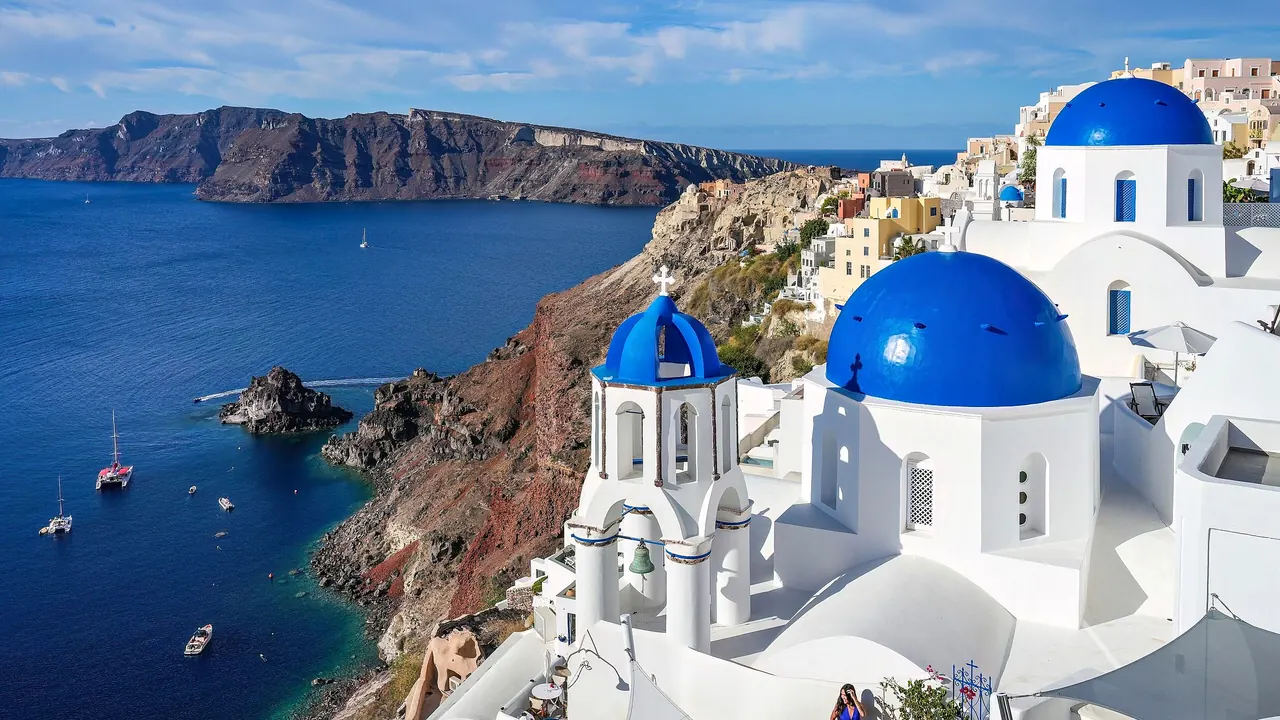
Photos: Santorini by Giles Laurent, CC BY-SA 4.0, cropped.
Halkidiki or Santorini?
Our verdict in twelve categories, each scored against the same fixed benchmark cities, and the climate month by month, so you can choose for your trip.
Choose Halkidiki for
- prices
- families
- beaches
Halkidiki suits travellers who want the beach to be the whole point of the trip: long days on pale sand in warm, shallow water, a car to explore the coves of Sithonia, and evenings at a village taverna. It is the better pick for families and for anyone watching the budget. Thessaloniki is also close enough for a day of Byzantine churches and serious food.
Choose Santorini for
- culture and sights
- shopping
- nature and the outdoors
Santorini is the choice for a shorter and more striking stay built around the volcano. It has the caldera cliffs, the walk along the rim, the buried town at Akrotiri and wines that are its own. Couples and honeymooners who care more about a sunset view than a long beach will find it worth the cost. Young children and tight budgets fit far less easily.
Scoreboard
Twelve categories on one fixed scale from 0 to 100. The shaded stretch is the gap between the two.
Your match
Pick a travel style or drag the sliders, and both match scores follow your weighting.
Wins on prices and families with your weighting.
Wins on culture and sights and shopping with your weighting.
What matters to you?
Category by category
What the scores mean for a trip.
Beaches & swimming
Halkidiki is the stronger beach destination by a distance. Its three peninsulas offer pale sand and small pebble running into clear turquoise water, often with pine forest right behind. The choice runs from the organised strips of Kassandra to the granite coves of Sithonia and the calmer water around Ouranoupoli and Ammouliani, and the sea is a little warmer in high summer.
Santorini's beaches are dark volcanic sand and pebble under coloured cliffs. They are memorable to look at but scorching underfoot, and the meltemi can make them choppy. Kamari and Perissa carry the beach life, and anyone staying on the caldera rim has to travel down to reach them.
Food & drink
Santorini has the edge for anyone who travels to eat. Its volcanic soil produces a cuisine of its own, with fava, tomato fritters, white aubergines and capers. Above all it has its wine: Assyrtiko from vines trained into low baskets, and sweet Vinsanto, both tasted at wineries around Pyrgos and Megalochori.
Halkidiki eats well but more simply, at seaside tavernas serving grilled fish, octopus and mussels. Its best meals are in Nikiti, Toroni and the hill villages, and its olives, thyme honey and Athos wines are worth seeking out. The Kassandra resort menus soon repeat themselves, though, and for serious eating people go to Thessaloniki for the day.
Culture & sights
Santorini is clearly ahead here. Akrotiri, the Bronze Age town preserved under volcanic ash, is a site of real importance, and some of its wall paintings are on show in Fira. Ancient Thera on its ridge, the cliff villages and the fortified cores of Pyrgos and Emporio fill two or three rewarding days.
Halkidiki's great monument, Mount Athos, is open only to men with a permit. Most visitors therefore see the monasteries from a boat out of Ouranoupoli. Olynthos, ancient Stagira and the Petralona cave make pleasant half-days rather than a reason to come.
Nightlife
Neither is a place for serious nightlife and the two are fairly even, but the evenings feel quite different. Halkidiki's nights are louder and younger, and they are concentrated on Kassandra. Kallithea's open-air clubs and the bar strips of Pefkohori and Hanioti fill with crowds from Thessaloniki at summer weekends.
On Santorini the evening is built around the sunset and a long dinner facing the caldera, which suits couples. The late scene is a few lanes in Fira plus the beach bars at Kamari and Perissa. Oia goes quiet after dinner.
Nature & outdoors
Santorini has the more dramatic landscape. Cliffs of ash and lava drop more than 300m into a flooded caldera, and the rim path from Fira to Oia and the climb up the lava cone of Nea Kameni are memorable outings. Caldera sailing and diving along the submerged walls add to them, although the dry interior is soon covered.
Halkidiki's nature is gentler: pine forest meeting clear water, at its best on Sithonia around Mount Itamos and the islets near Diaporos. Kayaking and snorkelling come before walking there. The Athos mule paths are the one big hike, and they are only for men with a permit.
Day trips
Halkidiki has the easier day trips because it sits on the mainland. Thessaloniki, with its Byzantine churches and waterfront, is a drive of an hour or so. The royal tombs at Vergina, Pella, Kavala and Amphipolis all make a long day out by car.
Every outing from Santorini goes by sea, to Thirasia across the caldera, to Ios, Folegandros and Naxos, or even to Knossos on Crete. The choice of islands appeals, but sailings from Athinios thin out outside summer and the meltemi can cancel them.
Good for families
With children, Halkidiki is much the easier choice. Kassandra and the beaches around Gerakini and Psakoudia have sand and water that stays shallow a long way out, and big resorts offer pools and children's clubs. Its gaps are a lack of purpose-built attractions and the midsummer heat.
Santorini's caldera villages, with their steep steps and unfenced terraces, are hard going with small children. Families do best in Kamari or Perissa, which have flat promenades and a small water park. Older children will also enjoy the volcano boat and Akrotiri.
Getting around
Both are awkward without your own wheels, but in different ways. Halkidiki is spread out and its buses are sparse. Its long peninsulas also mean driving back up one to get down the next, so a car is close to essential, though each resort village is walkable.
Santorini is compact, under an hour from end to end, and its buses can do the job. They all run through Fira and are packed in summer, however. Parking in Oia and Fira is scarce, and the caldera villages are covered on foot, up and down steps.
Shopping & style
Santorini is the better place to shop, though neither is a shopping destination. Oia and Fira have jewellers, galleries of island painters and photographers, linen boutiques and ceramics among the souvenir shops, and the wineries sell bottles to carry home.
Halkidiki offers little beyond beachwear and souvenir strips on Kassandra and in Neos Marmaras. Its best buys are olive oil, honey, and the icons and incense sold in Ouranoupoli.
Affordability
Halkidiki is much the cheaper trip. Much of its trade is Greek and Balkan families driving in, which keeps plenty of simple rooms, apartments and fairly priced tavernas. Costs climb mainly at the big Kassandra resorts in July and August.
Santorini is expensive, and the view sets the price. Rooms on the caldera rim in Oia, Imerovigli and Fira, and dinners facing the sunset, cost far more than almost anywhere else in Greece. A smaller budget works only by staying in Kamari or Perissa and walking up to the rim for the evening.
Live music & performing arts
Neither has much on stage, but Halkidiki offers a little more in summer. In July and August the Kassandra Festival puts on concerts and theatre in the open-air amphitheatre at Siviri, and the Sani Festival adds jazz and classical evenings.
Santorini's one fixture is an international classical music festival in Fira at the end of summer, along with the occasional concert in an old mansion or winery. Beyond that, both come down to a musician in a taverna.
Wellness & relaxation
The two are close, but the kind of rest differs. Halkidiki has natural thermal pools above the sea at Agia Paraskevi, spas at the large resorts and slow days in the pine shade. Sithonia and the coast towards Ouranoupoli are the calmest parts.
Santorini's version of rest is a cave suite with a heated plunge pool facing the caldera, quietest in Imerovigli or the wine villages of Pyrgos and Megalochori. Boats also stop off Palea Kameni for a swim in warm volcanic spring water.
When should you go?
Pick your month. The climate figures are measured averages, not a forecast.
Halkidiki in July
Santorini in July
Daytime high, °C
Rainfall in the month, mm
Where the figures come from
Halkidiki's temperatures are measured 64 km from the centre, at Thessaloniki Airport.
Halkidiki has no rain gauge within 25 km of the centre, so its rainfall comes from a gridded climate dataset read at the destination rather than from a gauge further away.
Santorini's station stands 182 m below the place it is measured for, so that place is likely a little cooler than the figures say.
Santorini has no rain gauge within 25 km of the centre, so its rainfall comes from a gridded climate dataset read at the destination rather than from a gauge further away.
Temperature and rainfall are climate normals, averaged over the years shown. Halkidiki: 1991-2020 normals, Thessaloniki Airport (63.7 km from centre). Santorini: 2000-2025, 12 years observed (rainfall 1991-2020) normals, Santorini Island / Monólithos (5 km from centre).
Halkidiki has the hotter summer, with highs of 32°C in July and August and plenty of sunshine. Its sea warms to 26°C, so June to September is ideal beach time and early October is still swimmable. Midsummer is hot for walking, which is better left to May and late September. Rain is spread through the year and is heaviest from October to December, and winters are cool and grey.
Santorini is milder at both ends of the year. Summer peaks at around 30°C, and from June to September almost no rain falls. The sea stays a little cooler, at about 24°C, but it holds that warmth well into October. Winter is warmer than in Halkidiki, at around 15°C, but much wetter. The island is best from May to October, and spring and autumn are the times for walking the cliffs.
Which traveller are you?
On a family trip with young children, Halkidiki lets the days run themselves: one resort, the beach each morning, the pool after lunch, dinner out with everyone. Santorini can work from an east-coast base, but every outing takes more planning.
For a culture and arts trip, Halkidiki offers only the odd half-day of history between beach days. Santorini is the better pick, with ancient sites and old villages close together, enough to fill two or three unhurried days.
On a tight budget, Halkidiki allows a room near the sea and a taverna dinner every night without much strain. On Santorini the same money buys a room on the east coast, and the sunset only as a visitor.
Before you go
| Measure | Halkidiki | Santorini |
|---|---|---|
| Official language | Greek | Greek |
| Currency | Euro (EUR) | Euro (EUR) |
| Sockets | CF230 V, 50 Hz | CF230 V, 50 Hz |
| Driving side | Right | Right |
| Time zone | UTC+2, UTC+3 in summer | UTC+2, UTC+3 in summer |
| Emergency number | 112 | 112 |
| Main airport | Thessaloniki Macedonia International Airport (SKG)93 non-stop destinations | Santorini International Airport (JTR)60 non-stop destinations |
| Public holidays this year | 15 days | 15 days |
By the numbers
| Measure | Halkidiki | Santorini |
|---|---|---|
| Population | 110,587 | 17,430 |
| People per km² | 38 | 220 |
| Swim season, months above 21 °C | 5 months | 5 months |
Where else could you go?
Every comparison below shares a destination with this one, so you can follow Halkidiki or Santorini somewhere new.
- Iosvs Santorini
- Naxosvs Santorini
- Parosvs Santorini
- Milosvs Santorini
- Mykonosvs Santorini
- Cretevs Santorini