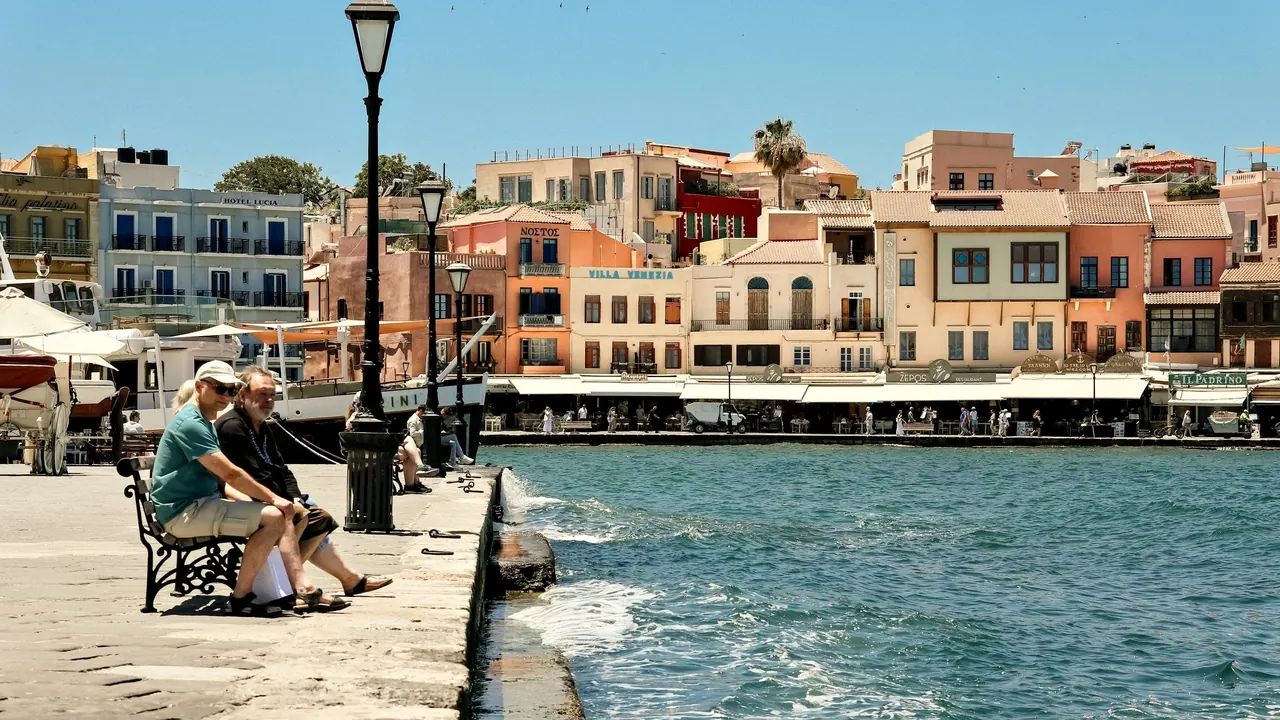
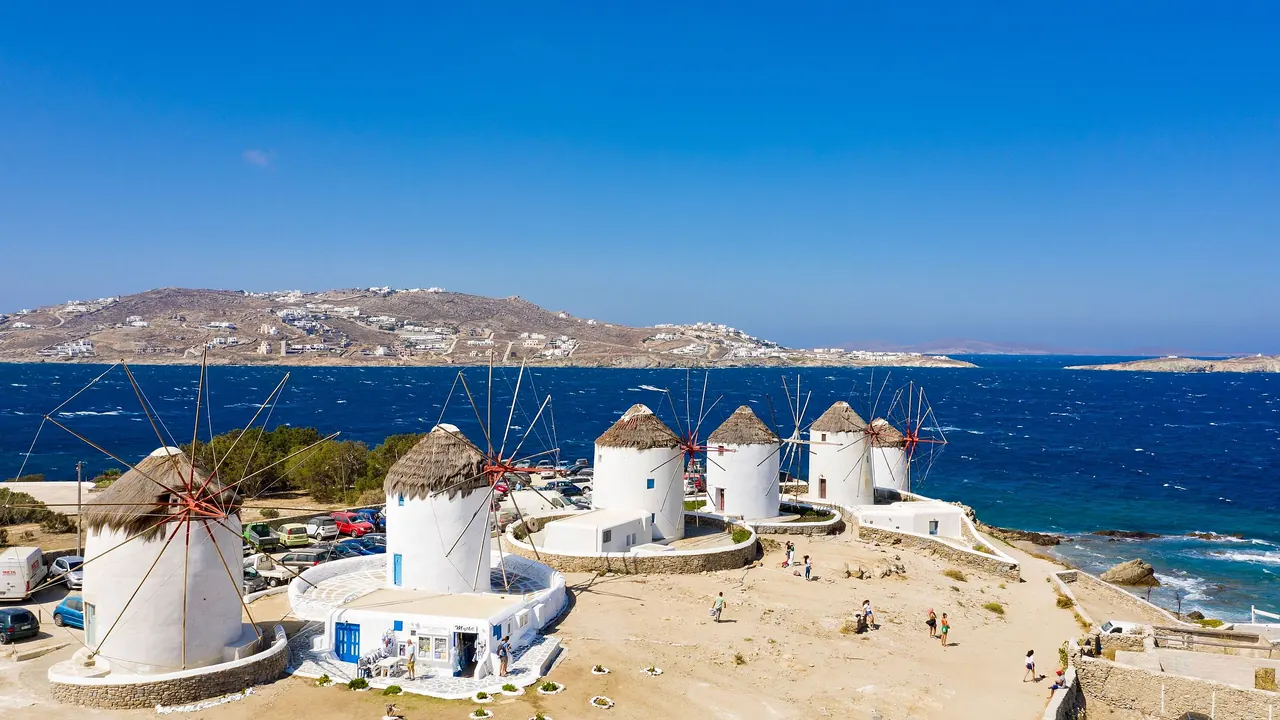
Photos: Crete by Piotr Baranowski, Pexels License; Mykonos by dronepicr, CC BY 2.0, cropped.
Crete or Mykonos?
Our verdict in twelve categories, each scored against the same fixed benchmark cities, and the climate month by month, so you can choose for your trip.
Choose Crete for
- nature and the outdoors
- prices
- families
Crete suits travellers who want a whole island to explore rather than one scene to join. It has the Minoan palaces and the great museum at Heraklion, gorges and mountains for walking, village cooking that ranks among the best in Greece, and beaches from western lagoons to south-coast coves. It works for families and for anyone watching their spending. The price is distance: you will need a car and more days, because the island's best places lie far apart.
Choose Mykonos for
- nightlife
- shopping
- getting around
Mykonos is the choice for a shorter, more polished stay in which the nights matter as much as the days. Its beach clubs, the late lanes of Chora and a long-established gay scene make it one of the Mediterranean's great party islands in summer, and everything sits within a short ride of town. Delos lies just offshore for a morning of ancient Greece. In return you pay luxury prices, and there is little to do in the hills or outside the season.
Scoreboard
Twelve categories on one fixed scale from 0 to 100. The shaded stretch is the gap between the two.
Your match
Pick a travel style or drag the sliders, and both match scores follow your weighting.
Wins on nature and the outdoors and prices with your weighting.
Wins on nightlife and shopping with your weighting.
What matters to you?
Category by category
What the scores mean for a trip.
Beaches & swimming
For beaches the two are broadly level, but the beaches are different in kind. Crete's are spread across a large island and vary widely: the pink-tinged lagoons of Elafonissi, Balos under the Gramvousa peninsula, the palm-backed bay at Vai and the pebble coves of the south coast, some reached only by boat. Seeing the best of them takes long drives.
On Mykonos the sandy bays sit close together along the sheltered south coast. They are lined with sunbeds and beach clubs, and the mood moves from polished Psarou to the party beaches at Paradise. If you want a lot of variety and some wild beaches, choose Crete. If you want easy, organised beach days a short hop from town, choose Mykonos.
Food & drink
Crete eats noticeably better. Its cuisine is a distinct regional one, built on its own olive oil, wild greens, graviera and mizithra cheeses and slow-cooked lamb. The best of it is found in village tavernas and in the backstreets of Chania and Rethymno. The resort menus on the north coast are the one place to avoid.
On Mykonos the setting matters more than the cooking: grilled octopus at Little Venice and smart sushi and fusion places aimed at the summer crowd. Kopanisti cheese, louza and the tavernas around the square at Ano Mera are the local flavours worth seeking out.
Culture & sights
Crete has far more to see. It was the centre of Minoan civilisation, so Knossos, Phaistos and the frescoes in the Heraklion Archaeological Museum are on the itinerary, along with Roman Gortyn, Chania's Venetian harbour, Rethymno's Ottoman balconies and Spinalonga. Seeing it all means several days of driving.
Mykonos has one outstanding site, Delos, a short boat ride away, and a lovely whitewashed townscape in Chora with its windmills and the Paraportiani church. Two or three days cover all of it.
Nightlife
Mykonos is in another league after dark. Afternoons at the Paradise and Super Paradise beach clubs run on into sunset drinks in Little Venice, dance bars in Chora's lanes and clubs where international DJs play until sunrise. It is at its loudest in July and August and almost silent in winter.
Crete's nights out are split. Malia and Hersonissos are package-resort party strips aimed at young groups. The harbour bars of Chania and the waterfront in Rethymno offer a calmer evening, shared with Greek students and locals.
Nature & outdoors
Here the gap is wide. Crete is a mountain island: the White Mountains and Psiloritis rise above 2,400m and are cut by gorges such as Samaria and Imbros. The E4 path crosses the island, kri-kri goats survive in the west, and Agiofarago draws climbers.
Mykonos is low, dry and stony, so its outdoor life is on the water instead. The meltemi makes Korfos Bay and Kalafatis good for kitesurfing and windsurfing, and the clear water suits divers. Walkers will find only country lanes.
Day trips
Both offer a fair choice of days out, but you travel differently. On Crete you go by road: to the other old towns, the wine villages around Peza and Archanes, or mountain Anogia. A boat to Chrissi or a long day to Santorini adds a sea outing.
From Mykonos every trip is by ferry: Delos, pilgrim Tinos, neoclassical Ermoupoli on Syros, Paros and Naxos. The meltemi can cancel a crossing, and the islands share a Cycladic likeness that Crete's landscapes do not.
Good for families
Crete is much the easier choice with children. The north coast and the area around Chania have shallow sandy beaches and resort hotels with pools and kids' clubs, and the warm lagoon at Elafonissi suits toddlers. There are waterparks and the aquarium at Gournes for days off the beach. The midsummer heat and winding car journeys are the drawbacks.
Mykonos can work if you base yourselves at a calm bay such as Ornos or Agios Stefanos. Otherwise the island is built around adult nights, and Chora is loud late into the evening.
Getting around
Mykonos is simpler to get around because it is small: nothing is much more than half an hour from Chora, buses reach the main beaches, and sea taxis run along the south coast. The weak points are the scarce taxis and the congested roads around town in high summer. You will need a scooter or car for the north and east.
On Crete a hire car is close to essential. Buses only link the north-coast towns well, the roads south are steep and twisting, and crossing from one end of the island to the other takes most of a day.
Shopping & style
Neither island is a shopping destination, but Mykonos has more to offer anyone looking for clothes. The boutiques around Matoyianni Street sell designer resort wear, linen, Greek jewellery and gallery pieces, and they stay open late on summer evenings. Much of it closes after the season.
Crete is the place for food and craft rather than fashion. Look for knives and leather in Chania's old lanes and the covered market, thyme honey and raki on Heraklion's market street, and pottery from Margarites.
Affordability
Crete costs far less. It is mid-priced for a Greek island, with good-value village tavernas and family-run apartments, and only Elounda and the most famous western beaches push prices up. Car hire is the cost most visitors cannot avoid.
Mykonos in season is among the most expensive places in Europe, from hotel rooms to beach-club sunbeds and cocktails. Staying at Ano Mera, eating gyros and taking buses lowers the bill, but a summer week still costs well above Crete.
Live music & performing arts
Crete has a living musical tradition of its own: the lyra and lute, improvised mantinades and circle dances. You can hear it in the music tavernas of Rethymno and Chania, at saints'-day festivals and in Anogia. Summer festivals also use the fortresses and open-air theatres of Heraklion and Chania.
Music on Mykonos mostly means DJ sets in clubs and beach bars, and an open-air concert is a lucky find rather than something to plan a trip around.
Wellness & relaxation
Neither island has a bathing culture, so spa time on either means a hotel. Crete is the better place to rest, though. Serious resort spas gather around Elounda and the Gulf of Mirabello, and car-free Loutro or the olive-grove hill villages give real quiet.
On Mykonos the hotel spas offer sea-view yoga and massage, but the island's summer rhythm works against rest. Peace means heading to Agios Sostis, Ftelia or the bays beyond Kalafatis, ideally in early June or late September.
When should you go?
Pick your month. The climate figures are measured averages, not a forecast.
Crete in July
Mykonos in July
Daytime high, °C
Rainfall in the month, mm
Where the figures come from
Mykonos has no weather station within reach, so its figures come from a gridded climate model rather than a measured record, and read a broad area rather than one spot.
Temperature and rainfall are climate normals, averaged over the years shown. Crete: 1991-2020 normals, Heraklion Airport (3.6 km from centre). Mykonos: 2001-2020 normals, NASA POWER reanalysis grid, no weather station within 90 km.
Both islands are dry and swimmable from June to September, with October still good. They differ in heat. Around the main resort areas on Crete, summer highs reach about 29°C, which suits the beach but makes July and August too hot for gorge walks and long days at Knossos. Spring and autumn are better for walking and sightseeing there. Crete also gets the most sunshine in June and July, and its sea is the warmer of the two, reaching about 25°C.
Where most visitors stay on Mykonos, summers are milder, with highs of about 25°C and the sea at around 24°C in August. The meltemi wind keeps it fresh but can make the north-coast beaches rough. On both islands the rain returns in October, and winter brings close to 100mm a month. Winter is the wettest season and too cool for the beach on either island.
Which traveller are you?
On an outdoors trip, Crete wins without much argument. Base yourself in the west, near Chania or on the Sfakia coast, and go in spring or autumn, when the gorges and mountain paths are cool enough to walk. On Mykonos a walker would run out of routes within a day or two.
For a trip on a tight budget, choose Crete, ideally in May, June, September or October. Set aside money for the hire car, the one cost that is hard to avoid. Mykonos stays expensive however carefully you spend, so it rarely suits a small budget.
For a party trip built around clubbing, pick Mykonos. Go in July or August if you want the island at full pitch, and plan for the bill. On Crete, Malia and Hersonissos appeal mainly to young groups, and the old-town bars of Chania and Rethymno are better for a calmer evening.
Before you go
| Measure | Crete | Mykonos |
|---|---|---|
| Official language | Greek | Greek |
| Currency | Euro (EUR) | Euro (EUR) |
| Sockets | CF230 V, 50 Hz | CF230 V, 50 Hz |
| Driving side | Right | Right |
| Time zone | UTC+2, UTC+3 in summer | UTC+2, UTC+3 in summer |
| Emergency number | 112 | 112 |
| Main airport | Heraklion International Nikos Kazantzakis Airport (HER)129 non-stop destinations | Mykonos Island National Airport (JMK)44 non-stop destinations |
| Public holidays this year | 15 days | 15 days |
By the numbers
| Measure | Crete | Mykonos |
|---|---|---|
| Population | 623,065 | 10,134 |
| People per km² | 75 | 96 |
| Swim season, months above 21 °C | 5 months | 5 months |
Where else could you go?
Every comparison below shares a destination with this one, so you can follow Crete or Mykonos somewhere new.