Halkidiki or Mykonos?
Our verdict in twelve categories, each scored against the same fixed benchmark cities, and the climate month by month, so you can choose for your trip.
Choose Halkidiki for
- prices
- families
- nature and the outdoors
Halkidiki suits a longer, slower beach vacation, especially for families or anyone watching costs. Its three peninsulas let you choose between the organised sands of Kassandra and the quieter coves of Sithonia. Pine forest runs down to the shore, and simple rooms and village tavernas keep the bill sensible. Plan on a car, and on Thessaloniki for a day in the city.
Choose Mykonos for
- nightlife
- shopping
- culture and sights
Mykonos is the pick for a trip built around nights out and the scene: beach clubs in the afternoon, Little Venice at sunset and Chora's bars until dawn. It also has Delos, a far greater ancient site than anything on the Halkidiki shore, and a compact town to explore on foot. All of this comes at a high price, and families or anyone looking for quiet will find the island working against them in high summer.
Scoreboard
Twelve categories on one fixed scale from 0 to 100. The shaded stretch is the gap between the two.
Your match
Pick a travel style or drag the sliders, and both match scores follow your weighting.
Too close to call, level with your weighting
Wins on prices and families with your weighting.
Wins on nightlife and shopping with your weighting.
What matters to you?
Category by category
What the scores mean for a trip.
Beaches & swimming
Both are first-rate for swimming, with clear water that is warm enough from June into early October. The difference is in kind and scale. Halkidiki has hundreds of kilometres of shore across three peninsulas, with pale sand or small pebble and pine forest behind. The beaches are organised along Kassandra and wilder among Sithonia's granite coves.
Mykonos packs its beaches into a small island. The south coast has sheltered bays lined with sunbeds, from Ornos to Kalafatis, while the north coast is exposed to the meltemi wind. Its beaches are more social, with beach clubs and party crowds at Paradise and Super Paradise. Halkidiki makes it easier to find an empty stretch, apart from July and August weekends.
Food & drink
Neither is a serious food destination, and they come out much the same, but the meals differ. In Halkidiki the best eating is simple and local: grilled fish in fishing villages such as Nikiti and Toroni, tavernas in the hill villages, the region's big green olives, honey and the Athos wines. Menus in the Kassandra resorts turn repetitive.
On Mykonos the setting matters most, with octopus eaten over the water in Little Venice. It also has a polished high-end layer of sushi and fusion that Halkidiki largely lacks outside its luxury resorts. Look out for the island's sharp kopanisti cheese and louza, a cured pork, and go to Ano Mera for a more local meal.
Culture & sights
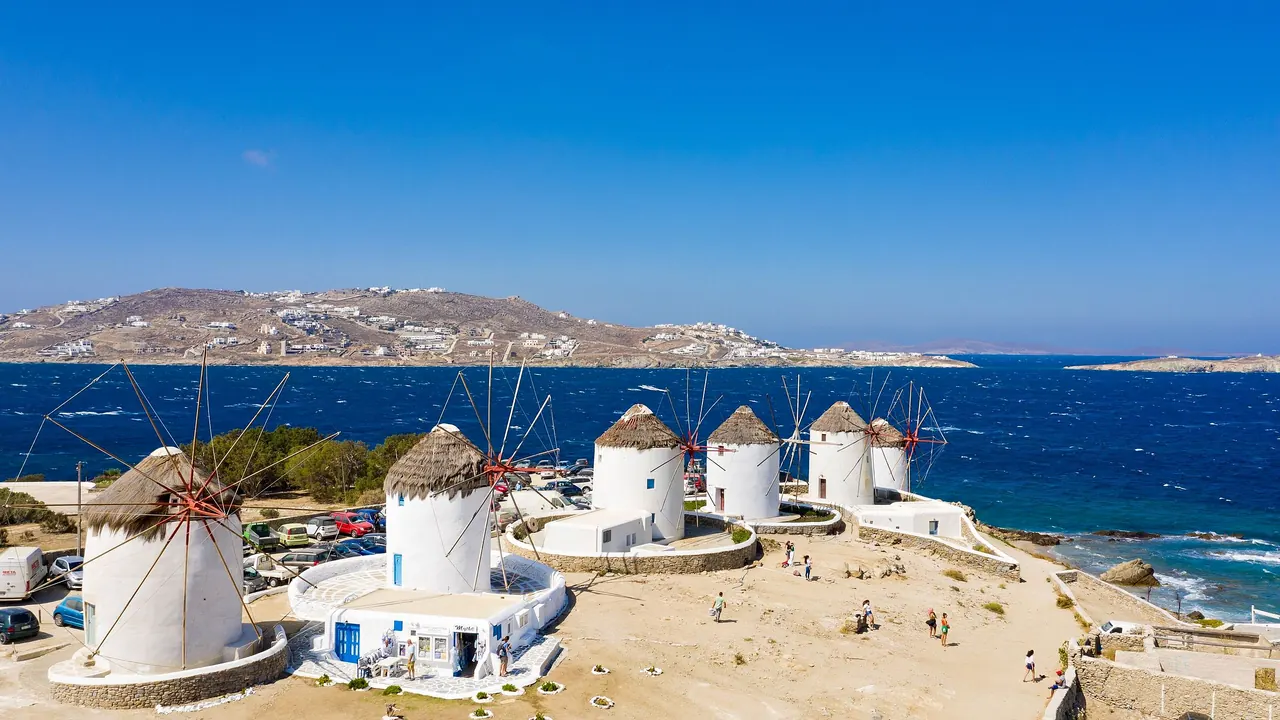
Mykonos has the stronger sightseeing, mainly because of Delos. The sacred island of Apollo is a short boat ride away and was one of the great religious centres of the ancient Greek world. Chora itself, with its windmills, Little Venice and the Paraportiani church, is worth wandering, and two or three days covers everything.
Halkidiki's great monument, Mount Athos, is closed to women and open only to a limited number of men with permits. Most visitors see the monasteries from a boat out of Ouranoupoli. Olynthos, ancient Stagira and the Petralona cave make pleasant half-days but are not a reason to come.
Nightlife
Halkidiki has a real summer scene, but almost all of it is on Kassandra. Kallithea's open-air clubs stay open latest, and Pefkohori and Hanioti have strips of music bars that fill after midnight. The busiest nights are at weekends, when young Greeks drive in from Thessaloniki. Sithonia and the Athos side are for a quiet drink by the water.
Mykonos is a party island on a different scale, and going out is the reason many people come. A night moves from the south-coast beach clubs to sunset in Little Venice, then through Chora's dance bars to the big clubs on the edge of town, with international DJs through July and August. Both scenes close down out of season, but on Mykonos the nights set the pace for the whole island, not just for one peninsula.
Nature & outdoors
Halkidiki has the more rewarding landscape, with pine forest running down to the sea. In Sithonia there are also granite headlands, small islets and the wooded slopes of Mount Itamos. Kayaking between coves, boat trips to Diaporos and walks in spring and autumn give it a fuller outdoor side.
Mykonos is low, dry and rocky. Its beauty lies in the light and the sea rather than the scenery, and walking is limited to country lanes and coastal paths. Its strength is the meltemi wind, which makes Korfos Bay and Kalafatis good spots for kitesurfing and windsurfing.
Day trips
Both offer good days out, of entirely different kinds. From Halkidiki the trips are by road: Thessaloniki for its Byzantine churches and food, the royal tombs at Vergina and Pella, or Kavala and Amphipolis from the Athos side. The stone hill village of Arnea makes a change from the coast.
From Mykonos every outing is by ferry, and the meltemi can disrupt crossings. The choices are Tinos for its pilgrimage church, Syros for the neoclassical port of Ermoupoli, or Paros and Naxos. That gives you a series of different Cycladic islands rather than the mainland's mix of a big city, ancient capitals and mountain villages.
Good for families
Halkidiki is much the better choice for families. Sandy beaches on Kassandra and at Gerakini and Psakoudia stay shallow a long way out, and the sea is usually calm. There are no zoos or theme parks, though, so days revolve around the water and the odd boat trip.
Mykonos can work if parents pick a gentle bay such as Agios Stefanos or Ornos. There is also a water park near Elia, and older children may enjoy a trip to Delos. Even so, Chora is loud and crowded late in summer, and the north coast can be rough for small swimmers.
Getting around
Mykonos is easier to get around because it is small. Nowhere is much more than half an hour from Chora, the town itself is explored on foot, buses reach the main beaches and sea taxis shuttle along the south coast. The weak points are scarce taxis, narrow roads and summer traffic, and the north and east need a hired car or scooter.
Halkidiki is car country on a larger scale. The airport is one to two hours from the beaches, and buses are sparse. Each peninsula is a long finger of land, so getting from Kassandra to Athos means driving back up one and down the next.
Shopping & style
Mykonos has the better shopping by some distance, though mostly for one thing. The boutiques and galleries around Matoyianni Street sell designer resort wear, linen, swimwear and Greek jewellery, and stay open late on summer evenings.
Halkidiki has resort strips of beachwear and souvenirs. Its best buys are local produce such as olive oil, honey and wine, along with the icons and incense sold in Ouranoupoli. For anything more, people go to Thessaloniki.
Affordability
Halkidiki is far easier on the budget. Its prices are fair for the Mediterranean, and only the big Kassandra resort hotels, beachfront rooms in high summer and sunbeds at the organised beaches push costs up.
Mykonos is one of Europe's most expensive places for a vacation in season, from hotels to cocktails, sunbeds and car hire. Staying inland, eating gyros and taking the bus soften the cost. In both places June and September are cheaper, but Mykonos never becomes cheap in summer.
Live music & performing arts
Neither is a place to plan a trip around live performance, but Halkidiki has a little more. In July and August the Kassandra Festival stages concerts and theatre in the open-air amphitheatre at Siviri, and the Sani Festival brings jazz and classical evenings. On Mykonos the music is essentially the DJ sets of its clubs, with only the occasional open-air concert or village festival.
Wellness & relaxation
Halkidiki is the more restful of the two. It also has the one real bathing site, the warm mineral pools of Agia Paraskevi above the sea on Kassandra's southern tip. Sithonia and the coast towards Ouranoupoli set a slow pace of pine shade and quiet evenings.
Mykonos offers hotel spas with yoga on terraces facing the sea, but its summer rhythm of beach clubs and late nights works against rest. Agios Sostis, Ftelia and the bays beyond Kalafatis are the quieter corners, best in early June or late September.
When should you go?
Pick your month. The climate figures are measured averages, not a forecast.
Halkidiki in July
Mykonos in July
Daytime high, °C
Rainfall in the month, mm
Where the figures come from
Halkidiki's temperatures are measured 64 km from the centre, at Thessaloniki Airport.
Halkidiki has no rain gauge within 25 km of the centre, so its rainfall comes from a gridded climate dataset read at the destination rather than from a gauge further away.
Mykonos has no weather station within reach, so its figures come from a gridded climate model rather than a measured record, and read a broad area rather than one spot.
Temperature and rainfall are climate normals, averaged over the years shown. Halkidiki: 1991-2020 normals, Thessaloniki Airport (63.7 km from centre). Mykonos: 2001-2020 normals, NASA POWER reanalysis grid, no weather station within 90 km.
Around the main resort coast, Halkidiki has the hotter and longer summer. Daytime highs reach 32°C in July and August, which is too hot for walking around villages at midday, and the sea is warmest then at 26°C. June and September are the best months, with warm water and gentler heat. Rain returns from October, and winters are cool and grey, so there is no beach season then.
Mykonos stays milder in summer, rarely much above 25°C, and July and August are almost completely dry. Its sea warms later and a little less, so a June swim feels cooler than in Halkidiki. Winter is wetter here, with around 100mm in January, but also milder, so spring and autumn are comfortable for wandering Chora's lanes.
Which traveller are you?
For a food and nightlife trip, Mykonos is in another league after dark. It has afternoon sessions at Paradise, cocktail bars in Chora's lanes, a long-established gay scene and clubs that run until sunrise. The food is about level, but Halkidiki's nightlife is mostly limited to Kassandra.
On a family trip with young children, Halkidiki is the easier choice. It has shallow, sandy water, resorts with pools and children's clubs, and relaxed taverna evenings. Mykonos can work for families in a quiet bay, but the island's summer revolves around adult nights out.
On a tight budget, Halkidiki wins clearly. Many of its visitors are families who drive in, so there are plenty of apartments and village tavernas to keep costs down. Mykonos is among Europe's priciest islands in season, and even careful choices do not make it cheap.
Before you go
| Measure | Halkidiki | Mykonos |
|---|---|---|
| Official language | Greek | Greek |
| Currency | Euro (EUR) | Euro (EUR) |
| Sockets | CF230 V, 50 Hz | CF230 V, 50 Hz |
| Driving side | Right | Right |
| Time zone | UTC+2, UTC+3 in summer | UTC+2, UTC+3 in summer |
| Emergency number | 112 | 112 |
| Main airport | Thessaloniki Macedonia International Airport (SKG)93 non-stop destinations | Mykonos Island National Airport (JMK)44 non-stop destinations |
| Public holidays this year | 15 days | 15 days |
By the numbers
| Measure | Halkidiki | Mykonos |
|---|---|---|
| Population | 110,587 | 10,134 |
| People per km² | 38 | 96 |
| Swim season, months above 21 °C | 5 months | 5 months |
Where else could you go?
Every comparison below shares a destination with this one, so you can follow Halkidiki or Mykonos somewhere new.