Kos or Mykonos?
Our verdict in twelve categories, each scored against the same fixed benchmark cities, and the climate month by month, so you can choose for your trip.
Choose Kos for
- prices
- families
- wellness
Kos suits a relaxed beach vacation at a sensible cost, especially with children. Its long north-coast sands shelve gently, the island is flat and short enough to cycle or bus around, and the resorts are built for families and all-inclusive stays. The Roman streets of Kos Town and the Asklepieion fill a couple of good days, and Kardamena is there for a late night without it taking over the trip.
Choose Mykonos for
- nightlife
- shopping
- culture and sights
Travellers who want the nights to count as much as the beach, and can pay for it, belong on Mykonos. Afternoon sessions at its beach clubs, Chora's bars and clubs that run to sunrise make it one of the Mediterranean's great party islands, and Delos gives it a finer ancient site than anything on Kos. The trade-off is a far higher bill, an island that does little for small children and fewer quiet corners in high summer.
Scoreboard
Twelve categories on one fixed scale from 0 to 100. The shaded stretch is the gap between the two.
Your match
Pick a travel style or drag the sliders, and both match scores follow your weighting.
Too close to call, 2 points apart
Wins on prices and families with your weighting.
Wins on nightlife and shopping with your weighting.
What matters to you?
Category by category
What the scores mean for a trip.
Beaches & swimming
Both islands are built around sandy beaches and both are very good, so the choice is about style. Kos gives you space: long, open strands from Tigaki to Mastichari with shallow water, though the meltemi can make the north coast choppy, and its prettiest bays lie far out on the Kefalos peninsula at Paradise Beach and Agios Stefanos.
Mykonos packs a run of distinct south-coast bays into a short stretch, from sheltered Ornos to the party beaches of Paradise and Super Paradise, with notably clear water. Many are lined with organised sunbeds and beach clubs, so it feels more groomed and social than Kos, and true quiet means heading to the eastern coves or the windy north.
Food & drink
Mykonos has the more interesting table, though neither island is a food destination. Its own specialities, the peppery kopanisti cheese, cured louza and almond sweets from Chora's bakeries, sit alongside a large high-end scene of sushi and fusion that is polished if sometimes more about being seen.
Kos eats more simply: grilled fish and meze, pitaroudia and wine-matured krasotyri, best found in Zia, Pyli or the harbour at Mastichari. In the big resorts much of the cooking is pitched at package and all-inclusive guests, which is where Kos falls behind.
Culture & sights
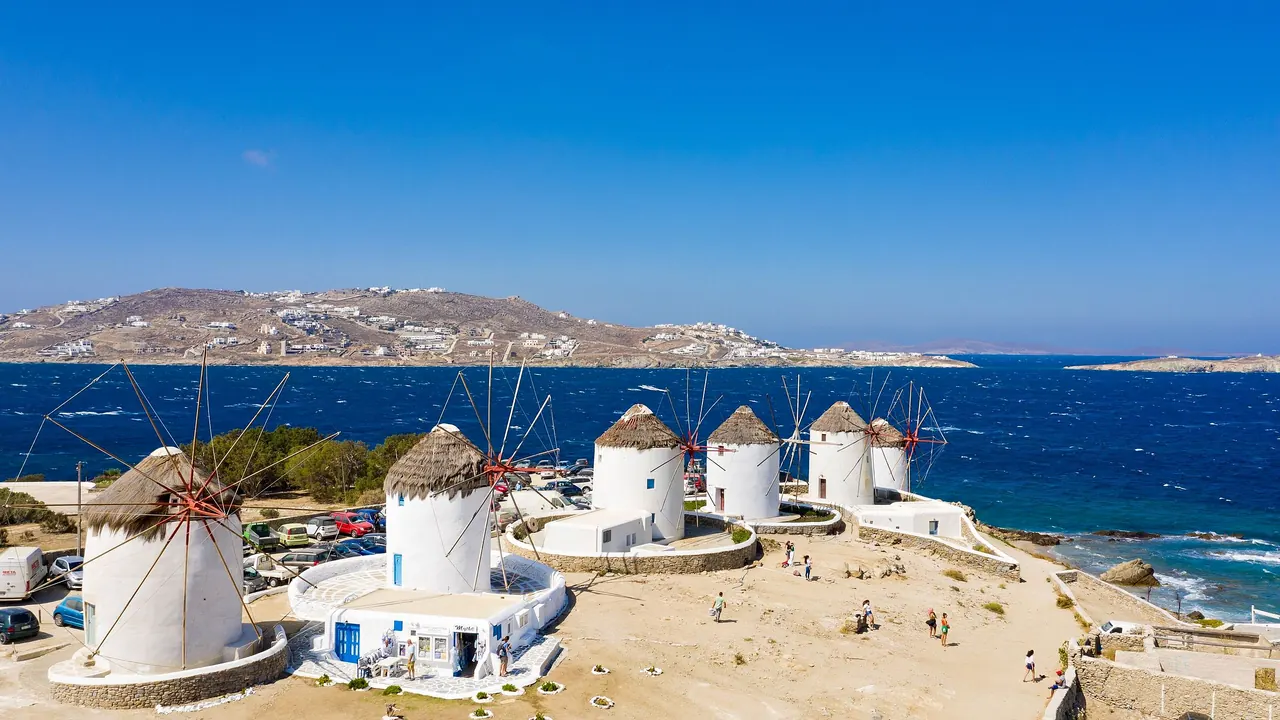
Delos is the decisive difference. A short boat ride from Chora brings you to one of the great religious sanctuaries of ancient Greece, and Chora itself, with its windmills, Little Venice and the Paraportiani church, is a sight in its own right.
Kos has more history on the island itself, with Roman ruins scattered through Kos Town, the Knights' castle on the harbour and the terraced Asklepieion above it. It is rewarding for two or three days, but nothing on it matches the scale of Delos.
Nightlife
Mykonos is the far stronger choice for going out. Its nights run from afternoon beach clubs through Little Venice sunsets and Chora's cocktail and dance bars, shaped by a long-established gay scene, to big clubs with international DJs that close at sunrise.
Kos has two hubs rather than an island-wide scene: the loud bar lanes of Kos Town's old quarter and Kardamena's young party resort. Elsewhere evenings end with a seafront drink, which many families and couples prefer.
Nature & outdoors
Kos has more landscape to explore. The Dikeos range rises to over 800m behind Zia, with pine-wood trails up to Mount Christos, and there are peacocks in the Plaka forest and flamingos on the Alikes salt lake in the cooler months.
Mykonos is low, bare and rocky, lovely for its light rather than its walking. Its outdoor appeal is on and under the water: the same summer wind drives kitesurfing at Korfos and Kalafatis as it does at Marmari on Kos, but Mykonos adds diving around reefs and wrecks.
Day trips
The two are broadly level, and every outing from either goes by boat. From Kos the trips change country and scenery: Bodrum's castle and bazaar across the water in Turkey, the volcanic crater on Nisyros and the sponge-diving harbour of Kalymnos.
From Mykonos you hop around the Cyclades instead, to pilgrim Tinos, neoclassical Ermoupoli on Syros, or Paros and Naxos on fast boats. There are more islands in reach, but they are more alike, and the meltemi can disrupt crossings.
Good for families
Kos is far better suited to children. Gentle north-coast shallows, resorts with pools and kids' clubs, a water park near Marmari, short flat distances and tavernas happy with children up late make daily life simple, though there are no zoos or museums aimed at them.
Mykonos can work with care, at calm bays such as Ornos or Platis Gialos, and Delos may grip older children. But the island's identity is adult nightlife, Chora gets loud late in summer, and the windy north coast is risky for small swimmers.
Getting around
On Kos, buses and bicycles do most of the work. Buses run along the main road from Kos Town to the big resorts, cycle lanes lead from the flat, walkable town to the beaches on either side, and you need a hire car only for the hill villages and the far south-west. It is the simpler island to manage without a car.
Mykonos is smaller, and here you get about on foot and by boat. Chora is entirely car-free, and sea taxis are a pleasant way between the south-coast beaches. Against that, taxis are scarce in summer, the roads around Chora are narrow and congested, and you need your own wheels for the quieter north and east.
Shopping & style
Mykonos is the better place to shop, within limits. Matoyianni Street and the alleys around it hold designer resort wear, fine Greek jewellery, galleries and small design shops open late into the evening, though most of it is beachwear and much closes out of season.
Kos offers mainly souvenirs, leather and sponges in the old-quarter lanes. Its best buys are edible: olive oil, honey and the herbs and spices in the Italian-era market hall on Eleftherias Square.
Affordability
Kos is much the cheaper island. Built for package travel, it has plenty of mid-range rooms in Tigaki, Marmari and Kardamena, inexpensive buses, bike hire and back-street tavernas, and its ancient sites cost little, leaving overall costs near mainland Southern Europe.
Mykonos in season is priced for a luxury crowd, from hotel rooms and beach-club sunbeds to taxis and car hire. Staying inland or at Ano Mera, eating gyros and travelling by bus all help, but it never becomes a budget trip in summer.
Live music & performing arts
Neither island has any real theatre or concert life, and both are quiet out of season. What Kos does have is the summer Hippokrateia festival, staging concerts, theatre and dance in the Asklepieion, the Roman Odeon and the castle, along with Greek-night shows in the resorts. On Mykonos the music is mostly club and beach-bar DJ sets, with only the occasional open-air concert or village festival.
Wellness & relaxation
Therma, on the south-east coast of Kos, has no equal on Mykonos. A hot sulphur spring runs down to the sea, and bathers pile up pebbles to make pools where the hot water mixes with the waves. The hill villages of Zia and Pyli and the quiet coast around Kefalos keep the rest of a stay slow.
Mykonos has no bathing tradition of its own, so wellness there means upmarket hotel spas and yoga terraces. Its summer rhythm works against rest. Calm comes mainly at Agios Sostis, at Ftelia or beyond Kalafatis, or in early June and late September.
When should you go?
Pick your month. The climate figures are measured averages, not a forecast.
Kos in July
Mykonos in July
Daytime high, °C
Rainfall in the month, mm
Where the figures come from
Kos has no rain gauge within 25 km of the centre, so its rainfall comes from a gridded climate dataset read at the destination rather than from a gauge further away.
Mykonos has no weather station within reach, so its figures come from a gridded climate model rather than a measured record, and read a broad area rather than one spot.
Temperature and rainfall are climate normals, averaged over the years shown. Kos: 1993-2020 (rainfall 1991-2020) normals, Kos Airport (23.2 km from centre). Mykonos: 2001-2020 normals, NASA POWER reanalysis grid, no weather station within 90 km.
On Kos the sea is warm enough to swim from June to October and peaks around 25°C in August, but the air runs much hotter than on Mykonos. July and August highs of about 31°C make midday walks among the ruins of Kos Town hard work, so May, June and September are the better months for mixing beach days with sightseeing. Mykonos stays milder through summer, with highs around 25°C, so Chora's lanes are comfortable to walk even in August, though its sea is a touch cooler and the swimming season fades in early October.
Both islands are close to rainless from June to August, and the wet season returns from October. Kos takes far more of it, around 170mm in January against a drier Mykonos winter, while spring on Mykonos warms more slowly and is still below 20°C in April. Neither is a beach destination outside the summer months.
Which traveller are you?
On a family trip with young children, Kos makes life easy: shallow north-coast sand, resort pools and kids' clubs, a water park and quiet evenings in Tigaki. Mykonos can work from one calm south-coast bay, but at luxury prices and with adult nights.
For a food and nightlife trip, choose Mykonos. On Kos the late nights stay in Kardamena and Kos Town's old quarter, and the cooking is rarely the draw. On Mykonos the south-coast beach clubs hand over to Chora's bars and sunrise clubs, with kopanisti and louza on the table.
On a trip on a tight budget, Kos wins by enough to settle the choice: mid-range rooms in Tigaki and Marmari, inexpensive buses and bike hire, back-street tavernas. Mykonos costs less in June or late September, but is never a budget island in summer.
Before you go
| Measure | Kos | Mykonos |
|---|---|---|
| Official language | Greek | Greek |
| Currency | Euro (EUR) | Euro (EUR) |
| Sockets | CF230 V, 50 Hz | CF230 V, 50 Hz |
| Driving side | Right | Right |
| Time zone | UTC+2, UTC+3 in summer | UTC+2, UTC+3 in summer |
| Emergency number | 112 | 112 |
| Main airport | Kos International Airport "Ippokratis" (KGS)75 non-stop destinations | Mykonos Island National Airport (JMK)44 non-stop destinations |
| Public holidays this year | 15 days | 15 days |
By the numbers
| Measure | Kos | Mykonos |
|---|---|---|
| Population | 33,387 | 10,134 |
| People per km² | 115 | 96 |
| Swim season, months above 21 °C | 5 months | 5 months |
Where else could you go?
Every comparison below shares a destination with this one, so you can follow Kos or Mykonos somewhere new.