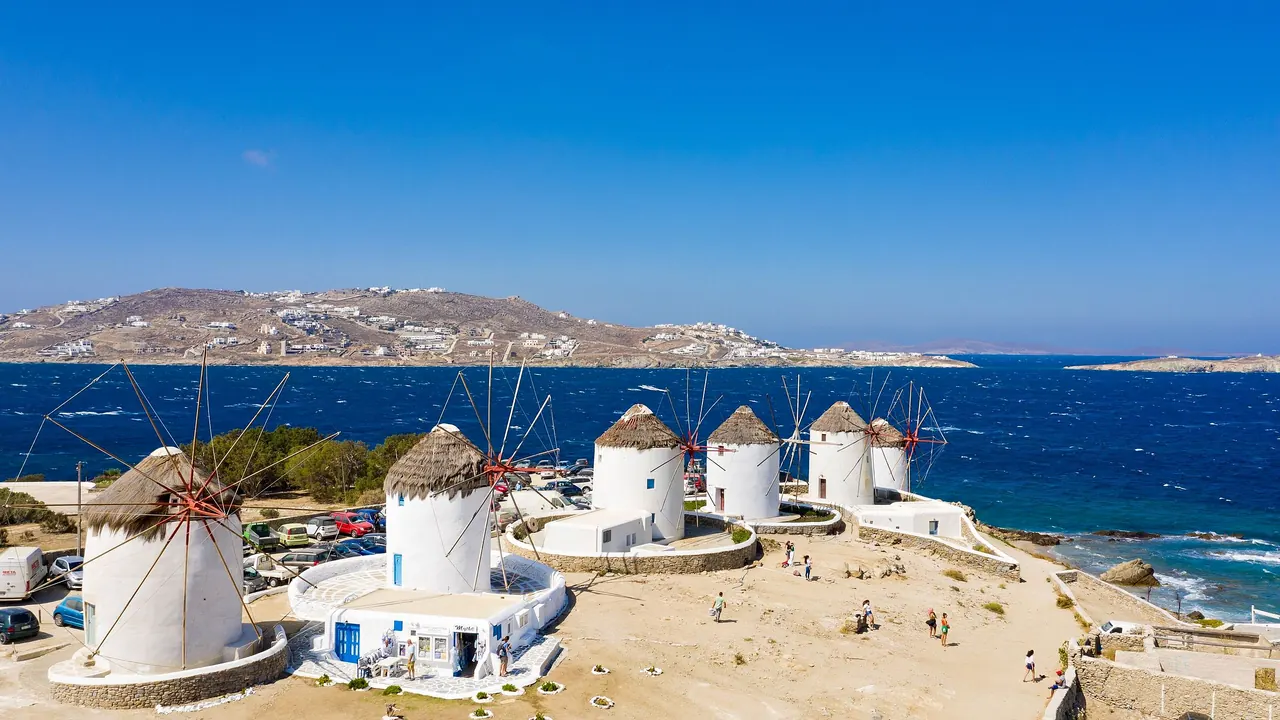
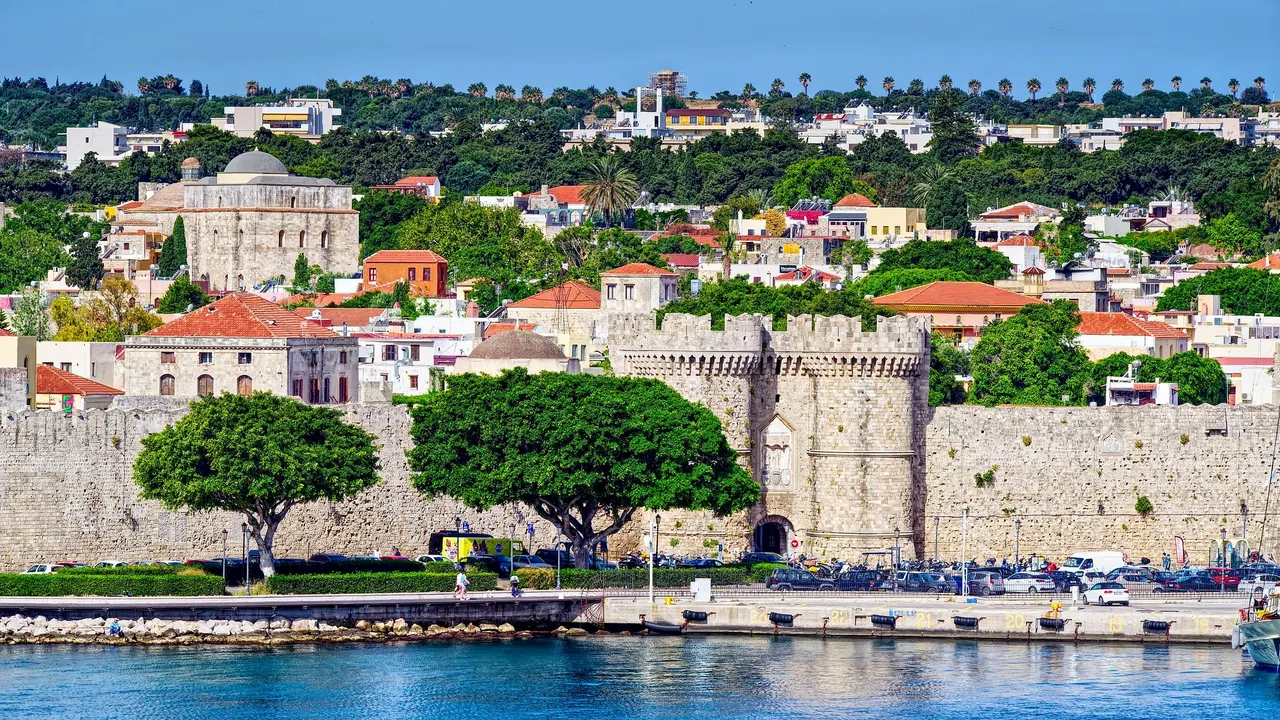
Photos: Mykonos by dronepicr, CC BY 2.0, cropped; Rhodes by Mark Thomas, Pexels License.
Mykonos or Rhodes?
Our verdict in twelve categories, each scored against the same fixed benchmark cities, and the climate month by month, so you can choose for your trip.
Choose Mykonos for
- nightlife
- shopping
- beaches
Mykonos is for adults who want a glamorous, late-night island and are ready to pay for it. The days go on the sandy south-coast bays and their beach clubs, the evenings on sunset drinks in Little Venice, and the nights in Chora's lanes and clubs until sunrise. Its boutiques suit a resort wardrobe, and Delos is a short boat ride away. It suits couples and groups of friends far better than families or anyone counting the cost.
Choose Rhodes for
- prices
- families
- nature and the outdoors
Rhodes gives a broader and calmer vacation at a much fairer price. The medieval Old Town and the acropolis of Lindos give it real historical depth. The sheltered, shallow east-coast bays and the resort hotels make life easy with children, and its pine hills and inland villages leave room for walking and slow evenings. The nightlife is there if you look for it, mostly in Faliraki, but it is not the reason to choose Rhodes.
Scoreboard
Twelve categories on one fixed scale from 0 to 100. The shaded stretch is the gap between the two.
Your match
Pick a travel style or drag the sliders, and both match scores follow your weighting.
Wins on nightlife and shopping with your weighting.
Wins on prices and families with your weighting.
What matters to you?
Category by category
What the scores mean for a trip.
Beaches & swimming
Both are true beach islands, and the difference lies in the sand and the scene. Mykonos's south coast offers sandy bays with very clear water, and each has a distinct mood: sheltered Ornos close to town, polished Psarou, party Paradise, and roomier Elia and Kalafatis. Beach clubs and rows of sunbeds set the tone on many of them.
Rhodes has a longer chain of sheltered east-coast bays from Faliraki to Lindos, often with sand mixed with fine shingle. The highlights are Tsambika's soft sweep, the snorkelling inlets of Anthony Quinn Bay and St Paul's below the acropolis. Its sea is a little warmer and its swimming season a little longer, and Prasonisi adds a sandbar between calm water and waves.
Food & drink
The two islands are about level for food, but they reward different approaches. On Mykonos the meal is mostly about the setting: grilled octopus by the water in Little Venice, island specialities such as kopanisti and louza, and a large, showy tier of sushi and celebrity-chef dining.
Rhodes has less glamour and more substance away from the resort buffets. Pitaroudia, matsi pasta and slow-cooked goat come from the family tavernas in the inland villages, alongside souma and wine from Embonas. Getting the best out of it means driving inland rather than dressing up.
Culture & sights
Rhodes has far more history to explore. Its medieval Old Town, one of Europe's most complete fortified towns, runs from the Street of the Knights to the Palace of the Grand Master, with mosques, a synagogue and the dry moat along the way. Beyond the walls are the acropolis of Lindos, ancient Kamiros and Monte Smith, and together they fill several days.
Mykonos has one outstanding sight in Delos, the sacred island of Apollo, which deserves a full morning. On the island itself, Chora's whitewashed maze, the windmills at Kato Mili and Paraportiani church make a lovely but short programme, done in two or three days.
Nightlife
This is where Mykonos pulls well ahead. The night begins at the Paradise and Super Paradise beach clubs in the afternoon, moves to Little Venice for sunset and then to Chora's dance bars, shaped by a long-established gay scene, before the big clubs carry on until sunrise.
Rhodes has pockets rather than a whole island given over to the night: Faliraki's strip for young package crowds, one late lane in the Old Town, and stylish rooftop bars in Lindos. In most of its coastal resorts the evening ends at the hotel bar.
Nature & outdoors
Rhodes is the greener and more varied island. Pine-covered hills, the shaded gorge of the Valley of the Butterflies and the wooded stream at Seven Springs make good walking in spring and autumn, and Mount Attavyros offers a real climb above the wine villages.
Mykonos is low, bare and brown, beautiful for its light and sea more than its land, and walkers are limited to lanes and coastal paths. Both islands use their wind well: Mykonos has kitesurfing at Korfos and Kalafatis plus good diving, while Rhodes has Prasonisi, one of the Mediterranean's best-known windsurfing spots.
Day trips
The day trips are about equal, and on both islands they depend on boats and summer seas. From Mykonos the ferries reach other Cycladic islands, such as pilgrim Tinos, neoclassical Ermoupoli on Syros, and Paros and Naxos, so the variety is between similar islands.
Rhodes has a smaller set but a wider spread. It offers the pastel harbour of Symi, quiet Halki, and a crossing to Marmaris for a taste of Turkey. It also has more to do by car on the island itself, with the castles of Monolithos and Kritinia and the potters of Archangelos.
Good for families
Rhodes is much the easier island with children. Tsambika, Afandou and Kolymbia have gently sloping sand, the big east-coast resorts run pools and kids' clubs, and there is a water park above Faliraki and an aquarium in Rhodes Town. The main thing to plan around is the July and August heat.
Mykonos can work if a family picks a calm bay such as Ornos or Agios Stefanos, hires a car and comes in June or September. Beyond the water park near Elia and a trip to Delos, though, little is aimed at children, and Chora gets loud late into the night.
Getting around
Neither island is effortless, and they are awkward in different ways. Mykonos is small, with nowhere much more than half an hour from Chora. Buses and handy sea taxis cover the south-coast beaches, but there are too few taxis in summer, the roads are narrow and congested, and the north and east need a car or scooter.
Rhodes is bigger, and the distances show: it takes about an hour and a half to drive to Prasonisi. On the other hand, its main roads are good and the east-coast buses to Lindos are reliable. Rhodes Town and its car-free Old Town are easy on foot.
Shopping & style
Mykonos is the better place to shop for style. Matoyianni Street and the lanes around it are full of designer resort wear, linen, swimwear and fine Greek jewellery, and the shops stay open late for evening browsing, though almost everything is fashion and almost nothing is local craft.
Rhodes is mainly souvenirs along Sokratous Street. Still, it has things Mykonos lacks: Lindian-style painted ceramics from Archangelos, village lace and embroidery, and honey and wine from Embonas.
Affordability
Rhodes costs far less. Its many package hotels and all-inclusive resorts keep the north and east coasts moderately priced, and village tavernas and buses are reasonable. Only Lindos and the boutique hotels of the Old Town reach high prices.
On Mykonos in summer, rooms, cocktails, sunbeds, taxis and car hire are all priced for a luxury crowd. Staying around Ano Mera, eating at bakeries and visiting in June or late September all help, but the island never becomes cheap.
Live music & performing arts
Neither island is somewhere to plan a trip around performances, but Rhodes has a little more. A long-established company performs Greek folk dance in a small Old Town theatre in season, and there are summer concerts in the medieval moat and the ancient stadium. On Mykonos the music is mostly the DJ sets of its clubs, with only the odd village festival or open-air concert.
Wellness & relaxation
Rest comes a little more easily on Rhodes. The quiet south, with villages such as Lahania and Asklipio, offers long meals, backgammon in the kafeneio and dark, clear skies far from the resort strip, and the big east-coast hotels have good spas.
On Mykonos, wellness means hotel spas with yoga facing the sea. Real calm means retreating to Agios Sostis, Ftelia or the bays beyond Kalafatis, or coming in early June or late September, when the party rhythm eases.
When should you go?
Pick your month. The climate figures are measured averages, not a forecast.
Mykonos in July
Rhodes in July
Daytime high, °C
Rainfall in the month, mm
Where the figures come from
Mykonos has no weather station within reach, so its figures come from a gridded climate model rather than a measured record, and read a broad area rather than one spot.
Rhodes has no rain gauge within 25 km of the centre, so its rainfall comes from a gridded climate dataset read at the destination rather than from a gauge further away.
Temperature and rainfall are climate normals, averaged over the years shown. Mykonos: 2001-2020 normals, NASA POWER reanalysis grid, no weather station within 90 km. Rhodes: 1991-2020 normals, Rhodes Airport (12.6 km from centre).
Mykonos has the milder summer. From June to September it is almost rainless, highs top out around 25°C, and the meltemi keeps it breezy, so walking Chora's lanes at midday stays pleasant. The sea is warm enough to swim from June into early October. May is good for walking but still cool for the beach, and the rain starts to come back in October.
Rhodes gets much hotter, reaching 31°C in August, so hiking and sightseeing are hard work in July and August. Its sea warms to about 27°C in August and is still warm in October at around 24°C, against 21°C on Mykonos. That makes late May and October good months there for both the beach and the ruins, though October brings the first real rain. Winter is wet on both islands, more so on Rhodes, and neither is a winter beach destination.
Which traveller are you?
For a food and nightlife trip, Mykonos is the clear choice. Its afternoon beach-club sessions, the long-established gay scene in Chora and the clubs with international DJs make a night out that Rhodes, outside Faliraki's loud strip, cannot match.
On a family trip with children, choose Rhodes. The east coast between Faliraki and Lindos has calm, shallow sandy bays and resort hotels with pools and kids' clubs. There is also a water park and an aquarium, while Mykonos is built around adult nights out.
On a tight budget, Rhodes is the realistic option. Its package resorts, village tavernas and buses keep costs moderate, whereas Mykonos in summer is among Europe's most expensive places to stay, even for travellers who eat gyros and skip the sunbeds.
Before you go
| Measure | Mykonos | Rhodes |
|---|---|---|
| Official language | Greek | Greek |
| Currency | Euro (EUR) | Euro (EUR) |
| Sockets | CF230 V, 50 Hz | CF230 V, 50 Hz |
| Driving side | Right | Right |
| Time zone | UTC+2, UTC+3 in summer | UTC+2, UTC+3 in summer |
| Emergency number | 112 | 112 |
| Main airport | Mykonos Island National Airport (JMK)44 non-stop destinations | Rhodes International Airport "Diagoras" (RHO)136 non-stop destinations |
| Public holidays this year | 15 days | 15 days |
By the numbers
| Measure | Mykonos | Rhodes |
|---|---|---|
| Population | 10,134 | 127,613 |
| People per km² | 96 | 91 |
| Swim season, months above 21 °C | 5 months | 6 months |
Where else could you go?
Every comparison below shares a destination with this one, so you can follow Mykonos or Rhodes somewhere new.