Lefkada or Mykonos?
Our verdict in twelve categories, each scored against the same fixed benchmark cities, and the climate month by month, so you can choose for your trip.
Choose Lefkada for
- prices
- nature and the outdoors
- families
Lefkada suits travellers who want the beach at the centre of the trip but with more around it than sand: a green, mountainous interior, a windsurfing bay at Vasiliki, sailing waters among the satellite islands and calm east-coast bays for children. It costs much less than Mykonos and its evenings are gentle. In return you give up serious nightlife and any sight to build a trip around.
Choose Mykonos for
- nightlife
- culture and sights
- shopping
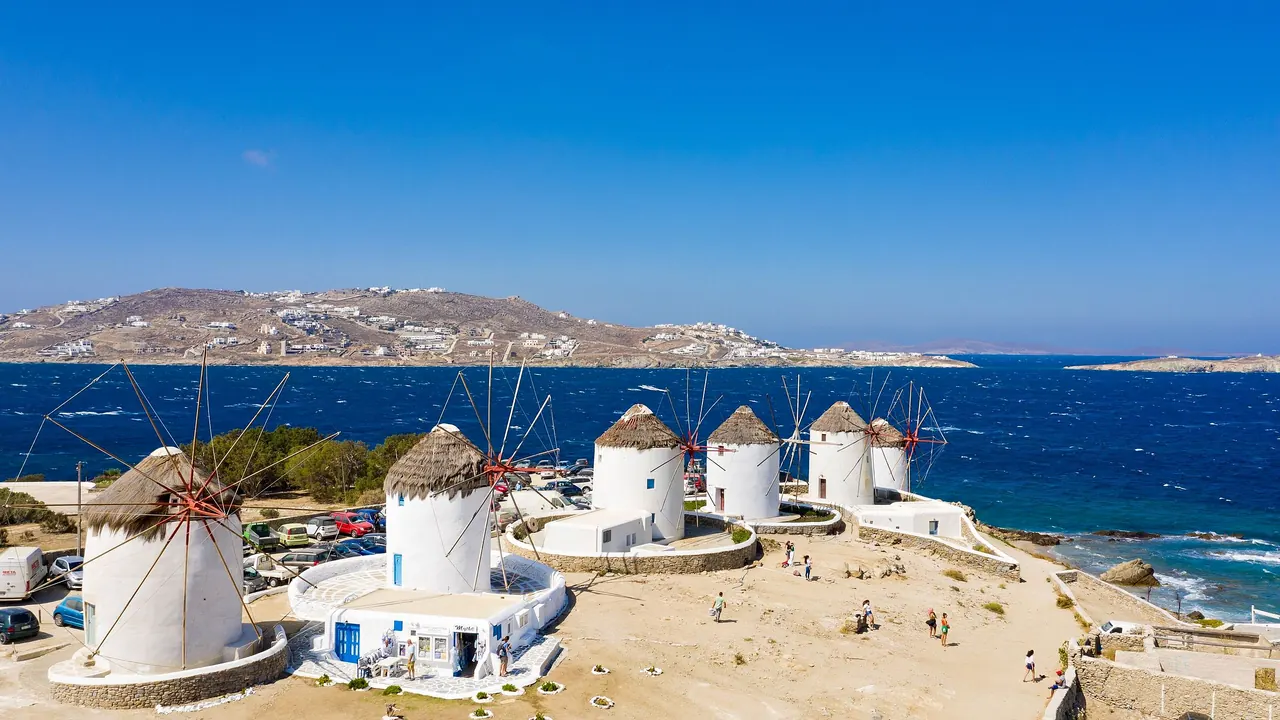
Mykonos is the choice for a glamorous, late-night summer. Its beach clubs and Chora's bars run until sunrise, the old town's lanes and windmills are a sight in themselves, and Delos, one of the great sanctuaries of the ancient world, lies a short boat ride away. It pays off for couples and groups who want to go out and can accept some of the highest prices in Europe. It is less rewarding for families or anyone after green walking country.
Scoreboard
Twelve categories on one fixed scale from 0 to 100. The shaded stretch is the gap between the two.
Your match
Pick a travel style or drag the sliders, and both match scores follow your weighting.
Wins on prices and nature and the outdoors with your weighting.
Wins on nightlife and culture and sights with your weighting.
What matters to you?
Category by category
What the scores mean for a trip.
Beaches & swimming
These are two of Greece's strongest beach islands, and the difference is in character rather than quality. Lefkada's showpieces are on the west coast, at Porto Katsiki, Egremni and Kathisma: long strands under white cliffs with startling turquoise water, but steeply shelving, wavy in the afternoon and sometimes reached by long staircases. Its calm swimming is on the east side, in the bays around Nikiana and Ligia.
Mykonos offers sandier, more organised south-coast bays, from sheltered Ornos and polished Psarou to the party beaches of Paradise and Super Paradise, many lined with sunbeds and beach clubs. When the meltemi blows, its wilder north coast is for still days only.
Food & drink
Mykonos eats a little better and more variously. Its own specialities, the peppery kopanisti cheese, louza and Chora's almond sweets, sit alongside a large high-end scene of sushi, fusion and celebrity-chef tables, though that scene is often more about being seen than eating well.
Lefkada stays with the Greek taverna: harbour fish in Lefkada town and Nidri, slow-cooked meat in mountain villages such as Karya, and the small lentils of the Eglouvi plateau. It is honest and simple, with little beyond Greek food.
Culture & sights
Mykonos has far more to see. Delos alone, with the Terrace of the Lions, mosaic-floored houses and theatres spread across the sacred island of Apollo, deserves a full morning. Back in Chora, the windmills at Kato Mili, the Paraportiani church and a handful of small museums fill another day or two.
Lefkada's sights are pleasant breaks from the beach rather than reasons to come: the Santa Maura fortress at the causeway, the Faneromeni monastery above the lagoon, the painted Ionian church ceilings in town and the embroidery tradition of Karya.
Nightlife
This is the widest gap between them. Mykonos is one of the Mediterranean's great party islands, with beach-club afternoons, dance bars in Chora's lanes, a long-established gay scene and big clubs with international DJs that run until sunrise through July and August.
Lefkada's evenings are a drink and a stroll: cocktail bars in the town's lanes full of young Greek visitors, sailing crews on Nidri's harbour and windsurfers in Vasiliki's relaxed bars. There is no clubbing to speak of, and outside high summer the island goes to bed early.
Nature & outdoors
Lefkada is much the better island for outdoor time. Olive and cypress slopes rise to an interior above 1,100m, paths link hill villages and lead to the Dimosari waterfall, and the cliff road to Cape Lefkatas is spectacular. On the water, Vasiliki is a famous windsurfing bay and the channels towards Meganisi are classic sailing country.
Mykonos is low, brown and rocky, beautiful for its light rather than its landscape. It has the meltemi for kitesurfing at Korfos Bay, though, and clear water with reefs and wrecks that suits divers and snorkellers better than Lefkada does.
Day trips
Both make good bases for excursions, but of different kinds. From Lefkada you can mix islands and mainland: the fishing villages of Meganisi, Fiskardo on Kefalonia and Ithaca by ferry, or a drive to Roman Nikopolis and Venetian Parga.
From Mykonos every outing is island-hopping in the Cyclades: pilgrim Tinos with its marble-carving villages, neoclassical Ermoupoli on Syros, and Paros or Naxos by fast boat. The variety is narrower, and the meltemi can disrupt crossings.
Good for families
Lefkada is the easier family island. The east-coast bays around Nikiana and Ligia, plus Agiofili and Vasiliki in the south, have calm water for paddling, and the island's evenings are relaxed enough for children. The dramatic west coast is best kept for an occasional day out.
Mykonos can work if you pick Agios Stefanos, Ornos or Platis Gialos, and the water park near Elia and the ruins on Delos help with older children. But the island is built around adult nights out, and Chora gets loud and crowded late in summer.
Getting around
Mykonos is somewhat simpler to move around. The island is small, Chora is entirely car-free, buses serve the main south-coast beaches and sea taxis hop between bays from Platis Gialos and Ornos. Its weak spots are the scarcity of taxis in summer and the congested roads around town.
Lefkada needs no ferry, thanks to its causeway, and Aktion airport is about half an hour away. Once there, though, a car or scooter is close to essential, the mountain and west-coast roads are slow and winding, and Nidri and Porto Katsiki jam up in August.
Shopping & style
Mykonos is the better place to shop, if what you want is a beach wardrobe. Matoyianni Street and the lanes around it are full of designer resort wear, linen, sandals, fine Greek jewellery and galleries that stay open late, though much of it closes outside the season.
Lefkada's shopping is an evening stroll down the town's pedestrian main street for olive oil, honey and lentils, plus hand embroidery in Karya. That is a modest list, but these are local crafts that Mykonos does not have.
Affordability
The price gap is large. Lefkada sits mid-range for a Greek island, with plenty of family-run studios, reasonable tavernas and few entry fees. The main costs are August rooms near the west-coast beaches, car hire and boat trips.
In season Mykonos ranks among Europe's most expensive destinations, with hotels far above Greek norms and beach clubs, sunbeds and cocktails priced for a luxury crowd. Rooms at Ano Mera, the buses and Chora's bakeries soften the bill, and on both islands June and September bring easier prices.
Live music & performing arts
Neither island is a place for theatre or concerts, but Lefkada has a little more. Its international folklore festival has filled open-air stages with dance groups every August for decades, and summer brings village festivals with traditional music. On Mykonos the music is mostly the DJ sets of its clubs, with only the occasional concert or village festival.
Wellness & relaxation
Neither island has a bathing tradition, and both are restful only away from their busiest corners. Mykonos offers pampering in upmarket hotel spas with yoga on sea-facing terraces, and quiet around Agios Sostis and Ftelia.
Lefkada's calm is more rural and spread across the island: yoga and retreat stays in the hills, quiet interior villages and slow evenings in the east-coast harbours, best in June or September.
When should you go?
Pick your month. The climate figures are measured averages, not a forecast.
Lefkada in July
Mykonos in July
Daytime high, °C
Rainfall in the month, mm
Where the figures come from
Lefkada has no rain gauge within 25 km of the centre, so its rainfall comes from a gridded climate dataset read at the destination rather than from a gauge further away.
Mykonos has no weather station within reach, so its figures come from a gridded climate model rather than a measured record, and read a broad area rather than one spot.
Temperature and rainfall are climate normals, averaged over the years shown. Lefkada: 1998-2020 (rainfall 1991-2020) normals, Aktion Airport (24.3 km from centre). Mykonos: 2001-2020 normals, NASA POWER reanalysis grid, no weather station within 90 km.
Both islands are beach destinations from June to early October, but they feel quite different in high summer. Lefkada gets properly hot, with daytime highs around 31°C in August and the sea reaching about 26°C, so walking around town is best left to the morning or evening. Mykonos stays milder, around 25°C, with a sea near 24°C, and the summer meltemi wind keeps it fresher still, though it also roughs up the north-coast beaches.
The shoulder seasons are where they part most. Lefkada's rain returns in September and builds into a wet autumn and winter, with November the wettest month at about 150mm, so May, June and early September are its sweetest months for walking and swimming. Mykonos is much drier through spring and autumn, which keeps late September and October pleasant for sightseeing, although the sea cools by then. In winter both islands are cool, damp and quiet.
Which traveller are you?
For a food and nightlife trip, Mykonos is the clear pick. Afternoon sessions at the beach clubs give way to sunset drinks in Little Venice, then bars and clubs until dawn, with waterfront fish dinners and a polished dining scene in between.
On a tight budget, Lefkada makes far more sense. Family-run studios, reasonable tavernas and few entry fees keep costs in the middle of the Greek range, while Mykonos stays one of Europe's most expensive places even if you eat gyros and take the bus.
For an outdoors trip, choose Lefkada. Vasiliki's steady afternoon winds make it a windsurfing classic, the sheltered channels are made for a week on a yacht, and hill paths lead to the Dimosari waterfall. Mykonos is mostly bare, low ground.
Before you go
| Measure | Lefkada | Mykonos |
|---|---|---|
| Official language | Greek | Greek |
| Currency | Euro (EUR) | Euro (EUR) |
| Sockets | CF230 V, 50 Hz | CF230 V, 50 Hz |
| Driving side | Right | Right |
| Time zone | UTC+2, UTC+3 in summer | UTC+2, UTC+3 in summer |
| Emergency number | 112 | 112 |
| Main airport | Aktion National Airport (PVK)47 non-stop destinations | Mykonos Island National Airport (JMK)44 non-stop destinations |
| Public holidays this year | 15 days | 15 days |
By the numbers
| Measure | Lefkada | Mykonos |
|---|---|---|
| Population | 22,652 | 10,134 |
| People per km² | 64 | 96 |
| Swim season, months above 21 °C | 5 months | 5 months |
Where else could you go?
Every comparison below shares a destination with this one, so you can follow Lefkada or Mykonos somewhere new.