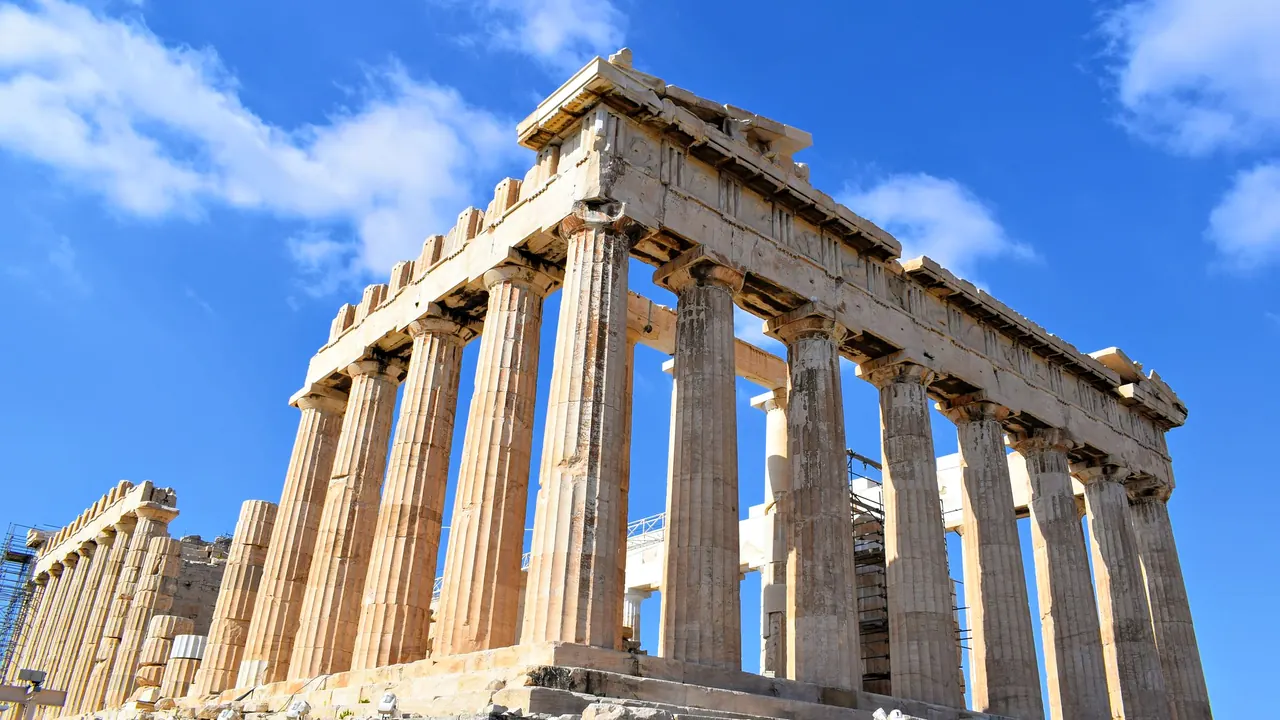
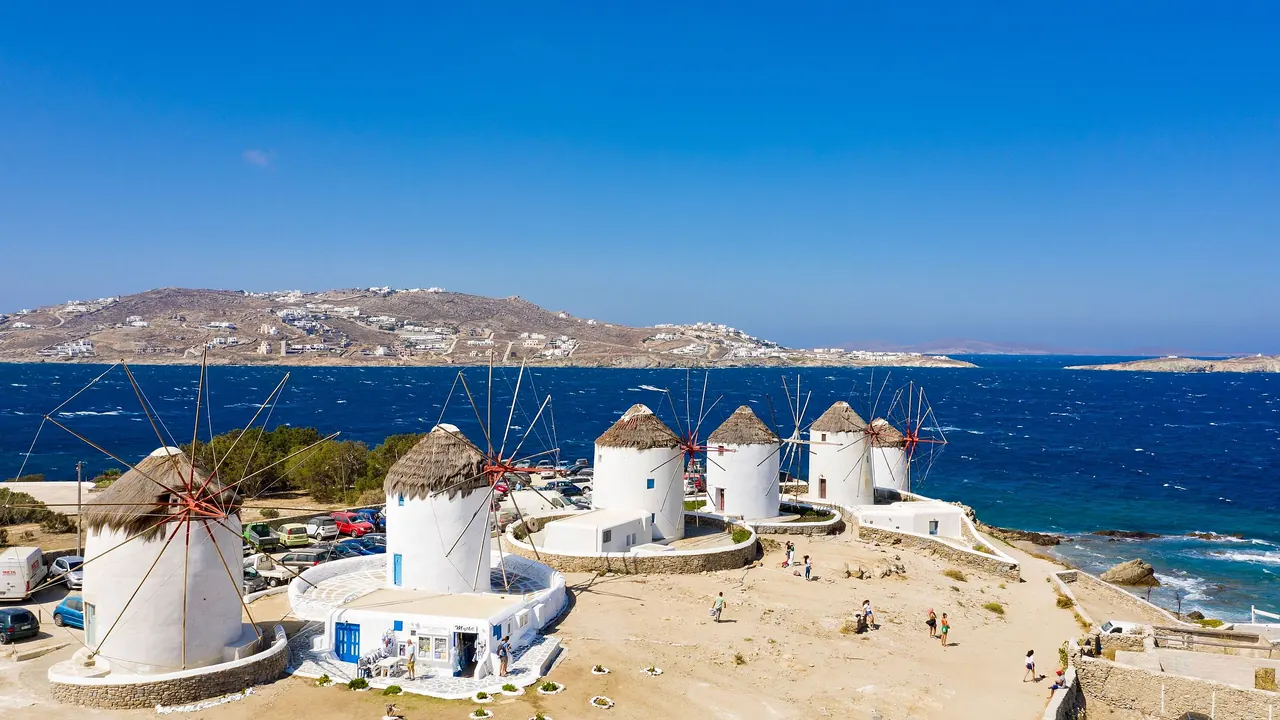
Photos: Athens by Ranjeet Kumar Singh, Pexels License; Mykonos by dronepicr, CC BY 2.0, cropped.
Athens or Mykonos?
Our verdict in twelve categories, each scored against the same fixed benchmark cities, and the climate month by month, so you can choose for your trip.
Choose Athens for
- live music and the arts
- prices
- nature and the outdoors
Athens is the choice for a trip built around the ancient world and the table. The Acropolis, the Agora and the great museums are all within walking distance of each other. Delphi and the Argolid make easy day trips, and neighbourhood tavernas in Koukaki or Pangrati feed you well for far less than the island charges. It also gives families, walkers and anyone watching costs much more room, and the Riviera is there when you want a swim.
Choose Mykonos for
- beaches
- nightlife
Pick Mykonos when the sea and the nights are the point. Its sandy south-coast bays and very clear water beat anything near the capital, and from June to September its beach clubs and Chora's lanes keep going later and harder than Athens does. The price is high and the sights take two or three days around Delos, so it suits adults on a beach and party vacation with money to spend.
Scoreboard
Twelve categories on one fixed scale from 0 to 100. The shaded stretch is the gap between the two.
Your match
Pick a travel style or drag the sliders, and both match scores follow your weighting.
Wins on live music and the arts and prices with your weighting.
Wins on beaches and nightlife with your weighting.
What matters to you?
Category by category
What the scores mean for a trip.
Beaches & swimming
Athens has a real coastline in the Riviera, which runs from Faliro past Glyfada and Vouliagmeni to Varkiza and is reached by tram and coastal bus. A ferry to Aegina or Agistri gives a calmer swim. Still, the beaches near the city are something to fit around sightseeing, often rocky or crowded lidos, rather than the reason to come.
Mykonos is the beach destination of the two. Its south coast is a string of sandy bays: sheltered Ornos and Agios Ioannis, polished Psarou, party Paradise, and the roomier Elia and Kalafatis, all with clearer water than you get near Athens. The one catch is the meltemi, which makes the north coast rough on windy days.
Food & drink
Athens eats better, and for less. Its strength is meze shared at the tavernas and mezedopoleia of Psyrri, Pangrati and Exarchia, with tsipouro or Attica savatiano on the table. The Varvakios market shows off the produce, and there is a serious fine-dining scene at the top end.
On Mykonos the setting does most of the work: grilled octopus by the water in Little Venice, or beach tavernas with the chairs almost in the sea. Kopanisti, louza and the tavernas around Ano Mera's square are worth finding, but much of the island's dining is high-end fusion that is more about being seen, and everyday Greek cooking plays a smaller part.
Culture & sights
Athens holds one of the world's great clusters of ancient sites. The Acropolis, the Agora with its Temple of Hephaestus, Kerameikos and the Temple of Olympian Zeus are linked by the pedestrian promenade, and the Acropolis Museum and the National Archaeological Museum are just as strong. Seeing it properly takes days, not hours.
Mykonos has one major site, Delos, a short boat ride away and worth a full morning. Otherwise the sight is Chora itself, with its windmills, Little Venice and the Paraportiani church, plus a few small museums and the Tourliani monastery, all easily covered in two or three days.
Nightlife
Athens offers the wider range, and it runs all year. There are rooftop bars facing the lit Acropolis in Psyrri and Monastiraki, clubs and a long-standing gay scene in Gazi, student bars in Exarchia and bouzouki nightclubs that go on until morning. In summer, the clubbing moves to open-air venues down the coast.
In high summer, though, Mykonos is the bigger party. Nights start in the afternoon at the beach clubs of Paradise and Super Paradise, move to sunset drinks in Little Venice and the gay bars of Chora's lanes, and end at clubs with international DJs at sunrise. It is a seasonal scene, at its fullest in July and August.
Nature & outdoors
Athens offers far more outdoors. Lycabettus and Filopappou give quick walks with views, Hymettus has pine trails, and Parnitha, about an hour north, has fir forest and proper hiking up to 1,400m. The Saronic Gulf adds sailing and paddleboarding, though the summer heat pushes anything strenuous into spring and autumn.
Mykonos is low and bare, and its beauty is in the light, the dry-stone walls and the sea. Walking is limited to lanes and coastal paths such as the one to the Armenistis lighthouse. The island makes up for it in the water, with the meltemi driving kitesurfing at Korfos Bay and Kalafatis, and clear water for diving around the reefs and wrecks.
Day trips
Athens is one of the best bases in Greece for days out. You can see Sounion at sunset, Mycenae, Epidaurus and Nafplio in the Argolid, and Delphi on the slopes of Parnassos. From Piraeus, ferries reach Aegina, Poros and car-free Hydra, so a week can mix ancient sites with island harbours.
Beyond Delos, every outing from Mykonos is a ferry ride, and the wind can disrupt it. Tinos, Syros with its neoclassical Ermoupoli, Paros and Naxos are all rewarding, but they are all Cycladic islands, so there is less variety between them.
Good for families
Athens works better with children, mainly because there is more to fill the days. There is the park and lake at the Stavros Niarchos centre, the planetarium, Hellenic Cosmos, the zoo and calm Riviera beaches, and older children who know the myths can be gripped by the ancient sites. The heat and broken pavements are the hard parts, so spring and autumn are easier.
Mykonos can give a good beach week with young children at Agios Stefanos, Ornos or Platis Gialos, where the water is shallow, and there is a water park near Elia. Little else is aimed at them, and in high summer Chora's late nights are built for adults.
Getting around
Athens has a metro from the airport and Piraeus, a tram down to the coast and plenty of taxis. The main sights sit in a walkable core around Syntagma, Plaka and Monastiraki. The annoyances are narrow, blocked pavements, the hills and heavy traffic.
Mykonos is small and Chora is closed to cars, so the town itself is easy on foot. Beyond the buses to the south-coast beaches and the sea taxis from Platis Gialos and Ornos, it gets harder. Taxis are scarce in summer, the roads are narrow, and the quieter north and east really need a hired car or scooter.
Shopping & style
Neither is a shopping destination, but they differ in kind. Athens has the range: chain fashion on Ermou, designer labels in Kolonaki, Monastiraki's weekend flea market, and leather sandals, honey, herbs and ancient-style jewellery around Athinas Street.
Mykonos is narrower and seasonal. The boutiques of Matoyianni Street sell resort wear, linen, swimwear and Greek jewellery late into summer evenings, which is fine for a beach wardrobe but not much more.
Affordability
Athens costs a little less than most Western European capitals, and the room is the biggest item on the bill. Central hotels, especially those with a view of the Acropolis, charge as much as any popular European city in July and August, so where you stay and when you come make the most difference. Spring and autumn, and a base away from Plaka, ease it. Day to day the city is kind to a wallet: street food, bakery snacks, taverna meals, the metro and the tram all cost little. The main extra is the entry fees to the ancient sites, which add up over several days.
Mykonos is at the other end, one of the most expensive places in Europe for a summer vacation. Here too the room takes the largest share, priced far above anywhere else in Greece. The beach then adds to it: sunbeds at the fashionable bays, beach-club afternoons and cocktails by the water, plus costly taxis or car hire. Staying inland or at Ano Mera, using the buses, picking beaches without sunbeds and coming in June or late September all help, but a summer week on the island still costs far more than one in the capital.
Live music & performing arts
Athens has a real performance life, and summer is its peak. The Athens Epidaurus Festival stages opera, dance and ancient drama in the Odeon of Herodes Atticus beneath the Acropolis and in the theatre at Epidaurus. For the rest of the year, the Greek National Opera and the Megaron keep a classical programme going, and rebetiko is played late in small tavernas.
Mykonos has nothing comparable, with no theatre, opera or concert season. Its music comes from the DJs at its clubs and beach bars. In summer, a village festival with traditional dance or an occasional open-air concert is a pleasant find, but not something to plan a trip around.
Wellness & relaxation
Athens has one thing worth making the trip for: Lake Vouliagmeni, a warm spring-fed lake at the foot of a cliff on the southern Riviera. You can swim there in mild water even in winter, which no hotel spa on Mykonos can offer. Back in the loud, hot centre, calm comes from a hotel spa, a bathhouse in the old town or a slow coffee in the shade.
On Mykonos, how restful your stay is depends on where you stay and when you go, since the island has no bathing tradition. The upmarket hotels offer massages and yoga, but the summer rhythm of beach clubs and late nights works against rest. The windier, less built-up north coast, the far eastern bays and the edges of summer suit a quiet stay better.
When should you go?
Pick your month. The climate figures are measured averages, not a forecast.
Athens in July
Mykonos in July
Daytime high, °C
Rainfall in the month, mm
Where the figures come from
Mykonos has no weather station within reach, so its figures come from a gridded climate model rather than a measured record, and read a broad area rather than one spot.
Temperature and rainfall are climate normals, averaged over the years shown. Athens: 1991-2020 normals, Athens / Athenai / Pláka (2.2 km from centre). Mykonos: 2001-2020 normals, NASA POWER reanalysis grid, no weather station within 90 km.
Athens is best for sightseeing in April, May, late September and October, when the streets are warm but you can still walk them in comfort. From June to August it gets very hot, up to 35°C in August, so walking around the ruins becomes something for the morning or evening. Summer is also when the sea is warmest, at around 26°C, and it stays good for swimming from late May into October. The long sunny days last all summer, and the rain arrives in November and December.
Mykonos stays much milder in high summer, with highs of around 25°C and almost no rain from June to September, so long days on the sand are more comfortable there than in Athens. The sea peaks at about 24°C in August and is warm enough to swim in from June to early October. Winter is wetter on the island than in the capital, with about 100mm of rain in January, and from late autumn to spring it is too cool for a beach visit.
Which traveller are you?
On a beach and sun trip, Mykonos is the clear pick. Its south-coast bays have sand and very clear water, from sheltered Ornos to the roomier Elia, and the swimming lasts from June into early October. The Athens Riviera is a pleasant extra to a city stay, not a reason to travel.
For a culture and arts trip, Athens is the obvious choice. The Acropolis, the Agora and the National Archaeological Museum fill several days, summer brings drama at the Odeon of Herodes Atticus, and Delphi and Mycenae are day trips. Mykonos has Delos and Chora's lanes, and little beyond them.
On a tight budget, choose Athens. Souvlaki, bakeries, neighbourhood tavernas and a cheap metro keep daily costs down, especially if you stay in Koukaki or Pangrati. Mykonos in summer charges luxury prices for rooms, sunbeds and drinks, and even careful spending there adds up quickly.
Before you go
| Measure | Athens | Mykonos |
|---|---|---|
| Official language | Greek | Greek |
| Currency | Euro (EUR) | Euro (EUR) |
| Sockets | CF230 V, 50 Hz | CF230 V, 50 Hz |
| Driving side | Right | Right |
| Time zone | UTC+2, UTC+3 in summer | UTC+2, UTC+3 in summer |
| Emergency number | 112 | 112 |
| Elevation | 74 m | - |
| Main airport | Athens Eleftherios Venizelos International Airport (ATH)20 km from centre176 non-stop destinations | Mykonos Island National Airport (JMK)44 non-stop destinations |
| Public holidays this year | 15 days | 15 days |
By the numbers
| Measure | Athens | Mykonos |
|---|---|---|
| Population | 643,452 | 10,134 |
| People per km² | 16,499 | 96 |
| Museums within 10 km | 88 | - |
| UNESCO World Heritage sites within 50 km | 2 | - |
| Swim season, months above 21 °C | 5 months | 5 months |
Where else could you go?
Every comparison below shares a destination with this one, so you can follow Athens or Mykonos somewhere new.