Kefalonia or Mykonos?
Our verdict in twelve categories, each scored against the same fixed benchmark cities, and the climate month by month, so you can choose for your trip.
Choose Kefalonia for
- prices
- nature and the outdoors
- families
Kefalonia suits travellers who want a large, green island to explore by car: fir forest on Mount Ainos, cliff-backed coves spread across several coasts, a lake cave and turtles in the harbour, with evenings spent over a long dinner by the water rather than in a club. It is the gentler and more affordable choice, and it works better for families and for anyone who wants space and quiet.
Choose Mykonos for
- nightlife
- culture and sights
- shopping
Pick Mykonos for the nights and the scene. Beach clubs, the late lanes of Chora and clubs that run until sunrise make it one of the Mediterranean's great party islands, and the ancient sanctuary of Delos is a sight Kefalonia cannot match. It is compact, polished and very expensive, best for adults on a short, social trip who care more about the atmosphere than the landscape.
Scoreboard
Twelve categories on one fixed scale from 0 to 100. The shaded stretch is the gap between the two.
Your match
Pick a travel style or drag the sliders, and both match scores follow your weighting.
Wins on prices and nature and the outdoors with your weighting.
Wins on nightlife and culture and sights with your weighting.
What matters to you?
Category by category
What the scores mean for a trip.
Beaches & swimming
The beaches are equally strong, but they work in different ways. Kefalonia's are dramatic and spread out: the white pebble crescent of Myrtos under cliffs, quieter Petani and red-sand Xi on the Paliki peninsula, and long sand at Skala and Lourdas in the south. Choosing between them means a base on the right coast and drives along winding roads.
Mykonos packs its sandy bays along the south coast, close to Chora and linked by sea taxis. They are more organised and more social, from polished Psarou to the party beaches and roomier Elia and Kalafatis, while the north coast is often too windy in summer.
Food & drink
Neither island is a serious food destination, but they feed you differently. Kefalonia is family tavernas in harbour villages and hill villages, its own meat pie and garlic aliada with salt cod, and Robola tastings at the wineries of the Omala valley, though menus soon repeat.
On Mykonos the meal is often about the setting, grilled octopus at tables over the water in Little Venice. There is far more choice of sushi, fusion and chef-led dining, but it is aimed at being seen, and good, simple Greek cooking takes more seeking out, around Ano Mera's square for instance.
Culture & sights
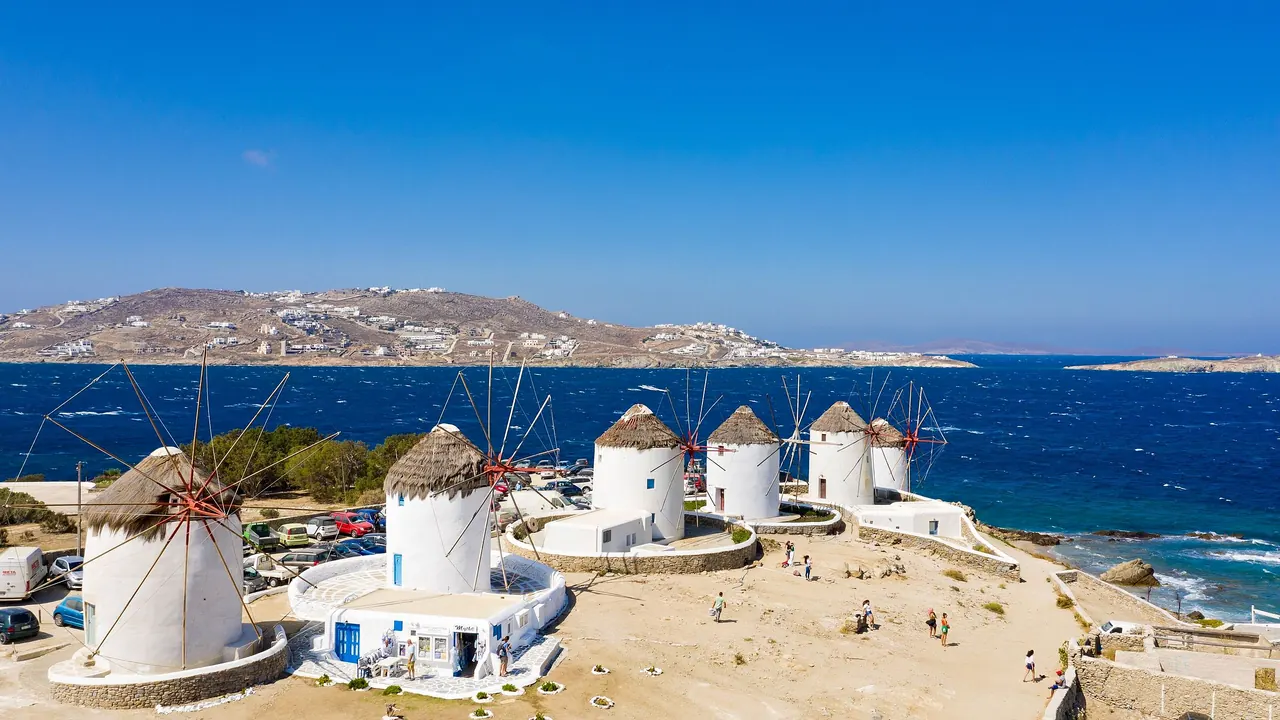
Mykonos has much more to see, thanks above all to Delos, the sacred island of Apollo, whose sprawling ruins and mosaic floors are a short boat ride away. Chora itself, with its windmills, Little Venice and the Paraportiani church, makes a full day of wandering.
Kefalonia lost most of its old towns in the 1953 earthquake, so its sights are scattered outings: pastel Fiskardo, the Venetian fortress at Assos, the Mycenaean tomb at Tzanata and the Agios Gerasimos monastery. Pleasant, but not a reason to choose the island.
Nightlife
This is where the two are furthest apart. From June to September Mykonos runs from beach-club afternoons through Chora's cocktail and dance bars, with its long-established gay scene, to big clubs that close at sunrise.
Kefalonia's evenings are long dinners and a drink by the harbour, with a modest bar strip at Lassi and a late summer crowd on Argostoli's Lithostroto. Anyone wanting to dance until morning will be disappointed there.
Nature & outdoors
Kefalonia is by far the greener, wilder island. Mount Ainos rises to about 1,628m as a national park of dark Greek fir and semi-wild horses, the west coast falls in white cliffs, and under the ground lie the boat-borne lake of Melissani and the stalactites of Drogarati, with loggerhead turtles in Argostoli harbour.
Mykonos is low, brown and stony, beautiful for its light and sea rather than its scenery. Its outdoor strengths are the meltemi, which makes Korfos Bay and Kalafatis good for kitesurfing and windsurfing, and clear water for diving around reefs and wrecks.
Day trips
Mykonos has the wider choice, all of it by boat across the Cyclades: Tinos with its pilgrimage church and marble villages, neoclassical Ermoupoli on Syros, and Paros and Naxos within about an hour on fast boats. The meltemi can cancel crossings, and every outing is another Cycladic island.
From Kefalonia the standout is Ithaca, a short ferry from Sami, with Vathy, Kioni and the sites linked to Odysseus. Summer boats reach northern Zakynthos and Lefkada, but beyond that the list is short and mostly seasonal.
Good for families
Kefalonia is the easier family choice. The sandy, shelving beaches at Skala, Lourdas and Xi suit small children, the boat ride through Melissani and turtle spotting make good outings, and the evenings are quiet. The catch is long, hot drives and no attractions built for children.
Mykonos has shallow bays at Agios Stefanos, Ornos and Platis Gialos and a water park near Elia, but the island is shaped around adult nights out, and Chora is loud and packed late in high summer.
Getting around
Mykonos is easier because it is small: nowhere is much more than half an hour from Chora, the town is car-free, buses serve the south-coast beaches and sea taxis hop between bays. Its weak points are a shortage of taxis and congested roads in July and August.
Kefalonia is large and mountainous, so a hired car is close to essential. The drive from Argostoli to Fiskardo takes about an hour and a half, buses are too infrequent to plan around, and parking at Myrtos and Assos is tight in summer.
Shopping & style
Mykonos is the better place to shop, if what you want is a summer wardrobe. Matoyianni Street and the lanes around it hold designer resort wear, linen, Greek jewellery and galleries, open late into the evening.
Kefalonia offers everyday clothes and gifts on Argostoli's Lithostroto and a few craft stalls in Fiskardo. The best things to take home are edible: Robola wine, thyme honey and boxes of red mandoles.
Affordability
Kefalonia costs much less. Taverna meals are reasonable and apartments around Skala, Lourdas and Lassi are fair value, with car hire the main extra and Fiskardo and Assos the pricier corners.
Mykonos in season is among the most expensive places to vacation in Europe, from hotel rooms to cocktails and sunbeds at the fashionable beaches. Staying inland, eating gyros and using buses helps, but it never becomes cheap in summer.
Live music & performing arts
Neither island has a theatre or concert season, but Kefalonia has a musical tradition of its own: kantades serenades with guitar and mandolin and a philharmonic band heard at village festivals and summer concerts in Argostoli's squares. On Mykonos the music is mostly club and beach-bar DJ sets, with an occasional village festival as a lucky find.
Wellness & relaxation
Kefalonia is the more restful island, less for its spas than for its pace: long lunches in hill villages, slow harbour evenings in Assos and the quiet of the Paliki peninsula.
Mykonos has polished hotel spas with massages and sea-facing yoga, but its summer rhythm of beach clubs and late nights works against rest. Those wanting calm should stay near Agios Sostis, Ftelia or beyond Kalafatis.
When should you go?
Pick your month. The climate figures are measured averages, not a forecast.
Kefalonia in July
Mykonos in July
Daytime high, °C
Rainfall in the month, mm
Where the figures come from
Kefalonia's temperatures are measured 59 km from the centre, at Zakinthos / Agrilia.
Kefalonia has no rain gauge within 25 km of the centre, so its rainfall comes from a gridded climate dataset read at the destination rather than from a gauge further away.
Mykonos has no weather station within reach, so its figures come from a gridded climate model rather than a measured record, and read a broad area rather than one spot.
Temperature and rainfall are climate normals, averaged over the years shown. Kefalonia: 1991-2020 normals, Zakinthos / Agrilia (58.6 km from centre). Mykonos: 2001-2020 normals, NASA POWER reanalysis grid, no weather station within 90 km.
Both islands are for swimming from June to early October, but their summers feel quite different. Kefalonia gets properly hot, with highs of about 33°C in July and August and sunshine almost every day, so walking and hiking belong to the early morning, while the sea is at its warmest at around 26°C. Mykonos stays milder, at about 25°C through high summer, which keeps Chora's lanes comfortable to wander in the middle of the day.
June and September are the best balance on Kefalonia, with a warm sea and more bearable heat, while May and early October suit walks on Mount Ainos. The rain also comes earlier and harder there: it builds from October, and November is the wettest month at around 159mm. Mykonos stays drier into autumn and takes most of its rain from December to February. Neither island is a beach trip in winter.
Which traveller are you?
For a food and nightlife trip, choose Mykonos for its nights. The eating is level: Kefalonia has its meat pie and Robola from the Omala wineries, Mykonos kopanisti and octopus over the water, but only Chora parties until sunrise.
On an outdoors trip, Kefalonia wins clearly. Trails climb through the fir forest of Mount Ainos, boats glide into the Melissani cave and kayaks follow the north-east coast, while bare, rocky Mykonos offers little beyond windsurfing and diving.
On a trip on a tight budget, Kefalonia is far easier to manage. Taverna meals and apartments around Skala and Lourdas are fairly priced, even with a hired car, whereas Mykonos in season is costly for everything from rooms to sunbeds.
Before you go
| Measure | Kefalonia | Mykonos |
|---|---|---|
| Official language | Greek | Greek |
| Currency | Euro (EUR) | Euro (EUR) |
| Sockets | CF230 V, 50 Hz | CF230 V, 50 Hz |
| Driving side | Right | Right |
| Time zone | UTC+2, UTC+3 in summer | UTC+2, UTC+3 in summer |
| Emergency number | 112 | 112 |
| Main airport | Kefalonia International Airport "Anna Pollatou" (EFL)41 non-stop destinations | Mykonos Island National Airport (JMK)44 non-stop destinations |
| Public holidays this year | 15 days | 15 days |
By the numbers
| Measure | Kefalonia | Mykonos |
|---|---|---|
| Population | 36,064 | 10,134 |
| People per km² | 49 | 96 |
| Swim season, months above 21 °C | 5 months | 5 months |
Where else could you go?
Every comparison below shares a destination with this one, so you can follow Kefalonia or Mykonos somewhere new.