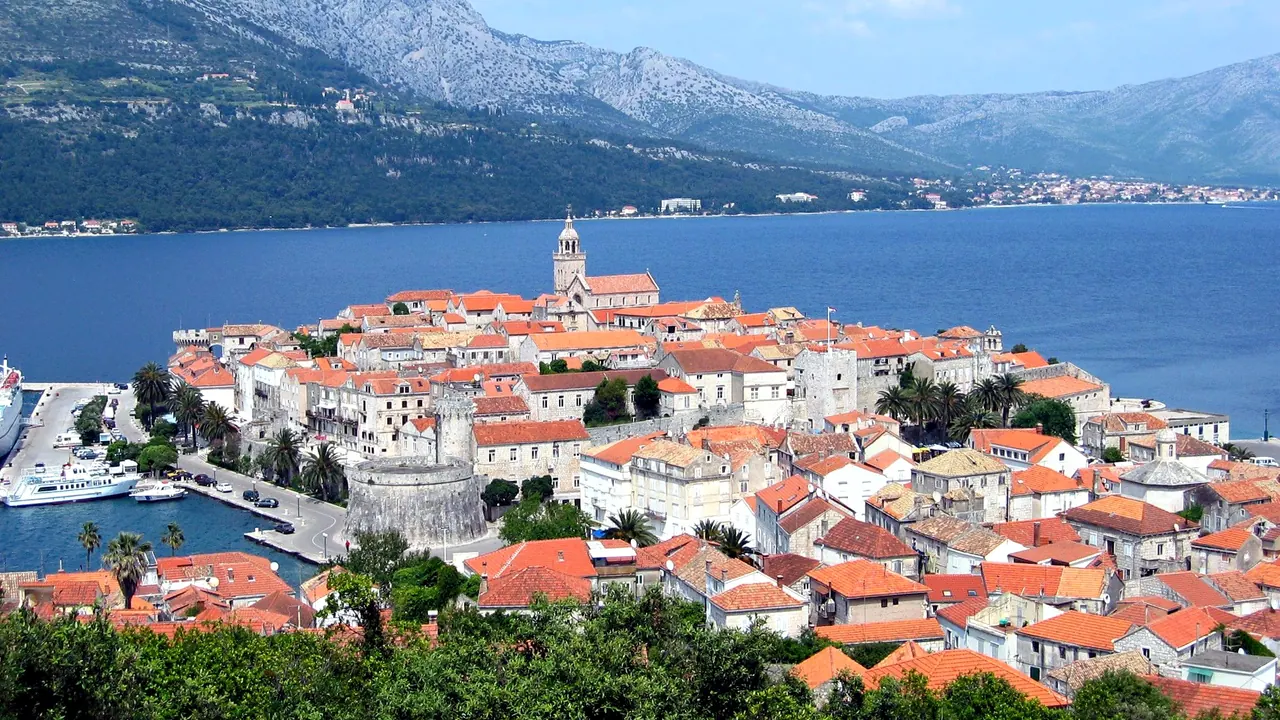
Photos: Korčula by Εὐθυμένης, CC BY-SA 3.0, cropped.
Ischia or Korčula?
Our verdict in twelve categories, each scored against the same fixed benchmark cities, and the climate month by month, so you can choose for your trip.
Choose Ischia for
- wellness
- day trips
- food and drink
Choose Ischia if the warm water itself is the point of the trip. Hot springs run through the whole island, from terraced thermal parks to rock pools at Sorgeto where the sea mixes with spring water, and the island has more sandy beach than most of the Bay of Naples. Ferries to Naples, Procida and the Phlegraean Fields make it a strong base for day outings. It also suits a slow family week of pools and sheltered bays.
Choose Korčula for
- culture and sights
- getting around
- nature and the outdoors
Korčula is the quieter, more handsome pick for travellers who like stone towns and wine. Its walled old town on a peninsula has more to look at than anything on Ischia, the water in its pine-backed coves is very clear, and the vineyards growing Grk and Pošip sit a short drive away. Pelješac and Mljet are just across the water. Expect fewer comforts, though: no thermal tradition, sparse buses and a car or scooter to reach the best coves.
Scoreboard
Twelve categories on one fixed scale from 0 to 100. The shaded stretch is the gap between the two.
Your match
Pick a travel style or drag the sliders, and both match scores follow your weighting.
Wins on wellness and day trips with your weighting.
Wins on culture and sights and getting around with your weighting.
What matters to you?
Category by category
What the scores mean for a trip.
Beaches & swimming
The two are evenly matched for swimming, but the beaches feel different. Ischia has more sand, most of it dark and volcanic: the long sweep of Maronti with hot springs at its western end, sunset-facing Citara and the calm, shallow bay of San Montano.
Korčula's strength is the clarity of its water. Its coast is mostly pebble and rock coves under pine, with real sand only at Pržina and Bilin Žal near Lumbarda, and the bright pebble bay of Pupnatska Luka at the bottom of a steep road on the south coast. Taxi boats from Korčula Town also reach wooded Badija and the other islets just offshore.
Food & drink
Ischia eats a little better. Its slow-braised rabbit in terracotta, the grilled catch in harbours like Sant'Angelo and Forio, and white wines from Epomeo's terraces give it a sense of place, even if half-board hotels keep many visitors from finding the best village tables.
Korčula's Dalmatian cooking is honest but samey from one konoba to the next, with peka-cooked octopus and lamb and Žrnovo's makaruni as the highlights. Its wines are the real draw: Grk at Lumbarda, Pošip around Čara, and oysters at Ston across the channel. Many kitchens close when summer ends.
Culture & sights
Korčula has more to see. The walled old town, laid out in a herringbone pattern on its peninsula, holds St Mark's Cathedral with its Tintoretto, the treasury, the town museum and the house claimed as Marco Polo's birthplace, and the prehistoric cave of Vela Spila lies at the far end of the island.
Ischia's heritage is concentrated in the Aragonese Castle on its causeway and in Nestor's Cup at the Villa Arbusta museum. Beyond those, it's mostly pleasant villages and the Mortella gardens. Anyone wanting more heads to Naples.
Nightlife
Neither island is for a night out, and on both the evening means a long dinner and a drink at sunset. Ischia Porto has the most going on, with wine bars, cocktail terraces and a couple of summer disco venues. In Korčula Town the best drinks are on the old walls and towers above the channel, and anyone who wants to party takes a boat to a livelier island.
Nature & outdoors
The landscapes are equally rewarding but quite different. Ischia is a steep volcano: paths climb through chestnut woods to the green tuff summit of Monte Epomeo, steam rises from the south coast, and the Regno di Nettuno marine reserve is good for snorkelling and diving.
Korčula is gentler, with a pine-and-vineyard ridge for walking and cycling and islets made for sea kayaking. Its wilder country lies off the island, on Sveti Ilija above Orebić and in the saltwater lakes and forest of Mljet's national park.
Day trips
Ischia has the stronger list of outings. Naples is about an hour away by fast ferry, Procida is a short hop, and boats to Pozzuoli open up Baia, Solfatara and the Roman amphitheatre. In summer, Capri and Sorrento are a direct crossing away.
Korčula's outings are more rural and fewer: Pelješac's wineries and the walls of Ston, a full day on Mljet with its lake monastery, or a catamaran to Hvar Town. Dubrovnik and Split are both long days.
Good for families
Ischia is the easier island with children. Its thermal parks around Forio and Lacco Ameno double as water parks set in gardens, and San Montano and Maronti offer gentle water.
Korčula's sandy, shallow bays at Lumbarda are lovely for small children, and boat trips to the islets are fun. Beyond that there is little to fill the days, and the stepped lanes of the old town, the long ferry journeys and the summer heat all need planning.
Getting around
Getting around is equally awkward on both islands, but in different ways. On Ischia, one bus loop reaches every village and a car is more burden than help, so you pick a base and ride crowded buses, microtaxis and water taxis. Korčula is long and thinly served by buses, with the best coves at the bottom of steep side roads, so a hired car or scooter makes a real difference. Taxi boats are handy around Korčula Town and Lumbarda.
Shopping & style
Ischia gives shoppers a little more. The long stroll from Ischia Porto to Ischia Ponte has resort fashion, linen, leather sandals and jewellery, plus ceramics and thermal cosmetics. Korčula has no fashion street at all, just craft studios and galleries in the old town, and its best souvenirs are bottles of Grk or Pošip, olive oil and cukarini biscuits.
Affordability
Ischia is somewhat easier on the budget. Its many family-run spa hotels sell half-board stays with thermal pools included, and buses and ferries are fairly priced. Korčula's old town charges resort prices, and car hire and boat trips add up. Staying in an apartment in Lumbarda or Vela Luka and eating at inland konobas brings the cost down. On both islands, the shoulder months are noticeably cheaper than high summer.
Live music & performing arts
Both islands are thin on performing arts, and what they offer is seasonal. Ischia's is more refined: chamber music in William Walton's Mortella gardens and film screenings at the castle. Korčula's is folk tradition: the Moreška sword dance, performed in the old town through the summer, and unaccompanied klapa singing in churches and squares. For real opera you'd need to cross to Naples from Ischia, and from Korčula there is nothing close.
Wellness & relaxation
This is the widest gap between the two islands. Ischia is built around its hot springs: hotel pools fed by thermal water, terraced parks at Citara, Lacco Ameno and Casamicciola, the steam caves of Cavascura and Sorgeto's hot sea pools, which are usable even on winter evenings.
Korčula has no springs and no bathing culture. Its calm comes from quiet vineyard villages and long shaded lunches, especially in June and September.
When should you go?
Pick your month. The climate figures are measured averages, not a forecast.
Ischia in July
Korčula in July
Daytime high, °C
Rainfall in the month, mm
Where the figures come from
Ischia's temperatures are measured 36 km from the centre, at Grazzanise.
Ischia has no rain gauge within 25 km of the centre, so its rainfall comes from a gridded climate dataset read at the destination rather than from a gauge further away.
Korčula's temperatures are measured 69 km from the centre, at Mostar.
Korčula has no rain gauge within 25 km of the centre, so its rainfall comes from a gridded climate dataset read at the destination rather than from a gauge further away.
Temperature and rainfall are climate normals, averaged over the years shown. Ischia: 1991-2020 normals, Grazzanise (36 km from centre). Korčula: 1991-2020 normals, Mostar (69.2 km from centre).
Both islands follow the same broad year: dry, very sunny summers, a wet autumn and winter, and mild springs. The sea is warm enough to swim from June to September on both, and Ischia's water is a degree warmer at its peak, about 26°C in August, with a little warmth left into early October. Korčula has the hotter summer, with highs around 33°C in July and August against Ischia's 31°C, so walking in the middle of the day is harder work there.
For walking and sightseeing, May and early June are the best months on both islands: warm, settled and mostly dry. September is still warm, but rain becomes much more frequent after the dry summer, and the wet weather builds through October to a peak in November, when Ischia gets about 148mm. Winter is milder on Ischia. Korčula's January days reach only about 9°C, while on Ischia the thermal pools and Sorgeto's hot sea spring keep a cool-season visit worthwhile even when it's too cold for the beach.
Which traveller are you?
On a relaxing and wellness trip, make Ischia the base. Book a spa hotel with its own thermal pools, give a full day to a terraced park near Forio and go down to Sorgeto at dusk. Korčula can offer quiet, but not the waters.
For a culture and arts trip, Korčula rewards a slower look. Stay in or near the old town, walk the walls in the evening, catch a Moreška performance and save a morning for Vela Spila. On Ischia, plan on ferries to Naples for real depth.
On a family trip with young children, Ischia makes the days easier to fill. Alternate the sheltered sand at San Montano with a thermal park's warm pools, and add boat days for older children. Korčula's Lumbarda bays are gentle, but there's less to do over a week.
Before you go
| Measure | Ischia | Korčula |
|---|---|---|
| Official language | Italian | Croatian |
| Currency | Euro (EUR) | Euro (EUR) |
| Sockets | CFL230 V, 50 Hz | CF230 V, 50 Hz |
| Driving side | Right | Right |
| Time zone | UTC+1, UTC+2 in summer | UTC+1, UTC+2 in summer |
| Emergency number | 112 | 112 |
| Main airport | Naples International Airport (NAP)131 non-stop destinations | Dubrovnik Ruđer Bošković Airport (DBV)76 non-stop destinations |
| Public holidays this year | 13 days | 14 days |
By the numbers
| Measure | Ischia | Korčula |
|---|---|---|
| Population | 62,027 | - |
| People per km² | 1,340 | - |
| Swim season, months above 21 °C | 5 months | 5 months |
Where else could you go?
Every comparison below shares a destination with this one, so you can follow Ischia or Korčula somewhere new.