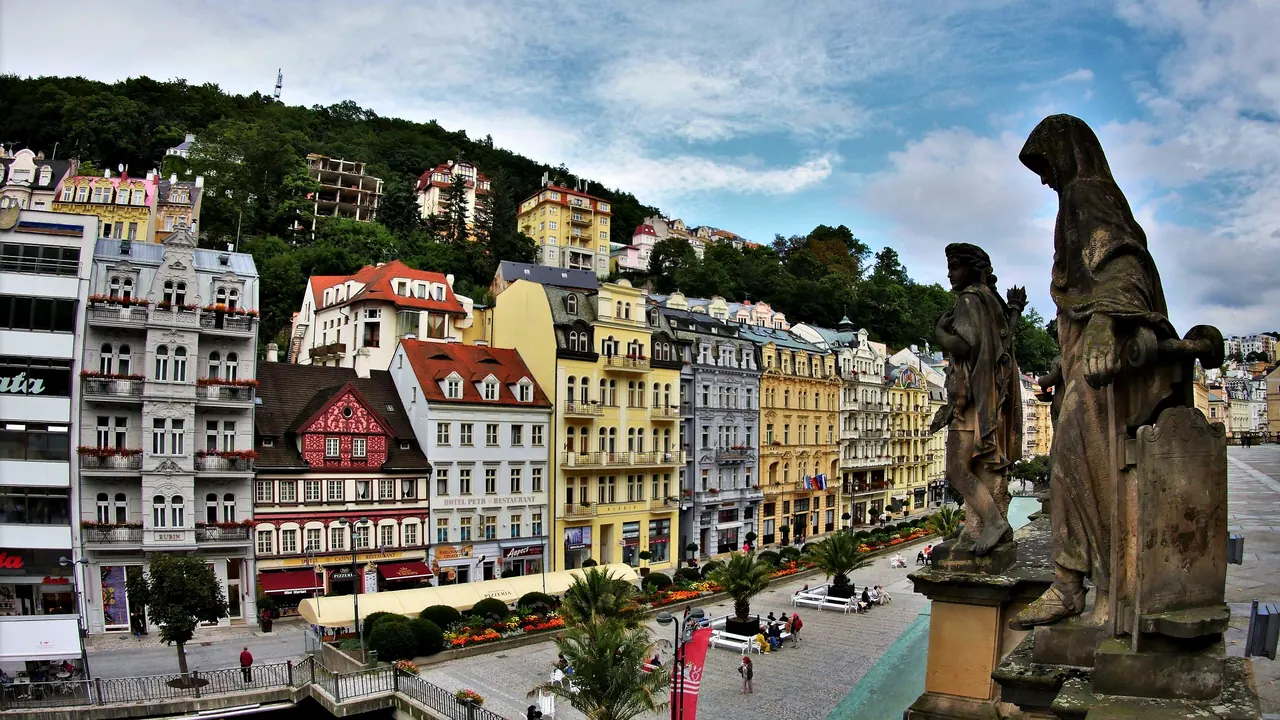
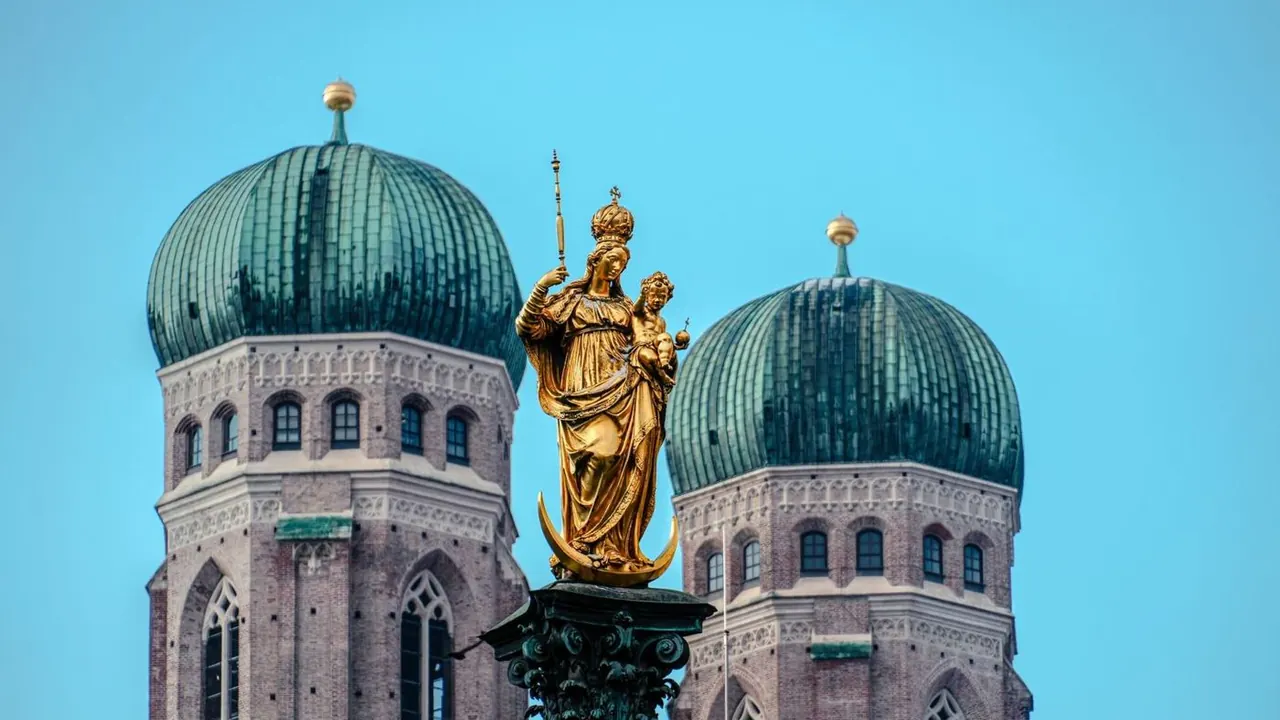
Photos: Karlovy Vary by Rolf Dietrich Brecher from Germany, CC BY-SA 2.0, cropped; Munich by 0xd1ma, Pexels License.
Karlovy Vary or Munich?
Our verdict in twelve categories, each scored against the same fixed benchmark cities, and the climate month by month, so you can choose for your trip.
Choose Karlovy Vary for
- prices
- wellness
Karlovy Vary suits a slower, smaller trip built around rest. The town exists for the drinking cure and the spa hotel stay. A few days of sipping from the springs along the colonnades, walking the forest paths and taking cake by the Teplá cost less here than a city break in Munich. Come for calm, and expect evenings to end early.
Choose Munich for
- live music and the arts
- families
- nightlife
Munich is the choice for a fuller trip with more to do each day. Its picture galleries, opera house and orchestras are far beyond anything the Czech spa town offers. Its trains open up the Alps, the lakes and Salzburg. Families, beer-garden lovers and anyone who wants a proper night out will find much more here, but at a noticeably higher cost.
Scoreboard
Twelve categories on one fixed scale from 0 to 100. The shaded stretch is the gap between the two.
Your match
Pick a travel style or drag the sliders, and both match scores follow your weighting.
Wins on prices and wellness with your weighting.
Wins on live music and the arts and families with your weighting.
What matters to you?
Category by category
What the scores mean for a trip.
Beaches & swimming
Neither city has a coast, and swimming is a sideline in both. In Karlovy Vary it means the warm pools fed by the springs, or a trip out to Lake Medard, a flooded former mine near Sokolov.
Munich does better in summer. Locals sunbathe on the Isar's gravel banks at the Flaucher. The Starnberger See and the Ammersee, under an hour away by S-Bahn, have jetties, lawns and clear, fresh alpine water.
Food & drink
Both kitchens rest on roast pork, dumplings and good beer, so the difference is depth rather than style. Karlovy Vary has its own spa wafers and Becherovka, but it has no proper market, little street food and few ambitious restaurants.
Munich has a whole way of eating built around its breweries, from white sausage before noon to picnics under the chestnut trees of a beer garden. It also has the Viktualienmarkt, a serious coffee-and-cake habit and a tier of starred kitchens.
Culture & sights
Karlovy Vary is one very pretty ensemble. Pastel Belle Époque hotels climb the Teplá valley around the colonnades and the Vřídlo geyser, and the spa quarter itself is the UNESCO-listed sight. Its museums of glass and liqueur are small, and a day or two is enough.
Munich has far more to fill a stay. The Pinakotheks and the Glyptothek in the Kunstareal, the Residenz, Nymphenburg and the Deutsches Museum are collections of European rank, even if much of the old town was rebuilt after the war.
Nightlife
Karlovy Vary goes to bed early. Outside the film festival week, a night out means a hotel bar, a casino or a Czech pub. Munich is no party capital, but it has real choice: long evenings in beer halls, cocktail and gay bars around Gärtnerplatz, student pubs in Schwabing, and techno clubs that stay open until morning at weekends.
Nature & outdoors
Both have green country close by, but on very different scales. In Karlovy Vary, beech and spruce woods rise straight out of the spa valley, with gentle paths up to the Diana tower, and Klínovec in the Ore Mountains offers modest skiing.
From Munich, the Alps are about an hour away by train. The Zugspitze, Garmisch and Tegernsee offer proper alpine hiking and skiing. In the city itself, the English Garden and the cycle paths along the Isar give you plenty of space outdoors.
Day trips
Karlovy Vary has a good short list. Loket's castle is twenty minutes away, the sister spa towns of Mariánské Lázně and Františkovy Lázně are about an hour away, and Plzeň or Prague make a long day out. Munich reaches much further, and more quickly, by rail: Salzburg, Nuremberg, Regensburg, Innsbruck and the royal castles of Neuschwanstein and Herrenchiemsee, with Augsburg barely half an hour away.
Good for families
Children enjoy Karlovy Vary's geyser, the funicular up to the Diana lookout and the warm wafers, but the town is made for adults taking cures, and the steep valley is tiring with a pushchair. Munich is built for families: a large zoo on the Isar meadows, the Deutsches Museum's children's area, an aquarium in the Olympic Park, beer gardens with playgrounds and public transport that takes pushchairs, with Legoland within reach.
Getting around
Both centres are walkable, but they are shaped differently. Karlovy Vary is one long strip along the Teplá, level on the promenade and steep above it. Buses and the funicular handle the climbs, and slow regional trains run beyond the town.
Munich's pedestrianised old town is compact and flat. One network of U-Bahn, S-Bahn, trams and buses reaches the museums, palaces, lakes and airport, and cycling suits the riverside routes. Only the spa town's forests and villages really call for a car.
Shopping & style
Shopping in Karlovy Vary happens along the promenades, among jewellers, fur shops and spa souvenirs. It is worth it mainly for Moser crystal, local porcelain and Bohemian garnets. Munich has the full range of a wealthy city, from the luxury houses of Maximilianstrasse and the department stores of Kaufingerstrasse to independent boutiques in Glockenbach and specialist tailors selling dirndls and lederhosen.
Affordability
Karlovy Vary is the cheaper of the two. Its promenade hotels and restaurants charge for the setting, but one street back the pubs and canteens charge local Czech prices, and rooms cost less outside summer.
Munich is Germany's most expensive city. Hotels are dear all year and very dear during the Oktoberfest and the big trade fairs. Picnics in beer gardens, free parks and lakes, and token museum fees on Sundays soften the bill.
Live music & performing arts
Karlovy Vary's symphony orchestra grew out of the old spa bands and plays light classical programmes, sometimes outdoors on the colonnades. The Fellner and Helmer theatre takes touring productions. It makes a pleasant evening rather than a reason to go.
Munich is a destination for this in its own right. The Bavarian State Opera plays at the National Theatre, and the city has three major orchestras, the rococo Cuvilliés Theatre, operetta at the Gärtnerplatztheater and a respected jazz scene.
Wellness & relaxation
This is where the spa town leads clearly. In Karlovy Vary, rest is the whole point: thirteen springs sipped from spouted cups, medical stays with carbonated baths and peat wraps, pools of warm spring water, and days that move at a convalescent's pace.
Munich has a real bathing culture too, with the Art Nouveau Müller'sches Volksbad, textile-free saunas and the huge thermal complex at Erding, forty minutes away. There, though, these are outings during a busy city trip rather than the purpose of it.
When should you go?
Pick your month. The climate figures are measured averages, not a forecast.
Karlovy Vary in July
Munich in July
Daytime high, °C
Rainfall in the month, mm
Where the figures come from
Karlovy Vary's station stands 156 m above the city centre, so the centre is likely a little warmer than the figures say.
Karlovy Vary has no rain gauge within 25 km of the centre, so its rainfall comes from a gridded climate dataset read at the city rather than from a gauge further away.
Karlovy Vary's sunshine is measured 37 km from the centre, at Cheb.
Temperature and rainfall are climate normals, averaged over the years shown. Karlovy Vary: 1999-2020 (sunshine 1981-2010, rainfall 1991-2020) normals, Karlovy Vary (4.6 km from centre). Munich: 1991-2020 normals, München (1.9 km from centre).
Karlovy Vary is the cooler of the two all year. It peaks at about 22°C in July and August, which is pleasant for forest walks and the colonnades but rarely hot. Its wettest spell runs from June to August, with July the rainiest month at about 95mm. Munich is a few degrees warmer and reaches about 25°C, which is warm enough for lake swims from June to early September. Its rain starts earlier and is heavier, with May to August all wet and around 120mm falling in each summer month.
Both cities are cold and grey in winter. The spa town sits near freezing in January and gets less sunshine than Munich, which is clearly brighter through the darker months. May, June and September are good walking months in either city, but Munich's sunnier late spring and early autumn give it the edge for sightseeing outdoors. A spa stay in Karlovy Vary works in any month, because the warm pools and treatments do not depend on the weather.
Which traveller are you?
For a relaxing and wellness trip, Karlovy Vary is the stronger pick. Thirteen mineral springs, medical spa hotels with carbonated baths and peat wraps, and an unhurried routine of spa cups and forest paths outdo Munich's good but scattered baths.
On a culture and arts trip, Munich wins clearly. The Alte Pinakothek, the Residenz and the Deutsches Museum can fill several days, and the evenings can go to the Bavarian State Opera or a leading orchestra. Karlovy Vary has light concerts and one or two days of sights.
On a family trip with children, Munich is much easier. The Hellabrunn zoo, hands-on museum sections, beer gardens with playgrounds and lake days keep children busy. In Karlovy Vary, the geyser, funicular and wafers fill an afternoon, and the steep slopes are hard going with a pushchair.
Before you go
| Measure | Karlovy Vary | Munich |
|---|---|---|
| Official language | Czech | German |
| Currency | Czech Koruna (CZK) | Euro (EUR) |
| Sockets | CE230 V, 50 Hz | CF230 V, 50 Hz |
| Driving side | Right | Right |
| Time zone | UTC+1, UTC+2 in summer | UTC+1, UTC+2 in summer |
| Emergency number | 112 | 112 |
| Elevation | 447 m | 519 m |
| Main airport | Václav Havel Airport Prague (PRG)100 km from centre178 non-stop destinations | Munich Airport (MUC)29 km from centre210 non-stop destinations |
| Public holidays this year | 13 days | 12 days |
By the numbers
| Measure | Karlovy Vary | Munich |
|---|---|---|
| City population | 49,073 | 1,505,036 |
| People per km² | 830 | 4,844 |
| Museums within 10 km | 2 | 75 |
| UNESCO World Heritage sites within 50 km | 3 | 1 |
Where else could you go?
Every comparison below shares a destination with this one, so you can follow Karlovy Vary or Munich somewhere new.
- Innsbruckvs Munich
- Dresdenvs Karlovy Vary
- Praguevs Karlovy Vary
- Salzburgvs Munich
- Leipzigvs Karlovy Vary
- Nurembergvs Munich