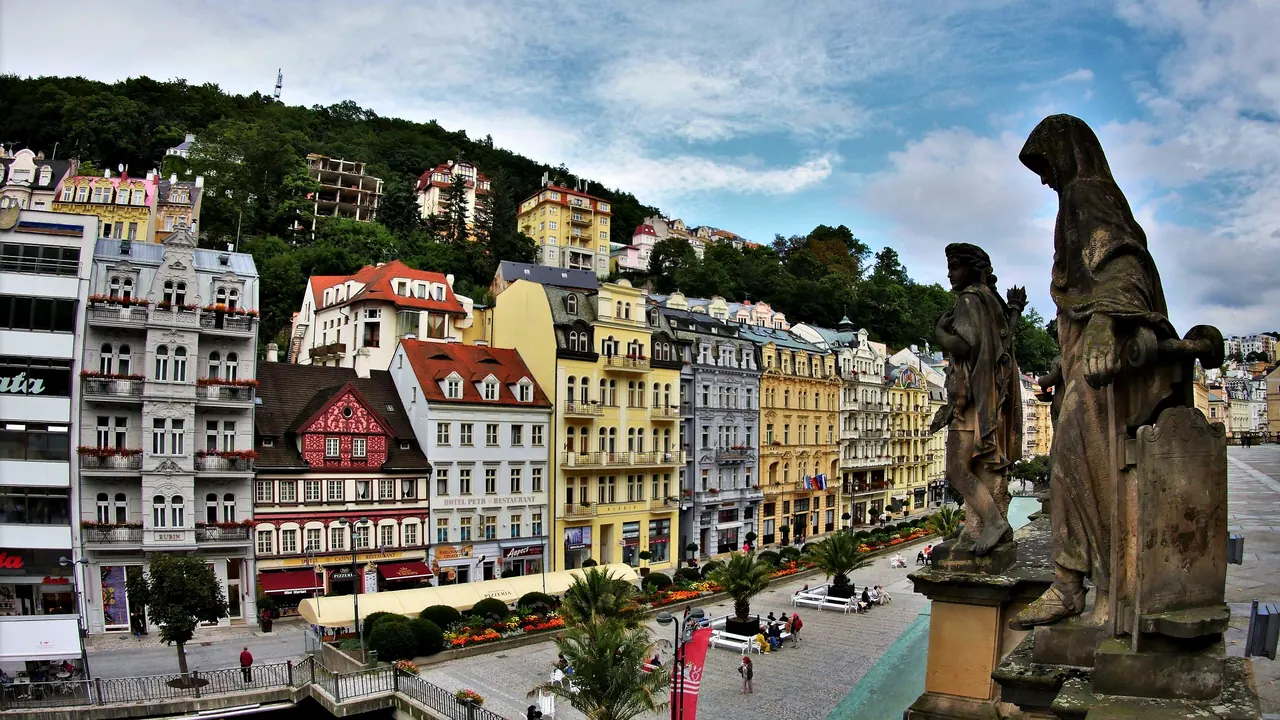
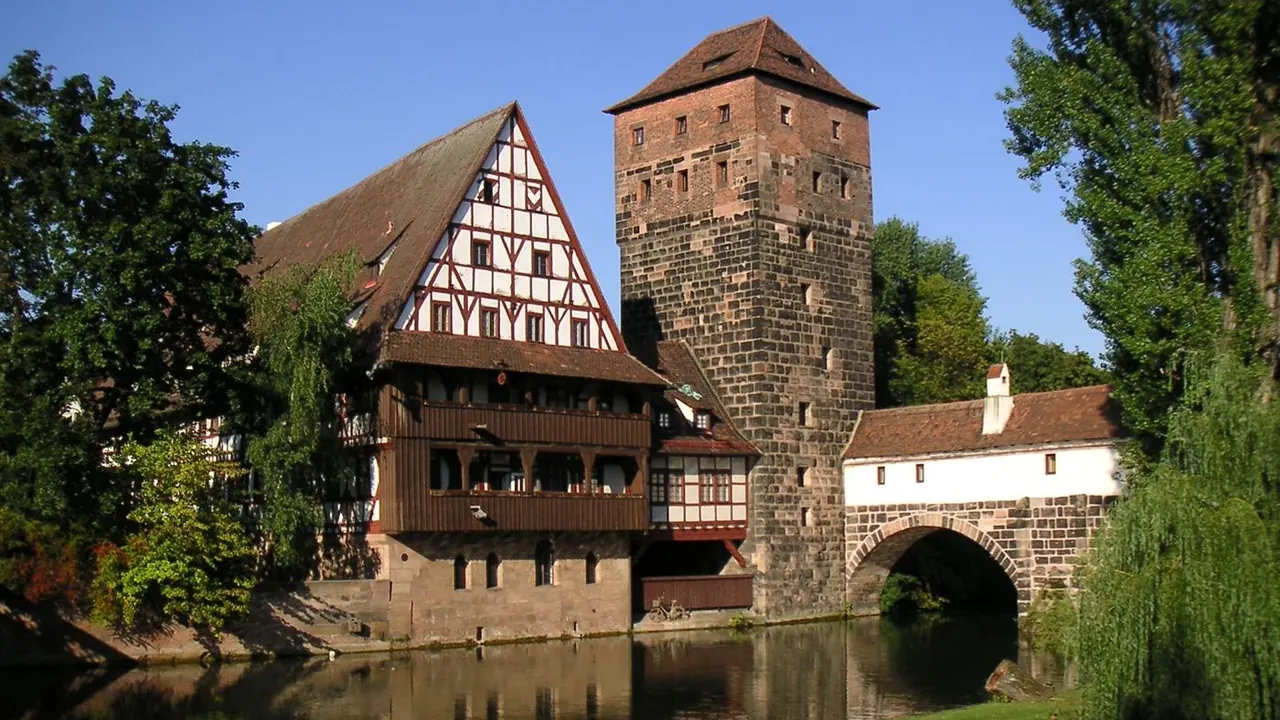
Photos: Karlovy Vary by Rolf Dietrich Brecher from Germany, CC BY-SA 2.0, cropped; Nuremberg by Horst Gutmann, CC BY 2.0, cropped.
Karlovy Vary or Nuremberg?
Our verdict in twelve categories, each scored against the same fixed benchmark cities, and the climate month by month, so you can choose for your trip.
Choose Karlovy Vary for
- wellness
- prices
- nature and the outdoors
Karlovy Vary suits the traveller who wants to slow down. It is a spa town in the old sense: you drink from the springs as you walk the colonnades, spend afternoons in a café by the Teplá and book a stay with baths and massages. It is also the cheaper of the two once you eat a street back from the promenade. It suits couples and older travellers who want a calm, handsome town and forest paths on the doorstep, not a full itinerary.
Choose Nuremberg for
- families
- nightlife
- food and drink
Travellers who want more to do each day should pick Nuremberg. Its walled old town, imperial castle and major national museum give it more depth, and the Rally Grounds and Courtroom 600 add a sobering chapter of modern history. Beer taverns, a real bar district and a choice of first-rate towns by train make it the stronger base for families, food lovers and anyone planning a busy week.
Scoreboard
Twelve categories on one fixed scale from 0 to 100. The shaded stretch is the gap between the two.
Your match
Pick a travel style or drag the sliders, and both match scores follow your weighting.
Wins on wellness and prices with your weighting.
Wins on families and nightlife with your weighting.
What matters to you?
Category by category
What the scores mean for a trip.
Beaches & swimming
Neither city is a place to swim, and there is little between them. The difference is the kind of water. In Karlovy Vary, the best swim is in the warm spring-fed pools, including the outdoor thermal pool on the hillside, and Lake Medard, a flooded mine near Sokolov, is the summer lake. Nuremberg's lakes are a chain of reservoirs an hour to the south, with grassy shores and small sandy strips around the Brombachsee, which makes them a better full day out.
Food & drink
Both kitchens serve hearty pork and dumplings with lager, but Nuremberg gives you more to eat your way through. Its small bratwurst grilled over beechwood, Schäufele on a Sunday and centuries-old Lebkuchen come on top of one of Europe's densest brewing regions. Moving from tavern to tavern and drinking Kellerbier in a riverside beer garden is a reason to go in itself.
Karlovy Vary's food is narrower: svíčková and goulash, warm spa wafers from the colonnade stalls and Becherovka, which is distilled in the town. Its best moment is the afternoon coffee and cake by the Teplá, not dinner, and the restaurants on the promenade cater to hotel guests.
Culture & sights
Nuremberg has more depth. Inside its walls are the Kaiserburg, the Gothic churches of St Sebaldus and St Lorenz and Dürer's house, and the Germanisches Nationalmuseum alone can take a day. The Rally Grounds and Courtroom 600 add a twentieth-century chapter that Karlovy Vary has nothing to match.
In Karlovy Vary, the town itself is the sight, not a list of places to visit. Pastel Belle Époque hotels rise up the valley sides around the UNESCO-listed spa quarter, its colonnades and the Vřídlo geyser. The museums are small and specialised, so a day or two is enough.
Nightlife
Nuremberg is the clear choice for an evening out, though even there it means bars, not clubs. The small bars and alternative venues of Gostenhof, west of the walls, and the students on the squares and riverbanks in summer keep weekends lively.
Karlovy Vary goes to bed early, and its evenings come down to hotel bars, casinos and a few pubs. The one exception is the film festival week in early summer, when parties and outdoor bars fill the valley.
Nature & outdoors
Both offer gentle green country, not drama, and the difference lies in how close it is. In Karlovy Vary, the forest starts at the hotel door. Graded spa paths climb to the Diana tower and the stag-leap rock, the Ohře is good for easy canoeing, and the Ore Mountains around Klínovec add skiing in winter.
Nuremberg's best scenery is an hour away in Franconian Switzerland, a region of limestone towers, caves and well-known rock climbing. Closer to town, the Reichswald and the Pegnitz valley are good for walking and cycling.
Day trips
Nuremberg is the better base by some way. Regional trains put Bamberg, Regensburg and Würzburg within about an hour, with Rothenburg ob der Tauber a little further and Munich reachable by fast train. You could fill a week without repeating yourself.
Karlovy Vary's outings are smaller and closer. Loket's castle sits in a loop of the river, Mariánské Lázně and Františkovy Lázně are its sister spa towns, and Bečov keeps the St Maurus reliquary. Prague is possible, but it is a long day by coach.
Good for families
Nuremberg is much easier with children. Its toy-making past gives it the Toy Museum and the railway museum with full-size locomotives. The zoo is spread through old wooded quarries and has a dolphin house, and in Advent there is a separate children's Christmas market with carousels.
Karlovy Vary manages a couple of good days. Children like the geyser, sipping spring water from spouted cups, the funicular to the Diana lookout and the outdoor thermal pool. After that it is a town for adults taking cures, and the steep valley sides are hard work with a pushchair.
Getting around
Both have a centre you can walk, but Nuremberg's is compact and backed by a proper network. The walled old town is about 1.5km across. U-Bahn, tram and S-Bahn lines on one ticket reach the zoo, the Rally Grounds and Fürth, and regional trains serve every day trip.
Karlovy Vary is a long, narrow strip along the Teplá. It is easy along the valley floor but steep up the sides, so you rely on local buses and the funicular. Its regional trains are slow, and a car helps for the forests and villages.
Shopping & style
Neither city is a shopping destination, and what you take home differs. Karlovy Vary sells to well-off spa guests, with jewellers and fur boutiques along the promenades. Its local buys are Moser crystal from the firm's own showroom, local porcelain and Bohemian garnets.
Nuremberg's buys are simpler and more seasonal: Lebkuchen in decorated tins, wooden toys and crafts from the Handwerkerhof. In Advent, the Christkindlesmarkt on the Hauptmarkt is when its shopping comes into its own.
Affordability
Karlovy Vary is easier on the budget, as long as you step one street back from the colonnades into the pubs and canteens that charge local prices. Buses, the funicular and the springs themselves cost little or nothing.
Nuremberg is mid-priced for Western Europe, with cheap beer and transport. Its hotel rooms get scarce and expensive during trade fairs and the Advent season, in the same way that Karlovy Vary's do in film festival week.
Live music & performing arts
In Karlovy Vary, music is part of the spa routine, not a reason to book. The orchestra still plays the light classics its spa-band ancestors played to bathers. The Fellner and Helmer theatre relies on touring companies for its operetta and drama, and the autumn Dvořák festival is a modest affair next to the town's film festival.
Nuremberg has its own opera and ballet company, so during the season you can usually see a full production by the house company rather than one passing through. Its summer is bigger too. The free Bardentreffen fills the old town's squares with folk and world music, the orchestras play a large open-air evening in the Luitpoldhain, and a rock festival takes over the grounds around the Zeppelinfeld.
Wellness & relaxation
Taking the waters is the reason Karlovy Vary exists, and Nuremberg cannot compete. Thirteen springs feed the colonnades, and the spa hotels and sanatoria offer medical stays with carbonated baths and peat wraps. The whole day moves at the slow pace of a drinking cure.
Nuremberg relaxes the German way. There are sauna gardens at the thermal spa in Fürth, nude mixed saunas at the leisure pools, and saline pools at Bad Windsheim an hour to the west. These make a pleasant afternoon, but not a reason to plan a trip.
When should you go?
Pick your month. The climate figures are measured averages, not a forecast.
Karlovy Vary in July
Nuremberg in July
Daytime high, °C
Rainfall in the month, mm
Where the figures come from
Karlovy Vary's station stands 156 m above the city centre, so the centre is likely a little warmer than the figures say.
Karlovy Vary has no rain gauge within 25 km of the centre, so its rainfall comes from a gridded climate dataset read at the city rather than from a gauge further away.
Karlovy Vary's sunshine is measured 37 km from the centre, at Cheb.
Temperature and rainfall are climate normals, averaged over the years shown. Karlovy Vary: 1999-2020 (sunshine 1981-2010, rainfall 1991-2020) normals, Karlovy Vary (4.6 km from centre). Nuremberg: 1991-2020 normals, Nuernberg (5.5 km from centre).
The two places share the same central European pattern: cold, grey winters and a warm, changeable summer, with the most rain falling from June to August. Nuremberg is a little warmer and clearly sunnier all year. Its July and August highs reach about 25°C, against 22°C in Karlovy Vary. That makes it the better summer for beer gardens and a swim in the Franconian lakes. July is Karlovy Vary's wettest month at 95mm, so expect showers on a high-summer spa stay.
May, June and September are the best months for walking in both places. They are mild enough for the forest paths above the Teplá and the cobbled climb to the Kaiserburg. From November to February, Karlovy Vary hovers just above freezing and has very little sunshine. Nuremberg is only slightly milder, at around 4°C in January, and it has the Advent market season to brighten its darkest weeks.
Which traveller are you?
For a relaxing and wellness trip, Karlovy Vary is the obvious choice. A booked spa stay brings warm spring-water pools, baths, massages and doctors' consultations. The days settle into slow walks between springs, coffee and cake, and forest paths. Nuremberg has saunas but no cure.
On a family trip with children, Nuremberg is far the better base. The toy and railway museums, a large zoo with a dolphin house and an easy U-Bahn make full days simple. In Karlovy Vary, the attractions for children run out after a day or two.
For a food and nightlife trip, Nuremberg is ahead on both. Franconian breweries, bratwurst taverns and beer gardens on the Pegnitz lead into evenings in the small bars of Gostenhof. Karlovy Vary eats early and is largely asleep by eleven.
Before you go
| Measure | Karlovy Vary | Nuremberg |
|---|---|---|
| Official language | Czech | German |
| Currency | Czech Koruna (CZK) | Euro (EUR) |
| Sockets | CE230 V, 50 Hz | CF230 V, 50 Hz |
| Driving side | Right | Right |
| Time zone | UTC+1, UTC+2 in summer | UTC+1, UTC+2 in summer |
| Emergency number | 112 | 112 |
| Elevation | 447 m | 209 m |
| Main airport | Václav Havel Airport Prague (PRG)100 km from centre178 non-stop destinations | Nuremberg Airport (NUE)5 km from centre56 non-stop destinations |
| Public holidays this year | 13 days | 12 days |
By the numbers
| Measure | Karlovy Vary | Nuremberg |
|---|---|---|
| City population | 49,073 | 531,159 |
| People per km² | 830 | 2,848 |
| Museums within 10 km | 2 | 50 |
| UNESCO World Heritage sites within 50 km | 3 | 1 |
Where else could you go?
Every comparison below shares a destination with this one, so you can follow Karlovy Vary or Nuremberg somewhere new.
- Dresdenvs Karlovy Vary
- Praguevs Karlovy Vary
- Leipzigvs Karlovy Vary
- Munichvs Nuremberg
- Stuttgartvs Nuremberg
- Heidelbergvs Nuremberg