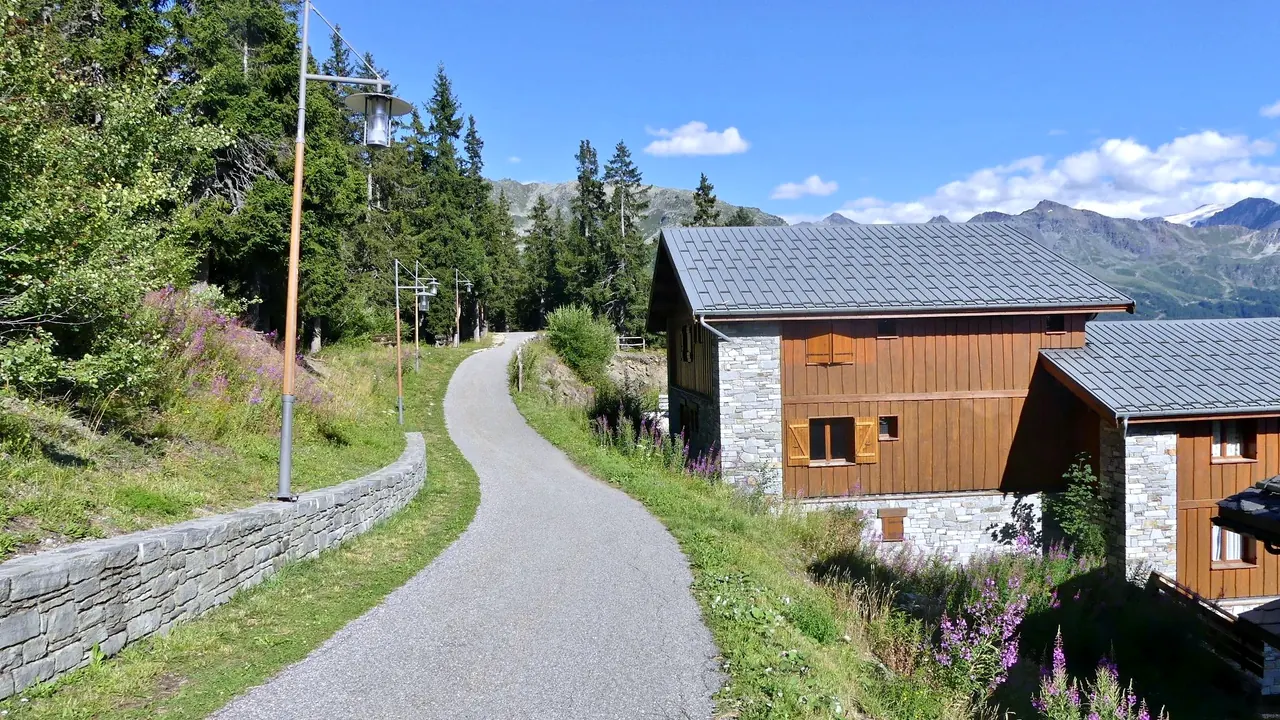
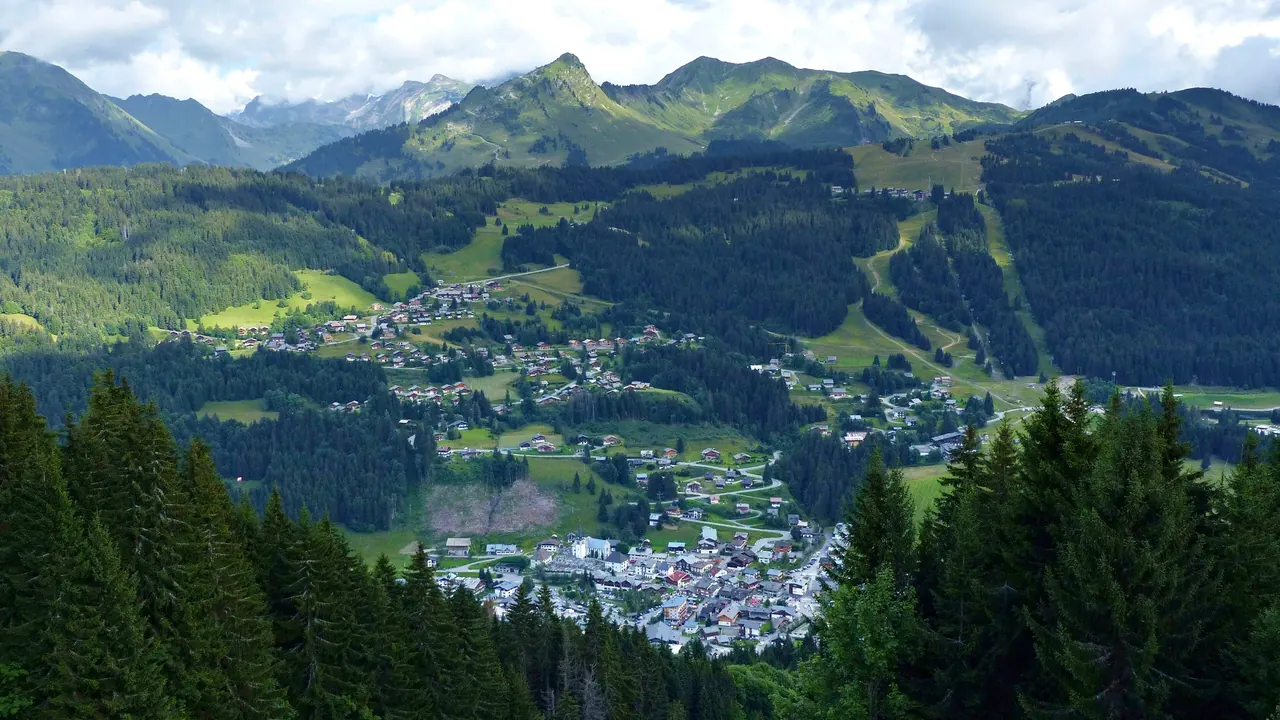
Photos: La Rosière by Florian Pépellin, CC BY-SA 4.0, cropped; Les Gets by Jjt.pub, CC BY 3.0, cropped.
La Rosière or Les Gets?
Our verdict in twelve categories, each scored against the same fixed benchmark cities, and the climate month by month, so you can choose for your trip.
Choose La Rosière for
- prices
- wellness
La Rosière is the better pick for skiers who care most about the mountain itself. It sits high on a sunny balcony above the Tarentaise, the ski area runs over the frontier into Italy for pasta lunches and off-piste from La Thuile, and the village stays small and quiet after dark. It also costs a little less, and in summer the Little St Bernard Pass opens the way to Aosta and Courmayeur.
Choose Les Gets for
- day trips
- beaches
- families
Families wanting more to fill the days should look to Les Gets, and so should anyone who wants to see more of the region. The children's ski schools, the swimming lake, the luge and the mechanical music museum give it more beyond the pistes. Its summer bike park is one of the best known in Europe, and Geneva, Annecy, Chamonix and Lake Geneva are all within a day's drive. Evenings are livelier too, with Morzine next door.
Scoreboard
Twelve categories on one fixed scale from 0 to 100. The shaded stretch is the gap between the two.
Your match
Pick a travel style or drag the sliders, and both match scores follow your weighting.
Wins on prices and wellness with your weighting.
Wins on day trips and beaches with your weighting.
What matters to you?
Category by category
What the scores mean for a trip.
Beaches & swimming
Neither is a swimming destination, but Les Gets at least gives you somewhere to get wet in summer. The Lac des Écoles above the village has a supervised shallow area, a lawn and water that warms up nicely by July, and the shores of Lake Geneva are about an hour away.
In La Rosière, swimming means the hotel pool or a cold plunge in an Alpine lake further down the valley.
Food & drink
Both serve the same hearty Savoyard repertoire of fondue, raclette and tartiflette, and in both the choice runs thin after a few nights. What differs is the escape route. In La Rosière the best variety comes from skiing over to Italy for pasta, polenta and espresso at lunch, with Beaufort cheese as the local pride.
Les Gets keeps its variety in the village, with crêperies, pizzerias and a few more ambitious dining rooms, plus Reblochon and Abondance from the surrounding valleys. Out of season, though, much of it shuts.
Culture & sights
La Rosière's sights lie outside the resort, which is a modern station of wood and stone chalets with little past of its own. The interest is in the baroque churches of the Tarentaise villages below and, in summer, in the Iron Age stone circle and old hospice up on the Little St Bernard Pass.
Les Gets keeps its one real attraction in the village itself. At the Musée de la Musique Mécanique, music boxes, barrel organs and automata are played on guided tours. Beyond that there is a traditional church and some old farmhouses with wooden balconies, so for museums or historic towns you still drive down into the valleys.
Nightlife
Les Gets has more going on after the lifts close. Slope-side terraces fill for après-ski, a few village bars have DJs, and Morzine next door is there for a bigger night.
La Rosière winds down earlier. A handful of bars catch the après crowd, and most guests are back in their chalets after dinner. Between seasons, both go almost silent.
Nature & outdoors
These are equally strong mountain bases, but they offer different mountains. La Rosière is high and sunny at about 1,850m, facing the Vanoise glaciers, and its ski area crosses the Little St Bernard Pass into Italy, with serious off-piste, ski touring and heli-skiing from La Thuile. In summer, ibex, marmots and high pastures take over.
Les Gets belongs to the vast Portes du Soleil, which reaches into Switzerland. Its skiing is lower and tree-lined, which helps on grey days, and its summer bike park makes it a magnet for mountain bikers.
Day trips
Les Gets is far better placed for outings. Geneva, Annecy and Chamonix are each about an hour or a little more by car, and the southern shore of Lake Geneva adds Évian, walled Yvoire and ferries to Lausanne.
La Rosière's best excursion depends on the season. When the pass is open in summer, Aosta's Roman remains and Courmayeur are close, but in winter the road shuts and the towns are around two hours away.
Good for families
Both resorts are built around families, but Les Gets gives children more to do away from the snow. Summer brings the swimming lake and playground, easy bike trails, a luge, rope parks and a little tourist train, and the music museum is a good rainy-day standby.
La Rosière's strengths are on the slopes: sunny nursery areas, central ski schools, ski-in, ski-out lodging and a village small enough for older children to roam. Off the snow it has little more than the pool.
Getting around
Getting about is similar in both, with lifts and free shuttles doing most of the work and a car needed for anything further afield. The difference is in the layout and the arrival. La Rosière is spread along a hillside road in several quarters, with uphill walks between them, but trains reach Bourg-Saint-Maurice half an hour below.
Les Gets has a compact, walkable centre but no railway, so most visitors come by transfer from Geneva airport, sometimes on roads that need snow chains.
Shopping & style
Les Gets offers a little more. Alongside the rental shops there are sports boutiques, delicatessens selling Reblochon and génépi, and a weekly market with crafts, and Geneva and Annecy are within reach for real shopping.
La Rosière stops at ski hire, small supermarkets and a couple of cheese and souvenir shops, so for anything more you have to drive down to Bourg-Saint-Maurice.
Affordability
Both are costly in winter, but La Rosière is a little easier on the wallet. It is noticeably cheaper than the glamorous Tarentaise resorts around it, and in summer hotels and lifts are priced for walkers.
In Les Gets, catered chalets and mountain-terrace lunches push costs up further. Summer brings relief there too, and a bike-park pass or a lake day costs far less than a ski week.
Live music & performing arts
There is no theatre or concert life in either, though Les Gets has a little more. It hosts outdoor concerts on the slopes during the Portes du Soleil's end-of-season festival, summer street entertainment and demonstrations of the old instruments at the museum. In La Rosière, the most you will find is the odd band in a bar.
Wellness & relaxation
Pré-Saint-Didier's historic thermal baths, just below La Thuile on the Italian side, give La Rosière the better bathing outing, though only in summer when the pass is open. In the resort itself, unwinding means the pools, saunas and small spas of the hotels and apartment residences, and quiet evenings among the larches.
In Les Gets, more of the unwinding happens at the chalet, with hot tubs on balconies and massages booked in the village, and long lunches on mountain terraces slow the days down. Évian, about an hour down the valley, is the nearest place to take the waters.
When should you go?
Pick your month. The climate figures are measured averages, not a forecast.
La Rosière in July
Les Gets in July
Daytime high, °C
Rainfall in the month, mm
Where the figures come from
La Rosière has no weather station within reach, so its figures come from a gridded climate model rather than a measured record, and read a broad area rather than one spot.
Les Gets's temperatures are measured 61 km from the centre, at Bourg-St-Maurice.
Les Gets has no rain gauge within 25 km of the centre, so its rainfall comes from a gridded climate dataset read at the destination rather than from a gauge further away.
Temperature and rainfall are climate normals, averaged over the years shown. La Rosière: 2001-2020 normals, NASA POWER reanalysis grid, no weather station within 90 km. Les Gets: 1999-2020 (rainfall 1991-2020) normals, Bourg-St-Maurice (60.8 km from centre).
La Rosière has a proper high-mountain climate. Daytime highs stay below freezing from December to March, around -4°C in January, which suits snow but makes strolling round the village a bundled-up affair. Summer is short and mild, peaking near 18°C in July, so June to September is the window for hiking, biking and crossing the pass into Italy. Rain is moderate all year, heaviest in May at about 103mm.
The figures for Les Gets are much milder through the year, with July highs around 27°C. That is warm enough to make the summer lake genuinely inviting, and walking and biking are comfortable from May to September. It is also clearly the wetter of the two in every month, with December the dampest at about 160mm. Choose La Rosière for colder, drier winter days and Les Gets for longer, warmer summers.
Which traveller are you?
On a family trip with young children, Les Gets is the stronger choice. Its ski schools and beginner slopes are close to the village, and summer brings a supervised lake, a luge, rope parks and pony rides. La Rosière offers sledging and snow play but little else.
For a trip on a tight budget, La Rosière stretches the money a little further. Both are expensive ski resorts in winter, but La Rosière is the cheaper of the two, and its self-catering chalets and much cheaper summer season help keep costs down.
For skiers chasing off-piste and heli-skiing, La Rosière has the edge. Its lift link over the frontier to La Thuile opens up big freeride terrain and heli-drops on the Italian side, while Les Gets is mostly tree-lined, mid-altitude cruising.
Before you go
| Measure | La Rosière | Les Gets |
|---|---|---|
| Official language | French | French |
| Currency | Euro (EUR) | Euro (EUR) |
| Sockets | CE230 V, 50 Hz | CE230 V, 50 Hz |
| Driving side | Right | Right |
| Time zone | UTC+1, UTC+2 in summer | UTC+1, UTC+2 in summer |
| Emergency number | 112 | 112 |
| Elevation | 1,844 m | 900 m |
| Main airport | Geneva International Airport (GVA)89 km from centre150 non-stop destinations | Geneva International Airport (GVA)44 km from centre150 non-stop destinations |
| Public holidays this year | 11 days | 11 days |
By the numbers
| Measure | La Rosière | Les Gets |
|---|---|---|
| Population | - | 1,227 |
| People per km² | - | 41 |
| Museums within 10 km | 0 | 1 |
| UNESCO World Heritage sites within 50 km | 0 | 3 |
Where else could you go?
Every comparison below shares a destination with this one, so you can follow La Rosière or Les Gets somewhere new.
- Morzinevs Les Gets
- Les Arcsvs La Rosière
- Avoriazvs Les Gets
- Samoënsvs Les Gets
- Flainevs Les Gets
- Châtelvs Les Gets