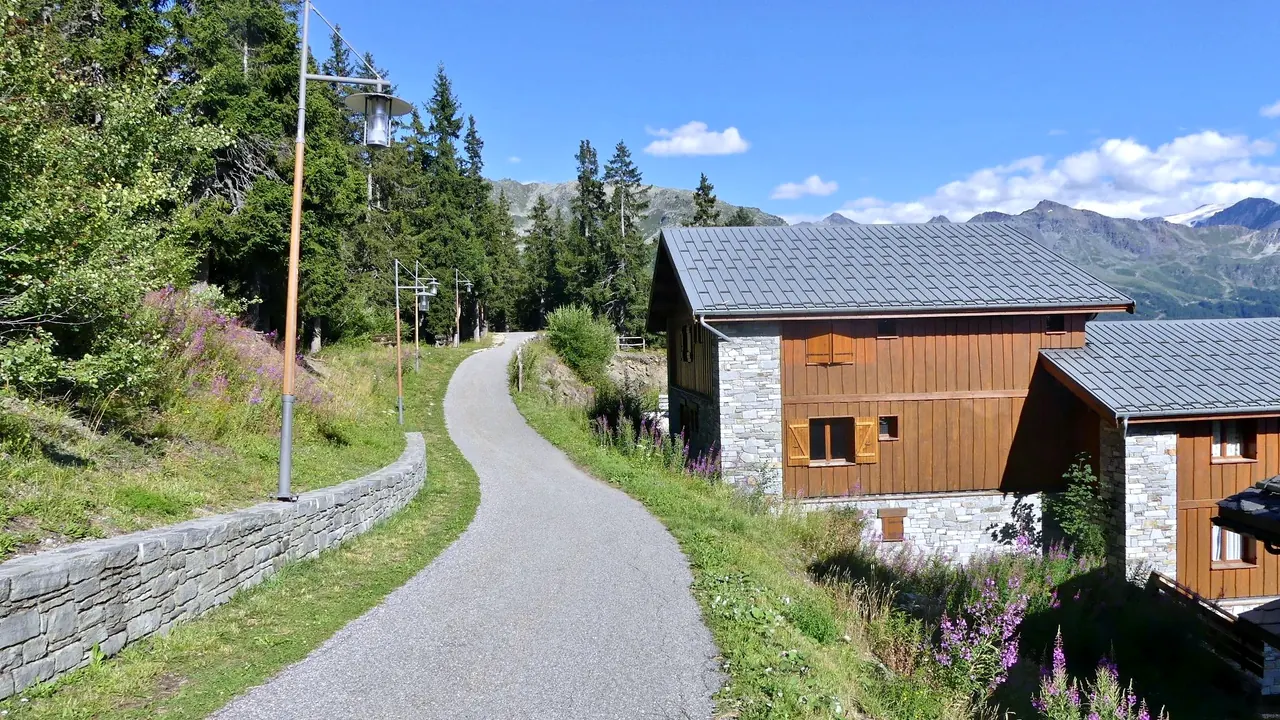
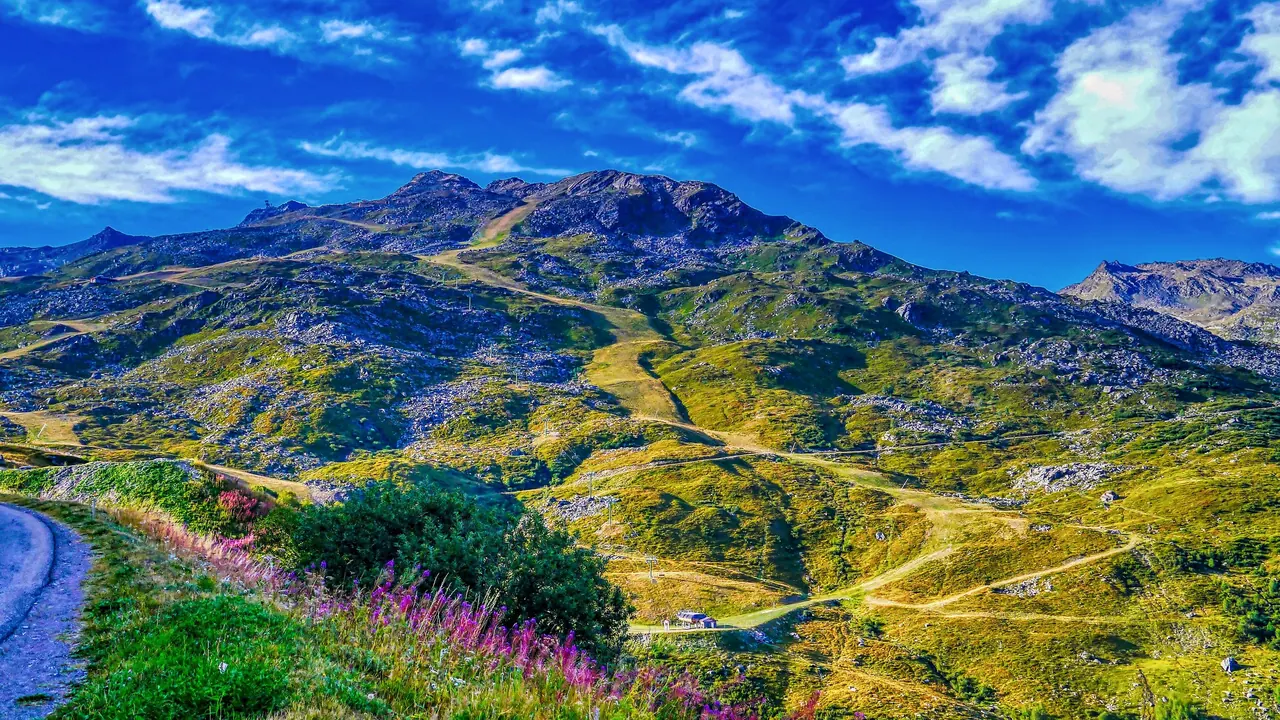
Photos: La Rosière by Florian Pépellin, CC BY-SA 4.0, cropped; Val Thorens by Zairon, CC BY-SA 4.0, cropped.
La Rosière or Val Thorens?
Our verdict in twelve categories, each scored against the same fixed benchmark cities, and the climate month by month, so you can choose for your trip.
Choose La Rosière for
- day trips
- prices
- families
La Rosière suits families and couples who want a sunny, quiet resort with a gentler pace. Its south-facing slopes, central nursery areas and early evenings make ski weeks with children easy. The link over the pass to La Thuile adds Italian lunches and a second country to the trip. It also costs less, and in summer it makes a good base for walking, with the Aosta valley close enough for a day out.
Choose Val Thorens for
- nightlife
- getting around
- food and drink
Val Thorens is the pick for groups of friends who want serious skiing and a proper party afterwards. From the highest resort in Europe you can ski across the whole Three Valleys, and the snow is reliable from late autumn into spring. Après-ski starts on the mountain terraces and runs on into clubs late at night. The car-free village is easy to get around, and the dining runs further up the scale, but you pay for all of it and the mood is loud rather than restful.
Scoreboard
Twelve categories on one fixed scale from 0 to 100. The shaded stretch is the gap between the two.
Your match
Pick a travel style or drag the sliders, and both match scores follow your weighting.
Wins on day trips and prices with your weighting.
Wins on nightlife and getting around with your weighting.
What matters to you?
Category by category
What the scores mean for a trip.
Beaches & swimming
Swimming is not a reason to visit either resort. At La Rosière the only open-air water is a cold Alpine lake further down the valley, good for a brave dip on a warm summer day and little more. The lakes around Val Thorens are close by, but they are fed by glaciers and stay far too cold to swim in, even in high summer.
In practice, both resorts rely on pools. At La Rosière that means a hotel or chalet pool. Val Thorens has hotel pools too, plus a public indoor pool at the sports centre.
Food & drink
Both resorts serve the same Savoyard staples of fondue, raclette, tartiflette and Beaufort, but Val Thorens offers more choice. Long lunches on sunny terraces in the huts on the slopes are part of the ski day there, and a handful of gastronomic kitchens in the upmarket hotels give you somewhere special for one evening.
La Rosière's menus repeat sooner. Its main advantage is the border: you can ski over to the Italian side for pasta, polenta and espresso at lunch. For anything more ordinary, you have to go down to Bourg-Saint-Maurice.
Culture & sights
Neither resort has much to see beyond the mountains. La Rosière has a little more nearby: the baroque churches of the Tarentaise villages, and in summer the Iron Age stone circle and old hospice on the Little St Bernard Pass. Val Thorens was built on a bare slope in the 1970s, so its nearest heritage is down in the valley, such as the medieval quarter of Conflans.
Nightlife
Evenings at La Rosière are short and low-key. A few bars fill up for an hour or so as the lifts close, and one or two stay open later in the busiest weeks. The resort is set up for families rather than for nights out, so anyone after real après is better off in one of the livelier Tarentaise resorts.
Val Thorens is the clear choice for going out, and its nights run into the small hours. The crowd is young, mostly students and groups of friends, so the mood is loud and sociable. It is still one small village, though, and by the end of a week the same few venues start to feel familiar. Out of the winter season most of it closes, so summer evenings there are as quiet as anywhere in the mountains.
Nature & outdoors
Both are first-rate mountain bases, but the landscapes are very different. La Rosière sits on a sunny balcony with larch forest and wide tree-lined runs lower down, looking across to the Vanoise glaciers. It links over the pass to La Thuile in Italy for long runs on both sides of the border and heli-skiing. In summer it becomes green pasture with wildflowers and paragliding.
Val Thorens is higher and harsher: rock, snowfields and glacier above the treeline, with lifts reaching past 3,200m. Its pull is the size of the Three Valleys network, which runs across to Méribel and Courchevel, and snow that holds into May. Its summer walking is shorter and more alpine.
Day trips
La Rosière has the better day out, though mainly in summer. Once the pass opens, Aosta's Roman walls, theatre and arch, the castles along the valley and Courmayeur are all within easy reach, and the Beaufortain cheese villages lie on the French side.
From Val Thorens, most outings are really ski days to Méribel or Courchevel. Off the slopes, Moûtiers and Conflans are modest. In winter both resorts are about two hours from Annecy and Chambéry, so neither makes a good base for towns at that time of year.
Good for families
La Rosière was largely built with families in mind. Its slopes face the sun, the children's ski schools and nursery areas are in the centre, and the village is calm enough for older children to roam. Afternoons can be filled with sledging and dog-sled rides.
Val Thorens works for families who ski, thanks to its car-free centre, children's clubs, long toboggan run and sports centre pool. However, the cold, the wind and lift closures at that height can be hard on small children, and the young party crowd sets the tone. Neither resort has much to offer on a wet day.
Getting around
Val Thorens is easier to get around once you arrive. It is one compact, largely car-free village, with free shuttle loops, and its lifts reach the whole Three Valleys. La Rosière is spread across several quarters along a hillside road. A free shuttle and the pistes connect them, but walking between them means uphill stretches that can be icy.
Getting there is the other way round. La Rosière is about half an hour by road from the station at Bourg-Saint-Maurice, while Val Thorens is roughly an hour of hairpin bends up from Moûtiers. Beyond the slopes, both are much easier with a car.
Shopping & style
Both resorts offer only practical shopping: ski hire, outdoor gear, small supermarkets and local cheese and charcuterie. Val Thorens has a little more resort clothing and delicatessen stock, at high-altitude prices. From La Rosière, the shops of Bourg-Saint-Maurice are a short drive down the valley.
Affordability
Neither resort is cheap in winter, but La Rosière costs noticeably less. Its self-catering chalets and apartments keep a family week within reach, and in summer prices drop sharply as lifts and hotels cater for walkers.
At Val Thorens, lift passes, hire, ski school and lunches on the slopes all carry high-altitude prices, and school vacation weeks cost the most. Groups who share an apartment and cook for themselves can cut the cost, but it is never a cheap week.
Live music & performing arts
Neither resort has a theatre or concert hall. The difference is in the bars. At Val Thorens, live music means DJs and cover bands at après-ski, plus the odd event on the slopes during the season. La Rosière has a few seasonal resort events and the occasional live set in a bar.
Wellness & relaxation
The two are level on facilities: both rely on hotel and residence pools, saunas and spas. Val Thorens also has the public spa at its sports centre. The difference is in atmosphere. La Rosière is quiet in itself, with chalets among the larches and early nights, while Val Thorens revolves around hard skiing and loud evenings.
Each has a real thermal spa within reach. From La Rosière, Pré-Saint-Didier in Italy is an easy summer trip over the pass. From Val Thorens, the old spa town of Brides-les-Bains is about an hour down the valley.
When should you go?
Pick your month. The climate figures are measured averages, not a forecast.
La Rosière in July
Val Thorens in July
Daytime high, °C
Rainfall in the month, mm
Where the figures come from
La Rosière has no weather station within reach, so its figures come from a gridded climate model rather than a measured record, and read a broad area rather than one spot.
Val Thorens has no weather station within reach, so its figures come from a gridded climate model rather than a measured record, and read a broad area rather than one spot.
Temperature and rainfall are climate normals, averaged over the years shown. La Rosière: 2001-2020 normals, NASA POWER reanalysis grid, no weather station within 90 km. Val Thorens: 1991-2020 normals, TerraClimate 4 km grid at the town, no weather station within 90 km.
Both resorts stay below freezing through the heart of winter, and both are at their best for skiing from December to March. Val Thorens is higher, so its snow lasts longer into spring. Its weather is also much stormier: precipitation peaks at around 180mm in November, about twice what La Rosière gets that month (88mm), so heavy snowfalls and closed lifts are more likely.
In summer La Rosière is the warmer and greener of the two, reaching about 18°C in July. That is pleasant hiking weather on the high pastures, though May is its wettest month. Val Thorens peaks at about 15°C even in high summer and can turn cold on any day, so its short summer is for well-prepared walkers rather than anyone hoping for warmth. Neither resort gets hot enough for beach-style weather in any month.
Which traveller are you?
On a family trip with young children, La Rosière is the easier choice. Its nursery slopes and ski schools are in the centre, many chalets are ski-in, ski-out, and the village is quiet. At Val Thorens the high altitude, cold winds and party crowd are harder on small children.
For a food and nightlife trip, Val Thorens wins clearly. Dancing at the terrace bars as the lifts close leads on to pubs and late clubs, and a few ambitious hotel kitchens raise the dining. La Rosière's bars are quiet by comparison and empty soon after dinner.
On a tight budget, La Rosière stretches the money further. It costs noticeably less than the big-name resorts, self-catering chalets are easy to find, and summer is far cheaper. Val Thorens is never a budget week, even for groups who share an apartment.
Before you go
| Measure | La Rosière | Val Thorens |
|---|---|---|
| Official language | French | French |
| Currency | Euro (EUR) | Euro (EUR) |
| Sockets | CE230 V, 50 Hz | CE230 V, 50 Hz |
| Driving side | Right | Right |
| Time zone | UTC+1, UTC+2 in summer | UTC+1, UTC+2 in summer |
| Emergency number | 112 | 112 |
| Elevation | 1,844 m | 1,710 m |
| Main airport | Geneva International Airport (GVA)89 km from centre150 non-stop destinations | Geneva International Airport (GVA)111 km from centre150 non-stop destinations |
| Public holidays this year | 11 days | 11 days |
By the numbers
| Measure | La Rosière | Val Thorens |
|---|---|---|
| Museums within 10 km | 0 | 0 |
| UNESCO World Heritage sites within 50 km | 0 | 1 |
Where else could you go?
Every comparison below shares a destination with this one, so you can follow La Rosière or Val Thorens somewhere new.
- Les Menuiresvs Val Thorens
- Les Arcsvs La Rosière
- Méribelvs Val Thorens
- Courchevelvs Val Thorens
- Tignesvs La Rosière
- La Plagnevs La Rosière