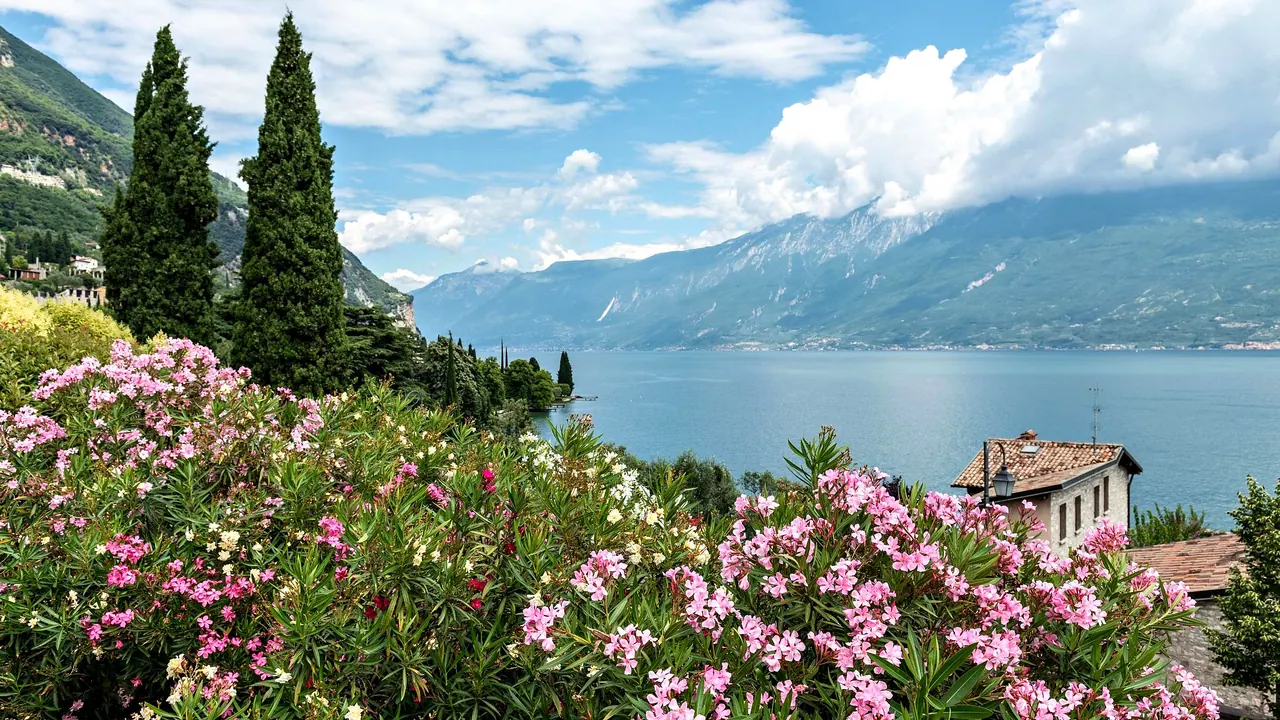
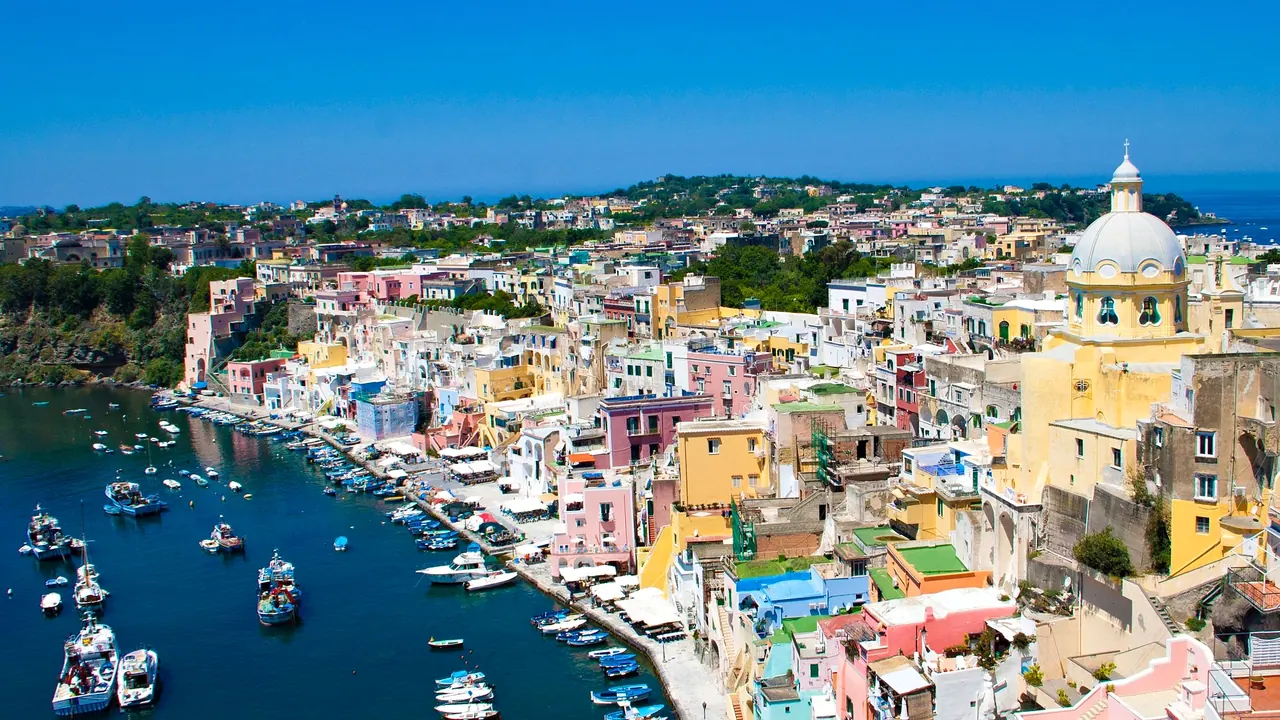
Photos: Lake Garda by Wolfgang Weiser, Pexels License; Procida by DIANA.GRYGAROVA, CC BY-SA 4.0, cropped.
Lake Garda or Procida?
Our verdict in twelve categories, each scored against the same fixed benchmark cities, and the climate month by month, so you can choose for your trip.
Choose Lake Garda for
- nature and the outdoors
- families
- live music and the arts
Lake Garda suits travellers who want plenty to do and room to move. The north shore around Riva, Torbole and Arco is one of Europe's great bases for climbing, biking and wind sports, the south-east shore is built for family vacations around Gardaland and the big campsites, and the railway at Peschiera and Desenzano puts Verona and Venice within easy reach. Add the Bardolino and Lugana wines and Sirmione's thermal springs, and it carries a long, varied stay far better.
Choose Procida for
- getting around
- beaches
- prices
Procida is for a slower, smaller trip by the sea. It is an island you can cross in minutes without a car, with dark-sand coves, the pastel harbour at Corricella and warm Mediterranean water, and very little to organise beyond lunch and a swim. Its real reach lies across the water: Ischia's hot springs, the Roman sites of the Phlegraean Fields and Naples are all a boat ride away, provided you keep an eye on the last ferry back.
Scoreboard
Twelve categories on one fixed scale from 0 to 100. The shaded stretch is the gap between the two.
Your match
Pick a travel style or drag the sliders, and both match scores follow your weighting.
Wins on nature and the outdoors and families with your weighting.
Wins on getting around and beaches with your weighting.
What matters to you?
Category by category
What the scores mean for a trip.
Beaches & swimming
There is little to choose between them for swimming, but the water is a different thing. Garda means lake bathing from pebble shores, jetties and grassy lidos at Sirmione, Lazise, Bardolino and Desenzano, with cooler, windier water up in the narrow north.
Procida gives you the open sea: small coves of dark volcanic sand at Chiaiolella, Ciraccio, Chiaia and Pozzo Vecchio, clear water and a season that runs into October. Its beaches are tiny and fill early in August, where Garda's long lawns leave more room to spread out.
Food & drink
Garda eats and drinks better, mainly because of its wine. Bardolino and Chiaretto on the east shore, Lugana in the south and Amarone in the Valpolicella hills sit beside lake fish, bigoli and the lake's own olive oil, and the agriturismi above Bardolino and the Valtenesi reward anyone who avoids the pizza-heavy harbour fronts.
Procida's table is shorter and simpler: the morning's catch at Corricella and Marina Grande, the island's mint-and-chilli lemon salad and the lemon-filled lingua pastry. It is honest Campanian cooking, but you will have tried most of it within a week, and many kitchens close out of season.
Culture & sights
Neither is a museum destination, but Garda has more to fill its half-days. Sirmione pairs a moated Scaliger castle with the Roman villa ruins of the Grotte di Catullo, d'Annunzio's Vittoriale at Gardone Riviera is one of the oddest estates in Italy, and castles stand over Malcesine, Torri del Benaco, Arco and Riva.
Procida's heritage is concentrated at Terra Murata, where the Abbey of San Michele Arcangelo and the former prison of Palazzo d'Avalos look down on Corricella's stacked pastel houses. It makes a lovely day or two of slow walking, after which the island's sights are done.
Nightlife
Garda offers more of a night out, though only in one corner of the lake. Desenzano on the south shore draws students and a crowd from Brescia and Verona to its lakefront bars, and a few big clubs close by fill up on summer weekends. Riva and Bardolino add a smaller cluster of bars in season, but most other lake towns wind down after dinner and an evening walk.
Procida has nothing to match Desenzano. Its evenings centre on the waterfront bars at Marina Grande and Chiaiolella, which stay busy until about midnight in July and August, and the island has hardly a club to its name. Anyone who wants to dance has to cross to Naples or Ischia and work out the last boat home.
Nature & outdoors
This is where the two are furthest apart. Garda's fjord-like north is a serious outdoor base: the rotating cable car up Monte Baldo from Malcesine, ridge walks and paragliding, Arco's limestone climbing walls, via ferrate on the old military paths and mountain-bike trails in every valley, with Torbole's afternoon wind for windsurfing and kitesurfing.
Procida is a low island of drowned craters and walled lemon gardens, where walks lead to viewpoints such as Terra Murata and the headlands above Pozzo Vecchio. The Vivara reserve, snorkelling and diving off the south coast add interest, but it is a few days' worth of outdoors rather than a reason to come.
Day trips
Both are superb bases, and Garda edges ahead because its outings run on rails. From Peschiera or Desenzano, Verona is well under an hour and Venice about an hour and a half, with Vicenza, Padua, Brescia and Bergamo on the same line and Mantua an hour away by road.
Procida's outings run by boat instead: Ischia is a quarter of an hour away, while Pozzuoli leads on to Baia and Cuma, and Naples, with Herculaneum and Pompeii beyond, can be done in a day. The range of ancient sites is outstanding, but every trip runs to the ferry timetable.
Good for families
Garda's south-east shore is one of Italy's classic family regions, and Procida cannot compete. Gardaland and its aquarium, water parks and the Parco Natura Viva safari park sit near Peschiera, resort campsites have pools and children's clubs, and the north gives older children bikes, climbing and windsurfing.
Procida is calm and safe, with gently shelving sand at Chiaiolella and Ciraccio, but beyond the sea and an ice cream there is nothing aimed at children. Its walled lanes without pavements and the steps down to Corricella and Chiaia make pushchairs hard work.
Getting around
Procida is the easier place to get about, simply because it is so small. Little buses run from Marina Grande to Chiaiolella, three-wheeled taxis fill the gaps, nobody needs a car, and the ferries to Naples, Pozzuoli and Ischia are frequent, though the narrow lanes without pavements make walking less relaxed than the distances suggest.
On Garda each town is walkable, but crossing the lake is slow. The ferries are lovely but unhurried, the railway touches only the south, and the shore roads are narrow, tunnelled in the north and jammed in summer, with parking scarce in the popular towns.
Shopping & style
Neither is a place to come for shopping, but Garda gives you clearly more to buy. On market days the lakefronts of Desenzano, Lazise and Bardolino fill with long rows of stalls selling clothes, leather and household goods. The lake's own produce makes the best souvenirs: oil from the shore's olive groves, bottles of Lugana and Bardolino, lemon goods from Limone, and proper climbing and cycling kit in Riva and Arco.
Procida's shopping fits into a single street, Via Roma by the port at Marina Grande, where ceramics, limoncello, linen and beachwear make for a short browse before the ferry. Garda's market towns can fill a morning. On Procida, anything beyond a souvenir means taking the boat to Naples.
Affordability
Costs come out much the same, and both get cheaper in spring and autumn, but the ways of saving differ. On Garda the money goes on lakefront hotels in Sirmione, Malcesine and Limone, theme park tickets and ferries, and the savings lie in the campsites, camping villages and hill agriturismi away from the water.
Procida has few rooms, mostly guesthouses and rented flats that fill and rise in price in high summer, and harbour seafood is priced for an island. Pastries, pizza and buses are cheap, and a beach day costs little if you lay a towel on the sand rather than hire a sunbed.
Live music & performing arts
Garda has the edge, largely thanks to its neighbour. The summer opera season in Verona's Roman arena is under an hour from the south shore, and the open-air amphitheatre at the Vittoriale stages concerts in season, with band concerts in the town squares.
Procida has no stage of its own. Its one great performance is the Good Friday procession of the Misteri from Terra Murata down to the sea. Naples has opera and concerts, but the last boats make an evening there awkward.
Wellness & relaxation
Garda has the real thermal tradition. Sirmione's warm sulphurous springs feed spa pools that look out over the lake, a historic villa park near Lazise has open-air thermal pools among old trees, and hotel spas line the western Riviera at Gardone and Salò.
Procida's restfulness comes from its pace rather than its facilities: quiet minor lanes, long lunches and evening light on Corricella, with no spa to speak of. For soaking, Ischia's hot springs and thermal gardens are a quarter of an hour away, an easy day out with a boat back by evening.
When should you go?
Pick your month. The climate figures are measured averages, not a forecast.
Lake Garda in July
Procida in July
Daytime high, °C
Rainfall in the month, mm
Where the figures come from
Lake Garda's sunshine is measured 28 km from the centre, at Verona / Villafranca.
Procida's temperatures are measured 32 km from the centre, at Grazzanise.
Temperature and rainfall are climate normals, averaged over the years shown. Lake Garda: 2005-2025 (sunshine 1991-2020, rainfall 1991-2020) normals, Verona / Rivoltella (1.6 km from centre). Procida: 1991-2020 (rainfall 1971-2000) normals, Grazzanise (32.2 km from centre).
Both are summer destinations, but Procida runs hotter and drier at its peak. Around Garda's southern shore, June to September is the swimming season, with July highs near 29°C and long sunny days. Spring and early autumn are the comfortable months for hiking and climbing in the north, November is the wettest month, and winter is cold and grey, with little reason to be outdoors.
Procida's summer is close to rainless, with June the driest month at 25mm, and July and August reach about 31°C, hot for walking the lanes at midday. The sea is warmest in August at around 26°C and stays swimmable into October, though autumn then brings heavy rain, peaking at 163mm in November. Its winters are milder than Garda's but wet, so late spring and September are the sweet spot.
Which traveller are you?
For a beach and sun trip, Procida edges it. You swim in the clear, warm sea from coves of dark volcanic sand at Chiaiolella or Pozzo Vecchio, the summer is hotter and drier, and boat trips reach coves that are inaccessible from land.
On an outdoors trip, Lake Garda wins outright. Monte Baldo's cable car, Arco's climbing walls, via ferrate, mountain-bike valleys and Torbole's reliable wind for windsurfing give weeks of activity, where Procida's viewpoints and short headland paths are covered in a few days.
On a family trip with children, Lake Garda is far stronger. Gardaland, the safari park in the hills and campsites with pools and entertainment fill the days, while Procida offers gentle beaches but steep steps, pavement-free lanes and nothing else built for children.
Before you go
| Measure | Lake Garda | Procida |
|---|---|---|
| Official language | Italian | Italian |
| Currency | Euro (EUR) | Euro (EUR) |
| Sockets | CFL230 V, 50 Hz | CFL230 V, 50 Hz |
| Driving side | Right | Right |
| Time zone | UTC+1, UTC+2 in summer | UTC+1, UTC+2 in summer |
| Emergency number | 112 | 112 |
| Main airport | Verona Villafranca Valerio Catullo Airport (VRN)96 non-stop destinations | Naples International Airport (NAP)131 non-stop destinations |
| Public holidays this year | 13 days | 13 days |
By the numbers
| Measure | Lake Garda | Procida |
|---|---|---|
| Population | - | 10,092 |
| People per km² | - | 2,347 |
| Swim season, months above 21 °C | - | 5 months |
Where else could you go?
Every comparison below shares a destination with this one, so you can follow Lake Garda or Procida somewhere new.
- Ischiavs Procida
- Caprivs Procida
- Amalfi Coastvs Procida
- Lake Comovs Lake Garda
- Lake Maggiorevs Lake Garda
- Cinque Terrevs Lake Garda