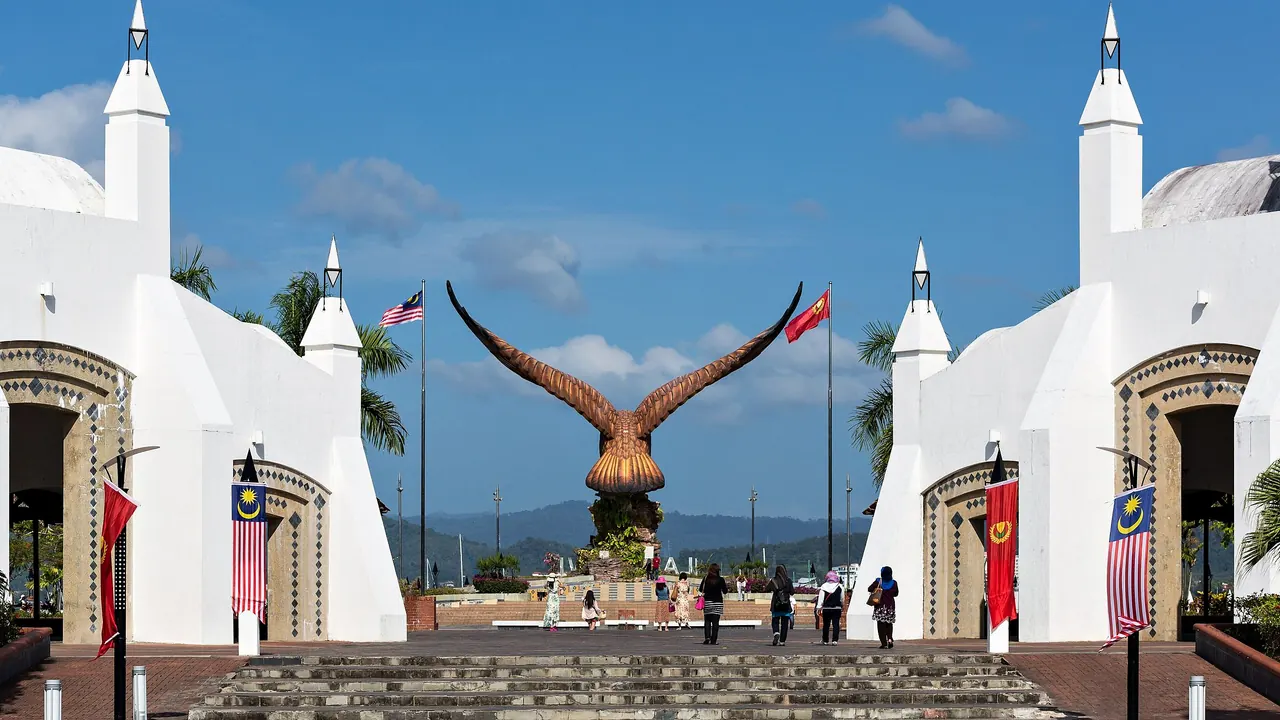
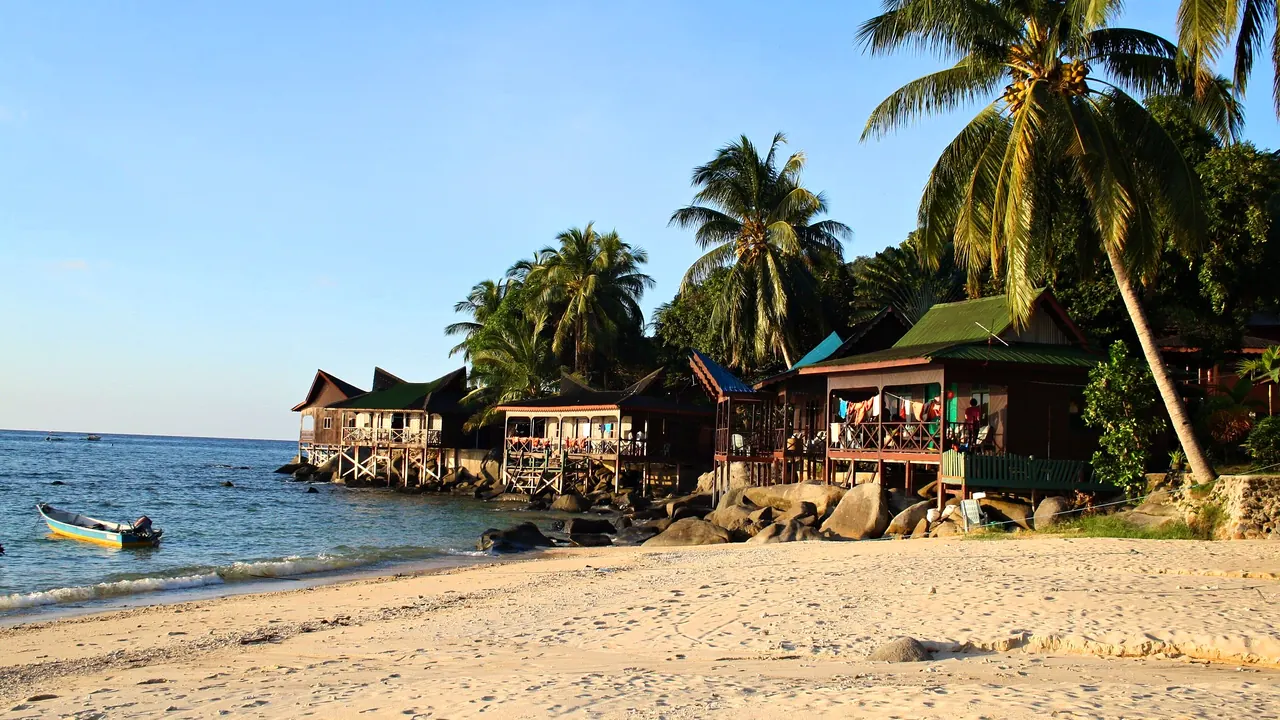
Photos: Langkawi by CEphoto, Uwe Aranas, CC BY-SA 3.0, cropped; Tioman by Jorge Cancela, CC BY 2.0, cropped.
Langkawi or Tioman?
Our verdict in twelve categories, each scored against the same fixed benchmark cities, and the climate month by month, so you can choose for your trip.
Choose Langkawi for
- getting around
- families
- shopping
Langkawi is the easier, rounder beach vacation. Pantai Cenang gives you a long, wide bay with the airport close by. A hire car or ride-hailing app gets you to the Kilim mangroves, the Machinchang cable car or a resort spa in well under an hour, and children, food and evenings are better served. It is also the choice for the northern winter, when its dry season lines up with Tioman's monsoon.
Choose Tioman for
- beaches
Choose Tioman if you want to live on the water and under it. Coral grows a few steps off the sand, the marine park is one of the country's favourite places to learn to dive, and a jungle trail crosses the island to Juara's open beach. In return you get few roads, simple village food, almost no evenings out and a ferry crossing each way. It is at its best from spring to early autumn.
Scoreboard
Twelve categories on one fixed scale from 0 to 100. The shaded stretch is the gap between the two.
Your match
Pick a travel style or drag the sliders, and both match scores follow your weighting.
Wins on getting around and families with your weighting.
Wins on beaches with your weighting.
What matters to you?
Category by category
What the scores mean for a trip.
Beaches & swimming
The beaches are equally good, but they are different kinds of beach. Langkawi's main draw is Pantai Cenang, a long, wide bay of pale sand with shallow water and sunsets over the outer islands. Tanjung Rhu and Datai Bay in the north are quieter alternatives. The water is pleasant but not very clear, and jellyfish turn up at times in the wet months.
Tioman is a string of small village coves on the west coast, from Salang down to Genting, with coral close enough to snorkel straight from the sand. Across the island, Juara is its one long open beach. Expect some coral rubble at low tide and sandflies at dusk. Remember the seasons are reversed: Langkawi's best sea is November to April, Tioman's is March to October.
Food & drink
Langkawi eats noticeably better. Its pasar malam night markets move to a different village each evening, with satay, grilled fish and kuih. Coastal seafood places sell fish and prawns by weight, and Kuah has Chinese and Malay canteens for breakfast. Pantai Cenang adds plenty of choice, even if most of it is ordinary tourist food.
On Tioman, meals come from a few open-sided eateries in each village and grilled squid on the beach at Salang, Air Batang or Tekek. Outside the main villages there is little choice, and many kitchens close in the monsoon. Both islands are duty-free, so beer is easy to find and cheap.
Culture & sights
Neither island is a culture trip, but Langkawi at least fills a morning. There is Mahsuri's tomb in its small village of traditional Malay houses, the eagle statue and Al-Hana mosque on Kuah's waterfront, the rice-growing story at Laman Padi and the state gifts in the Galeria Perdana. On Tioman there are no sights to tick off. What it offers is the everyday life of fishing kampungs like Juara and Mukut, with timber houses and boats pulled up on the sand.
Nightlife
Langkawi has the livelier evenings, though only by a beach resort's standards. Pantai Cenang's bars put bean bags on the sand and stage fire-twirling shows after sunset, and Pantai Tengah has a few calmer lounges. There are no clubs on either island. On Tioman, a sundowner at one of a handful of bars in Salang, Air Batang or Tekek, sometimes with a bonfire, is the whole night. It is a conservative area, and most villages are asleep soon after dinner.
Nature & outdoors
Both islands are strong on nature, but you see it in different ways. On Langkawi you mostly take in the landscape from a road, a boat or the cable car. You can kayak or take a boat through the Kilim mangroves beneath limestone cliffs, ride up the Machinchang range to the sky bridge, or drive up Gunung Raya to look for hornbills. The heat keeps hikes short.
Tioman is wilder, and you see more of it on foot. Its rainforest interior rises to Gunung Kajang at just over 1,000m, and the old trail from Tekek to Juara crosses the island through it in a steep half-day among huge trees, with monitor lizards and macaques along the way. Far to the south, the granite spires of the Dragon's Horns stand above Mukut. Its real advantage is underwater, where the coral, turtles and reef sharks of the marine park are close at hand.
Day trips
Neither island makes a good base for outings, but Langkawi has a couple of real options. In the dry season you can cross the border by ferry to the Thai island of Koh Lipe, or make a long day of it to Alor Setar on the mainland. From Tioman the only trips are boat runs to the snorkelling islets. The mainland ports are a long crossing away and offer little, so most people simply move from one bay to another.
Good for families
Langkawi is far easier with children. There are resorts with pools and kids' clubs, the Underwater World aquarium on the Cenang strip, the cable car and sky bridge, mangrove boat trips to watch eagles being fed, and a wildlife park near Kuah. The attractions run out after a few days, though, and you will need a car or taxi to reach them.
Tioman suits families who are happy with sand and sea. Children can snorkel among fish in the sheltered west-coast bays, and Juara has a turtle hatchery. Against that, the ferry crossing can be choppy, you often need a boat to get between villages, and medical care is basic.
Getting around
Langkawi has no buses worth the name, but that hardly matters. Ride-hailing apps work across the island, car and scooter hire is simple, the roads are good and nothing is more than about forty minutes away. The airport is next to Pantai Cenang.
Tioman takes more planning, starting with a ferry of up to two hours from Mersing or Tanjung Gemok, with fewer sailings in the monsoon. Once there, a single road crosses from Tekek to Juara. Otherwise the villages are linked by water taxis and jungle paths. Inside your own bay everything is a barefoot stroll away, so choose your village carefully.
Shopping & style
Both islands are duty-free, but only Langkawi has shopping to speak of. Its big complexes in Kuah and along Cenang sell chocolate, alcohol, cosmetics and kitchenware, and there are batik, pearl stalls and the night markets on top. Tioman has a few duty-free shops in Tekek and village stores selling sunscreen and snorkel gear, so bring what you need from the mainland.
Affordability
Both are cheap islands, and duty-free drink helps on each. What differs is where the money goes. On Langkawi, night-market meals, car hire and mid-range hotels around Cenang cost little, while the cable car, boat tours and the luxury rainforest resorts push the bill up. On Tioman, beach chalets and village meals are very cheap and dive courses are good value, but the ferry, the marine park fee and water taxis between bays all add up.
Live music & performing arts
Neither island has any performing arts. Langkawi's live entertainment is the fire-dancing on Cenang beach, cover bands and the occasional Malay cultural show over a resort dinner. On Tioman, a guitar at a beach bar is about as far as it goes.
Wellness & relaxation
Langkawi is the better place to be looked after. Resorts in the northwest rainforest and on the Tanjung Rhu coast have serious spas, some with treatment pavilions among the streams. Simple massage and reflexology shops line Pantai Cenang, and there is a small hot-spring complex near Kuah.
Tioman's way of relaxing is to take things away. Most villages have no cars, there are no crowds, and the days follow the tide. A few resort spas and some beachfront yoga are all the treatment on offer.
When should you go?
Pick your month. The climate figures are measured averages, not a forecast.
Langkawi in July
Tioman in July
Daytime high, °C
Rainfall in the month, mm
Where the figures come from
Langkawi's temperatures are measured 75 km from the centre, at Alor Star.
Langkawi has no rain gauge within 25 km of the centre, so its rainfall comes from a gridded climate dataset read at the destination rather than from a gauge further away.
Tioman's temperatures are measured 55 km from the centre, at Mersing.
Tioman has no rain gauge within 25 km of the centre, so its rainfall comes from a gridded climate dataset read at the destination rather than from a gauge further away.
Temperature and rainfall are climate normals, averaged over the years shown. Langkawi: 2004-2020 (rainfall 1991-2020) normals, Alor Star (75 km from centre). Tioman: 1991-2020 normals, Mersing (54.5 km from centre).
The two islands have opposite seasons. Langkawi is driest from December to March, with February down to about 38mm, and that is when the west-coast sea is calmest and clearest. The rain builds from April and stays heavy through October, the wettest month at around 385mm. The heat barely changes and peaks at 35°C in March, so all year it is best to walk early or late in the day.
Tioman is the other way round. From March to October it is fairly dry, with August the driest month at about 105mm, and the sea stays warm enough for a swim every day. The monsoon arrives in November and peaks in December at around 721mm, bringing rough seas, fewer ferries and slightly cooler water. From November to April, Tioman's afternoons are cooler than Langkawi's, most noticeably in February and March. From May to October the two islands are about equally hot. For a vacation from December to February, pick Langkawi. From June to August, Tioman has the drier weather.
Which traveller are you?
On a family trip with children, Langkawi is the safer bet. Its resorts have pools and kids' clubs, the shallow water at Pantai Cenang suits small swimmers, and the aquarium, cable car and eagle-feeding boat trips are all a short drive away.
For a relaxing and wellness trip, Langkawi also comes out ahead. Large resorts in the northwest rainforest and on the Tanjung Rhu coast run proper spas using Malay herbal traditions, and Cenang has cheap massage on every corner. On Tioman, the rest comes mostly from the slow pace.
For divers and keen snorkellers, Tioman is the island to pick. The marine park has reef sharks, turtles and sites such as Renggis and Chebeh, dive courses are good value, and coral starts right off the beach. On Langkawi you need a boat to the southern islands to snorkel at all.
Before you go
| Measure | Langkawi | Tioman |
|---|---|---|
| Official language | Malay | Malay |
| Currency | Malaysian Ringgit (MYR) | Malaysian Ringgit (MYR) |
| Sockets | G240 V, 50 Hz | G240 V, 50 Hz |
| Driving side | Left | Left |
| Time zone | UTC+8 | UTC+8 |
| Emergency number | 999 | 999 |
| Main airport | Langkawi International Airport (LGK)9 non-stop destinations | Singapore Changi Airport (SIN)168 non-stop destinations |
By the numbers
| Measure | Langkawi | Tioman |
|---|---|---|
| Population | 64,792 | 432 |
| People per km² | 136 | - |
| Swim season, months above 21 °C | 12 months | 12 months |
Where else could you go?
Every comparison below shares a destination with this one, so you can follow Langkawi or Tioman somewhere new.
- Koh Lipevs Langkawi
- Penangvs Langkawi
- Koh Lantavs Langkawi
- Koh Phi Phivs Langkawi
- Phuketvs Langkawi
- Koh Samuivs Langkawi