Malaysia
Tioman
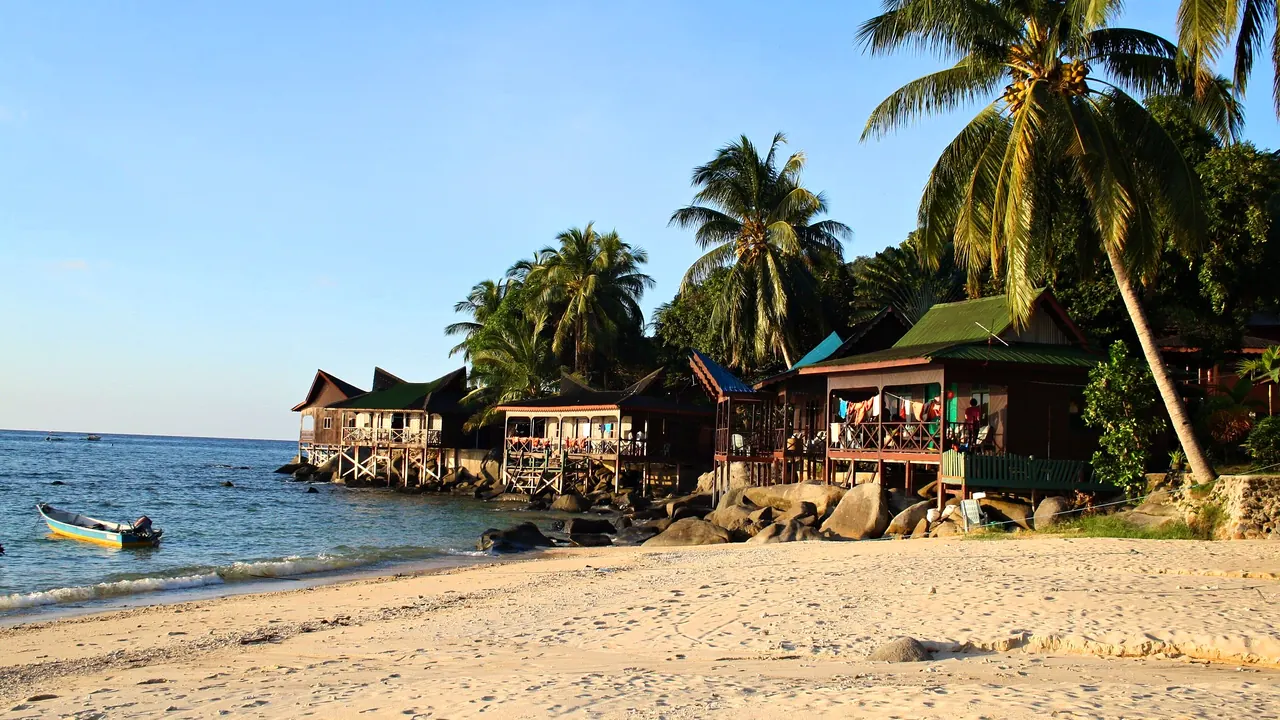
Wooden chalets on stilts among the palms at Salang Bay
- Beaches82
- Affordability70
- Nature & outdoors67
Photo: Jorge Cancela, CC BY 2.0, cropped
Match
32
Every category weighted equally
- Beach & sun42
- Culture & arts21
- Food & nightlife24
- Family trip40
- Outdoors39
- Relax & unwind39
- Shopping & style23
- On a budget36
Tioman in twelve categories
Our verdict on each, scored 0 to 100 against the same fixed benchmark cities, so a score means the same thing on every page.
Beaches & swimming. Scores 82 out of 100.
Food & drink. Scores 24 out of 100.
Culture & sights. Scores 7 out of 100.
Nightlife. Scores 14 out of 100.
Nature & outdoors. Scores 67 out of 100.
Day trips. Scores 6 out of 100.
Good for families. Scores 38 out of 100.
Getting around. Scores 22 out of 100.
Shopping & style. Scores 7 out of 100.
Affordability. Scores 70 out of 100.
Live music & performing arts. Scores 3 out of 100.
Wellness & relaxation. Scores 40 out of 100.
Tioman category by category
Beaches & swimming
82Beaches are what Tioman is for. The sea is warm and clear, around 29°C through the dry season, and coral grows close enough to shore that many visitors snorkel straight off the sand. The west coast is a chain of small bays, each with its own village: Salang in the north has a pretty sandy cove and good snorkelling, Air Batang and Panuba are calm and low-key, and Paya and Genting further south are quieter still. Across the island, Juara is the long, open sweep of pale sand that many consider the finest beach of all.
The swimming season runs from about March to October. From November to February the monsoon brings rain and rough seas, and the east coast fills with surf instead of swimmers. Some stretches have coral rubble at low tide, and sandflies can bother you at dusk on a few beaches.
Food & drink
24Eating on Tioman is simple. Every village has a few open-sided Malay eateries serving nasi lemak, roti canai, mee goreng and fried rice. In the evening there is grilled fish and squid on the beach at Salang, Air Batang and Tekek, and the resorts run their own dining rooms. Choice gets thin outside the main villages, and in the monsoon months many kitchens close. The island is duty-free, so beer and spirits are easier to find and cheaper than on the mainland. Nobody comes for the food, but fresh seafood by the water is a pleasant end to the day.
Culture & sights
7There is very little to see in the way of sights. What Tioman has is the everyday life of its Malay fishing kampungs: timber houses, small mosques and boats pulled up on the sand, at their most traditional in Juara and Mukut. The island's twin peaks carry a legend about a dragon princess who turned to stone, and that is close to the whole of its heritage. Visitors come for the sea and the forest.
Nightlife
14Evenings are low-key. A few beach bars in Salang, Air Batang and Tekek serve cheap duty-free beer at sunset, sometimes with a bonfire or music on the sand. Most of the island is asleep soon after dinner. There are no clubs and no late scene. It is a conservative Muslim area, and outside the traveller villages people drink quietly, if they drink at all.
Nature & outdoors
67Tioman is greener and wilder than most beach islands. Dense rainforest covers its interior and climbs to Gunung Kajang at just over 1,000m, and the twin granite spires of the Dragon's Horns rise above the southern villages of Mukut. The classic walk crosses the island on an old jungle trail from Tekek to Juara, a steep half-day among huge trees, with a waterfall stop for those who want one. You may well see monitor lizards, macaques, flying foxes and hornbills along the way.
Underwater, the surrounding marine park protects hard and soft coral, reef sharks and turtles. Renggis, Chebeh and the Tulai islets are the best-known dive sites, and the island is a popular place to learn to dive. The east coast has surf in the monsoon months.
Day trips
6There is nowhere else to go for the day. Boat trips run to the small coral islets offshore, but they are for snorkelling and diving, not for visiting towns. The mainland port towns are a long ferry ride away and have little to offer a visitor. A stay here means staying put, perhaps moving from one village bay to another.
Good for families
38Families who like simple beach life can do well here. The west-coast bays are sheltered, the water is warm, and children can snorkel among fish a few steps from the sand. A turtle hatchery at Juara and nature walks add some variety. The larger resorts near Tekek have pools and space for children.
There are no attractions made for children, though, and the island takes effort to reach, with a ferry crossing that can be choppy. Getting between villages often means a boat, and medical facilities are basic. It suits families who are happy with sand, sea and a slow pace.
Getting around
22Reaching Tioman means a ferry from the mainland ports of Mersing or Tanjung Gemok, about an hour and a half to two hours each way, and sailings thin out sharply in the monsoon months. On the island there are few roads. One road crosses the hills from Tekek to Juara, and a paved path links Tekek with Air Batang. Otherwise villages are joined by water taxis and jungle trails. Once you are settled in one bay, everything is a short barefoot walk. Choose your village with care, though, because moving around the island takes planning.
Shopping & style
7Shopping hardly exists. Tekek has a few duty-free shops, mostly selling alcohol, tobacco and chocolate, and the villages have small stores with sarongs, sunscreen and snorkelling gear. Bring what you need from the mainland.
Affordability
70Tioman is easy on a budget. Simple beach chalets in Air Batang, Salang and Juara cost little, village meals are cheap, and duty-free status makes alcohol far cheaper than elsewhere in Malaysia. Dive courses are good value. Costs build up through the ferry, the marine park fee and water taxis between bays, and the island's resorts charge noticeably more than the chalets. Stay simple and it is a cheap place to spend a week.
Live music & performing arts
3There is no performing arts scene. You might hear a guitar at a beach bar or catch a resort cultural evening, but that is all.
Wellness & relaxation
40Tioman's wellness is mostly its pace. There are no cars in most villages, no crowds, and days follow the tide and the light, which makes it a good place to switch off. Some of the larger resorts have spas, and a few chalets offer massage or beachfront yoga, but there is no bathing or spa tradition to seek out. Come to rest, not to be treated.
Where to stay in Tioman
Most visitors stay on the west coast, where each village has its own small bay. Salang, in the north, has the island's most sociable evenings, with a few beach bars, grilled seafood on the sand and good snorkelling straight off the beach. It suits divers, couples and anyone who wants a little company after dark. Air Batang is calmer, with simple chalets linked to Tekek by a paved path, and makes a cheap, unhurried base. Tekek is the main village, with the duty-free shops and the larger resorts whose pools and space suit families.
For a truly quiet stay, Panuba is low-key, and Paya and Genting further south are sleepier still. Across the hills, Juara faces the open sea with a long sweep of pale sand, a traditional fishing kampung and a turtle hatchery. It is reached by the road or the jungle trail from Tekek. Come between March and October, because in the monsoon months the east coast gets surf rather than calm swimming.
There are no day trips to plan around, so one base is enough for most stays. Moving between bays means water taxis or trails, so choose your village before you arrive. If you want both coasts, split a week between a west-coast bay and Juara.
When should you go?
Pick a month to see what it is like. The climate figures are measured averages, not a forecast.
Tioman in July
Daytime high, °C
Rainfall in the month, mm
The whole year
Shaded against this destination’s own year: the deepest cell is its best month for that figure and the palest its weakest.
Where the figures come from
Tioman's temperatures are measured 55 km from the centre, at Mersing.
Tioman has no rain gauge within 25 km of the centre, so its rainfall comes from a gridded climate dataset read at the destination rather than from a gauge further away.
Temperature and rainfall are climate normals, averaged over the years shown. Tioman: 1991-2020 normals, Mersing (54.5 km from centre).
Before you go
| Measure | Tioman |
|---|---|
| Official language | Malay |
| Currency | Malaysian Ringgit (MYR) |
| Sockets | G240 V, 50 Hz |
| Driving side | Left |
| Time zone | UTC+8 |
| Emergency number | 999 |
| Main airport | Singapore Changi Airport (SIN)168 non-stop destinations |
By the numbers
| Measure | Tioman |
|---|---|
| Population | 432 |
| Swim season, months above 21 °C | 12 months |
Compare Tioman with
Every comparison with a written verdict behind it.