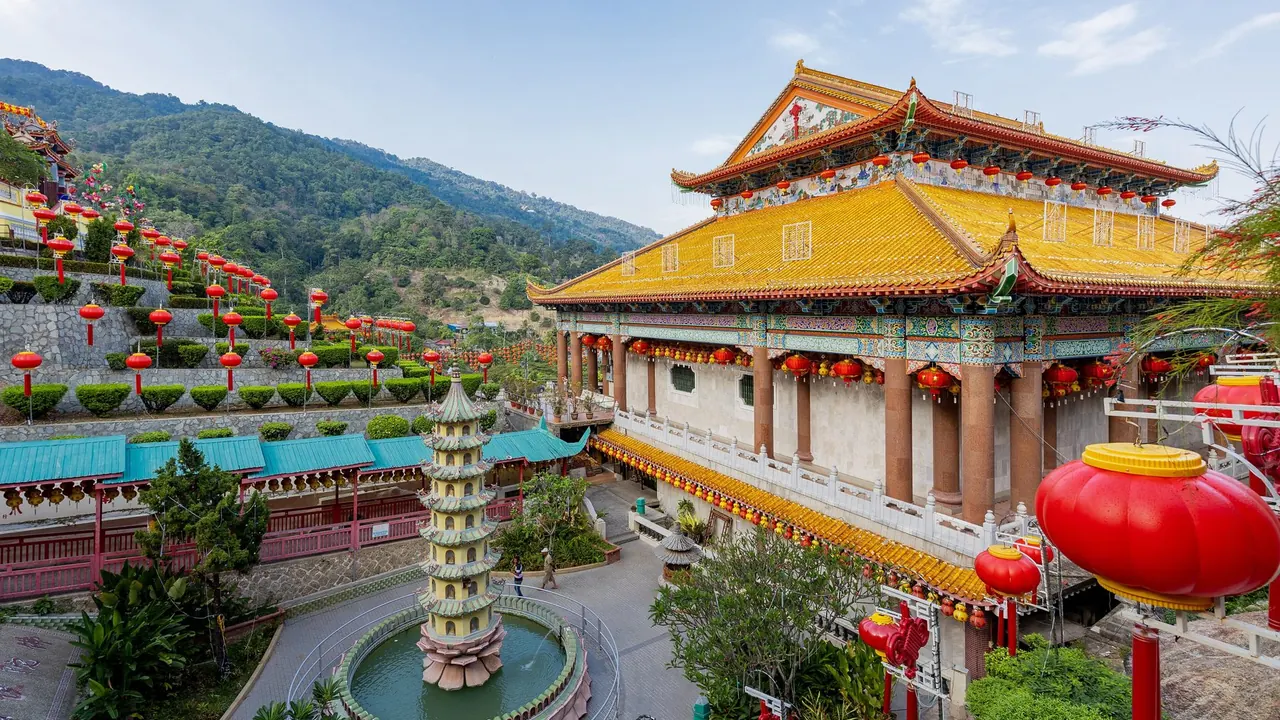
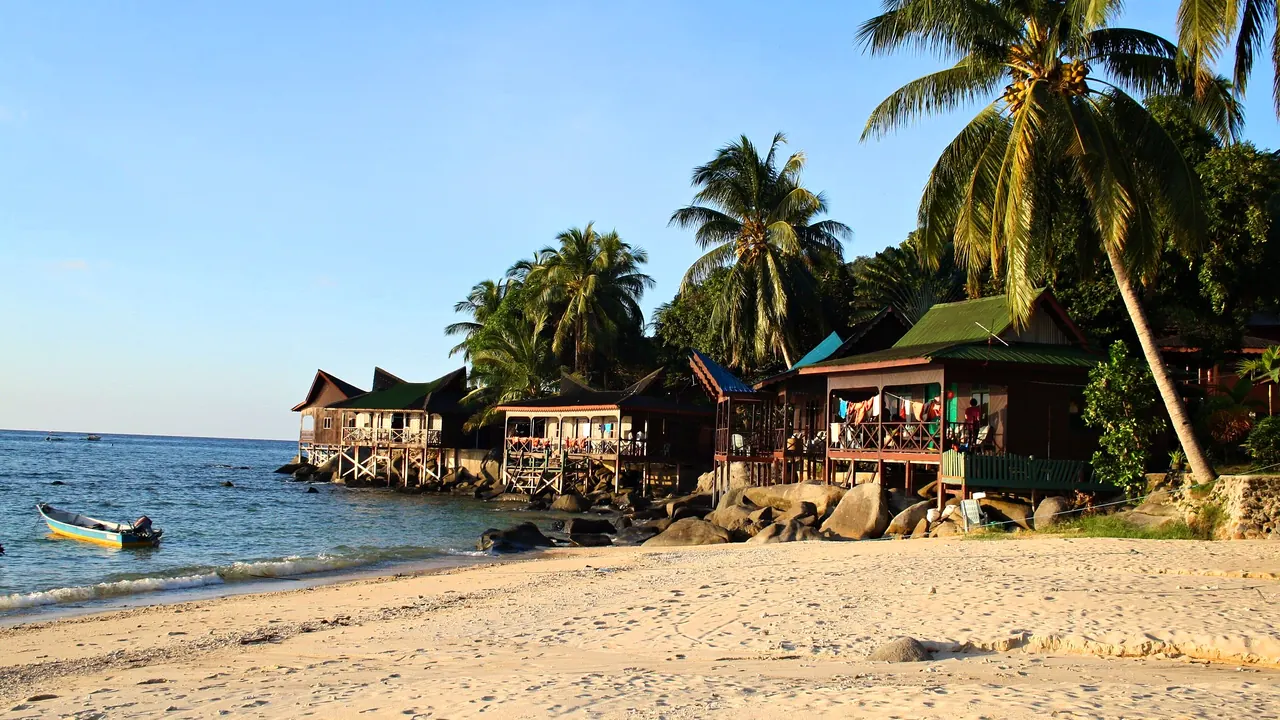
Photos: Penang by Supanut Arunoprayote, CC BY 4.0, cropped; Tioman by Jorge Cancela, CC BY 2.0, cropped.
Penang or Tioman?
Our verdict in twelve categories, each scored against the same fixed benchmark cities, and the climate month by month, so you can choose for your trip.
Choose Penang for
- culture and sights
- food and drink
- day trips
Penang is the one for travellers who want a place with plenty going on. George Town gives you shophouse streets, clan temples and the clan jetties to walk, hawker food from half a dozen kitchens at every meal, and enough bars to fill an evening. You can add Penang Hill, the national park and a train down to Ipoh. The sea is the weak point, so you get a full and varied trip rather than a beach one.
Choose Tioman for
- beaches
- nature and the outdoors
Tioman suits people who mostly want to be in the water. Its west-coast bays and the long sand at Juara have clear sea with coral close enough to snorkel from the shore, and rainforest climbs behind every village. In exchange you get simple food, almost no sights and early nights, and once you have settled into one bay you will mostly stay there. Come to swim, dive, walk the jungle trail and do very little else.
Scoreboard
Twelve categories on one fixed scale from 0 to 100. The shaded stretch is the gap between the two.
Your match
Pick a travel style or drag the sliders, and both match scores follow your weighting.
Wins on culture and sights and food and drink with your weighting.
Wins on beaches and nature and the outdoors with your weighting.
What matters to you?
Category by category
What the scores mean for a trip.
Beaches & swimming
This is where Tioman pulls well ahead. Its sea is clear, and the coral grows close enough that you can snorkel straight off the sand at Salang. The calm bays of Air Batang and Panuba make easy swimming, and Juara on the east side is a long sweep of pale sand. The catch is the season: from November to February the monsoon makes the sea rough.
Penang's beaches are something you fit around a stay rather than the reason for one. Batu Ferringhi is busy with jet skis and resort hotels. The water is often murky and jellyfish come in at certain times of year, so the pool tends to win. The nicer sand at Monkey Beach and Kerachut takes a forest walk or a boat to reach.
Food & drink
Penang is one of the great eating destinations of Asia, and Tioman makes no claim on that front. In George Town you can eat charcoal-fried char kway teow, assam laksa, prawn mee and nasi kandar in hawker centres and old coffee shops. Little India serves banana-leaf meals and the Nyonya kitchens cook slow Straits Chinese dishes, so every meal can be different.
On Tioman you eat nasi lemak, roti canai and fried rice in open-sided village eateries, and in the evening there is grilled fish on the beach. It is pleasant, but the choice thins quickly outside Salang, Air Batang and Tekek, and in the monsoon many kitchens close. The one thing Tioman does better is cheap duty-free beer.
Culture & sights
Penang has the sightseeing and Tioman has very little. George Town's UNESCO-listed streets hold the carved Khoo Kongsi, the stilt villages of the clan jetties, the Cheong Fatt Tze and Peranakan mansions and the mix of mosques, churches and temples along Harmony Street. Kek Lok Si rises on the hillside outside town. It is easily two or three days of walking.
Tioman's heritage is its everyday life: timber kampung houses, small mosques and fishing boats at Juara and Mukut, plus the legend of the dragon princess behind the twin peaks. That is something to notice on a walk, not an itinerary.
Nightlife
Neither island is a party destination, but Penang has a proper evening out. The backpacker bars along Love Lane and Chulia Street, cocktail bars in restored shophouses and later venues on Upper Penang Road give you choices after dinner. On Tioman you get a duty-free beer at sunset in Salang or Air Batang, maybe a bonfire, and then most of the island goes to sleep. It is a conservative area, so drinking stays quiet outside the traveller villages.
Nature & outdoors
Both islands have a rainforest interior, but Tioman's is wilder, and it has a reef as well. The jungle trail from Tekek to Juara is a steep half-day among huge trees, Gunung Kajang rises past 1,000m, and the Dragon's Horns stand over Mukut. Hornbills and monitor lizards are common sightings, and the marine park offshore adds coral, turtles and reef sharks.
Penang's nature is gentler and easier to reach. You can take the funicular or walk up Penang Hill to its canopy walkway and cooler air, follow the coastal trails in the national park to the lighthouse and turtle beaches, or cycle among the durian orchards around Balik Pulau. It suits short outings from a city base rather than a trip built around the outdoors.
Day trips
Penang's link to the mainland gives it a handful of outings that Tioman cannot offer. Ipoh makes the fullest day: a train journey of around two hours brings you to a colonial old town, shrines tucked into caves in the surrounding limestone cliffs, and cooking good enough to compare with George Town's. Nearer at hand, Taiping's lake garden and colonial streets combine easily with the domed mosque of royal Kuala Kangsar, and in Kedah the Bujang Valley keeps the ruins of early Hindu-Buddhist temples. Langkawi needs more than a day.
On Tioman, a day away means a boat to the coral islets offshore, which is a snorkelling or diving trip rather than a change of scene. The mainland ports are too far by ferry to be worth it, so the most variety you will get is moving from one village bay to the next. If you like to explore further afield, base yourself in Penang.
Good for families
Penang gives families more to fill the days. Batu Ferringhi's resort pools are close to the water theme park, the butterfly park and the spice garden at Teluk Bahang, and the Penang Hill funicular and the Botanic Gardens monkeys go down well with children. The drawbacks are the heat and George Town's stepped walkways, which are hard going with a pushchair.
Tioman suits families who are happy with just sand and sea. The sheltered west-coast bays let children snorkel among fish a few steps from the beach, and the turtle hatchery at Juara adds an outing. But there is nothing built for children, the ferry can be choppy, and medical care is basic.
Getting around
Penang is easier to move around, even without rail. The heritage core of George Town can be covered on foot, by bicycle or by trishaw, and cheap ride-hailing or the slow Rapid Penang buses reach Batu Ferringhi and beyond. A hired car or scooter handles the hill road to Balik Pulau.
Tioman starts with a ferry of up to two hours from Mersing or Tanjung Gemok, and sailings thin out in the monsoon. On the island there is one road over the hills to Juara, and otherwise you rely on water taxis and jungle trails. Within your own bay everything is a barefoot stroll, so choosing the right village matters more than transport.
Shopping & style
Penang is the only one of the two where shopping is worth any time. The Gurney Drive malls cover mainstream brands. The better finds are in George Town: antique and curio shops, studios selling Peranakan beadwork and batik, fabrics and gold in Little India, and nutmeg at the Chowrasta market. Tioman has a few duty-free shops in Tekek selling alcohol and chocolate, and village stores with sarongs and snorkel gear, so bring anything you need from the mainland.
Affordability
Both islands are cheap, and Penang is slightly cheaper overall. Hawker meals, ride-hailing and simple George Town guesthouses cost very little, and most temples and clan houses are free or nearly so. The exception is alcohol, which is heavily taxed.
On Tioman, beach chalets and village meals are cheap, and duty-free status makes drink far cheaper than on Penang. But the ferry, the marine park fee and water taxis between bays add up, and the resorts cost noticeably more than the chalets.
Live music & performing arts
Penang has a little to offer and Tioman has almost nothing. Penang's highlight is the yearly George Town Festival in the heritage streets. Temple festivals bring Chinese street opera and puppet shows on temporary stages, there are lion dances at Chinese New Year, and a north-coast arts centre stages local plays and concerts. On Tioman the most you will find is a guitar at a beach bar or a resort cultural evening.
Wellness & relaxation
Both islands are equally restful, but in different ways. In Penang the draw is cheap reflexology and traditional Chinese and Malay massage on almost every street, plus resort spas at Batu Ferringhi and cool air on Penang Hill, though George Town's traffic and heat are not soothing. On Tioman the rest comes from the island itself: most villages have no cars, the days follow the tide, and a beachfront yoga session or a massage at a chalet is all the treatment you are likely to find.
When should you go?
Pick your month. The climate figures are measured averages, not a forecast.
Penang in July
Tioman in July
Daytime high, °C
Rainfall in the month, mm
Where the figures come from
Tioman's temperatures are measured 55 km from the centre, at Mersing.
Tioman has no rain gauge within 25 km of the centre, so its rainfall comes from a gridded climate dataset read at the destination rather than from a gauge further away.
Temperature and rainfall are climate normals, averaged over the years shown. Penang: 1991-2020 (sunshine 1981-2010) normals, Penang / Bayan Lepas (14.5 km from centre). Tioman: 1991-2020 normals, Mersing (54.5 km from centre).
The two islands have their wet seasons at opposite ends of the year, and for many dates that decides the choice. Penang is at its best from December to March. January and February are the driest and sunniest months, with under 90mm of rain each. From April the rain builds steadily, and September and October are the wettest stretch, with well over 300mm a month and the fewest sunny hours. It is hot all year, with highs around 32°C, so walking around George Town is best done in the morning and early evening whatever the month.
Tioman runs the other way. The west-coast swimming season lasts from March to October, and June to August are the driest months. From October the northeast monsoon builds, and December is far wetter than anything Penang gets, at more than 700mm, with rough seas into January. The sea around both islands stays near 29°C for most of the year, so the rain matters more than the water. In the northern winter, Penang is the better bet. From late spring to early autumn, Tioman wins.
Which traveller are you?
On a beach and sun trip, Tioman is the clear choice. Its west-coast bays and Juara have clear, warm water with coral just offshore, while Penang's Batu Ferringhi is a resort strip where many visitors end up swimming in the hotel pool.
For a food and nightlife trip, pick Penang. George Town's hawker centres, coffee shops and night stalls are a reason to come in their own right, and Love Lane and Upper Penang Road keep going late. Tioman offers village eateries and a few sunset beach bars.
For divers, and for anyone who wants to learn, Tioman has the marine park, with reef sharks, turtles and well-known sites around Renggis, Chebeh and the Tulai islets, and the dive courses are good value. Penang has no reef diving worth planning a trip around.
Before you go
| Measure | Penang | Tioman |
|---|---|---|
| Official language | Malay | Malay |
| Currency | Malaysian Ringgit (MYR) | Malaysian Ringgit (MYR) |
| Sockets | G240 V, 50 Hz | G240 V, 50 Hz |
| Driving side | Left | Left |
| Time zone | UTC+8 | UTC+8 |
| Emergency number | 999 | 999 |
| Main airport | Penang International Airport (PEN)32 non-stop destinations | Singapore Changi Airport (SIN)168 non-stop destinations |
By the numbers
| Measure | Penang | Tioman |
|---|---|---|
| Population | 794,313 | 432 |
| Swim season, months above 21 °C | 12 months | 12 months |
Where else could you go?
Every comparison below shares a destination with this one, so you can follow Penang or Tioman somewhere new.
- Langkawivs Penang
- Koh Lipevs Penang
- Koh Lantavs Penang
- Kuala Lumpurvs Penang
- Koh Phi Phivs Penang
- Krabivs Penang