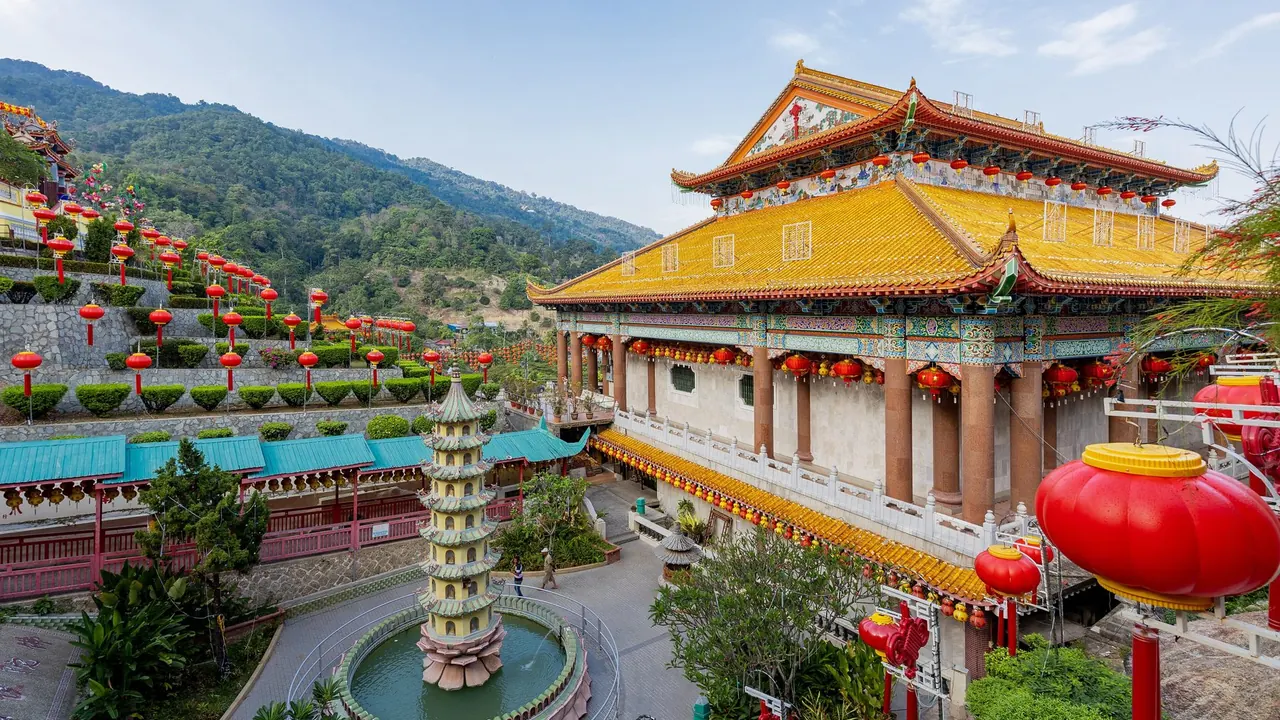
Photos: Penang by Supanut Arunoprayote, CC BY 4.0, cropped.
Koh Phi Phi or Penang?
Our verdict in twelve categories, each scored against the same fixed benchmark cities, and the climate month by month, so you can choose for your trip.
Choose Koh Phi Phi for
- beaches
- nightlife
- nature and the outdoors
Koh Phi Phi suits a trip built around the sea. You get turquoise water under limestone cliffs, boat days to Phi Phi Leh and Bamboo Island, snorkelling on coral walls and, if you want it, a beach party after dark. The island is small and car-free, and you can know it in a few days. It has almost no sights and little serious food, so it works best as a beach stop for people happy to swim, climb to the viewpoint and do little else.
Choose Penang for
- culture and sights
- food and drink
- shopping
Travellers who want to eat well and walk through history will be happier in Penang. George Town's shophouse streets, clan houses and temples, along with hawker cooking from half a dozen traditions, fill the days in a way Phi Phi cannot, and they cost less. The beaches are an extra rather than the point. In return the island has more for children, more to buy and easy outings to Ipoh and Taiping.
Scoreboard
Twelve categories on one fixed scale from 0 to 100. The shaded stretch is the gap between the two.
Your match
Pick a travel style or drag the sliders, and both match scores follow your weighting.
Wins on beaches and nightlife with your weighting.
Wins on culture and sights and food and drink with your weighting.
What matters to you?
Category by category
What the scores mean for a trip.
Beaches & swimming
Koh Phi Phi wins easily. Its water is clear and turquoise beneath limestone cliffs, with soft sand at Laem Tong in the north, better swimming off Long Beach and boat days to Bamboo Island and the coves of Phi Phi Leh. The weak spot is Loh Dalum by the village, which is shallow at low tide and crowded.
Penang's sea is just as warm, but it is often cloudy and jellyfish come in at times, so along Batu Ferringhi the resort pool usually wins. Monkey Beach and Kerachut in the national park have nicer sand, but they make a day out rather than a base.
Food & drink
Penang is far ahead, and many visitors come for the food alone. Hawker centres, old coffee shops and the night stalls on Gurney Drive serve char kway teow, assam laksa, nasi kandar and slow-cooked Nyonya dishes, Little India adds banana-leaf meals, and most of it costs very little.
On Phi Phi you eat in Tonsai village's backpacker restaurants, where curries are toned down and pizza sits on the same menu. The best moments are simple ones, such as roti from a cart or seafood grilled on the beach at night.
Culture & sights
There is barely a contest. Phi Phi has a small tsunami memorial and the cliff entrance of Viking Cave, seen from a boat, and little else. People go for the scenery, not the sights.
George Town is a UNESCO-listed port, and its main sights are within walking distance of each other: the carved Khoo Kongsi, the clan jetties on stilts, the blue Cheong Fatt Tze Mansion and the mosques, temples and churches side by side along Harmony Street. With Kek Lok Si on the hillside as well, two or three days pass easily.
Nightlife
Phi Phi is the place for a big night out, though only of one kind. On Loh Dalum the beach bars put on fire shows, play dance music and serve drinks in buckets until the small hours, and the village adds reggae bars and Muay Thai bouts. The crowd is loud and young, and staying in the north is how you avoid it.
Penang's evenings are calmer. There are backpacker bars on Love Lane, cocktail bars in restored shophouses and a few clubs on Upper Penang Road. A night is more likely to end at a hawker stall than on a dance floor.
Nature & outdoors
Phi Phi has the more dramatic landscape. Sheer limestone walls rise from the sea, a steep path climbs to the viewpoint over the twin bays, kayaks slip into Pileh Lagoon, and climbers use the bolted cliffs near Tonsai. It is all compact, though, and a few days covers it.
Penang's outdoors is green rather than spectacular. There are rainforest trails up Penang Hill, a path through the national park to a lighthouse and turtle beaches, and cycling among the durian orchards of Balik Pulau. The heat pushes most walks into the early morning.
Day trips
Penang has more within reach by land. Ipoh, with its old town and cave temples, is about two hours away by train. Taiping's lake gardens and royal Kuala Kangsar can be done in one day, and the ancient temple remains of the Bujang Valley in Kedah are another option.
From Phi Phi every outing starts with a boat. Koh Lanta is an hour away and Railay about an hour and a half, but most excursions are tours of empty islands and bays. Towns are better visited as separate stops on a longer Andaman route.
Good for families
Penang is easier with children. From a base at Batu Ferringhi, the water park, the butterfly park and the spice garden at Teluk Bahang are close by. Other days can go on the Penang Hill funicular, the monkeys in the Botanic Gardens and George Town's interactive museums. The main nuisance is the uneven walkways, which are hard with a pushchair.
Phi Phi can work if you stay at a calm northern resort such as Laem Tong, with shallow water, pools and snorkelling, and having no cars on the island helps. On the other hand, the village is loud, the paths to the outer beaches are steep and unlit, nothing is built for children and medical care is basic.
Getting around
On Phi Phi your own feet and a longtail do all the work. Tonsai and Loh Dalum are a few minutes apart along narrow lanes shared with handcarts and bicycles. Long Beach, Laem Tong and the outer bays mean hiring a boat or climbing a steep, rough path over the hills. Even arriving takes a ferry of up to two hours from Phuket or Krabi, and the crossing gets choppier from May to October.
With roads to use, Penang lets you range much further. Buses circle the island, cheap ride-hailing reaches Batu Ferringhi and beyond, and a hired car or scooter takes you along the national park coast and over the hills to Balik Pulau. On foot, the comparison is closer. Phi Phi's car-free lanes are quiet but run out at the edge of the village, while George Town's shophouse streets give you far more to walk through, with traffic alongside.
Shopping & style
Penang has far more to buy, though nothing grand. The malls along Gurney Drive stock mainstream brands. In George Town there are antique shops, studios selling Peranakan beadwork and batik, fabrics and spices in Little India and nutmeg at Chowrasta market. Phi Phi's village lanes sell beachwear, sarongs, sunscreen and snorkel gear and little else, so bring what you need.
Affordability
Penang is clearly the cheaper of the two. Hawker meals, ride-hailing and George Town guesthouses all cost little, and most temples and clan houses are free or nearly so. Alcohol is where the bill goes up.
Phi Phi is expensive for Thailand because everything arrives by boat. Dry-season rooms, boat tours, longtail rides and the island and marine park fees add up, though dormitories and food from carts keep a tight budget possible.
Live music & performing arts
You would not plan a trip to either around a show, but Penang at least has its occasions. The George Town Festival brings theatre and music to the heritage streets, temple festivals bring Chinese street opera and puppet shows, and there are lion dances at Chinese New Year. On Phi Phi the entertainment is fire dancing on the beach and cover bands in bars, which are part of a night out rather than events in their own right.
Wellness & relaxation
Phi Phi is the more restful of the two, as long as you sleep in the right place. At Laem Tong or the isolated eastern bays the days pass between hammock, sea and massage, and the northern resorts have spas among the trees. Tonsai village is the opposite.
Penang has cheap reflexology and Chinese and Malay massage on almost every street, and slow pool days at the Batu Ferringhi resorts. George Town itself, with its traffic and heat, does not feel restful. The calm places are the cool top of Penang Hill and the countryside around Balik Pulau.
When should you go?
Pick your month. The climate figures are measured averages, not a forecast.
Koh Phi Phi in July
Penang in July
Daytime high, °C
Rainfall in the month, mm
Where the figures come from
Koh Phi Phi's temperatures are measured 65 km from the centre, at Phuket Airport.
Koh Phi Phi has no rain gauge within 25 km of the centre, so its rainfall comes from a gridded climate dataset read at the destination rather than from a gauge further away.
Temperature and rainfall are climate normals, averaged over the years shown. Koh Phi Phi: 1991-2020 (sunshine 1961-1990) normals, Phuket Airport (65.2 km from centre). Penang: 1991-2020 (sunshine 1981-2010) normals, Penang / Bayan Lepas (14.5 km from centre).
Both islands follow the same monsoon pattern, so the month matters more than the island. Days are hot all year, between 31°C and 34°C, and in either place it is hard to walk about at midday. The dry season runs from December to March and is best in January and February. Phi Phi then gets only about 40mm of rain in February and long, sunny days, and its sea is calmest for boat trips.
From May the rain sets in and builds to a peak in October, when both islands get over 300mm. The change hurts a beach trip on Phi Phi more, with rough crossings and cancelled tours. George Town still works between showers, and Penang's sunshine drops off less sharply through the middle of the year. The sea stays warm around both islands in every month.
Which traveller are you?
On a beach and sun trip, choose Koh Phi Phi. Days fall into an easy rhythm of swimming, longtail hops between bays and sunset at the viewpoint, with the sea a few steps from your room. In Penang, the beach is an afternoon you fit around the town.
For a culture and arts trip, Penang is the obvious base. Mornings go on wandering George Town before the heat builds, stepping into temples and clan houses along the way, with street opera on a festival evening if your timing is right. Phi Phi offers scenery, not history.
For divers and snorkellers, Phi Phi has something Penang lacks. The soft-coral walls of Bida Nok and Bida Nai and the blacktip reef sharks at Shark Point are a short boat ride from the village. Penang's murky sea has nothing comparable.
Before you go
| Measure | Koh Phi Phi | Penang |
|---|---|---|
| Official language | Thai | Malay |
| Currency | Baht (THB) | Malaysian Ringgit (MYR) |
| Sockets | ABCF220 V, 50 Hz | G240 V, 50 Hz |
| Driving side | Left | Left |
| Time zone | UTC+7 | UTC+8 |
| Emergency number | Police 191, ambulance 1669, fire 199 | 999 |
| Main airport | Krabi International Airport (KBV)14 non-stop destinations | Penang International Airport (PEN)32 non-stop destinations |
By the numbers
| Measure | Koh Phi Phi | Penang |
|---|---|---|
| Population | - | 794,313 |
| Swim season, months above 21 °C | 12 months | 12 months |
Where else could you go?
Every comparison below shares a destination with this one, so you can follow Koh Phi Phi or Penang somewhere new.
- Koh Lantavs Koh Phi Phi
- Phuketvs Koh Phi Phi
- Langkawivs Penang
- Langkawivs Koh Phi Phi
- Koh Samuivs Koh Phi Phi
- Koh Phanganvs Koh Phi Phi