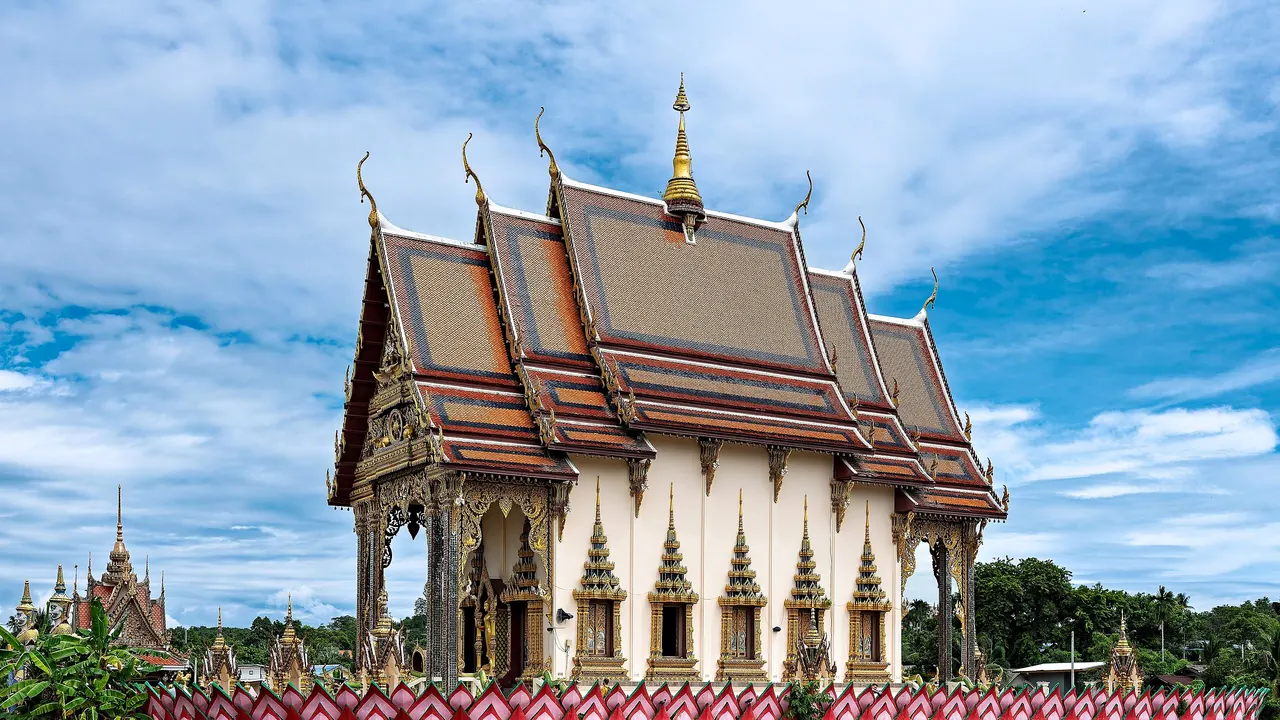
Photos: Koh Samui by Mustang Joe, CC0.
Koh Phi Phi or Koh Samui?
Our verdict in twelve categories, each scored against the same fixed benchmark cities, and the climate month by month, so you can choose for your trip.
Choose Koh Phi Phi for
- nature and the outdoors
- getting around
- beaches
Koh Phi Phi suits travellers who come for the setting itself: sheer limestone cliffs rising from turquoise water, kayaking into Pileh Lagoon, diving coral walls and swimming with reef sharks, all on a small island with no cars. It works best for a few days of sea and scenery, ideally as one stop on a wider Andaman route, and for younger visitors who want the nightly beach party on Loh Dalum close at hand.
Choose Koh Samui for
- wellness
- food and drink
- shopping
For a longer, more comfortable stay, Koh Samui is the easier choice. Its family resorts, yoga and detox retreats, night markets and calmer northern bays give it more to do and more ways to unwind, and its own airport makes it simpler to reach. What you give up is drama: Samui's most striking scenery sits offshore in Ang Thong, a boat trip away.
Scoreboard
Twelve categories on one fixed scale from 0 to 100. The shaded stretch is the gap between the two.
Your match
Pick a travel style or drag the sliders, and both match scores follow your weighting.
Wins on nature and the outdoors and getting around with your weighting.
Wins on wellness and food and drink with your weighting.
What matters to you?
Category by category
What the scores mean for a trip.
Beaches & swimming
Both islands are built around their beaches, and the difference is one of setting rather than quality. Phi Phi's beaches are smaller and framed by sheer cliffs. Long Beach looks across to Phi Phi Leh, Laem Tong has soft sand and calm water, and boat trips reach Bamboo Island and the coves around Maya Bay. Loh Dalum, though, turns very shallow at low tide.
Samui gives you length and choice instead. Chaweng is a long sweep of white sand, Lamai is a little rougher, and Choeng Mon is a sheltered bay for easy swimming. Boulder coves like Silver Beach add variety, though the north coast beaches go shallow and cloudy when the tide is out.
Food & drink
Samui is the better island for eating. Its night markets at Lamai, Maenam and the Fisherman's Village walking street serve grilled squid, papaya salad and roti. Roadside kitchens away from the main strips cook fiery southern curries, and there is a tier of polished restaurants with sea views in the hills and along the Bophut waterfront.
Phi Phi's food is mostly Tonsai's backpacker menus of fried rice, pizza and burgers, with the spice often toned down. The good moments are simple ones: banana roti from a cart, pad kra pao, or fish grilled on the beach at dusk.
Culture & sights
Neither island is a heritage destination, but Samui at least fills a half-day loop. You can see the gilded Big Buddha on its causeway islet, the many-armed Guanyin at Wat Plai Laem, the mummified monk at Wat Khunaram and the old Chinese wooden shophouses of Bophut. Phi Phi has almost nothing to set out for beyond a small tsunami memorial and a glimpse of Viking Cave from a boat.
Nightlife
Phi Phi's nights come in one style, and if you stay in the village you will hear it. Mats are laid out along Loh Dalum for fire shows, dance music and drinks by the bucket, and the lanes behind have reggae bars and amateur Muay Thai bouts. It is loud and young. The quiet alternative is a northern beach, where evenings end with dinner.
Samui gives you a choice of scene. Chaweng has clubs and beach clubs with DJs, Lamai has a rougher bar strip, and Bophut is for quiet drinks by the water. For something bigger, Koh Phangan's full moon parties at Haad Rin are a short boat ride away.
Nature & outdoors
Phi Phi has the more dramatic landscape, and it starts at your doorstep. Limestone walls rise straight from the sea, a narrow sandy isthmus joins the two halves of Phi Phi Don, and the sunset viewpoint, Pileh Lagoon and the soft-coral walls of Bida Nok and Bida Nai are all close by. The reefs do show wear from heavy boat traffic.
Samui's own coast is pretty rather than spectacular. Its jungle interior offers the Na Muang waterfalls and rough tracks through coconut plantations. Its finest scenery means a boat trip to the forty-odd islands of Ang Thong, and its best diving is further out, around Sail Rock.
Day trips
Day trips from both islands mean boats, but Samui's neighbours are closer and easier to reach. Koh Phangan, with its port town at Thong Sala, is under an hour away, and Koh Tao and the sandbar islets of Koh Nang Yuan make a full day out.
From Phi Phi, the best places to visit lie further off. Koh Lanta's stilt-house old town is about an hour away, Railay a bit more, and Phuket Town's shophouses two hours each way. These work better as separate stops on a wider route than as day trips.
Good for families
Samui is far better set up for children. Many resorts have large pools and children's clubs, the bays at Choeng Mon, Bophut and Maenam are gentle, and older children can try a water park, animal parks, elephant sanctuaries or a boat trip to Ang Thong. The busy ring road is the main drawback.
On Phi Phi, families can manage at the quieter Laem Tong resorts, where the lack of cars and the longtail rides are a plus. Elsewhere it gets harder: the village is loud until late, paths to the outer beaches are steep and unlit, there are no attractions aimed at children, and medical care is basic.
Getting around
Phi Phi has no cars at all. Tonsai and Loh Dalum are a short walk apart through lanes shared with handcarts and bicycles. Long Beach, Laem Tong and the outer bays mean a longtail boat or a steep hill path, and getting to the island takes a ferry of up to two hours.
On Samui a single ring road of about 51km links every beach, so drives are short, but you depend on wheels. Taxi fares are negotiated rather than metered, songthaews run without a timetable, and scooters are risky on the hills when the roads are wet. In return, the island's own airport spares you the ferry.
Shopping & style
Samui gives you something to browse. The Friday walking street in Fisherman's Village sells crafts, clothes and coconut-wood homeware, Lamai and Maenam have weekly markets, and Chaweng has a modern mall with international chains. Phi Phi's village lanes sell little beyond sarongs, sunscreen and snorkel gear, so bring what you need.
Affordability
Both are expensive by Thai standards, but Samui is easier to do cheaply. Simple bungalows set back from the beach, night-market meals and the quieter north and west coasts all keep costs down, as long as you avoid resort restaurants and taxis.
On Phi Phi, everything arrives by boat and space is tight, so dry-season rooms cost well above mainland levels. Boat tours and longtail rides add up, and there are island and marine park fees on top. Dormitories and food from roti carts are the main ways to save.
Live music & performing arts
Neither island has a theatre or a serious music scene. Samui at least offers organised shows: Muay Thai fight nights at small stadiums around Chaweng and Lamai, and ladyboy cabaret. On Phi Phi, live entertainment is fire dancing on the beach and cover acts in bars, which come with a night out rather than being worth planning around.
Wellness & relaxation
Samui is one of Asia's established places for a restorative stay. Lamai and its hills have long hosted detox and fasting programmes, yoga and meditation retreats are found across the island, and resort spas look out over the Gulf. Around Maenam and Lipa Noi, the days are slow and evenings end early.
Phi Phi has Thai massage on every corner and proper spas at the northern resorts, so a few unhurried days between hammock and sea are possible at Laem Tong. Stay near Tonsai, though, and the late music and day-tripper crowds work against rest.
When should you go?
Pick your month. The climate figures are measured averages, not a forecast.
Koh Phi Phi in July
Koh Samui in July
Daytime high, °C
Rainfall in the month, mm
Where the figures come from
Koh Phi Phi's temperatures are measured 65 km from the centre, at Phuket Airport.
Koh Phi Phi has no rain gauge within 25 km of the centre, so its rainfall comes from a gridded climate dataset read at the destination rather than from a gauge further away.
Koh Samui has no rain gauge within 25 km of the centre, so its rainfall comes from a gridded climate dataset read at the destination rather than from a gauge further away.
Temperature and rainfall are climate normals, averaged over the years shown. Koh Phi Phi: 1991-2020 (sunshine 1961-1990) normals, Phuket Airport (65.2 km from centre). Koh Samui: 1991-2020 normals, Ko Samui (7.4 km from centre).
Neither island has a cool season. Daytime highs sit between about 29°C and 34°C all year, and the sea is warm enough to swim in every month. Their rains come at different times, though, because the two islands lie on opposite sides of the Thai peninsula. Phi Phi, on the Andaman side, is at its best from December to April, when the days are driest and sunniest. March is the hottest month at 34°C, which makes the steep climb to the viewpoint hard work around midday. From May the rain builds steadily and peaks in October at 316mm, and the sunshine drops away as it does.
Samui, on the Gulf side, stays fairly settled from January to September, with moderate showers and slightly milder heat early in the year. Its wet season comes late and hits hard. November is the wettest month at 372mm, and October and December are wet too. From January to April either island works well. From June to September Samui is clearly the drier choice, while November and December favour Phi Phi, though November is still rainy there.
Which traveller are you?
For an outdoors trip, Koh Phi Phi is the stronger pick. The scenery and the water begin a short walk or longtail ride from your room, so active days take almost no planning. A few days covers most of it, though.
On a family trip with children, Koh Samui is the safer choice. It has more resorts built with children in mind and more to do when the beach wears thin. On Phi Phi, everything depends on getting the base exactly right.
For a relaxing and wellness trip, choose Koh Samui. You can book a full programme of treatments or simply stay somewhere truly quiet. On Phi Phi, rest comes down to how far your bed is from the music.
Before you go
| Measure | Koh Phi Phi | Koh Samui |
|---|---|---|
| Official language | Thai | Thai |
| Currency | Baht (THB) | Baht (THB) |
| Sockets | ABCF220 V, 50 Hz | ABCF220 V, 50 Hz |
| Driving side | Left | Left |
| Time zone | UTC+7 | UTC+7 |
| Emergency number | Police 191, ambulance 1669, fire 199 | Police 191, ambulance 1669, fire 199 |
| Main airport | Krabi International Airport (KBV)14 non-stop destinations | Samui International Airport (USM)10 non-stop destinations |
By the numbers
| Measure | Koh Phi Phi | Koh Samui |
|---|---|---|
| Population | - | 62,500 |
| People per km² | - | 273 |
| Swim season, months above 21 °C | 12 months | 12 months |
Where else could you go?
Every comparison below shares a destination with this one, so you can follow Koh Phi Phi or Koh Samui somewhere new.
- Koh Phanganvs Koh Samui
- Koh Lantavs Koh Phi Phi
- Phuketvs Koh Phi Phi
- Koh Taovs Koh Samui
- Langkawivs Koh Phi Phi
- Koh Lantavs Koh Samui