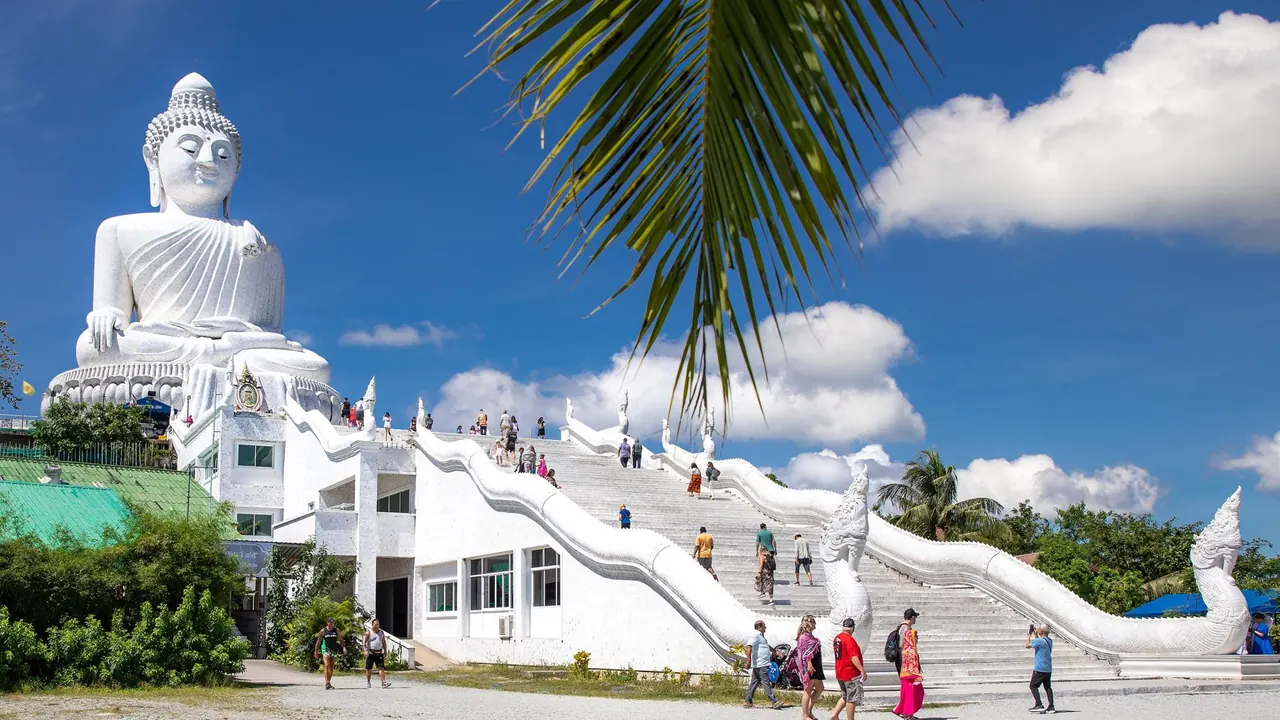
Photos: Phuket by Mussi Katz, CC0.
Koh Phi Phi or Phuket?
Our verdict in twelve categories, each scored against the same fixed benchmark cities, and the climate month by month, so you can choose for your trip.
Choose Koh Phi Phi for
- getting around
- nature and the outdoors
Koh Phi Phi suits a short, simple island stay built around the sea. Its pull is the scenery: sheer limestone cliffs, turquoise water you swim and snorkel in from the doorstep, and a car-free island small enough to know in a few days. Young travellers who want beach parties at night and long boat days will be happy here. Anyone looking for good food, sights, shopping or variety will run out of things to do quickly.
Choose Phuket for
- food and drink
- shopping
- culture and sights
Phuket is the better choice for a longer or more varied vacation, and for most families. Its beaches are just as good and there are far more of them to choose from. Around them you get Phuket Town's Hokkien and Peranakan cooking, a real spa and retreat scene, attractions for children and boat trips across Phang Nga Bay. You lose Phi Phi's sense of being somewhere remote, and you will spend more time in taxis.
Scoreboard
Twelve categories on one fixed scale from 0 to 100. The shaded stretch is the gap between the two.
Your match
Pick a travel style or drag the sliders, and both match scores follow your weighting.
Wins on getting around and nature and the outdoors with your weighting.
Wins on food and drink and shopping with your weighting.
What matters to you?
Category by category
What the scores mean for a trip.
Beaches & swimming
On beaches the two are level, and the water is the same warm, clear Andaman Sea. Phi Phi has only a few beaches, framed by cliffs. Loh Dalum is broad but shallow at low tide, so the better swimming is at Long Beach or Laem Tong, and boats go out to Bamboo Island and the coves of Phi Phi Leh.
Phuket gives you far more choice along its west coast. Patong is busy and full of loungers, Kata and Karon are easygoing, Nai Harn and Kata Noi are pretty headland coves, and the long northern stretches are quiet. Phuket also has a bigger hazard. From May to October, monsoon surf and rip currents make many of its bays unsafe, while on Phi Phi the rougher season mostly means cancelled boat trips.
Food & drink
Phuket is far better for anyone who travels to eat. Phuket Town has a local cuisine shaped by Hokkien and Peranakan settlers. You can have dim sum and crab curry with rice noodles for breakfast, braised pork belly, and grilled food at the old-town walking street. There is good seafood at Rawai and a small fine-dining scene as well.
Phi Phi's food comes from a few lanes in Tonsai village, with curries, pizza and burgers aimed at backpackers. The best of it is banana roti from street carts and seafood grilled on the beach in the evening.
Culture & sights
Neither island is a culture trip, but Phuket at least gives you a worthwhile half day. You can walk the pastel shophouse streets of Phuket Town's old quarter, visit Wat Chalong and the Big Buddha above Chalong Bay, and learn about the Burmese siege of 1785 at the Thalang National Museum.
Phi Phi has almost nothing to visit. There is a small tsunami memorial, and you can see the swiftlet-nest cliffs of Viking Cave from a passing boat.
Nightlife
Phuket has more nightlife and more kinds of it. Bangla Road in Patong is a long strip of clubs, neon bars and go-go bars that runs until the small hours. Beyond it there are sunset sessions at west-coast beach clubs, relaxed bars at Kata and Karon, and shophouse cocktail bars in Phuket Town where many of the customers are Thai.
Phi Phi offers one kind of night out, and does it with energy. Loh Dalum turns into a beach party with mats, fire shows, dance music and drinks served in buckets, while reggae bars fill up in the village. It is young and loud, and if you want variety you will not find it here.
Nature & outdoors
On nature the two are level, but they offer it at different scales. On Phi Phi the limestone walls rise straight from the water around you. The viewpoint over the two bays, Pileh Lagoon, the soft coral at Bida Nok and the blacktip sharks at Shark Point are all close by. The trade-off is that the island is small and its reefs show wear from heavy boat traffic.
Phuket is a base for a wider area. You can kayak through the caves of Phang Nga Bay, dive the Similans in season, and visit the rainforest of Khao Phra Thaeo with its gibbons and waterfalls. Each of these takes more travel to reach.
Day trips
Phuket has much more within a day's reach, and one of its classic outings is Phi Phi itself. Boats also go to the stilt village of Koh Panyee and the rural Koh Yao islands. The bridge to the mainland opens up Phang Nga, Krabi and the old tin town of Takua Pa by road.
From Phi Phi, nearly everything means a ferry. Koh Lanta and Railay are reasonable outings, but Phuket Town makes a long day. Most excursions from Phi Phi are boat tours to empty bays, so towns and heritage are better planned as separate stops on a wider route.
Good for families
Phuket works much better with children. Its big resorts are designed for families, and there are water parks, an aquarium at Cape Panwa and snorkelling trips to fill the days. Its weak points are the dangerous surf in the monsoon months and busy roads with few pavements.
On Phi Phi, a family needs to stay at Laem Tong or one of the quiet northern beaches, where the water is calm. There are no cars, which helps. The village is noisy and crowded, the paths to the outer beaches are steep and unlit, medical care is basic, and the ferry over can be rough.
Getting around
Phi Phi is the easier of the two once you are there, because there are no cars at all. Tonsai and Loh Dalum are a few minutes' walk apart, and longtail boats or hill paths cover the rest. The catch is that you need a ferry to get there, plus a boat transfer if you stay in the north.
Phuket has no rail and only basic buses that run from town out to the beaches, not between them. That leaves taxis and tuk-tuks on fixed fares, ride-hailing or a hired scooter. Its hilly roads get congested and are risky for inexperienced riders.
Shopping & style
Phuket is the only one of the two where shopping is worth doing. It has large malls near Phuket Town and in Patong, tailors who make clothes in a few days, and pearls from local farms. The better finds are at the Sunday walking street and in the old-town boutiques selling batik and Peranakan-style goods.
On Phi Phi you can buy beachwear, sunscreen and snorkel gear in the village lanes, and little else. It is best to stock up before you take the ferry.
Affordability
Phuket is easier on the budget. Street food and markets in Phuket Town are cheap, and there are simple guesthouses at every beach, although taxis and high-season resorts push costs up.
On Phi Phi, everything comes in by boat. Dry-season rooms cost far more than on the mainland, and the island entry fee, longtail rides and drinks add up quickly. Backpackers in dormitories get by, but even they will notice it costs more than most of Thailand.
Live music & performing arts
Neither island has theatre or concerts of any substance, but Phuket at least has a few shows to book. There are long-running cabaret revues in Patong, a large cultural show with dancers, and Thai boxing nights. On Phi Phi, entertainment is limited to fire dancers on the sand and cover acts in the village bars.
Wellness & relaxation
Phuket is the clear choice for a restorative trip. You can have a Thai massage almost anywhere, there are resort spas in open pavilions over the sea, and around Chalong there are yoga stays, detox programmes and Muay Thai camps. Mai Khao, Bang Tao and Nai Harn are quiet places to stay.
On Phi Phi you will find massage on beach mats and in village parlours, plus a few resort spas in the north. Your stay will only feel restful if you sleep at Laem Tong or the remote eastern bays, well away from Tonsai's late music.
When should you go?
Pick your month. The climate figures are measured averages, not a forecast.
Koh Phi Phi in July
Phuket in July
Daytime high, °C
Rainfall in the month, mm
Where the figures come from
Koh Phi Phi's temperatures are measured 65 km from the centre, at Phuket Airport.
Koh Phi Phi has no rain gauge within 25 km of the centre, so its rainfall comes from a gridded climate dataset read at the destination rather than from a gauge further away.
Phuket's temperatures are measured 27 km from the centre, at Phuket Airport.
Temperature and rainfall are climate normals, averaged over the years shown. Koh Phi Phi: 1991-2020 (sunshine 1961-1990) normals, Phuket Airport (65.2 km from centre). Phuket: 1991-2020 (sunshine 1961-1990, rainfall 1981-2010) normals, Phuket Airport (26.9 km from centre).
The two islands share the same weather pattern. Daytime highs stay between 31°C and 34°C all year, and the sea is around 29°C in every month, so heat never rules out a swim. It does make long walks in the middle of the day hard work anywhere. The best months on both are December to March, when the rain is light and the skies are at their sunniest. Phuket is slightly drier in January and February. Rain builds through April, and from May to October the southwest monsoon brings heavy showers, less sun and rougher seas.
The wet season hits Phuket a little harder. Its rainfall peaks at around 373mm in September, while Phi Phi's peak is somewhat lower. On Phuket the bigger issue is surf and rip currents on the west-coast beaches. On Phi Phi it is choppy ferry crossings and boat trips that get cancelled, which matters more on an island you can only reach and explore by boat.
Which traveller are you?
On a family trip with young children, Phuket makes the better base, and Phi Phi works best as a day out by boat from it. Choose a resort at Kata, Karon or the northern beaches rather than Patong, and come between November and April, when the sea is calm.
For a relaxing and wellness trip, Phuket is the island to plan a whole week around, with a quiet bay to stay in and a retreat programme if you want one. On Phi Phi, peace depends on booking a northern resort and its boat transfer in advance.
On an outdoors trip, splitting the stay works best. Spend two or three nights on Phi Phi, where the cliffs, reefs and lagoon are a short walk or longtail ride away. Then move to Phuket for longer outings by sea and, in season, diving further out.
Before you go
| Measure | Koh Phi Phi | Phuket |
|---|---|---|
| Official language | Thai | Thai |
| Currency | Baht (THB) | Baht (THB) |
| Sockets | ABCF220 V, 50 Hz | ABCF220 V, 50 Hz |
| Driving side | Left | Left |
| Time zone | UTC+7 | UTC+7 |
| Emergency number | Police 191, ambulance 1669, fire 199 | Police 191, ambulance 1669, fire 199 |
| Main airport | Krabi International Airport (KBV)14 non-stop destinations | Phuket International Airport (HKT)85 non-stop destinations |
By the numbers
| Measure | Koh Phi Phi | Phuket |
|---|---|---|
| Population | - | 77,610 |
| People per km² | - | 6,468 |
| Swim season, months above 21 °C | 12 months | 12 months |
Where else could you go?
Every comparison below shares a destination with this one, so you can follow Koh Phi Phi or Phuket somewhere new.
- Koh Lantavs Koh Phi Phi
- Krabivs Phuket
- Koh Lantavs Phuket
- Langkawivs Koh Phi Phi
- Langkawivs Phuket
- Koh Samuivs Koh Phi Phi