Thailand
Phuket
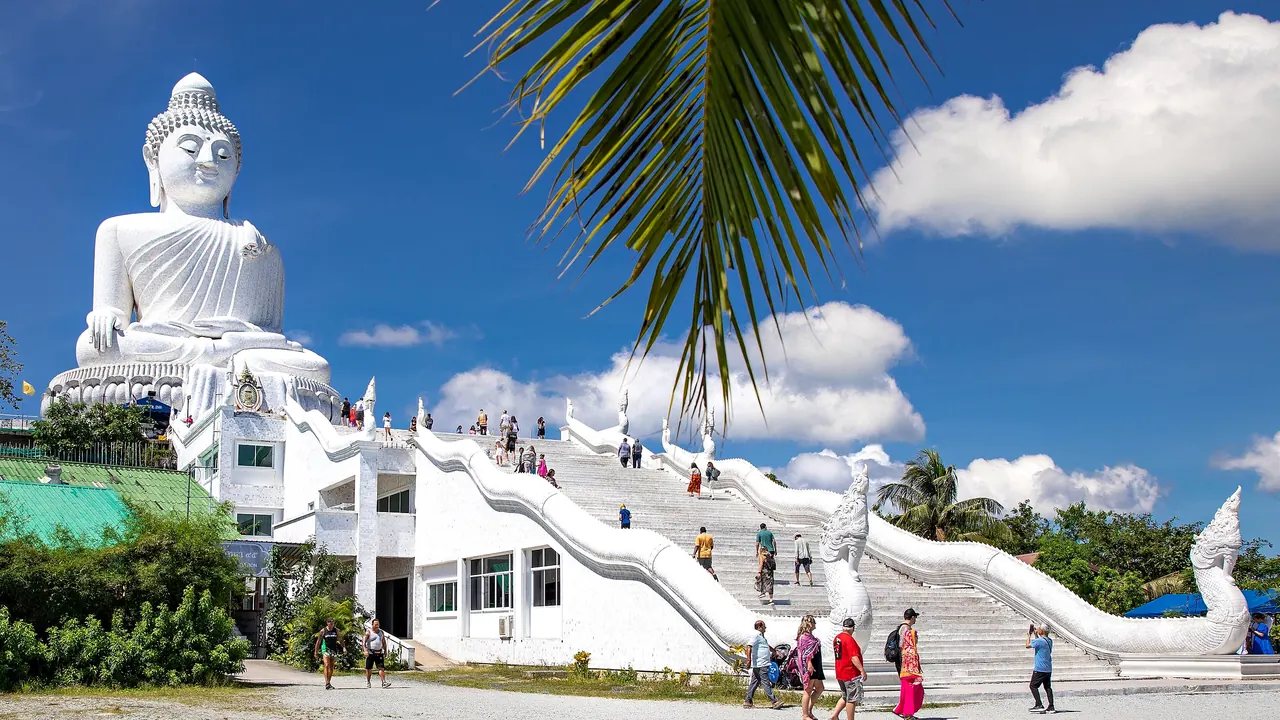
The Big Buddha on the hill above Phuket
- Beaches89
- Wellness & relaxation80
- Nature & outdoors76
Photo: Mussi Katz, CC0
Match
59
Every category weighted equally
- Beach & sun67
- Culture & arts49
- Food & nightlife55
- Family trip61
- Outdoors63
- Relax & unwind65
- Shopping & style54
- On a budget59
Phuket in twelve categories
Our verdict on each, scored 0 to 100 against the same fixed benchmark cities, so a score means the same thing on every page.
Beaches & swimming. Scores 89 out of 100.
Food & drink. Scores 68 out of 100.
Culture & sights. Scores 38 out of 100.
Nightlife. Scores 72 out of 100.
Nature & outdoors. Scores 76 out of 100.
Day trips. Scores 50 out of 100.
Good for families. Scores 68 out of 100.
Getting around. Scores 30 out of 100.
Shopping & style. Scores 44 out of 100.
Affordability. Scores 64 out of 100.
Live music & performing arts. Scores 25 out of 100.
Wellness & relaxation. Scores 80 out of 100.
Phuket category by category
Beaches & swimming
89Beach life is the reason most people come. The west coast is a chain of sandy bays on the warm Andaman Sea, around 29°C, each with its own character. Patong is long, busy and lined with loungers. Kata and Karon are broad and easygoing. Kata Noi, Nai Harn and Freedom Beach are smaller and prettier, tucked between headlands. In the north, Surin, Bang Tao, Nai Yang and Mai Khao are quieter and longer, backed by casuarina trees and resorts.
The season matters. From November to April the sea is calm and clear and swimming is easy almost everywhere. From May to October the southwest monsoon sends heavy surf onto the west coast, red flags go up and rip currents are a real danger, so swim only where lifeguards allow it. Boat trips reach the white sand of the Phi Phi, Racha and Similan islands.
Food & drink
68The island has a cuisine of its own, shaped by Hokkien Chinese and Peranakan settlers who came for the tin mines. Phuket Town is the place to eat it: thick yellow Hokkien noodles, slow-braised pork belly, rice noodles with fiery crab curry eaten at breakfast, and steamed dim sum in old shophouse cafés from early morning. Evening markets and the weekend walking street in the old town add grilled skewers, curries and southern Thai desserts.
On the beaches the food is more predictable, with long menus aimed at visitors, but the fresh seafood is good, especially in the fishing villages at Rawai and on the east coast. A small group of ambitious tasting-menu restaurants and resort kitchens add a fine-dining tier. Southern Thai cooking here is hotter and more herbal than in the north, so ask for it mild if needed.
Culture & sights
38Heritage comes mainly from the island's tin-mining past. Phuket Town's old quarter, around Thalang, Dibuk and Krabi roads, is a well-kept grid of pastel Sino-Portuguese shophouses and merchants' mansions, with Chinese shrines and a few small museums on the Peranakan and mining history. It makes a pleasant half day.
Elsewhere there is Wat Chalong, the island's most important temple, and the Big Buddha, a huge white marble figure on a ridge above Chalong Bay with wide views. The Thalang National Museum and the Heroines Monument tell the story of the Burmese siege of 1785. That is broadly the list. Culture here is a supplement to a beach stay, not a reason to choose the island.
Nightlife
72Nights centre on Patong. Bangla Road closes to traffic in the evening and becomes a long strip of neon bars, go-go bars, big clubs and touts, loud and unapologetic, running until the small hours. It is a party street rather than a refined one, and its edges are seedy, but it is undeniably lively every night of the high season.
Away from Patong the tone changes. Beach clubs on the west coast host sunset sessions and day parties, Kata and Karon have relaxed bars, and Phuket Town has a small scene of cocktail and live-music bars in old shophouses popular with Thai residents. The northern beaches are quiet after dinner.
Nature & outdoors
76The great outdoor draw is the sea around the island. Phang Nga Bay, to the northeast, is a drowned landscape of sheer limestone towers rising from green water, best explored by sea kayak through caves into hidden lagoons. To the west and south, the Racha islands and, from October to May, the Similan islands offer some of the best diving and snorkelling in Thailand, with reef sharks, rays and clear water.
On land the island is hilly and partly forested. Khao Phra Thaeo, in the north, protects a patch of original rainforest with waterfalls and gibbons, and the headland viewpoints at Promthep Cape and Black Rock make short walks. Sailing, paddleboarding and surfing in the monsoon months round it out. Heat and humidity keep hiking short.
Day trips
50Outings mostly mean boats. The Phi Phi islands are the classic day out, with the village of Tonsai on the narrow isthmus between two bays. In Phang Nga Bay, Koh Panyee is a Muslim fishing village built on stilts against a limestone cliff, and Koh Yao Noi and Koh Yao Yai offer a slower, rural island life.
By road, the bridge in the north leads to Phang Nga town and on to Krabi and Ao Nang, about two to three hours away, and to the old tin-mining town of Takua Pa. There are few heritage sites of note, and many tours repeat the same stops, so most visitors pick one or two trips rather than a full programme.
Good for families
68With the right base, the island works well for families. In the dry season the sandy bays at Kata, Karon, Nai Harn and the quieter northern beaches have gentle water, and the big resorts are built for children, with lagoon pools, kids' clubs and family rooms. Thai staff are famously warm with young children.
Attractions include two large water parks, an aquarium at Cape Panwa, elephant sanctuaries, cultural theme-park shows and boat trips to snorkelling islands. The downsides: from May to October the west-coast surf is dangerous, roads are busy with few pavements, and Patong's nightlife is not a place for children. Families are best based at Kata, Karon or the northern beaches.
Getting around
30The island has no rail and only basic public transport. Open-sided songthaew buses run from Phuket Town out to the main beaches, but not between them, and an airport bus covers the west coast. Otherwise visitors rely on taxis, tuk-tuks, ride-hailing apps or a hired car or scooter.
Distances are short, an hour or so from end to end, but the hilly coastal roads are congested in high season and road safety is poor, especially for inexperienced scooter riders. The beach towns are walkable within themselves, though pavements are patchy. Most visitors stay put at one beach and book transport for outings, which are usually by boat.
Shopping & style
44Shopping is practical rather than stylish. A few large malls, one in Patong and a bigger one near Phuket Town, cover international chains and Thai brands, and the beach strips are lined with stalls selling beachwear, souvenirs and copies. Tailors on every street will make suits and dresses in a few days.
The more interesting shopping is local: the Sunday walking street in Phuket Town's old quarter, evening markets with food, clothes and crafts, and small galleries and shophouse boutiques in the old town selling batik, local design and Peranakan-style goods. Pearls from nearby farms are a local speciality.
Affordability
64Phuket is among the more expensive places in Thailand, but still affordable by Western standards if you choose carefully. Street food, markets and local restaurants in Phuket Town are cheap, and simple guesthouses and mid-range hotels exist at every beach.
Costs rise quickly in the high season from December to March, at the big resorts, in beachfront restaurants and in Patong. Taxis and tuk-tuks are notably expensive, with fixed fares rather than meters, and boat trips and imported wine add up. Staying in Phuket Town or at Kata and Karon, eating locally and visiting in the shoulder months keeps a stay good value.
Live music & performing arts
25There is little formal performing arts life. What a visitor can attend is entertainment built for tourists: long-running ladyboy cabaret revues in Patong, a large cultural theme-park show with dancers and elephants, and Thai boxing nights. Bars in Patong, Kata and Phuket Town have cover bands and reggae or blues sets most evenings. There is no theatre, orchestra or opera to speak of, so anyone who cares about live performance should treat this as an evening's diversion.
Wellness & relaxation
80Wellness is a genuine strength. Thai massage is everywhere, from simple shopfronts on every beach road to elaborate resort spas with open-air pavilions over the sea, and treatments of high quality are easy to find at any level. The island also has a large retreat scene: detox and weight-loss programmes, yoga and meditation stays, and Muay Thai and fitness camps clustered around Chalong.
The pace depends on where you stay. The northern beaches at Mai Khao, Nai Yang and Bang Tao, the Laguna area and the southern bays around Nai Harn are quiet, green and made for unwinding. Patong is the opposite. There is no bathing tradition as such, so the focus is on massage, spa and retreat.
Where to stay in Phuket
Patong is the base for nightlife. Bangla Road is a short walk from the sand and everything is close at hand, but it is loud, crowded and not the place for children or an early night. Kata and Karon, just to the south, suit most first visits. The beaches are broad, the water is gentle in the dry season, the bars are relaxed and there are rooms at every level, so families and anyone watching costs do well here.
For a quieter stay, look south to Nai Harn and Rawai, with small bays between headlands, short walks to the viewpoints, seafood in the fishing village and the retreat and fitness camps of Chalong nearby. The northern beaches of Surin, Bang Tao with the Laguna area, Nai Yang and Mai Khao are long, green and calm after dinner. They are close to the airport and suit families and couples who want to unwind at a large resort.
Phuket Town has no beach, but it has the best food on the island, the old quarter and some of the cheapest rooms. It suits travellers who care about eating well, or a night or two at the end of a beach stay. The island takes about an hour to cross, so one base is enough. Choose it by the beach you want, because moving between beaches means taxis.
When should you go?
Pick a month to see what it is like. The climate figures are measured averages, not a forecast.
Phuket in July
Daytime high, °C
Rainfall in the month, mm
The whole year
Shaded against this destination’s own year: the deepest cell is its best month for that figure and the palest its weakest.
Where the figures come from
Phuket's temperatures are measured 27 km from the centre, at Phuket Airport.
Temperature and rainfall are climate normals, averaged over the years shown. Phuket: 1991-2020 (sunshine 1961-1990, rainfall 1981-2010) normals, Phuket Airport (26.9 km from centre).
Before you go
| Measure | Phuket |
|---|---|
| Official language | Thai |
| Currency | Baht (THB) |
| Sockets | ABCF220 V, 50 Hz |
| Driving side | Left |
| Time zone | UTC+7 |
| Emergency number | Police 191, ambulance 1669, fire 199 |
| Main airport | Phuket International Airport (HKT)85 non-stop destinations |
By the numbers
| Measure | Phuket |
|---|---|
| Population | 77,610 |
| People per km² | 6,468 |
| Swim season, months above 21 °C | 12 months |
Compare Phuket with
Every comparison with a written verdict behind it.
- Andaman Islands
- Ayutthaya
- Bali
- Bangkok
- Cairns
- Cebu
- Chiang Mai
- Chiang Rai
- Colombo
- Da Nang
- Galle
- Goa
- Hainan
- Hua Hin
- Kanchanaburi
- Koh Chang
- Koh Kood
- Koh Lanta
- Koh Lipe
- Koh Phangan
- Koh Phi Phi
- Koh Samet
- Koh Samui
- Koh Tao
- Krabi
- Langkawi
- Mombasa
- Nha Trang
- Pattaya
- Penang
- Phu Quoc
- Sabah
- Singapore
- Ubud