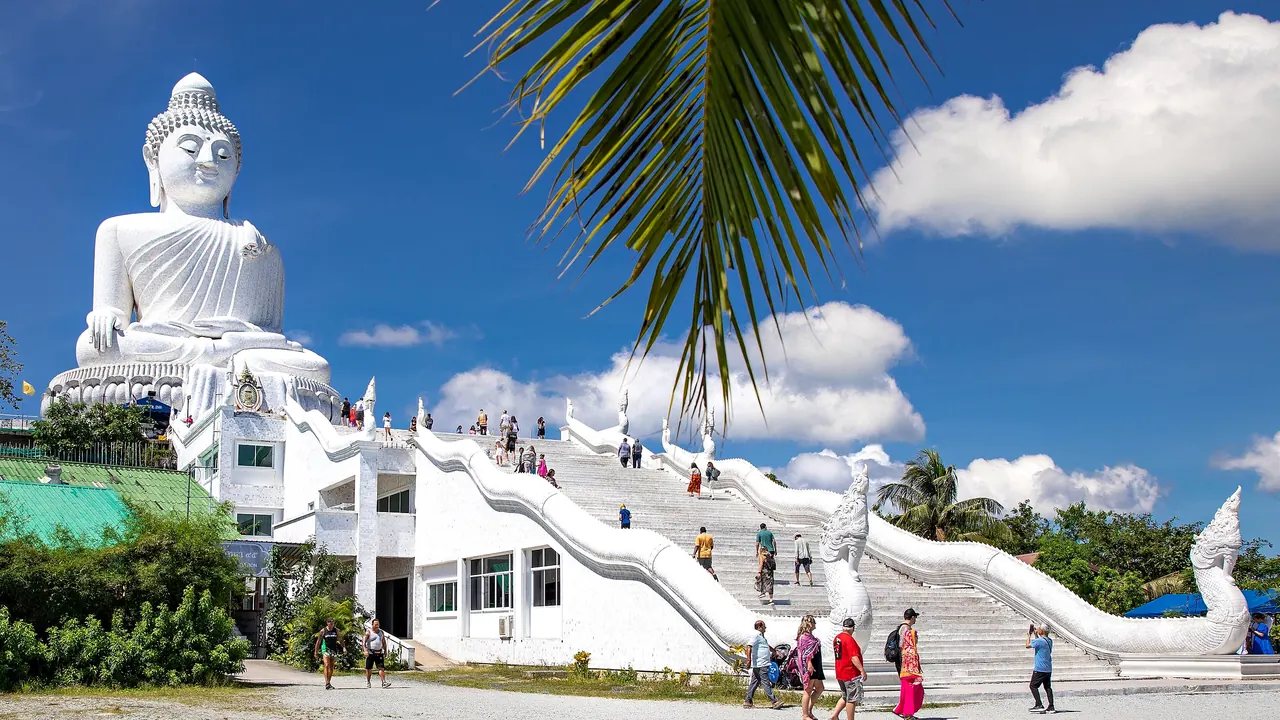
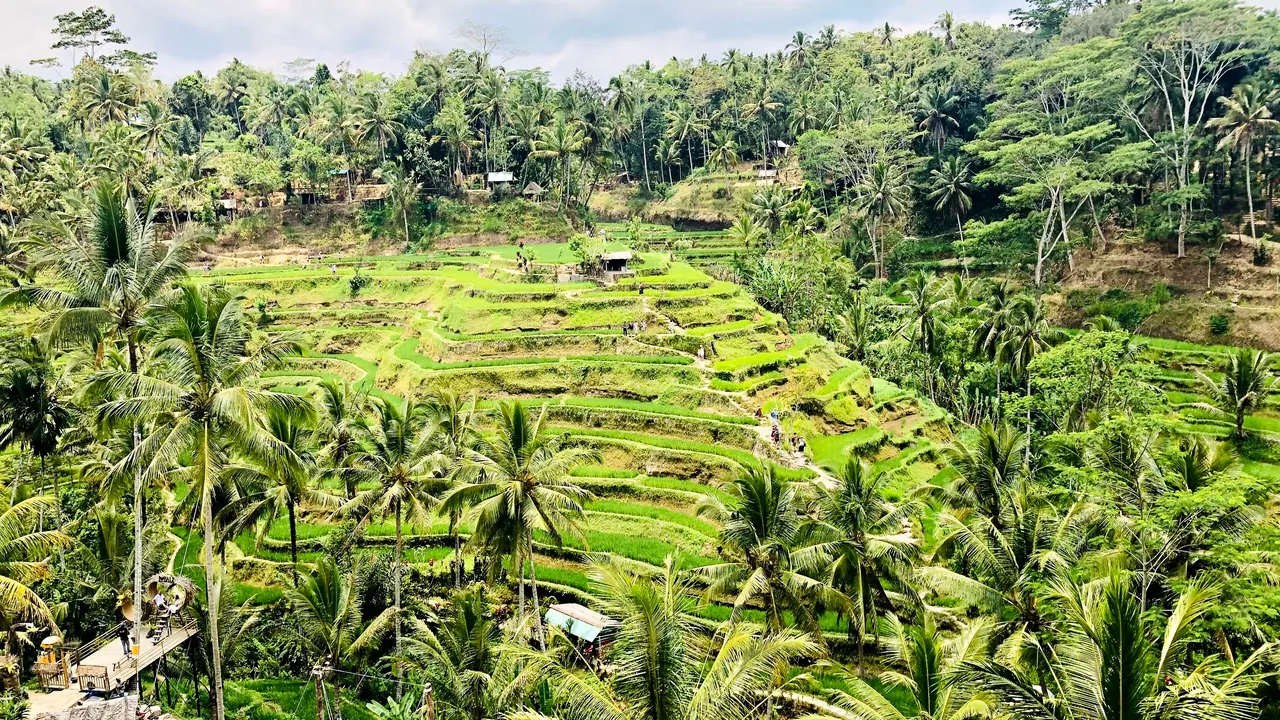
Photos: Phuket by Mussi Katz, CC0; Ubud by Pinterpandai, CC BY-SA 3.0, cropped.
Phuket or Ubud?
Our verdict in twelve categories, each scored against the same fixed benchmark cities, and the climate month by month, so you can choose for your trip.
Choose Phuket for
- nightlife
- beaches
- families
Phuket is the choice when the sea is the point of the trip. Its west coast strings together sandy bays, from busy Patong to the quiet northern beaches, and boats run out to Phi Phi and the Similans for diving. Bangla Road keeps going long after Ubud has gone to sleep. Families with young children will also find the resort beaches at Kata and Karon easier than a hill town with no pavements.
Choose Ubud for
- day trips
- live music and the arts
- culture and sights
Ubud suits travellers who want to slow down inland, among rice terraces and river gorges, with yoga at dawn and a Balinese massage most afternoons. It has the deeper culture of the two, with dance at the palace, painting museums and Bali's great temples within a driver's reach. It also costs less from day to day. Anyone who needs a beach on the doorstep or a late night should look to the coast instead.
Scoreboard
Twelve categories on one fixed scale from 0 to 100. The shaded stretch is the gap between the two.
Your match
Pick a travel style or drag the sliders, and both match scores follow your weighting.
Wins on nightlife and beaches with your weighting.
Wins on day trips and live music and the arts with your weighting.
What matters to you?
Category by category
What the scores mean for a trip.
Beaches & swimming
This is Phuket's home ground. The west coast alone offers a choice between the loungers of Patong, the broad sand of Kata and Karon, small coves such as Nai Harn and Freedom Beach, and long, quiet strands in the north at Mai Khao and Bang Tao. The one caveat is the monsoon, when red flags fly and rip currents close much of that coast to swimmers.
Ubud is a hill town, so a beach day means the best part of an hour by car, usually to Sanur, where the reef keeps the water calm. The black sand at Keramas and Saba is better for watching surfers than for swimming. Most Ubud stays revolve around a pool facing the rice fields.
Food & drink
Phuket has a cuisine of its own, and Phuket Town is the place to try it: thick Hokkien noodles, braised pork belly and crab curry with rice noodles at breakfast, served in shophouse cafés with Peranakan roots. The seafood in Rawai and the east-coast fishing villages adds to that, even if the menus along the beach strips are predictable.
Ubud's strength is Balinese cooking: suckling pig at lunch counters, slow-cooked bebek betutu and nasi campur in family warungs. Around it is a large plant-based café scene that suits health-minded eaters. It is varied for a town of its size, but it has nothing to match the distinct regional kitchen of Phuket Town.
Culture & sights
Ubud has far more to see. Culture there is lived in the open, in household shrines, daily offerings and temple processions. Around that are the royal palace, Pura Taman Saraswati with its lotus pond, three museums of Balinese painting and the eleventh-century Elephant Cave of Goa Gajah on the edge of town.
Phuket's heritage fits into a half day in the Sino-Portuguese old quarter of Phuket Town, plus Wat Chalong and the Big Buddha above Chalong Bay. It is pleasant enough, but it is an addition to a beach stay rather than a reason to come.
Nightlife
The gap here is wide. Phuket has Bangla Road in Patong, a neon strip of bars and big clubs open until the small hours every night of the high season. There are also sunset beach clubs on the west coast and a quieter scene of shophouse bars in Phuket Town.
Ubud keeps early hours, because many of its visitors get up for dawn yoga or a sunrise on Mount Batur. An evening means dinner, a garden bar and perhaps a band, and anyone who wants clubs has to make the long drive down to Seminyak or Canggu.
Nature & outdoors
Both are strong outdoors, but in different elements. Phuket's nature is mostly at sea: kayaking through the limestone towers and hidden lagoons of Phang Nga Bay, or diving with reef sharks and rays around the Racha and Similan islands. On land the island offers little more than the Khao Phra Thaeo rainforest and short headland walks.
Ubud's landscape is inland and best seen on foot: the Campuhan Ridge path, the Tegallalang terraces, rafting on the Ayung, jungle waterfalls and the pre-dawn climb of Mount Batur. Choose by whether you would rather be in the water or walking above the paddies.
Day trips
Ubud is the better base for excursions. It sits in the middle of Bali, within reach of the island's great temples: Tirta Empul and Gunung Kawi close by, Besakih on Mount Agung, Tanah Lot on the coast, and the UNESCO-listed terraces of Jatiluwih. The limit is the slow roads, and almost every trip needs a hired driver.
From Phuket most outings are by boat, to Phi Phi, the stilt village of Koh Panyee or the rural Koh Yao islands, and Krabi is two to three hours away by road. Tours tend to repeat the same stops, so one or two trips are usually enough.
Good for families
Phuket is the easier choice with children. The resorts at Kata, Karon and the northern beaches come with lagoon pools and kids' clubs, the water is gentle in the dry season, and water parks and an aquarium fill the extra days. Keep away from Patong after dark and from the west coast during the monsoon.
Ubud gives families just as warm a welcome, and older children enjoy the rafting, the dance shows and the walks through the rice fields. Missing pavements, macaques that grab at bags and long car journeys make it hard work with toddlers, though.
Getting around
Neither is easy without a driver, but Phuket is the less awkward of the two. Songthaew buses link Phuket Town with the main beaches, an airport bus runs along the west coast, and the island takes only about an hour to cross from end to end. Its roads are congested, though, and risky for novice scooter riders.
Ubud has no public transport worth using, and its pavements are broken and its valley roads steep, so most days are planned around ride-hailing or a hired driver. Staying near the centre is the only way to walk to dinner.
Shopping & style
Ubud is the better place to buy something made by hand. The art market across from the palace, woodcarving in Mas, silver in Celuk, paintings in Batuan and furniture workshops on the road to Tegallalang add up to a genuine craft trail. In town, small boutiques sell linen clothing and yoga wear.
Phuket's shopping is more practical: malls with international chains, beach stalls and tailors who make clothes in a few days. Its best finds are in Phuket Town, at the Sunday walking street and in the old-town boutiques selling batik, and in the pearls from nearby farms.
Affordability
Ubud stretches a budget further. Homestays with breakfast, meals in warungs, massages and day-long drivers all cost little, though its jungle resorts and tasting menus can be as expensive as anywhere on Bali.
Phuket is one of Thailand's pricier places, and fixed-fare taxis, boat trips and high-season beachfront prices soon add up. Staying in Phuket Town or at Kata and Karon and eating locally keeps a trip reasonable.
Live music & performing arts
Ubud has a real tradition to watch. Legong, Barong and Kecak are danced every evening to a live gamelan in the palace courtyard and at Pura Taman Saraswati, by village troupes that also perform at temple festivals. Beyond dance there is little, and there is no theatre or concert hall.
Phuket offers entertainment made for tourists: cabaret revues in Patong, a theme-park show, Thai boxing nights and cover bands in the bars. It fills an evening, but it is no reason to choose the island.
Wellness & relaxation
Both are good places to unwind, but Ubud is built around it. Yoga runs from dawn in open pavilions, retreats last anywhere from a weekend to several weeks, and Balinese massage, flower baths and traditional healers are part of local life. The purification ritual at Tirta Empul is close by.
In Phuket, wellness means massage and spa, from shopfronts on the beach roads to resort pavilions over the sea, plus detox programmes and Muay Thai camps around Chalong. For calm, stay at Mai Khao, Laguna or Nai Harn, because Patong is anything but calm.
When should you go?
Pick your month. The climate figures are measured averages, not a forecast.
Phuket in July
Ubud in July
Daytime high, °C
Rainfall in the month, mm
Where the figures come from
Phuket's temperatures are measured 27 km from the centre, at Phuket Airport.
Ubud's temperatures are measured 29 km from the centre, at Denpasar / Ngurah-Rai.
Ubud's station stands 209 m below the city centre, so the centre is likely a little cooler than the figures say.
Ubud has no rain gauge within 25 km of the centre, so its rainfall comes from a gridded climate dataset read at the destination rather than from a gauge further away.
Temperature and rainfall are climate normals, averaged over the years shown. Phuket: 1991-2020 (sunshine 1961-1990, rainfall 1981-2010) normals, Phuket Airport (26.9 km from centre). Ubud: 1991-2020 normals, Denpasar / Ngurah-Rai (29 km from centre).
Both are hot all year, with daytime highs around 30°C or a little more in every month, so the real question is rain, and the two run on opposite calendars. Phuket is at its best from December to April, when the Andaman Sea is calm, the sun shines for most of the day and January and February see barely any rain. The southwest monsoon arrives in May, and September is the wettest month at 373mm. Until the season turns in November the west-coast surf makes swimming risky.
Ubud's dry months fall in the middle of the year, from about May to October, with August the driest and sunniest. December to February is the heart of the rainy season, with close to 300mm in January. The rice fields are at their greenest then, but the trails turn muddy. The sea off Sanur stays around 28°C all year, a little cooler in August. A July or August trip favours Ubud, and a January or February trip favours Phuket.
Which traveller are you?
For a beach and sun trip, Phuket wins easily. Its west coast offers a choice of sandy bays with warm, clear water from November to April, plus boat trips to the islands, while Ubud has no beach and the coast is a long drive away.
On a culture and arts trip, Ubud is the better base. Dance with a live gamelan is staged every evening, three museums trace the history of Balinese painting, and Tirta Empul, Gunung Kawi and Besakih are all within a day's drive.
For a food and nightlife trip, Phuket has the edge. Phuket Town serves its own Hokkien-influenced cooking from breakfast onwards and Patong's Bangla Road runs until the small hours. In Ubud the evening ends with a garden dinner, and the streets are quiet before midnight.
Before you go
| Measure | Phuket | Ubud |
|---|---|---|
| Official language | Thai | Indonesian |
| Currency | Baht (THB) | Rupiah (IDR) |
| Sockets | ABCF220 V, 50 Hz | CF50 Hz |
| Driving side | Left | Left |
| Time zone | UTC+7 | UTC+8 |
| Emergency number | Police 191, ambulance 1669, fire 199 | 112 |
| Elevation | - | 210 m |
| Main airport | Phuket International Airport (HKT)85 non-stop destinations | Denpasar I Gusti Ngurah Rai International Airport (DPS)29 km from centre64 non-stop destinations |
By the numbers
| Measure | Phuket | Ubud |
|---|---|---|
| Population | 77,610 | - |
| People per km² | 6,468 | - |
| Museums within 10 km | - | 14 |
| UNESCO World Heritage sites within 50 km | - | 1 |
| Swim season, months above 21 °C | 12 months | 12 months |
Where else could you go?
Every comparison below shares a destination with this one, so you can follow Phuket or Ubud somewhere new.
- Koh Phi Phivs Phuket
- Krabivs Phuket
- Koh Lantavs Phuket
- Koh Lipevs Phuket
- Langkawivs Phuket
- Koh Samuivs Phuket