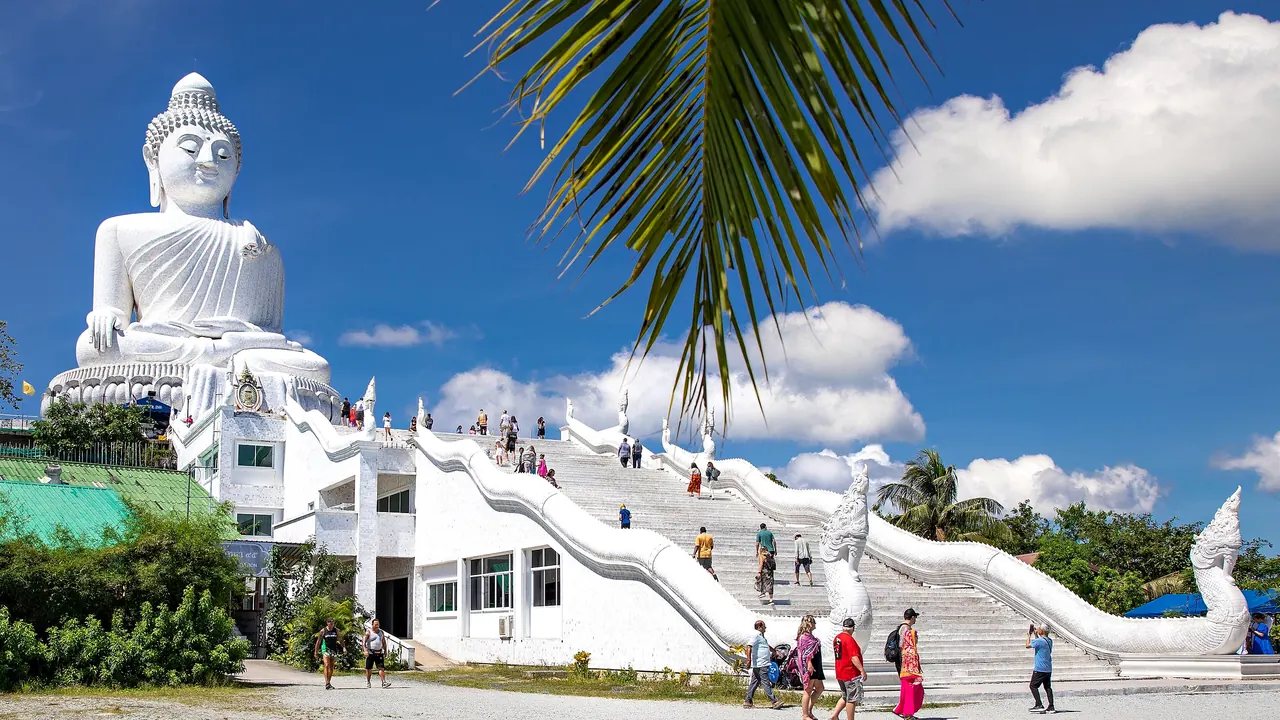
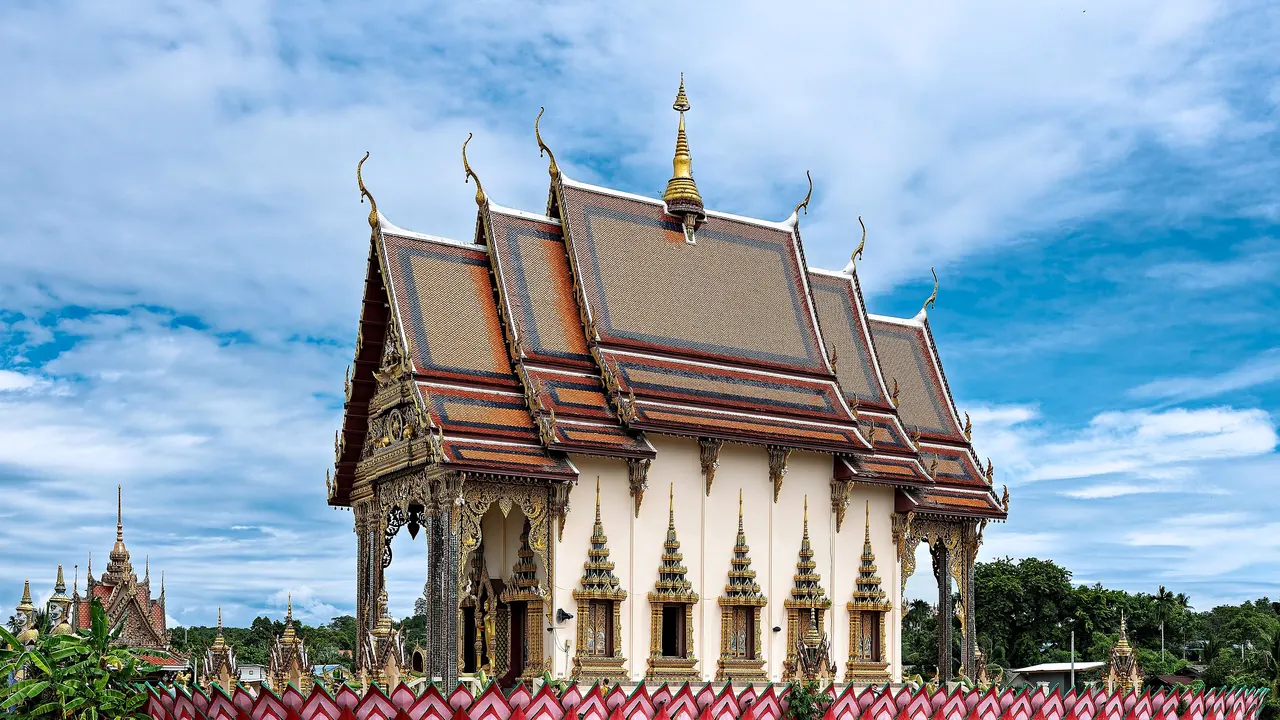
Photos: Phuket by Mussi Katz, CC0; Koh Samui by Mustang Joe, CC0.
Phuket or Koh Samui?
Our verdict in twelve categories, each scored against the same fixed benchmark cities, and the climate month by month, so you can choose for your trip.
Choose Phuket for
- culture and sights
- day trips
- nature and the outdoors
Phuket is the island with more to do. Phuket Town has a cooking tradition of its own and an old quarter worth walking, Phang Nga Bay and the Similan reefs give the outdoors real depth, and a bridge to the mainland opens up Krabi. It is at its best from late autumn to spring. Its beaches are as good as Samui's, but the monsoon surf makes the west coast risky in summer.
Choose Koh Samui for
- wellness
- getting around
Koh Samui suits travellers who want a slower beach stay with few demands on their time. It has a long-standing retreat culture around Lamai and quiet corners on the north and west coasts, and its sights fit into a single afternoon. It is also the better choice for a summer trip, because its heavy rain comes late in the year, when Phuket is drying out. What you give up is variety: the food is narrower, there are fewer outings, and there is little to see beyond the beach.
Scoreboard
Twelve categories on one fixed scale from 0 to 100. The shaded stretch is the gap between the two.
Your match
Pick a travel style or drag the sliders, and both match scores follow your weighting.
Wins on culture and sights and day trips with your weighting.
Wins on wellness and getting around with your weighting.
What matters to you?
Category by category
What the scores mean for a trip.
Beaches & swimming
The beaches are equally good, but they lie on different seas. Samui faces the Gulf of Thailand. Chaweng is its broad white strand, Choeng Mon a sheltered bay, and the north coast beaches go shallow and cloudy at low tide. Pretty coves like Silver Beach are tucked among the boulders.
Phuket's chain of west coast bays faces the open Andaman Sea. They range from busy Patong to small headland beaches like Nai Harn and Freedom Beach, with longer, quieter sand in the north at Mai Khao. That open water brings dangerous monsoon surf from May to October, while Samui's rough spell is shorter and hits only the east coast.
Food & drink
Phuket eats better, because it has a cuisine of its own. The Hokkien and Peranakan cooking in Phuket Town brings yellow noodles, braised pork belly, crab curry with rice noodles for breakfast and early-morning dim sum in old shophouses. Seafood in Rawai and a small fine-dining tier add to that.
Samui's food is good southern Thai cooking, at its best at the night markets in Lamai, Maenam and Fisherman's Village. Beyond that and grilled fish there is not much range, and the Chaweng strip is hit and miss.
Culture & sights
Neither island is a heritage destination, but Phuket has more to show. Its tin-mining wealth left the old quarter of Phuket Town, with pastel Sino-Portuguese shophouses, merchants' mansions, Chinese shrines and small museums. The Thalang National Museum tells the story of the Burmese siege of 1785.
Samui's sights are a half-day loop with no museums of note. The loop takes in the Big Buddha on its islet, the many-armed Guanyin at Wat Plai Laem, the seated mummified monk at Wat Khunaram and a lane of wooden shophouses in Bophut.
Nightlife
Both islands party hard in high season, but in different ways. Samui's nights are spread across the sand at Chaweng, with beach bars, fire shows and DJ sets and clubs in the lanes behind, and the full moon parties on Koh Phangan are a short boat ride away. Phuket packs its loudest night into Bangla Road in Patong, a pedestrian strip of neon bars and big clubs.
Phuket also has more choice away from the party street: sunset sessions at west coast beach clubs, and shophouse cocktail and live-music bars in Phuket Town that are popular with Thai residents.
Nature & outdoors
Phuket has the richer outdoors. Phang Nga Bay's limestone towers can be explored by sea kayak through caves into hidden lagoons. The Racha and Similan islands offer some of Thailand's best reef diving, and the island itself still has a patch of original rainforest with gibbons at Khao Phra Thaeo.
Samui's best outing is Ang Thong Marine Park, with its emerald inland lake and cliff-top viewpoint, and divers can head for Sail Rock. On land it has the Na Muang waterfalls and jeep tracks through coconut plantations, which are modest by comparison.
Day trips
Phuket has the wider range of outings, partly because a bridge joins it to the mainland. By boat you can reach the Phi Phi islands, the stilt village of Koh Panyee and the rural Koh Yao islands. By road you can get to Krabi and Ao Nang in two to three hours, or to the old tin town of Takua Pa.
From Samui, nearly every outing means a boat. Koh Phangan is the easy one, Koh Tao and the Nang Yuan sandbar take a full day, and the nearby mainland is just a transport hub.
Good for families
Phuket gives children more to do. It has two large water parks, an aquarium at Cape Panwa, a cultural theme-park show and gentle dry-season bays at Kata and Karon. The catch is summer, when the west coast surf is no place for small swimmers.
Samui's calm, shallow water at Choeng Mon, Bophut and Maenam suits toddlers, and its resorts are just as geared to families. Once you leave the pool, though, there is little more than a single water park, a few small animal parks and the boat trip to Ang Thong.
Getting around
On both islands you will need taxis, ride-hailing apps or a hire car, and on both, scooters on the hilly roads carry real risk. Their layouts differ. Samui is a single ring road of about 51km, with songthaews running along it and neighbouring beaches around a quarter of an hour apart.
Phuket takes about an hour to cross from end to end, and the coastal roads clog in high season. Its songthaews run from Phuket Town out to the beaches rather than between them, so most visitors stay at one beach and book transport for outings.
Shopping & style
Phuket is the better place to shop, mainly thanks to its old town. The shophouse boutiques and small galleries there sell batik, local design and Peranakan-style goods, there is a Sunday walking street, and pearls from nearby farms are a local speciality.
Samui's best browse is the Friday walking street in Fisherman's Village, with crafts and coconut-wood homeware. Otherwise there is beachwear, a mall in Chaweng and stalls selling copies.
Affordability
The two cost much the same: both are among Thailand's dearer places, yet cheaper than most Western beach resorts. Getting to Samui costs more because few flights serve its small airport, and on both islands taxis are expensive.
The ways to save differ. On Samui, stay on the north or west coast in a simple bungalow. On Phuket, base yourself in Phuket Town or at Kata and Karon, and come outside the December to March peak.
Live music & performing arts
Neither island offers serious theatre or concerts, and on both the evening shows are made for visitors. Phuket has a little more choice, with long-running cabaret revues in Patong, a large show with dancers and elephants, and blues or reggae sets in Phuket Town bars. On Samui it comes down to Muay Thai fight nights, cabaret, fire dancers and cover bands.
Wellness & relaxation
Both islands are strong for massage, spas and retreats, but the emphasis differs. Samui's retreat tradition is older and quieter, with detox and fasting programmes in the hills above Lamai and very slow days around Maenam, Bang Po and Lipa Noi.
Phuket's version is more active. Muay Thai and fitness camps are clustered around Chalong, and resort spas have open-air pavilions over the sea. For peace and quiet, stay in the north at Mai Khao or Nai Yang, or in the south around Nai Harn.
When should you go?
Pick your month. The climate figures are measured averages, not a forecast.
Phuket in July
Koh Samui in July
Daytime high, °C
Rainfall in the month, mm
Where the figures come from
Phuket's temperatures are measured 27 km from the centre, at Phuket Airport.
Koh Samui has no rain gauge within 25 km of the centre, so its rainfall comes from a gridded climate dataset read at the destination rather than from a gauge further away.
Temperature and rainfall are climate normals, averaged over the years shown. Phuket: 1991-2020 (sunshine 1961-1990, rainfall 1981-2010) normals, Phuket Airport (26.9 km from centre). Koh Samui: 1991-2020 normals, Ko Samui (7.4 km from centre).
These two islands sit on opposite sides of the Thai peninsula, so their wet seasons fall at different times. On Koh Samui the weather stays fairly settled from January to September, with February the driest month. The northeast monsoon then arrives from October to December, peaking at around 372mm of rain in November, and the east coast beaches turn choppy. Phuket's west coast is dry and sunny from December to March. January and February are almost rainless there, though March is the hottest month at around 34°C, which makes walking around Phuket Town at midday hard work.
From May to October Phuket gets the southwest monsoon. Rain peaks at about 373mm in September, sunshine drops sharply and the surf on the west coast is dangerous. Samui is hot through that period but much drier. Neither island ever gets cool, and the sea stays around 29°C at both all year. The simple rule is Phuket in winter and early spring, Samui in summer.
Which traveller are you?
For a relaxing and wellness trip, Koh Samui has the edge. Lamai's detox and fasting retreats have a long history, and the north and west coasts around Maenam and Lipa Noi have long, slow afternoons, with less going on to tempt you away from rest.
On an outdoors trip, Phuket offers far more. You can kayak through sea caves in Phang Nga Bay, dive with reef sharks around the Similans and walk in the rainforest at Khao Phra Thaeo. Samui's Ang Thong park makes a fine single day, but there is less beyond it.
On a beach and sun trip, choose by the calendar rather than the sand. Samui's beaches are calm and dry from late spring through September, when Phuket's west coast has red flags flying. Between December and April, Phuket's Andaman bays are at their best.
Before you go
| Measure | Phuket | Koh Samui |
|---|---|---|
| Official language | Thai | Thai |
| Currency | Baht (THB) | Baht (THB) |
| Sockets | ABCF220 V, 50 Hz | ABCF220 V, 50 Hz |
| Driving side | Left | Left |
| Time zone | UTC+7 | UTC+7 |
| Emergency number | Police 191, ambulance 1669, fire 199 | Police 191, ambulance 1669, fire 199 |
| Main airport | Phuket International Airport (HKT)85 non-stop destinations | Samui International Airport (USM)10 non-stop destinations |
By the numbers
| Measure | Phuket | Koh Samui |
|---|---|---|
| Population | 77,610 | 62,500 |
| People per km² | 6,468 | 273 |
| Swim season, months above 21 °C | 12 months | 12 months |
Where else could you go?
Every comparison below shares a destination with this one, so you can follow Phuket or Koh Samui somewhere new.
- Koh Phanganvs Koh Samui
- Koh Phi Phivs Phuket
- Krabivs Phuket
- Koh Taovs Koh Samui
- Koh Lantavs Phuket
- Koh Lipevs Phuket