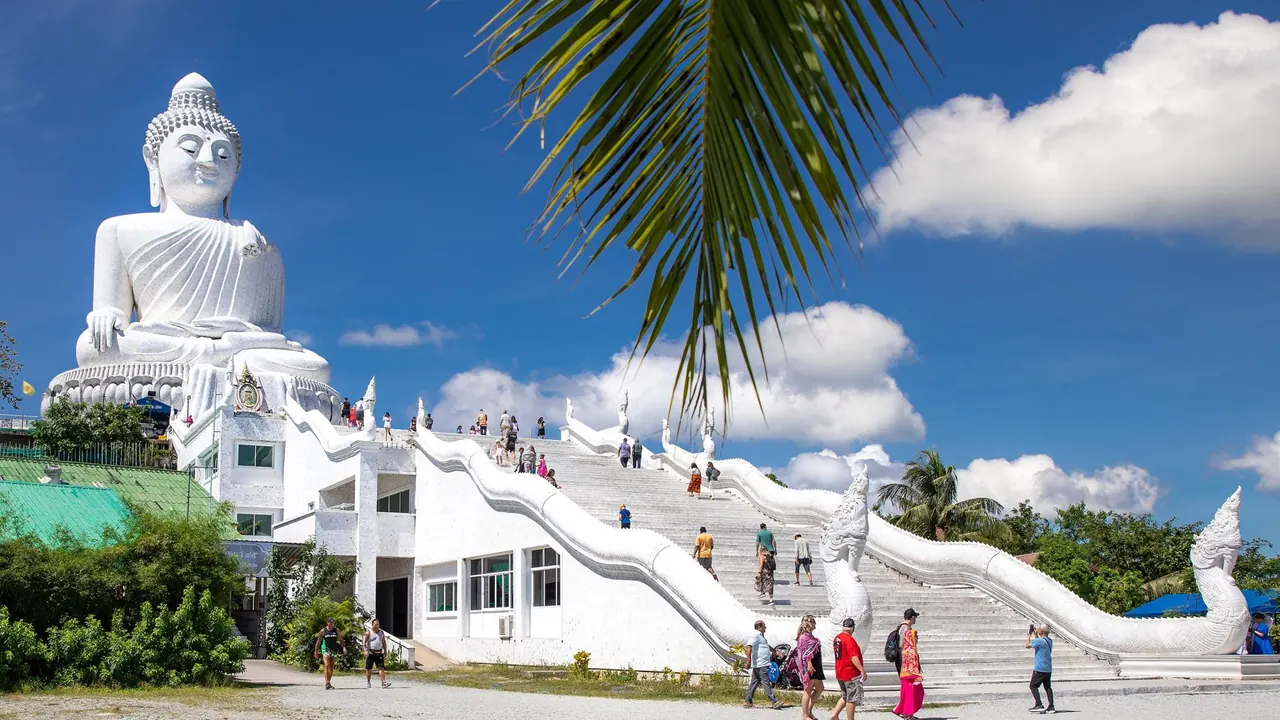
Photos: Phuket by Mussi Katz, CC0.
Goa or Phuket?
Our verdict in twelve categories, each scored against the same fixed benchmark cities, and the climate month by month, so you can choose for your trip.
Choose Goa for
- culture and sights
- prices
- live music and the arts
Goa suits a long winter beach stay with more history around it. The churches of Old Goa, the lanes of Fontainhas and the mansions of Chandor give real days away from the sand, and its Goan-Portuguese cooking rewards a trip inland. It is also the cheaper of the two, and the yoga villages of the far north and the south suit a slow, simple stay in a beach hut.
Choose Phuket for
- families
- nature and the outdoors
- getting around
Families and anyone drawn to the sea should lean towards Phuket. The resorts at Kata, Karon and the northern beaches are built around children, and the water beyond the bays is the real prize, with kayaking among the limestone towers of Phang Nga Bay and diving at the Similans. Massage and spa are easy to find at every level, though the heritage is an old town and a couple of temples.
Scoreboard
Twelve categories on one fixed scale from 0 to 100. The shaded stretch is the gap between the two.
Your match
Pick a travel style or drag the sliders, and both match scores follow your weighting.
Wins on culture and sights and prices with your weighting.
Wins on families and nature and the outdoors with your weighting.
What matters to you?
Category by category
What the scores mean for a trip.
Beaches & swimming
Both are long sandy coasts on very warm water with the same rhythm: calm from November and rough in the monsoon. Goa's beaches run for kilometres. They go from the crowded, shack-lined north at Calangute and Baga to the palm-backed coves of Palolem and Agonda, but the sea there is rarely clear.
Phuket's bays are shorter and set between headlands. In the dry season the Andaman is clear as well as calm, Kata Noi and Nai Harn are especially pretty, and boats go out to the white sand of Phi Phi and the Similans. For clear water Phuket has the slight edge. For a long walk along the sand, Goa does.
Food & drink
Both have a cuisine of their own, born of settlers from elsewhere, and both reward getting away from the beach menus. Goa's is Konkan coastal cooking reworked by the Portuguese: vindaloo, xacuti, sorpotel, bebinca and cashew feni, at their best in family kitchens in Panjim, Margao and the inland villages.
Phuket's comes from Hokkien and Peranakan families who arrived for the tin mines. Eat it in Phuket Town at breakfast, with yellow Hokkien noodles, rice noodles in crab curry and dim sum, then at the walking-street stalls in the evening. The Thai side is hotter and more herbal, while Goa leans on coconut, vinegar and pork.
Culture & sights
Goa has far more to see. Old Goa's basilica and cathedral form a World Heritage Site, and Fontainhas keeps a whole quarter of colonial houses. Add the Chandor mansions, the Ponda temples and the laterite forts, and there is enough for several days, though the sites are spread out and you need transport between them.
Phuket's heritage fits into a half day in the Sino-Portuguese shophouse grid of the old town, plus Wat Chalong, the Big Buddha and the Thalang museum. It is pleasant, but you fit it around the beach rather than plan the trip around it.
Nightlife
Both put their nights out on one stretch of coast, but the style differs. Goa's north has the club strips of Baga and Calangute and the electronic-music venues on the hills and cliffs at Anjuna and Vagator. Rules on amplified music push many parties indoors or end them early, everything peaks over Christmas and New Year, and the south goes to bed early.
Phuket's nights centre on Bangla Road in Patong, with neon bars and big clubs every night of the season and seedy edges. Beach-club day parties on the west coast and the shophouse cocktail bars of Phuket Town are the alternatives.
Nature & outdoors
Phuket is the stronger choice outdoors, and the reason is the sea. Kayaking into hidden lagoons among Phang Nga Bay's limestone towers, and diving or snorkelling at the Racha and Similan islands, are on another level from anything off the Goan coast.
Goa's nature lies inland: jungle trails in the Western Ghats sanctuaries, Dudhsagar Falls after the monsoon, and mangrove rivers that are excellent for birds in the dry months. It is green and pleasant rather than dramatic, and in both places the heat keeps hikes short.
Day trips
Neither is a great base for outings, and the outings themselves differ. From Goa they are mostly by road within the state: Panjim, market day in Mapusa, spice farms near Ponda and the ferry to Divar, with Gokarna about two hours south. Hampi needs a night away.
From Phuket they are mainly by boat: Phi Phi, the stilt village of Koh Panyee and the quiet Koh Yao islands. Krabi is two to three hours away by road.
Good for families
Phuket is much easier with children. The big resorts at Kata, Karon and the northern beaches have kids' clubs and lagoon pools. Two large water parks, an aquarium at Cape Panwa and boat trips to snorkelling islands give plenty to fill the days.
Goa offers the flat southern sands at Varca and Cavelossim, shallow warm water in winter and staff who dote on children, but almost nothing built for them. Its roads, currents, stray dogs and the care needed with food and water all take more managing.
Getting around
In both places you are best off choosing one beach and staying there, but Phuket is easier to manage. It takes about an hour to drive from one end to the other, songthaews run from Phuket Town to the main beaches, and ride-hailing works. Fares are fixed and high, though, and the hilly roads are risky for novice scooter riders.
Goa stretches along about 100km of coast. The drive from north to south can take two hours on narrow roads shared with cows and trucks, buses skip the beaches and ride-hailing is limited, so a scooter or a hired driver is close to essential.
Shopping & style
Neither is a shopping destination, but Phuket offers a little more. It has malls near Phuket Town and in Patong, tailors who make clothes in a few days, pearls from local farms, and Sunday's walking street in the old town with batik and Peranakan-style design.
Goa's shopping is its markets. The Anjuna flea market and the Arpora night market repeat the same shawls and silver, Mapusa sells spices and cashews, and a handful of boutiques around Panjim and Assagao sell linen and tiles.
Affordability
Goa is the cheaper stay. Huts in the quieter southern and far northern villages, fish curry at a shack and a rented scooter keep daily costs low, though rates jump over Christmas and New Year and taxis catch people out.
Phuket is among the pricier places in Thailand. High-season resorts, beachfront restaurants, fixed-fare taxis and boat trips all add up. Staying in Phuket Town or at Kata and eating locally narrows the gap but does not close it.
Live music & performing arts
Goa has stage traditions of its own, while Phuket's shows are put on for visitors. Goa has tiatr, a Konkani musical theatre, and the mando, a slow song with a Portuguese lilt, though both play to local audiences and few visitors see them. The Kala Academy on the Panjim riverfront puts on concerts, dance and drama, and the December arts festival and pre-Lenten Carnival bring music into the towns.
Phuket has no theatre or orchestra to speak of. Its evenings out are ladyboy cabaret revues in Patong, a large theme-park show with dancers and elephants, and Thai boxing nights. On either coast, most live music is a cover band playing in a bar.
Wellness & relaxation
Goa's wellness is built around yoga and ayurveda, and Phuket's around massage, spas and retreat camps. Phuket offers the wider choice. In Goa the yoga centres on the quiet villages of Arambol, Mandrem and Agonda, with shala platforms under the palms, teacher-training courses and ayurvedic cleansing programmes, all at the pace of hammocks and early nights.
Phuket has Thai massage on every beach road and resort spas with open-air pavilions over the sea. Around Chalong there are detox, meditation and Muay Thai camps. The northern beaches, the Laguna area and Nai Harn make calm bases, as long as you stay away from Patong.
When should you go?
Pick your month. The climate figures are measured averages, not a forecast.
Goa in July
Phuket in July
Daytime high, °C
Rainfall in the month, mm
Where the figures come from
Phuket's temperatures are measured 27 km from the centre, at Phuket Airport.
Temperature and rainfall are climate normals, averaged over the years shown. Goa: 1991-2020 normals, Goa / Panjim (9.4 km from centre). Phuket: 1991-2020 (sunshine 1961-1990, rainfall 1981-2010) normals, Phuket Airport (26.9 km from centre).
Goa has one sharply defined dry season. From November to April almost no rain falls, the sky is clear and the sea stays around 28°C. It is hot all year, so walking around Old Goa or Panjim is best done in the morning or late afternoon. Then the monsoon arrives hard. July brings close to 960mm and very little sun, swimming stops, and October is still damp.
Phuket has a shorter dry window, December to March, when rain is light and the west coast is calm. Rain builds from April, and May to October is wet, with dangerous surf on the west coast. Its monsoon is spread more evenly and is less extreme than Goa's, though, and keeps far more sunshine, so a midsummer visit is workable in a way it is not in Goa. Daytime highs sit around 32°C in both places all year.
Which traveller are you?
On a family trip with children, Phuket is the easier choice. The resorts at Kata, Karon and the northern beaches have kids' clubs and lagoon pools, and the water parks and the aquarium fill the days. The island is also smaller and quicker to cross than Goa's long coast.
For a culture and arts trip, Goa is clearly ahead. Old Goa's World Heritage churches, the Fontainhas quarter, the Chandor mansions and the Ponda temples fill several days, while Phuket's heritage barely stretches beyond a half day in its old town.
On an outdoors trip, especially one built around the water, choose Phuket. Sea kayaking through the caves of Phang Nga Bay and diving with rays and reef sharks at the Similans go well beyond Goa's gentler mix of jungle sanctuaries, river birdwatching and waterfalls.
Before you go
| Measure | Goa | Phuket |
|---|---|---|
| Official language | Hindi, English | Thai |
| Currency | Indian Rupee (INR) | Baht (THB) |
| Sockets | CM230 V, 50 Hz | ABCF220 V, 50 Hz |
| Driving side | Left | Left |
| Time zone | UTC+5:30 | UTC+7 |
| Emergency number | 108 or 112 | Police 191, ambulance 1669, fire 199 |
| Main airport | Goa Dabolim International Airport (GOI)24 non-stop destinations | Phuket International Airport (HKT)85 non-stop destinations |
By the numbers
| Measure | Goa | Phuket |
|---|---|---|
| Population | 1,458,545 | 77,610 |
| People per km² | 394 | 6,468 |
| Swim season, months above 21 °C | 12 months | 12 months |
Where else could you go?
Every comparison below shares a destination with this one, so you can follow Goa or Phuket somewhere new.
- Koh Phi Phivs Phuket
- Krabivs Phuket
- Koh Lantavs Phuket
- Langkawivs Phuket
- Koh Samuivs Phuket
- Koh Phanganvs Phuket