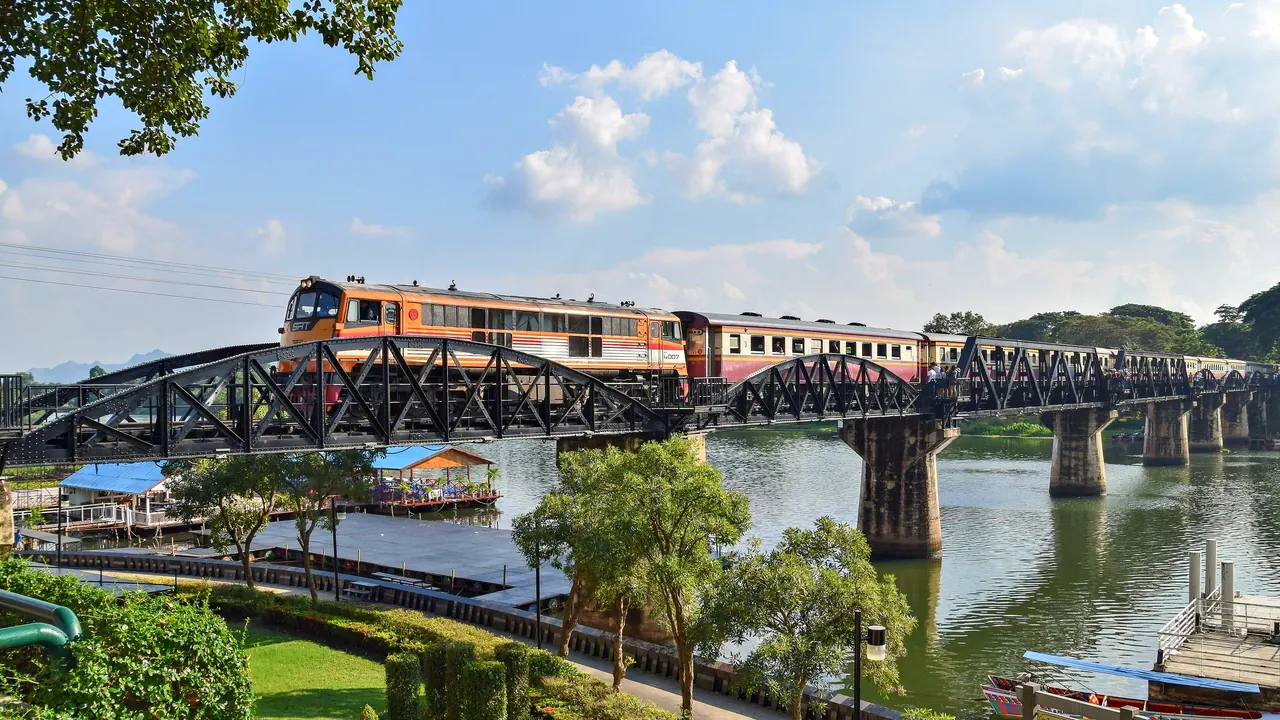
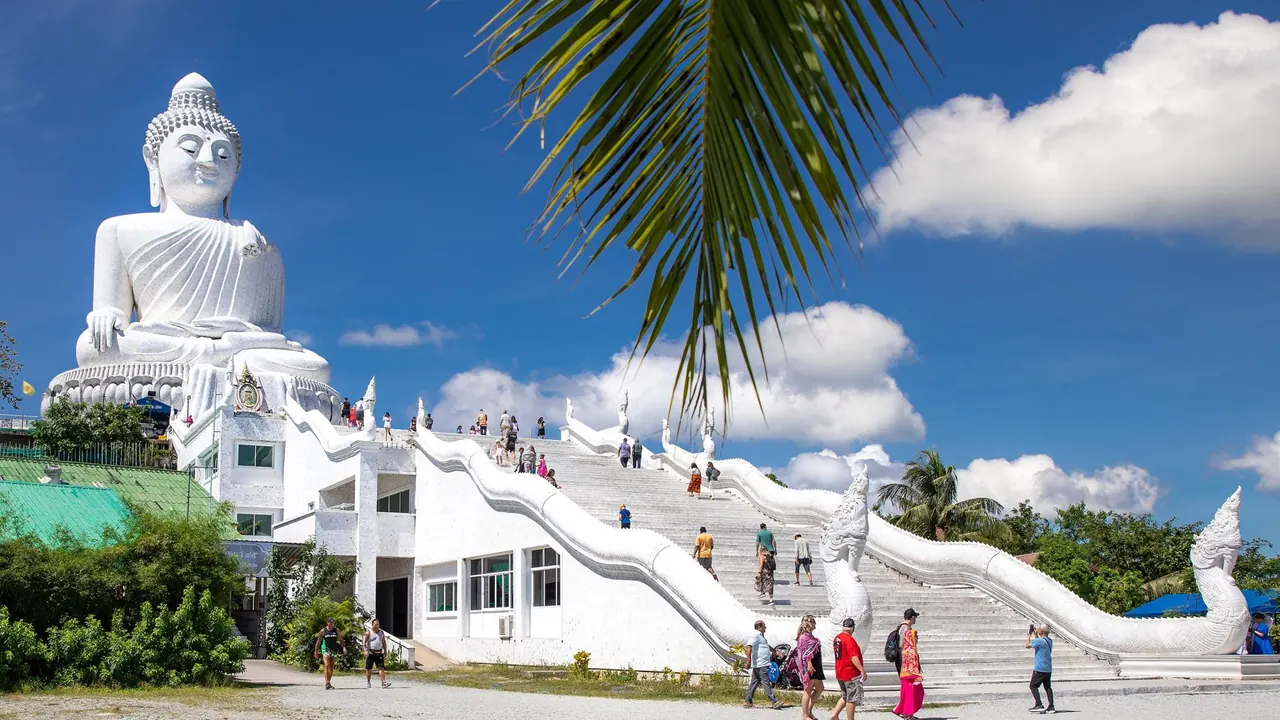
Photos: Kanchanaburi by Krzysztof Golik, CC BY-SA 4.0, cropped; Phuket by Mussi Katz, CC0.
Kanchanaburi or Phuket?
Our verdict in twelve categories, each scored against the same fixed benchmark cities, and the climate month by month, so you can choose for your trip.
Choose Kanchanaburi for
- prices
- getting around
- day trips
Kanchanaburi suits a slower, cheaper trip built around history and the river. You get a day at the Bridge over the River Kwai and the war cemeteries, a ride up the old Death Railway, the Erawan falls, and nights in a raft house where the evening ends after the night market. It's the better pick if you want rural Thailand on a small budget and don't need sand or a night out.
Choose Phuket for
- beaches
- nightlife
- wellness
If the sea is the point, go to Phuket. Its west-coast bays, boat trips into Phang Nga Bay and out to the islands, resort spas and Patong's late nights make it the stronger choice for beach vacations, for families who stay in one resort and for anyone who wants to be pampered. In return you'll pay more and take taxis almost everywhere.
Scoreboard
Twelve categories on one fixed scale from 0 to 100. The shaded stretch is the gap between the two.
Your match
Pick a travel style or drag the sliders, and both match scores follow your weighting.
Wins on prices and getting around with your weighting.
Wins on beaches and nightlife with your weighting.
What matters to you?
Category by category
What the scores mean for a trip.
Beaches & swimming
There's no contest here. Kanchanaburi is a river town several hours from the coast. Swimming means the turquoise pools at Erawan or floating on the River Kwai from a raft house, which is refreshing but no substitute for the sea.
Phuket has a whole coast of sandy bays: crowded Patong, the calmer Kata and Karon, quiet Nai Harn and the long, empty beach at Mai Khao, plus boat trips to island beaches. Come between November and April, though. For the rest of the year monsoon rip currents make the west coast dangerous.
Food & drink
Kanchanaburi feeds you well and cheaply with ordinary central Thai cooking. There are noodle shops, the night market by the station and river fish eaten on floating restaurants at sunset, but little beyond that.
Phuket has a cooking style of its own, rooted in its Hokkien and Peranakan past. Try the yellow Hokkien noodles, peppery moo hong and dim sum breakfasts in Phuket Town, along with fiery southern curries and seafood sold by weight. The beach towns add resort dining and international food, so the choice is much wider.
Culture & sights
Both give you a good day or two of sightseeing rather than a whole cultural trip, but what you see is very different. Kanchanaburi's sights tell one sobering story from the Second World War: the bridge, the cemeteries with their rows of Allied graves, and the Thailand-Burma Railway Centre.
Phuket's history comes from trade and tin mining. You'll find the pastel Sino-Portuguese shophouses of Thalang Road and Soi Romanee, Chinese clan houses and shrines, as well as Wat Chalong and the Big Buddha. Choose Kanchanaburi for a moving lesson in history, or Phuket for a pretty old town to wander.
Nightlife
Evenings in Kanchanaburi mean a few beers on the riverside backpacker strip, perhaps with a cover band, and at weekends the noise of Thai party rafts drifting past. Most people are in bed early.
Phuket offers a proper night out, centred on Bangla Road in Patong, where neon-lit bars and big clubs stay open until dawn. If that is too rowdy, there are sunset beach clubs at Bang Tao and Kamala, and quieter bars in Kata, Rawai and the old shophouses of Phuket Town.
Nature & outdoors
Both make good bases for the outdoors, with Phuket a step ahead, and the difference is land against sea. Kanchanaburi looks out over the forested limestone hills along the Burmese border. Its highlights are the seven-tier Erawan falls, the caves and falls at Sai Yok, kayaking on the reservoirs and cycling through paddy fields.
In Phuket the best outings are on the water. You can kayak among the limestone towers and lagoons of Phang Nga Bay, or snorkel and dive off the Racha islands, Phi Phi and, in the dry season, the Similans. On land there is less, mainly short rainforest trails at Khao Phra Thaeo and sunset viewpoints.
Day trips
Kanchanaburi has more varied outings by land. The old railway runs north along river cliffs towards Nam Tok and Hellfire Pass, and the Khmer ruins of Prasat Muang Singh make a quiet half day. To the east, Nakhon Pathom's great chedi and the canal markets are within two hours.
From Phuket, nearly every day out is a boat trip to another island, such as busy Phi Phi or the quiet villages of Koh Yao, or a drive to Krabi and Ao Nang. These are pleasant trips, but there are few historic places within reach, so the days tend to feel alike.
Good for families
Kanchanaburi has its moments for children: splashing in the Erawan pools, the slow train over wooden trestles and a night in a raft house. But the town's main sights are cemeteries and museums, the heat is tiring and most outings mean a minivan.
With children, Phuket is the easier choice. Resorts at Kata, Karon, Nai Harn and the northern bays have kids' clubs, big pools and shallow water in the dry season. There are also water parks, an aquarium and short snorkelling trips. Avoid Patong after dark and stay out of the west-coast sea in the monsoon months.
Getting around
Neither is easy without your own transport, but Kanchanaburi is easier. The town stretches along a flat riverbank where a bicycle works well, and cheap songthaews, local buses and the slow train reach the main sights, though slowly.
Phuket is a big, hilly island. Its one bus down the west coast runs infrequently and stops early, and the songthaews don't link one beach to the next. Most visitors end up in taxis with high fixed fares, and riding a scooter on the steep roads is a real risk.
Shopping & style
Phuket has much more for shoppers. There are malls near Phuket Town and in Patong, a big weekend night market, tailors and pearl shops, and small galleries and design shops in the old town, where Thalang Road becomes a walking-street market on Sundays.
In Kanchanaburi, shopping is limited to the markets, souvenir stalls by the bridge, a modest mall and some sapphire dealers, where you need to know what you are buying.
Affordability
Your money goes further in Kanchanaburi. Raft rooms and guesthouses cost little, market and shophouse meals are cheap, and the train and buses are almost free. The main extra costs are the foreigner entry fees at national parks and hiring private drivers.
Phuket is still good value by Western standards, but beachfront rooms, tourist restaurants and above all taxis add up quickly. Room prices also climb sharply from December to February. You can keep costs down by staying in Phuket Town or by coming in the monsoon.
Live music & performing arts
Neither is a place for theatre or concerts. Phuket at least has evening entertainment: big ladyboy cabaret shows, staged Thai cultural performances and reggae or cover bands in beach bars.
Kanchanaburi has little more than riverside cover bands for most of the year. The exception is River Kwai Bridge Week, when a sound-and-light show with fireworks restages the wartime bombing of the bridge. It's worth planning a visit around.
Wellness & relaxation
Kanchanaburi relaxes you through its slow pace, with hammocks at the raft houses on the upper River Kwai and cheap Thai massage in town. On the way north you can stop for a soak in the small hot springs at Hin Dat.
Phuket is set up for wellness. Massage is everywhere, from shopfronts on the beach roads to resort spas in the jungle, and there are retreats offering yoga, meditation and detox programmes. In Chalong, Muay Thai camps take visitors who want to train hard. For peace and quiet, stay at Nai Harn, Rawai, Mai Khao or on the east coast.
When should you go?
Pick your month. The climate figures are measured averages, not a forecast.
Kanchanaburi in July
Phuket in July
Daytime high, °C
Rainfall in the month, mm
Where the figures come from
Phuket's temperatures are measured 27 km from the centre, at Phuket Airport.
Temperature and rainfall are climate normals, averaged over the years shown. Kanchanaburi: 1961-1990 (rainfall 1981-2010) normals, Kanchanaburi (0.4 km from centre). Phuket: 1991-2020 (sunshine 1961-1990, rainfall 1981-2010) normals, Phuket Airport (26.9 km from centre).
Kanchanaburi is at its best from December to February. The rains are over, the countryside is still green from the wet season, and the days are hot but fine for sightseeing. November is greener still, but it gets real rain, around 106mm, as the wet season tails off. March and April are the hottest months, peaking near 38°C, which makes long walks hard work. The rains build from May and are heaviest in September and October, reaching about 236mm in September.
Phuket's dry, sunny season runs from about December to March, when the west coast has calm water and the most sunshine. The sea stays around 29°C all year. From May to October, though, the monsoon brings rough seas and far heavier rain than Kanchanaburi gets, peaking at about 373mm in September. On the island the daytime heat barely changes through the year, while inland Kanchanaburi swings from warm to scorching. Both are at their best around the turn of the year.
Which traveller are you?
For a beach and sun trip, choose Phuket. Its sandy west-coast bays, warm sea and boat trips to island beaches have no equivalent in Kanchanaburi, which lies hours inland. Just come in the dry season, when swimming is safe.
On a food and nightlife trip, Phuket wins easily. It has Hokkien noodles and dim sum in Phuket Town, seafood by the water and Patong's all-night bars and clubs. Kanchanaburi offers a night market and quiet evenings that end early by the river.
On a trip on a tight budget, Kanchanaburi is the safer choice. A small budget lasts a long stay, and its best days, cycling past paddy fields or a dip at Erawan, cost little. Phuket can be done cheaply, but mostly away from the beaches you came for.
Before you go
| Measure | Kanchanaburi | Phuket |
|---|---|---|
| Official language | Thai | Thai |
| Currency | Baht (THB) | Baht (THB) |
| Sockets | ABCF220 V, 50 Hz | ABCF220 V, 50 Hz |
| Driving side | Left | Left |
| Time zone | UTC+7 | UTC+7 |
| Emergency number | Police 191, ambulance 1669, fire 199 | Police 191, ambulance 1669, fire 199 |
| Elevation | 30 m | 19 m |
| Main airport | Suvarnabhumi Airport (BKK)137 km from centre150 non-stop destinations | Phuket International Airport (HKT)27 km from centre85 non-stop destinations |
By the numbers
| Measure | Kanchanaburi | Phuket |
|---|---|---|
| City population | 25,651 | 77,610 |
| People per km² | - | 6,468 |
| Museums within 10 km | 2 | 2 |
| UNESCO World Heritage sites within 50 km | 0 | 0 |
| Swim season, months above 21 °C | - | 12 months |
Where else could you go?
Every comparison below shares a destination with this one, so you can follow Kanchanaburi or Phuket somewhere new.
- Krabivs Phuket
- Bangkokvs Kanchanaburi
- Ayutthayavs Kanchanaburi
- Hua Hinvs Kanchanaburi
- Pattayavs Kanchanaburi
- Penangvs Phuket