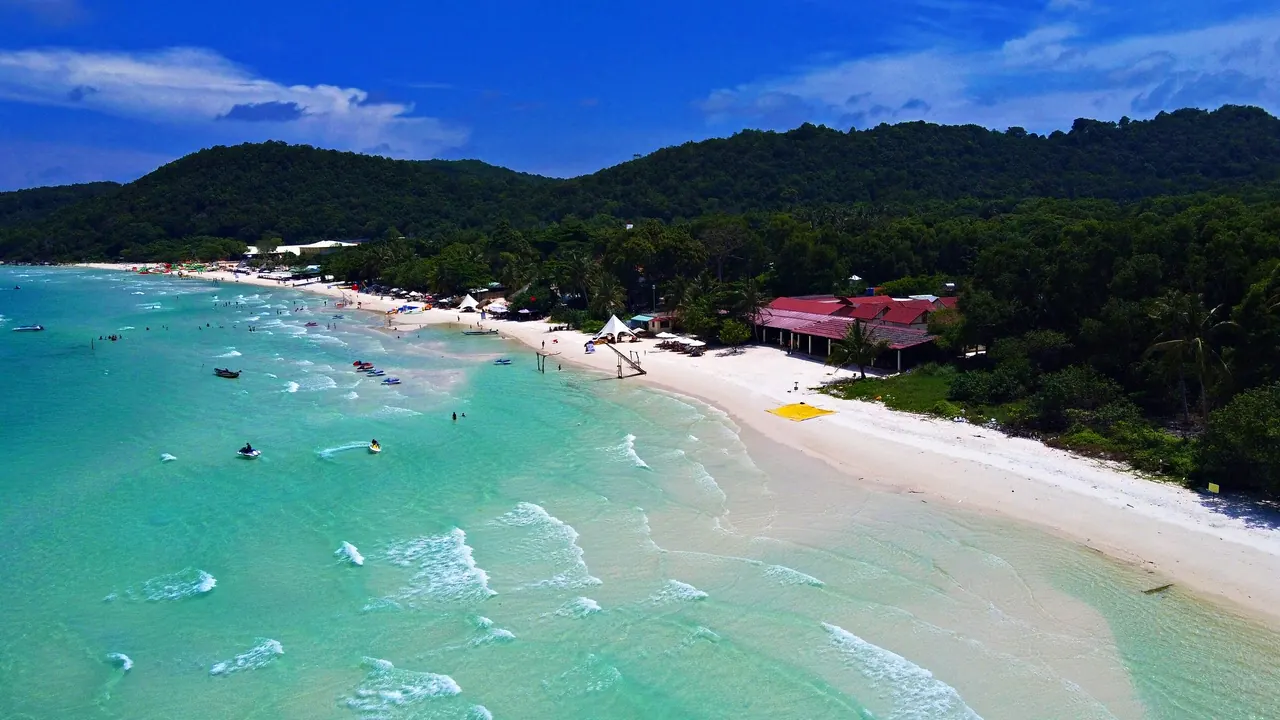
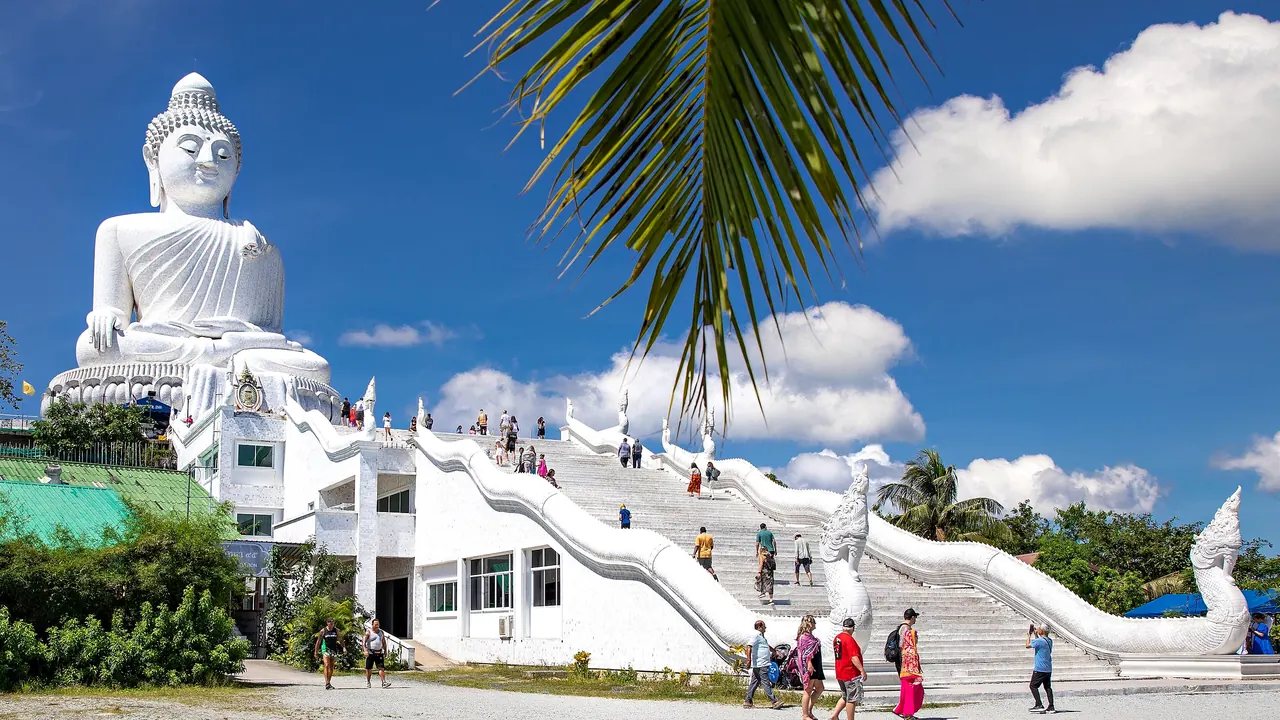
Photos: Phu Quoc by Trantuonglam, CC BY-SA 4.0, cropped; Phuket by Mussi Katz, CC0.
Phu Quoc or Phuket?
Our verdict in twelve categories, each scored against the same fixed benchmark cities, and the climate month by month, so you can choose for your trip.
Choose Phu Quoc for
- getting around
- prices
- families
Phu Quoc suits travellers who want a simple, good-value beach vacation and little else. It is cheaper to stay, eat and get about, the electric buses and metered taxis make the island easy to handle, and the safari park, theme park and cable car-to-water park keep children busy between swims. You give up almost all nightlife, serious diving and worthwhile excursions, so it works best for people who are happy to spend most days at the resort and on the sand.
Choose Phuket for
- nightlife
- day trips
- nature and the outdoors
Choose Phuket for a beach stay with more going on around it. Patong's nights, Phang Nga Bay by kayak, Similan diving and boat days to Phi Phi give it far more variety. Phuket Town adds a Peranakan food culture and an old quarter worth a morning, and the island's spas and retreats are a real reason to come. It costs more and is harder to get around, but there is much more to do once you are there.
Scoreboard
Twelve categories on one fixed scale from 0 to 100. The shaded stretch is the gap between the two.
Your match
Pick a travel style or drag the sliders, and both match scores follow your weighting.
Wins on getting around and prices with your weighting.
Wins on nightlife and day trips with your weighting.
What matters to you?
Category by category
What the scores mean for a trip.
Beaches & swimming
Both islands are first-rate beach destinations, and the difference is in the shape of the coast. Phu Quoc's sand mostly comes as one huge sweep, the 20km of Long Beach, plus the whiter, softer sand at Sao and Khem in the southeast. Phuket's west coast is instead a string of separate bays, from the crowded loungers of Patong to small coves like Kata Noi and Freedom Beach set between headlands.
The monsoon months also play out differently. Phu Quoc has a sheltered east coast to move to when the west side turns rough, although some beaches away from the resorts are untidy. Phuket's west coast has dangerous rip currents in those months, but in any season boats take you to the white sand of Phi Phi and Racha.
Food & drink
Phuket eats better. Its tin-mining history left a Hokkien and Peranakan kitchen that you find mainly in Phuket Town: yellow noodles, braised pork belly, crab curry with rice noodles at breakfast. There is also a small fine-dining tier for a special night out.
Phu Quoc's cooking is almost all seafood, chosen live from the tank and eaten at the Duong Dong night market or over the water at Ham Ninh. Its raw herring salad and its fish sauce and pepper are worth trying, but after a few days the range starts to feel narrow.
Culture & sights
Neither island is somewhere to go for sightseeing, but Phuket has more to see. Its old quarter of pastel Sino-Portuguese shophouses and merchants' mansions makes a good half day, and Wat Chalong and the Big Buddha above Chalong Bay round it out.
On Phu Quoc the one serious sight is the old wartime prison near An Thoi, a sobering stop, plus the Dinh Cau shrine and the hillside Ho Quoc Pagoda. Its mock-European resort streets are fun to stroll but have no history behind them.
Nightlife
This is one of the biggest gaps between the two. Phuket has Bangla Road in Patong, a pedestrian strip of neon bars and big clubs that runs into the small hours every night of the high season. It also has sunset sessions at beach clubs and a smaller, more local bar scene in Phuket Town's old shophouses.
Phu Quoc's evenings mean a drink on Long Beach, a few backpacker bars in Duong Dong and the evening shows in the resort districts, with a casino in the north. Outside the dry season it is very quiet, and most people are back at their hotel well before midnight.
Nature & outdoors
Phuket has much the better outdoors, and nearly all of it is at sea. Sea kayaks take you through the caves and lagoons among the limestone towers of Phang Nga Bay, and the Similan and Racha islands have some of Thailand's best diving. On land, the rainforest at Khao Phra Thaeo has waterfalls and gibbons.
Phu Quoc has a large forested national park in the north, but the hills are low and the reefs south of An Thoi are pleasant rather than memorable. Its high point is the long cable car to Hon Thom, with views over the whole archipelago.
Day trips
Phuket gives you far more reasons to leave your beach. The classic day out is a boat to Phi Phi. Phang Nga Bay has the stilted village of Koh Panyee and the rural Koh Yao islands, and the bridge north puts Krabi and Ao Nang within a few hours by road.
From Phu Quoc the choice is basically island-hopping in the An Thoi archipelago or the ferry to quiet Ha Tien on the mainland, a little over an hour away. Most visitors simply stay on the island.
Good for families
Both work well with children, and the difference is the kind of fun on offer. Phu Quoc has large purpose-built attractions: a drive-through safari park and a theme park with an aquarium in the north, and a water park at the end of the Hon Thom cable car. Each of them means a taxi ride, though.
Phuket has two water parks, the aquarium at Cape Panwa and elephant sanctuaries, and Thai staff are famously kind to small children. Where you stay matters more there: Kata, Karon or the northern beaches suit families, while the busy roads and Patong's nights do not.
Getting around
Phu Quoc is easier to get around. Its clean electric buses run along the busiest stretch, linking the airport, Long Beach, Duong Dong and the northern resort district, and ride-hailing and metered taxis cover the rest. Expect a ride of half an hour or more to the safari park or the southeast beaches, though.
Phuket's songthaews only run from Phuket Town out to the beaches, not between them, so most journeys mean a fixed-fare taxi or tuk-tuk on hilly roads that clog up in high season. Most visitors stay at one beach and book transport only for outings.
Shopping & style
Phuket has much more to shop for. There are big malls near Phuket Town and in Patong, tailors who will make clothes within days, and the Sunday walking street and shophouse boutiques of the old quarter, with batik and Peranakan-style goods.
On Phu Quoc shopping is mostly souvenirs: pepper, dried seafood and cultured pearls from the night market and the showrooms. The island's famous fish sauce is a fine thing to take home, but airlines may not let you pack it.
Affordability
Phu Quoc is the cheaper island day to day. Guesthouses near Duong Dong, market seafood and metered taxis all cost little, though the theme parks, the cable car and the boat trips add up quickly.
Phuket is among the pricier parts of Thailand. Its fixed-fare taxis and tuk-tuks are where the extra cost shows most, alongside Patong and beachfront dining. To keep it reasonable, stay in Phuket Town or at Kata and Karon, eat local food and travel outside the December to March peak.
Live music & performing arts
Neither island has a theatre or concert hall, but Phuket has more to fill an evening. There are long-running cabaret revues in Patong, Thai boxing nights, and cover bands or blues sets in bars most evenings. On Phu Quoc the offer is large staged spectacles of water, fireworks and drones in the resort districts, well produced but made for tourists, with little live music beyond resort bands.
Wellness & relaxation
Phuket is a real wellness destination. Alongside massage at every level, from beach-road shopfronts to spa pavilions over the sea, it has a large retreat scene: yoga and meditation stays, detox programmes, and Muay Thai camps around Chalong. The quiet northern beaches and Nai Harn are good places to slow down.
Phu Quoc is relaxing in a simpler way. Massage is cheap, resort spas offer herbal baths and some places run yoga classes, but most of the rest comes from a pool and a hammock. For the most peace, stay on the north coast around Ong Lang or near Khem Beach.
When should you go?
Pick your month. The climate figures are measured averages, not a forecast.
Phu Quoc in July
Phuket in July
Daytime high, °C
Rainfall in the month, mm
Where the figures come from
Phuket's temperatures are measured 27 km from the centre, at Phuket Airport.
Temperature and rainfall are climate normals, averaged over the years shown. Phu Quoc: 1991-2020 normals, Phu Quoc (0.7 km from centre). Phuket: 1991-2020 (sunshine 1961-1990, rainfall 1981-2010) normals, Phuket Airport (26.9 km from centre).
Both islands are hot in every month, so when to go depends on rain and the state of the sea rather than temperature. December to March is the best time on both. Rain is rare, the west coasts are calm and clear, and the sea stays warm enough for long swims all year. Daytime highs stay in the low thirties all year, a touch higher on Phuket, and both islands get slightly hotter in the weeks before the rains. Walking round Duong Dong or Phuket Town's old quarter is best done early in the day. April is the turning point, as showers become more frequent and the dry season ends.
From May the southwest monsoon sets in, and Phu Quoc gets more of the rain, with about 521mm in September against 373mm on Phuket. When Phu Quoc's west side turns rough, Sao and Khem on the sheltered southeast coast are still good for swimming. On Phuket the whole west coast takes heavy surf through those months, but the sun still breaks through, with about five hours a day even in September. A rainy-season trip there means working around showers rather than sitting out days of rain.
Which traveller are you?
For a food and nightlife trip, Phuket is the clear choice. Phuket Town's Hokkien noodles, crab curry and dim sum breakfasts beat Phu Quoc's narrower seafood menu, and Bangla Road, the beach clubs and the shophouse bars keep going long after Phu Quoc has gone to bed.
On an outdoors trip, Phuket wins easily. Kayaking through the caves of Phang Nga Bay, diving the Similans with reef sharks and rays, and walking among the gibbons at Khao Phra Thaeo go well beyond Phu Quoc's ordinary reefs and flat interior.
On a trip with a tight budget, Phu Quoc stretches the money further. Guesthouses near Duong Dong, the night market's seafood, metered taxis and cheap electric buses keep daily costs low, while Phuket's fixed taxi fares and busy high season soon add up.
Before you go
| Measure | Phu Quoc | Phuket |
|---|---|---|
| Official language | Vietnamese | Thai |
| Currency | Dong (VND) | Baht (THB) |
| Sockets | ACFG220 V, 50 Hz | ABCF220 V, 50 Hz |
| Driving side | Right | Left |
| Time zone | UTC+7 | UTC+7 |
| Emergency number | Police 113, ambulance 115, fire 114 | Police 191, ambulance 1669, fire 199 |
| Main airport | Phú Quốc International Airport (PQC)36 non-stop destinations | Phuket International Airport (HKT)85 non-stop destinations |
By the numbers
| Measure | Phu Quoc | Phuket |
|---|---|---|
| Population | 179,480 | 77,610 |
| People per km² | 305 | 6,468 |
| Swim season, months above 21 °C | 12 months | 12 months |
Where else could you go?
Every comparison below shares a destination with this one, so you can follow Phu Quoc or Phuket somewhere new.
- Koh Phi Phivs Phuket
- Krabivs Phuket
- Koh Lantavs Phuket
- Koh Rongvs Phu Quoc
- Koh Lipevs Phuket
- Mekong Deltavs Phu Quoc