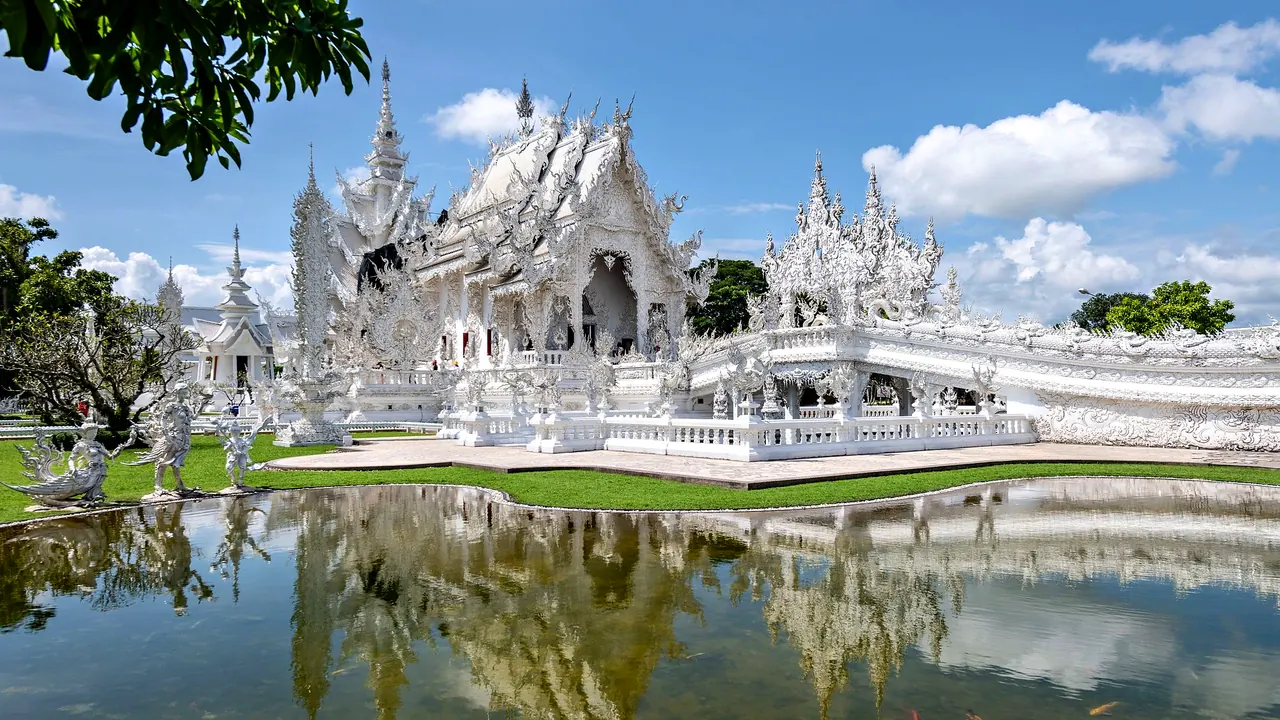
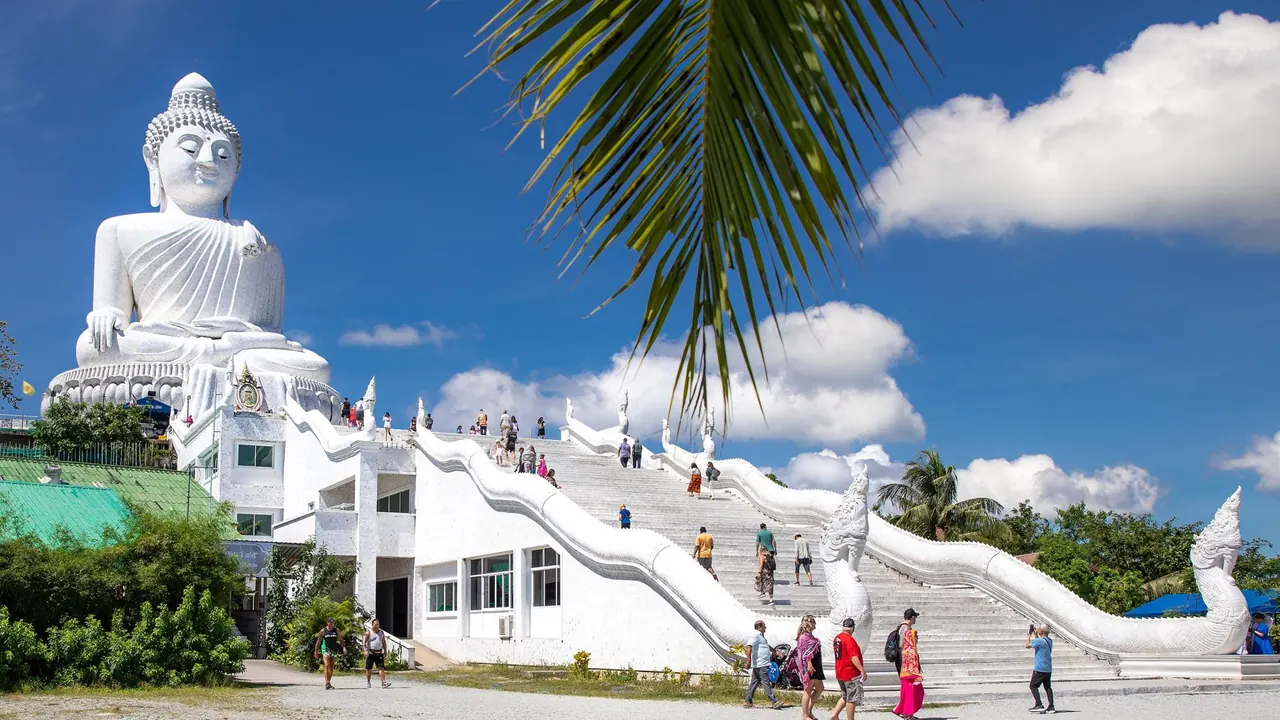
Photos: Chiang Rai by Kirandeep Singh Walia, Pexels License; Phuket by Mussi Katz, CC0.
Chiang Rai or Phuket?
Our verdict in twelve categories, each scored against the same fixed benchmark cities, and the climate month by month, so you can choose for your trip.
Choose Chiang Rai for
- prices
- culture and sights
- getting around
Chiang Rai suits a slow, inexpensive trip built around temples and hills. The White Temple, the Blue Temple and Baan Dam give it an art scene you won't find in other Thai towns, and the tea slopes of Doi Mae Salong and the misty mornings after the rains are a calm change from the coast. It works for travellers who are happy with early nights and long dinners, and who would rather pay for a driver to the Golden Triangle than for a beach resort.
Choose Phuket for
- beaches
- nightlife
- wellness
If the sea is the point of the trip, pick Phuket. Its west-coast bays, kayaking among the limestone towers of Phang Nga Bay, boat trips to the islands, resort spas and Patong's late nights make it the better choice for a beach vacation, for families who want one resort as a base, and for anyone after a proper spa stay or a big night out. You pay more for all of that, and the history is mostly in the old shophouse streets of Phuket Town.
Scoreboard
Twelve categories on one fixed scale from 0 to 100. The shaded stretch is the gap between the two.
Your match
Pick a travel style or drag the sliders, and both match scores follow your weighting.
Wins on prices and culture and sights with your weighting.
Wins on beaches and nightlife with your weighting.
What matters to you?
Category by category
What the scores mean for a trip.
Beaches & swimming
Chiang Rai sits deep in the northern hills, so there is no beach to speak of. A swim means a hotel pool, a cold plunge under a forest waterfall or a dip at a reservoir.
Phuket is one of Thailand's main beach islands. It has crowded Patong, the broader and calmer sands at Kata and Karon, Nai Harn between its headlands, and the long empty stretch at Mai Khao. Between November and April the water is calm and clear. In the monsoon months, rip currents make the west coast dangerous and the sheltered east-coast bays are safer.
Food & drink
Both have proper regional cooking. In Chiang Rai that means northern Thai food: khao soi, sai ua sausage and chilli dips with sticky rice, best eaten cheaply at the night bazaar and the walking-street markets, with hill-grown coffee in garden cafés. After a few days, though, the choice starts to feel narrow.
Phuket gives a food-focused trip more to work with. Phuket Town has Hokkien and Peranakan dishes such as moo hong and yellow noodles, along with morning dim sum, and you can buy seafood by weight on the waterfront. The beach resorts add a layer of upmarket restaurants that Chiang Rai doesn't have.
Culture & sights
Chiang Rai has more to see, and its best-known temples are modern works rather than ancient monuments, made by contemporary Thai artists who mix Buddhist imagery with personal fantasy. Most lie outside the low-rise centre, so each one means a ride out of town. The older Lanna-era temples, the gilded clock tower and the small hill-tribe museum fill out a stay of two or three days.
Phuket's heritage comes from trade, left by the tin-mining boom: pastel Sino-Portuguese shophouses on Thalang Road and Soi Romanee, Chinese clan houses and shrines, and a few tin barons' mansions, all close enough together to walk around Phuket Town. Wat Chalong, the hilltop Big Buddha and the museum at Thalang are spread across the island. A day or two covers it all, so here the culture fits between beach days rather than shaping the trip.
Nightlife
The two could hardly be more different after dark. In Chiang Rai you get a short street of small reggae and acoustic bars near the clock tower and beer tables at the night bazaar, and the town is mostly asleep by midnight.
In Phuket, Bangla Road in Patong fills every night with neon, go-go bars and big clubs open until dawn. There are also sunset beach clubs at Bang Tao and Kamala, quieter bars in Kata and Rawai, and a few small bars in Phuket Town's old shophouses.
Nature & outdoors
Phuket's outdoors is mostly on the water, and that is where it pulls ahead. You can kayak among the limestone towers and hidden lagoons of Phang Nga Bay, dive and snorkel at the Similans in the dry season, and visit the Racha islands. On land there is little beyond the rainforest trails of Khao Phra Thaeo.
Chiang Rai's outdoors is hill country: waterfalls such as Khun Korn, treks through hill-tribe villages, tea terraces on Doi Mae Salong and sunrise over the clouds at Phu Chi Fa. It is the better pick for walking, as long as you avoid the smoky months.
Day trips
Both offer a few days of pleasant outings without one famous trip that would justify the journey by itself. The difference is the kind of outing. From Chiang Rai you go by road, to the ruined chedis of Chiang Saen, the Golden Triangle on the Mekong, the border market at Mae Sai and the Yunnanese tea village of Doi Mae Salong.
From Phuket you mostly go by boat, to Phi Phi or the quieter Koh Yao islands, or by road to Krabi and Khao Lak. That gives you more beaches and islands, but almost no historic towns.
Good for families
Phuket suits families much better, provided you pick one resort and stay put. Kids' clubs, big pools, gentle shallows at Kata and Nai Harn in the dry season, water parks and the aquarium at Cape Panwa will keep children busy. Monsoon rip currents and Patong after dark are the things to avoid.
Chiang Rai is friendly to children but has little made for them. Singha Park, with its lakes, tea fields and bike paths, is the main family day out, and getting to most sights means long stretches in a vehicle.
Getting around
You need transport in both, but Chiang Rai is easier. Its centre around the clock tower and the night bazaar is small and flat enough to walk, a local bus runs to the White Temple, and regional buses reach Chiang Saen and Mae Sai. For the hills you still need a driver or a tour.
Phuket is large and hilly, with its beaches strung along a winding coast road. The west-coast bus is infrequent and stops early in the evening, the songthaews don't link one beach to another, taxis are expensive, and renting a scooter on the steep roads is a real risk.
Shopping & style
There is not much to choose between them on shopping, and neither is a reason to go. Chiang Rai is all markets: hill-tribe textiles, silver and carved wood at the night bazaar and on the Saturday walking street, with Doi Mae Salong oolong as the best thing to take home.
Phuket adds air-conditioned malls with international brands, tailors and pearl shops. Its most interesting browsing is the galleries, batik shops and Sunday market in Phuket Town's old quarter.
Affordability
Chiang Rai is clearly cheaper. Guesthouses, market meals and temple entry all cost very little, and the only real expense is a driver or tours to reach the hills.
Phuket is good value by Western standards but costs noticeably more. Beachfront rooms, imported drinks and taxi rides push daily costs up, and room rates at the main beaches climb sharply from December to February. Staying in Phuket Town or travelling in the monsoon brings costs down.
Live music & performing arts
Neither has a theatre or concert season, so this shouldn't decide your trip. In Chiang Rai, performances are rooted in local tradition: Lanna dance on the night bazaar stage, khantoke dinners, and processions at temple festivals and Loy Krathong.
Phuket's evening shows are made for visitors: ladyboy cabaret revues, staged cultural shows for tour groups, and cover bands in beach bars. Muay Thai fights in Patong are the most lively night out.
Wellness & relaxation
Phuket is the place for a proper wellness stay. It has resort spas with treatment pavilions in the jungle, dedicated detox and yoga retreats, and the Muay Thai and fitness camps in Chalong where people train for weeks. Nai Harn, Mai Khao and the east coast are calm places to base yourself.
Chiang Rai relaxes you mainly through its slow pace, with massage shops on every street and a few riverside spas. It does have the one thing Phuket lacks, natural hot springs at Pong Phrabat and Mae Kachan, but the smoky season takes away much of the calm.
When should you go?
Pick your month. The climate figures are measured averages, not a forecast.
Chiang Rai in July
Phuket in July
Daytime high, °C
Rainfall in the month, mm
Where the figures come from
Phuket's temperatures are measured 27 km from the centre, at Phuket Airport.
Temperature and rainfall are climate normals, averaged over the years shown. Chiang Rai: 1991-2020 (sunshine 1961-1990) normals, Chiang Rai (1 km from centre). Phuket: 1991-2020 (sunshine 1961-1990, rainfall 1981-2010) normals, Phuket Airport (26.9 km from centre).
Both are at their best from December to February, when they are dry and sunny. Chiang Rai is pleasant then, with highs around 28°C and cool mornings in the hills. By March and April it reaches 35°C, and field burning fills the valleys with smoke haze. The rains begin in May and are heaviest in August, at about 390mm, so treks and hill views are hard work until things clear in November.
Phuket stays hot all year with little change between months, and the sea is about 29°C in every season. What changes is the weather on the coast. From December to March the Andaman is calm and the sun shines nearly every day. The southwest monsoon brings heavy rain from May, with the most falling in September at around 373mm and October almost as wet, so beach days in those months are unreliable. If you want to combine the two cities, December and January are the safest months, before the haze settles over the north.
Which traveller are you?
For a beach and sun trip, choose Phuket without a second thought. Chiang Rai is far inland and has no coast at all. Phuket has a whole run of sandy bays from Kata to Mai Khao, warm sea all year and boats out to island beaches.
On a culture and arts trip, Chiang Rai gives you more. Its White and Blue Temples and the dark halls of Baan Dam are unlike anything else in Thailand, and Wat Phra Kaew adds older history. Phuket's culture amounts to a day or two in its shophouse old town.
On a tight budget, Chiang Rai stretches your money much further. Guesthouses, market meals and garden cafés all cost little, and many temples are free. In Phuket, beach rooms, tourist restaurants and taxis quickly push up what you spend each day.
Before you go
| Measure | Chiang Rai | Phuket |
|---|---|---|
| Official language | Thai | Thai |
| Currency | Baht (THB) | Baht (THB) |
| Sockets | ABCF220 V, 50 Hz | ABCF220 V, 50 Hz |
| Driving side | Left | Left |
| Time zone | UTC+7 | UTC+7 |
| Emergency number | Police 191, ambulance 1669, fire 199 | Police 191, ambulance 1669, fire 199 |
| Elevation | 390 m | 19 m |
| Main airport | Mae Fah Luang - Chiang Rai International Airport (CEI)8 km from centre4 non-stop destinations | Phuket International Airport (HKT)27 km from centre85 non-stop destinations |
By the numbers
| Measure | Chiang Rai | Phuket |
|---|---|---|
| City population | 70,610 | 77,610 |
| People per km² | 1,159 | 6,468 |
| Museums within 10 km | 4 | 2 |
| UNESCO World Heritage sites within 50 km | 0 | 0 |
| Swim season, months above 21 °C | - | 12 months |
Where else could you go?
Every comparison below shares a destination with this one, so you can follow Chiang Rai or Phuket somewhere new.
- Krabivs Phuket
- Chiang Maivs Chiang Rai
- Luang Prabangvs Chiang Rai
- Penangvs Phuket
- Hua Hinvs Phuket
- Pattayavs Phuket