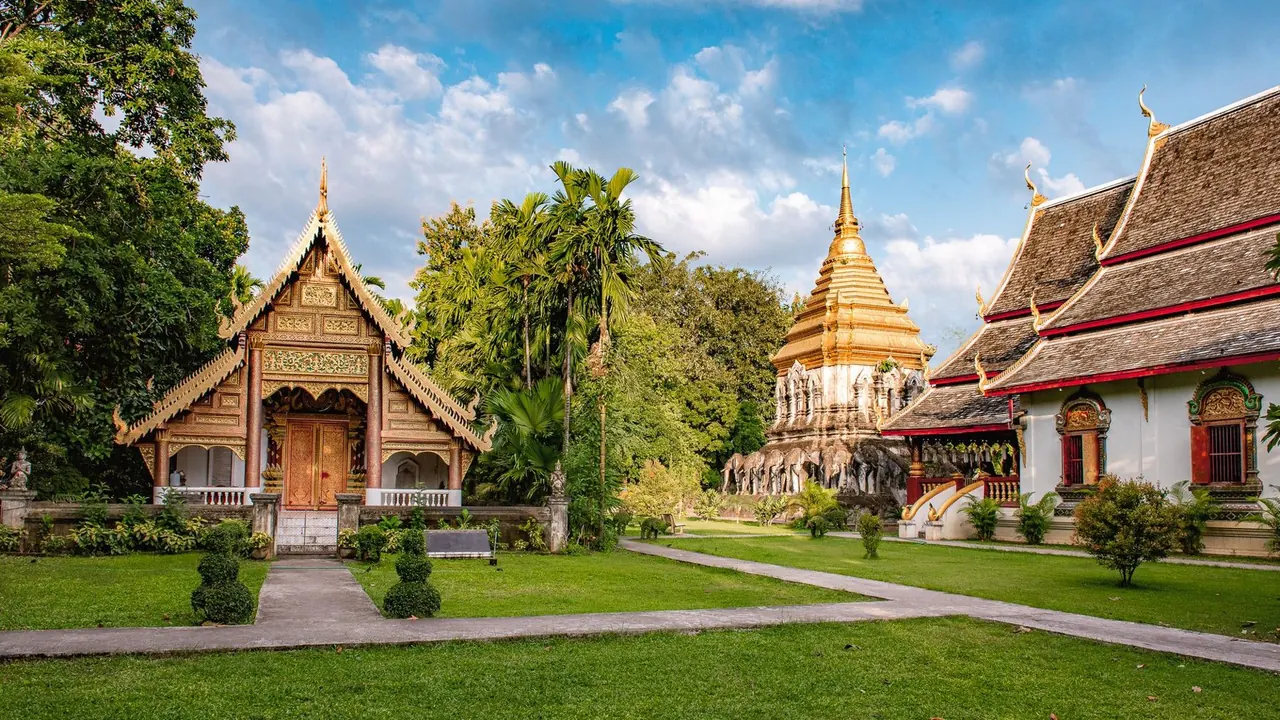
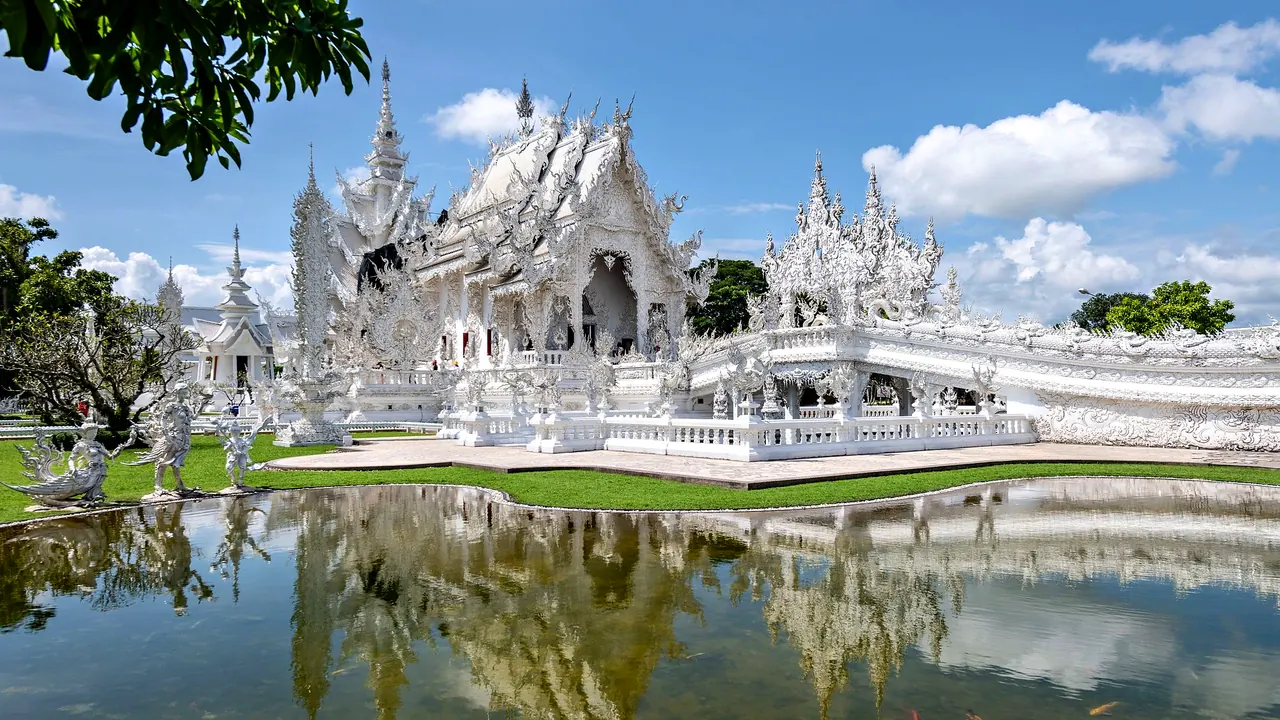
Photos: Chiang Mai by Gije Cho, Pexels License; Chiang Rai by Kirandeep Singh Walia, Pexels License.
Chiang Mai or Chiang Rai?
Our verdict in twelve categories, each scored against the same fixed benchmark cities, and the climate month by month, so you can choose for your trip.
Choose Chiang Mai for
- wellness
- shopping
- food and drink
Chiang Mai is the better base for most trips to northern Thailand. It is the larger city, so it gives you more of nearly everything: a moated old city with temples on almost every lane, a much deeper food scene, livelier evenings, real craft shopping and the country's best-known massage schools and meditation temples. If you want a week or more of eating well, walking slowly and slowing down, choose Chiang Mai.
Choose Chiang Rai for
- day trips
- prices
Chiang Rai suits a shorter, quieter stay, or a few days added on after Chiang Mai. Its draw is unusual modern temple art, such as the White Temple, the Blue Temple and the Black House, plus the border country to the north, with the Mekong at the Golden Triangle and the Yunnanese tea hills of Doi Mae Salong. Expect a small town with early nights and plenty of driving to reach the sights, not a city to linger in.
Scoreboard
Twelve categories on one fixed scale from 0 to 100. The shaded stretch is the gap between the two.
Your match
Pick a travel style or drag the sliders, and both match scores follow your weighting.
Wins on wellness and shopping with your weighting.
Wins on day trips and prices with your weighting.
What matters to you?
Category by category
What the scores mean for a trip.
Beaches & swimming
Neither city is a beach destination. Both lie deep in the northern hills, far from any coast, so sand and sea mean a separate leg of the trip in the south. For a swim nearby, both have hotel pools, cool pools under forest waterfalls and reservoirs to paddle in on a hot afternoon.
The difference is that Chiang Mai's options are closer and better known. Huay Tung Tao reservoir sits just under Doi Suthep, and the flooded quarry lakes on the edge of town are popular with locals for a proper swim. In Chiang Rai a swim more often comes as part of a trip out to a waterfall.
Food & drink
Both cities serve the same northern cooking, including khao soi, sai ua sausage, chilli dips and sticky rice, but Chiang Mai does it in far greater depth. Its morning markets, the evening stalls at Chang Phueak Gate and the weekend walking streets give you weeks of eating. A small group of kitchens also takes Lanna ingredients in modern directions, and the café scene runs from Nimmanhaemin roasters out to garden cafés towards the mountains.
Chiang Rai adds sour-spicy nam ngiao, roadside grills and hill-grown oolong tea alongside its coffee. Beyond the night bazaar food court and the markets, though, the choice soon narrows, and a trip planned around eating will feel short after a few days.
Culture & sights
Chiang Mai has more traditional heritage and more of it on foot. Inside the moat you can walk between Wat Chedi Luang, Wat Phra Singh, the silver Wat Sri Suphan and dozens of smaller teak monasteries, and Doi Suthep watches over the city from its mountain.
Chiang Rai's appeal is different and more recent. Its White Temple, Blue Temple and Black House are contemporary works that you will not find elsewhere in Thailand. Its older heritage is thinner, though Wat Phra Kaew, where the Emerald Buddha was found, is a notable exception. In both cities the museums are modest.
Nightlife
Chiang Mai gives you a proper evening out. Nimmanhaemin has cocktail and craft-beer bars full of university students, the old city has backpacker bars and rooftops, and Loi Kroh Road is the louder strip. There are a few clubs, but most places close around midnight.
Chiang Rai has a short street of small reggae and acoustic bars near the clock tower and beer tables at the night bazaar. Plan on dinner and a couple of drinks rather than a night out.
Nature & outdoors
Both cities sit in green, forested valleys and are about equally good for the outdoors, but they offer different kinds of trip. Chiang Mai's strengths are being close and having plenty to do. Doi Suthep-Pui National Park starts at the edge of town, Doi Inthanon, Thailand's highest peak, is a day out, and the Mae Taeng and Mae Rim valleys offer rafting, ziplines and treks.
Chiang Rai's countryside feels wider and more remote. There are tea terraces on Doi Mae Salong, sunrises over the clouds at Phu Chi Fa, the broad Mekong at the Golden Triangle, and quiet rural roads that are good for cycling. In both places the burning-season haze spoils the views.
Day trips
The two are about level for outings, but they lead to different places. From Chiang Mai the best day trips are to historic towns: Lamphun's gilded chedi half an hour away, and Lampang's horse carriages, teak mansions and walled temple. The craft villages make easy half days, while Pai and the city of Chiang Rai are better done as overnight stays.
From Chiang Rai the usual loop runs to the border. It takes in the ruined walled town of Chiang Saen, the Golden Triangle and its opium museum, the market at Mae Sai and the gardens at Doi Tung. Doi Mae Salong, a Yunnanese tea village, adds something you cannot reach as easily from Chiang Mai.
Good for families
Chiang Mai keeps children busy for longer. Elephant sanctuaries, the zoo on Doi Suthep, the Night Safari, quarry swimming parks and ziplines are all within easy reach, although broken pavements and traffic around the moat make getting about hard work.
Chiang Rai welcomes children just as warmly but has less made for them. Singha Park, with its lakes, tea fields and bikes, is the main outing, and the sights are far enough apart that you spend a lot of time in the car. In both cities, avoid the smoky months with young children.
Getting around
Neither city has a metro or tram, so in both you walk the centre and take the road beyond it. The difference is in the kind of journey. Chiang Mai's moated old city is the more pleasant place to explore on foot, with quiet lanes running between temples. Across the wider city, red songthaews that you flag down in the street and ride-hailing apps handle the short trips.
Chiang Rai's flat centre around the clock tower takes only minutes to cross, but there is little shade. Its advantage is the public bus. A local bus runs out to the White Temple, and regional buses from the old terminal reach Chiang Saen, Mae Sai and Phayao, so you can visit the border towns without hiring a driver. In the countryside around Chiang Mai, by contrast, you usually need a hired driver or a tour.
Shopping & style
Chiang Mai is the place to buy handmade things. The Sunday Walking Street on Ratchadamnoen and the Saturday market on Wualai, the old silversmiths' street, run for long evenings. There is also the nightly Night Bazaar, plus the craft villages of Bo Sang and San Kamphaeng for umbrellas and weaving, and design studios in Nimmanhaemin.
Chiang Rai has a smaller version of the same thing. Its night bazaar and the Saturday market on Thanalai sell textiles, silver and carvings, and Doi Mae Salong oolong and local coffee are the best things to take home.
Affordability
Both are among the cheapest stays in Thailand, and day-to-day costs barely differ. Chiang Mai keeps getting around cheap because songthaews and ride-hailing cover most trips. What adds up there are paid extras such as sanctuaries, treks and cooking classes.
Chiang Rai's rooms, meals and cafés cost a little less again. Because its main sights are spread out, though, drivers and tours become the largest part of your spending.
Live music & performing arts
Neither city has a theatre or concert season, but Chiang Mai has more live entertainment. There are nightly jazz and blues jams near the old city's north gate, rock and acoustic bands in Nimmanhaemin, Muay Thai fight nights and the Yi Peng processions.
Chiang Rai offers Lanna dance on the night bazaar stage, khantoke dinners and the odd acoustic set in a bar, and little beyond that.
Wellness & relaxation
Chiang Mai is the better place for a stay built around wellbeing. It is Thailand's best-known place to learn Thai massage, and it has spas in old teak houses and yoga studios. Wat Umong and Wat Suan Dok run meditation retreats, the San Kamphaeng hot springs are close, and the Mae Rim valley has resorts designed for quiet stays.
Chiang Rai relaxes you mainly through its slow pace. Massage shops are everywhere, but the hot springs at Pong Phrabat and Mae Kachan are simple pools, and its few retreats are out in the countryside.
When should you go?
Pick your month. The climate figures are measured averages, not a forecast.
Chiang Mai in July
Chiang Rai in July
Daytime high, °C
Rainfall in the month, mm
Temperature and rainfall are climate normals, averaged over the years shown. Chiang Mai: 1991-2020 normals, Chiang Mai (0.6 km from centre). Chiang Rai: 1991-2020 (sunshine 1961-1990) normals, Chiang Rai (1 km from centre).
The two cities share one calendar, and November to February is the best time for both. Days are warm rather than hot, with highs around 29°C to 31°C, the skies are clear and sunny and there is hardly any rain. From March the heat builds to a peak in April, when Chiang Mai reaches about 37°C and Chiang Rai a little less. Both city texts warn that smoke haze from field burning hangs over the valleys from late winter into spring, so walking and mountain views suffer.
The rains come in May and last until October. Chiang Rai gets much more of them: August brings about 390mm there, against roughly 234mm in Chiang Mai, and Chiang Rai stays wetter all through the summer. If you have to travel in the green season, Chiang Mai is the drier choice. Both cities lose a good share of their sunshine from June to September.
Which traveller are you?
For a food and nightlife trip, choose Chiang Mai. It has the northern dishes, the cafés and the markets, plus some ambitious kitchens and evenings that last until about midnight in Nimmanhaemin and around Tha Phae Gate. Chiang Rai serves the same dishes, but it has less range and goes to bed early.
On a relaxing and wellness trip, Chiang Mai is again the stronger choice. It has massage schools, spas in old teak houses, yoga studios and meditation retreats at Wat Umong and Wat Suan Dok. Chiang Rai is restful because it is small and slow, but it offers less of all these.
On a shopping trip, Chiang Mai is clearly better. It has the Sunday and Saturday walking streets, a night bazaar every evening, and craft villages for umbrellas, silk, celadon and lacquerware. Chiang Rai has one bazaar and a Saturday market, and its best buys are oolong tea and coffee.
Before you go
| Measure | Chiang Mai | Chiang Rai |
|---|---|---|
| Official language | Thai | Thai |
| Currency | Baht (THB) | Baht (THB) |
| Sockets | ABCF220 V, 50 Hz | ABCF220 V, 50 Hz |
| Driving side | Left | Left |
| Time zone | UTC+7 | UTC+7 |
| Emergency number | Police 191, ambulance 1669, fire 199 | Police 191, ambulance 1669, fire 199 |
| Elevation | 310 m | 390 m |
| Main airport | Chiang Mai International Airport (CNX)3 km from centre28 non-stop destinations | Mae Fah Luang - Chiang Rai International Airport (CEI)8 km from centre4 non-stop destinations |
By the numbers
| Measure | Chiang Mai | Chiang Rai |
|---|---|---|
| City population | 1,198,000 | 70,610 |
| People per km² | 2,958 | 1,159 |
| Museums within 10 km | 6 | 4 |
| UNESCO World Heritage sites within 50 km | 0 | 0 |
Where else could you go?
Every comparison below shares a destination with this one, so you can follow Chiang Mai or Chiang Rai somewhere new.
- Luang Prabangvs Chiang Rai
- Luang Prabangvs Chiang Mai
- Bangkokvs Chiang Mai
- Hanoivs Chiang Rai
- Pattayavs Chiang Mai
- Bangkokvs Chiang Rai