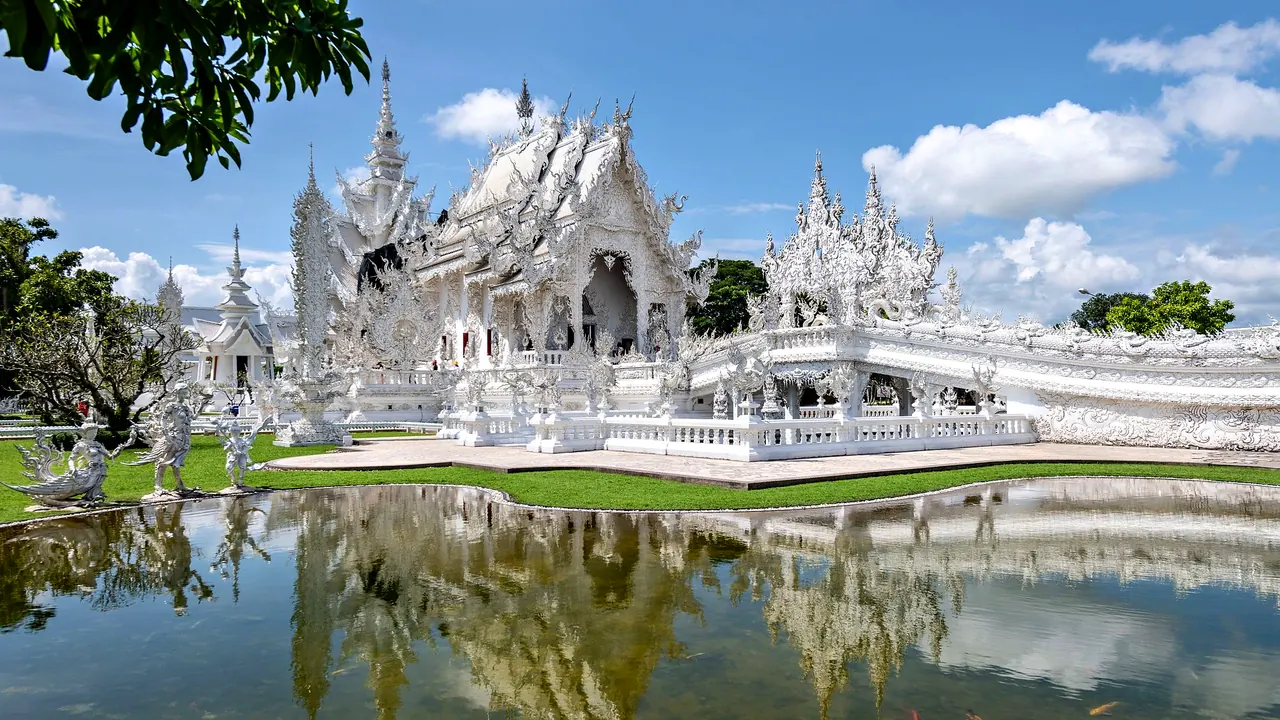
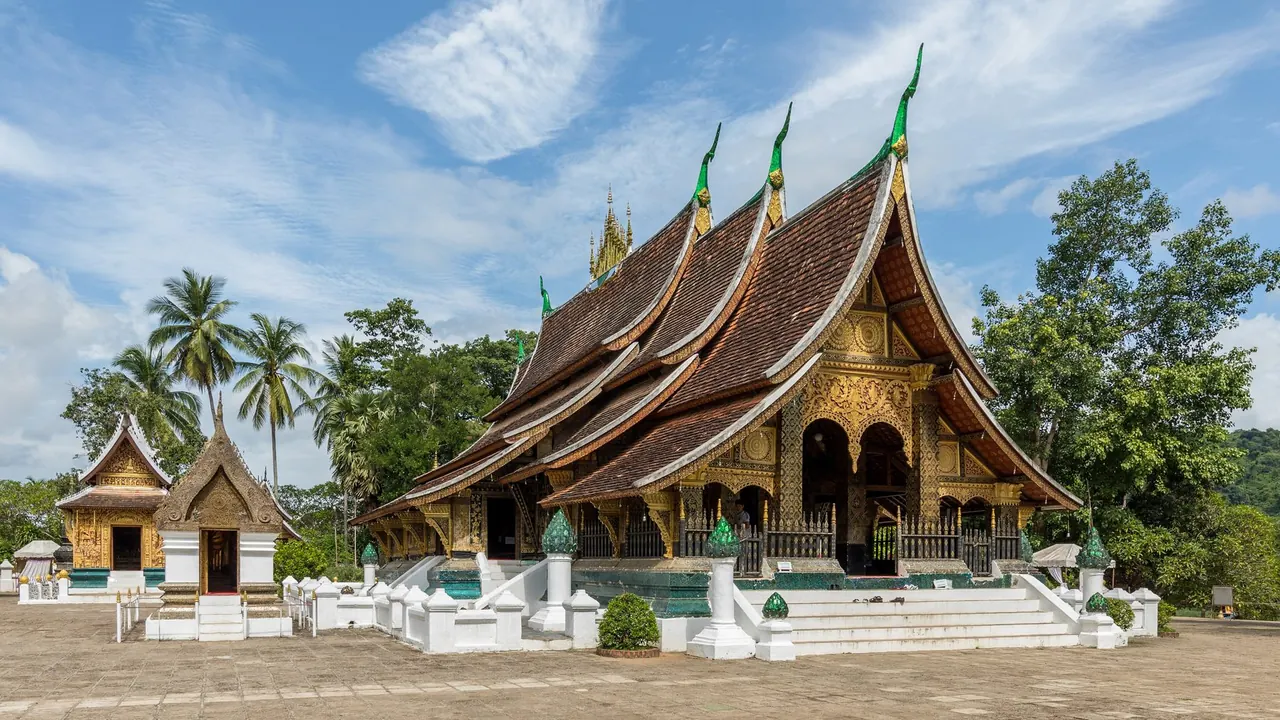
Photos: Chiang Rai by Kirandeep Singh Walia, Pexels License; Luang Prabang by Basile Morin, CC BY-SA 4.0, cropped.
Chiang Rai or Luang Prabang?
Our verdict in twelve categories, each scored against the same fixed benchmark cities, and the climate month by month, so you can choose for your trip.
Choose Chiang Rai for
- nightlife
- day trips
- food and drink
Chiang Rai suits the traveller who wants a very cheap base and plans to spend the days on the road. Its temples are modern art more than old heritage: the White Temple, the Blue Temple and the Black House. Most of the interest lies out of town, at Chiang Saen and the Golden Triangle on the Mekong, the Yunnanese tea village of Doi Mae Salong and the border market at Mae Sai. The food goes further and a few bars stay open later, but expect a lot of time in tuk-tuks and hired cars.
Choose Luang Prabang for
- getting around
- culture and sights
- beaches
For a slower stay in one beautiful place, Luang Prabang is the better pick. The whole old town on its peninsula is a World Heritage Site, and Wat Xieng Thong, the monks' dawn alms round and the colonial shophouses are all an easy walk or bicycle ride apart. Kuang Si's turquoise pools give it the better swim. Evenings end early and quietly, which for most people who choose it is part of the appeal.
Scoreboard
Twelve categories on one fixed scale from 0 to 100. The shaded stretch is the gap between the two.
Your match
Pick a travel style or drag the sliders, and both match scores follow your weighting.
Too close to call, 1 point apart
Wins on nightlife and day trips with your weighting.
Wins on getting around and culture and sights with your weighting.
What matters to you?
Category by category
What the scores mean for a trip.
Beaches & swimming
Chiang Rai has nowhere you would plan a swim around. You cool off wherever you happen to be: the hotel pool, a waterfall you pass on a drive through the hills, or a reservoir when the afternoon heat is at its worst. None of these is worth the trip on its own.
Luang Prabang comes out ahead because it has one swim worth going for: the stepped turquoise pools below Kuang Si, under an hour's drive from town. Tad Sae is a smaller second choice and is fullest later in the year. A morning in the water at Kuang Si is a highlight of many visits, though there is no sand to stretch out on.
Food & drink
Chiang Rai has more to eat. Northern Thai cooking brings khao soi, sour nam ngiao, sai ua sausage and chilli dips with sticky rice, and you can find it at the night bazaar food court, the weekend walking streets and the morning markets. The surrounding hills also supply coffee and oolong to a great many garden cafés.
Luang Prabang has distinctive dishes of its own, such as peppery or lam, smoky jeow bong and crisp kaipen river weed, along with baguettes and bakeries left from the French years. Its menus start repeating sooner, though, and neither town offers much fine dining or international cooking.
Culture & sights
Luang Prabang is the richer place for sightseeing. The entire old town on its peninsula is protected, with more than thirty monasteries among colonial shophouses and Wat Xieng Thong as the finest of them. The dawn alms procession shows that it is still a working religious town, not just a monument.
Chiang Rai's appeal is newer and more theatrical: the white plaster and mirrored glass of Wat Rong Khun, the sapphire Blue Temple and the dark teak halls of Baan Dam. Apart from these and Wat Phra Kaew, the centre is low-rise and modern, so the sights are scattered rather than forming a townscape you can wander.
Nightlife
Chiang Rai stays up a little later. The bar street near the clock tower plays reggae and acoustic covers, and people linger at the night bazaar's beer tables after dinner, though there are no clubs. In Luang Prabang the garden bars and riverside terraces shut at the midnight curfew, and after that the town is dark and silent.
Nature & outdoors
Both sit among green, forested hills on big rivers, and the outdoors is equally good in each. The difference is how far you travel to reach it. Chiang Rai's landscapes are spread wide: the tea terraces of Doi Mae Salong, the sunrise over a sea of cloud at Phu Chi Fa on the Lao border, and treks and waterfalls such as Khun Korn, best reached by car.
In Luang Prabang the countryside starts at the edge of town. Kuang Si and its bear sanctuary, kayaking on the Nam Khan and slow boats up the Mekong past limestone cliffs are all close at hand.
Day trips
Chiang Rai has the wider choice of outings. A loop north covers the ruined chedis of walled Chiang Saen, the Golden Triangle and its opium museum, the border market at Mae Sai and the gardens of Doi Tung. Doi Mae Salong's Yunnanese tea village and the lake town of Phayao can fill other days.
Luang Prabang has one classic outing, the boat up the Mekong to the Pak Ou caves and their thousands of Buddha images, plus the weaving villages of Ban Phanom and Ban Xang Khong. The railway brings Vang Vieng and Vientiane within reach, but beyond those the area offers villages and countryside rather than towns worth a day.
Good for families
For families the two come out about even, and the difference is in how the days are spent. Chiang Rai has the bigger single outing in Singha Park, with its lakes, tea fields, animals and room to cycle, and it also has the elephant sanctuaries. The sights are scattered across the valley, though, so small children face long rides in cars and songthaews to reach them.
Luang Prabang keeps a family close together. The old town is flat and quiet enough to explore by bicycle, and Kuang Si's bears and pools and the long-tail boats on the Mekong are all within an hour. There is less to do once you have seen those, and the heat, rough village roads and limited medical care suit older children better. Both towns are hazy with smoke late in the dry season, so the clearer winter months are the better time to bring young children.
Getting around
Luang Prabang is much easier on foot. The old town sits on a flat peninsula with light traffic, and a rented bicycle covers almost everything. Only the waterfalls, the villages and the train station need a tuk-tuk or minivan.
In Chiang Rai the walkable centre around the clock tower and night bazaar is small, with uneven pavements and little shade, and the main temples lie outside it. You will rely on ride-hailing apps, songthaews or a hired driver, and on a rented car or scooter if you want to see the hills.
Shopping & style
Both are market towns for crafts, with no fashion scene in either. Chiang Rai's night bazaar and Saturday walking street on Thanalai Road sell hill-tribe textiles and silver, and its best things to take home are Doi Mae Salong oolong and hill-grown coffee. Luang Prabang's nightly market of red-roofed stalls is similar, but its weaving studios and nearby villages are where you find genuinely fine naturally dyed silk and cotton.
Affordability
Both are cheap, but Chiang Rai is cheaper. Guesthouses, market meals and even the garden cafés cost very little. The main expense is transport to the sights out of town.
Luang Prabang's basics are inexpensive too, from bicycle hire to massages, but it is the costliest stop in Laos. The colonial boutique hotels, restaurants with wine lists and imported goods that draw many visitors push budgets up faster.
Live music & performing arts
Neither has a concert or theatre season, so performance here means traditional dance. Luang Prabang's main show is the masked Phralak Phralam, the Lao Ramayana, staged in the Royal Palace grounds. Chiang Rai has Lanna dance on the night bazaar stage, khantoke dinners that pair northern food with dancing, and street processions at Loy Krathong.
Wellness & relaxation
Luang Prabang is the more restful of the two. With no high-rise and little traffic, its days run from the dawn alms round to sunset over the Mekong. Its Lao massage is gentler than the Thai style, its wooden herbal saunas are scented with lemongrass, and boutique hotels offer garden spas and yoga by the river.
Chiang Rai's draw is its hot springs, simple soaking pools at Pong Phrabat north of town and at Mae Kachan on the road south. Thai massage shops are on almost every street, and a few meditation and yoga retreats work out of the countryside. In the smoky late-winter and spring months it feels far from restful.
When should you go?
Pick your month. The climate figures are measured averages, not a forecast.
Chiang Rai in July
Luang Prabang in July
Daytime high, °C
Rainfall in the month, mm
Temperature and rainfall are climate normals, averaged over the years shown. Chiang Rai: 1991-2020 (sunshine 1961-1990) normals, Chiang Rai (1 km from centre). Luang Prabang: 1991-2020 normals, Luang-Prabang (0.8 km from centre).
The two follow the same pattern: a dry, comfortable winter, a hot spring and a summer monsoon. November to February is the best time for both, when walking the streets and the hill trails is pleasant. Chiang Rai has the sunnier winter, with clear skies and highs near 28°C in December. March to May turns hot, and the rains build from May to a very wet August of around 390mm. Late winter and spring also bring smoke haze from field burning to both.
Luang Prabang's hot season is a little fiercer, reaching 36°C in April, and its winter days are noticeably less sunny than Chiang Rai's. Its monsoon is somewhat lighter, peaking in August at about 310mm, and the later months are when the Tad Sae falls run best. Neither town is by the sea, so in either place you swim in pools and waterfalls.
Which traveller are you?
On a culture and arts trip, Luang Prabang is the clear choice. Its whole old town is a World Heritage Site, with more than thirty monasteries, the former Royal Palace and the masked Phralak Phralam dance. Chiang Rai has striking modern temples but little older heritage.
For a food and nightlife trip, Chiang Rai gives you more to work with. Northern Thai dishes such as khao soi, hill-grown coffee in garden cafés and a short bar street by the clock tower beat Luang Prabang's repeating menus and midnight curfew.
On a trip on a tight budget, Chiang Rai makes your money go further. Guesthouses, street meals and temple entry cost very little. Luang Prabang is cheap too, but it is the priciest stop in Laos, and its boutique hotels and riverside restaurants push the bill up quickly.
Before you go
| Measure | Chiang Rai | Luang Prabang |
|---|---|---|
| Official language | Thai | Lao |
| Currency | Baht (THB) | Lao Kip (LAK) |
| Sockets | ABCF220 V, 50 Hz | ABCEF230 V, 50 Hz |
| Driving side | Left | Right |
| Time zone | UTC+7 | UTC+7 |
| Emergency number | Police 191, ambulance 1669, fire 199 | Police 191, ambulance 195, fire 190 |
| Elevation | 390 m | 305 m |
| Main airport | Mae Fah Luang - Chiang Rai International Airport (CEI)8 km from centre4 non-stop destinations | Luang Phabang International Airport (LPQ)4 km from centre7 non-stop destinations |
By the numbers
| Measure | Chiang Rai | Luang Prabang |
|---|---|---|
| City population | 70,610 | 53,792 |
| People per km² | 1,159 | - |
| Museums within 10 km | 4 | 0 |
| UNESCO World Heritage sites within 50 km | 0 | 1 |
Where else could you go?
Every comparison below shares a destination with this one, so you can follow Chiang Rai or Luang Prabang somewhere new.
- Chiang Maivs Chiang Rai
- Chiang Maivs Luang Prabang
- Hanoivs Luang Prabang
- Hanoivs Chiang Rai
- Bangkokvs Chiang Rai
- Huevs Luang Prabang