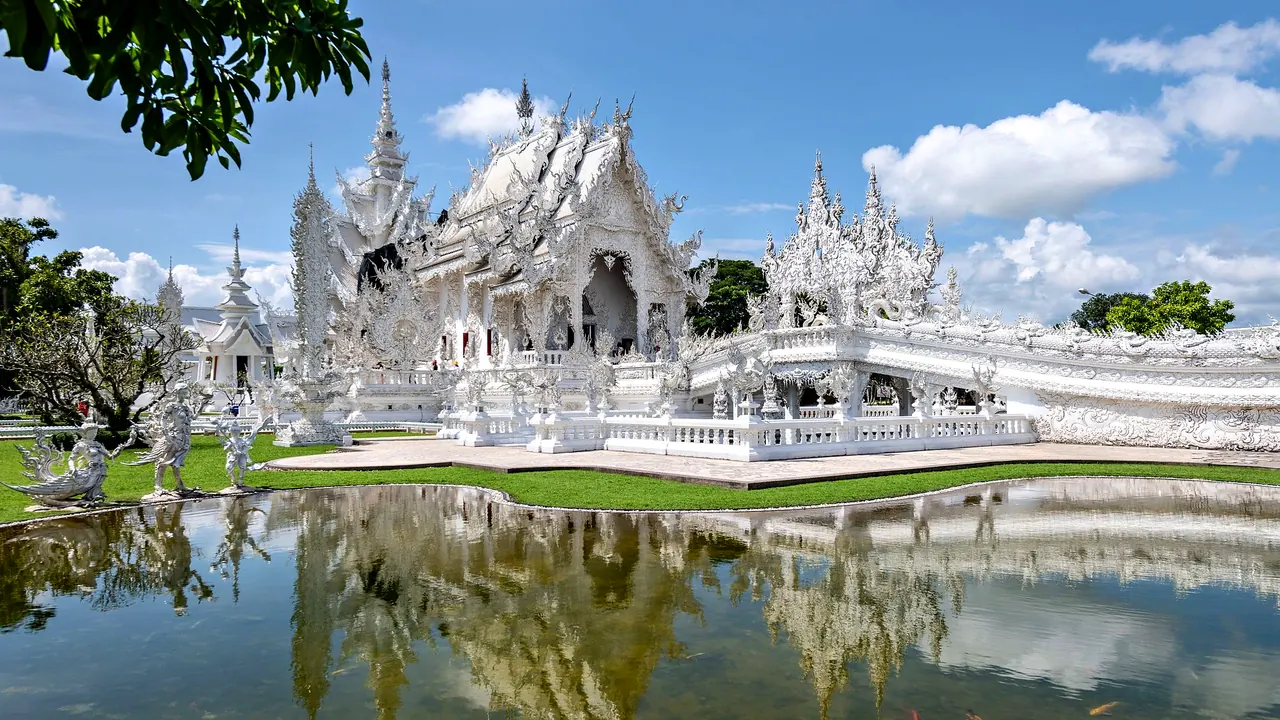
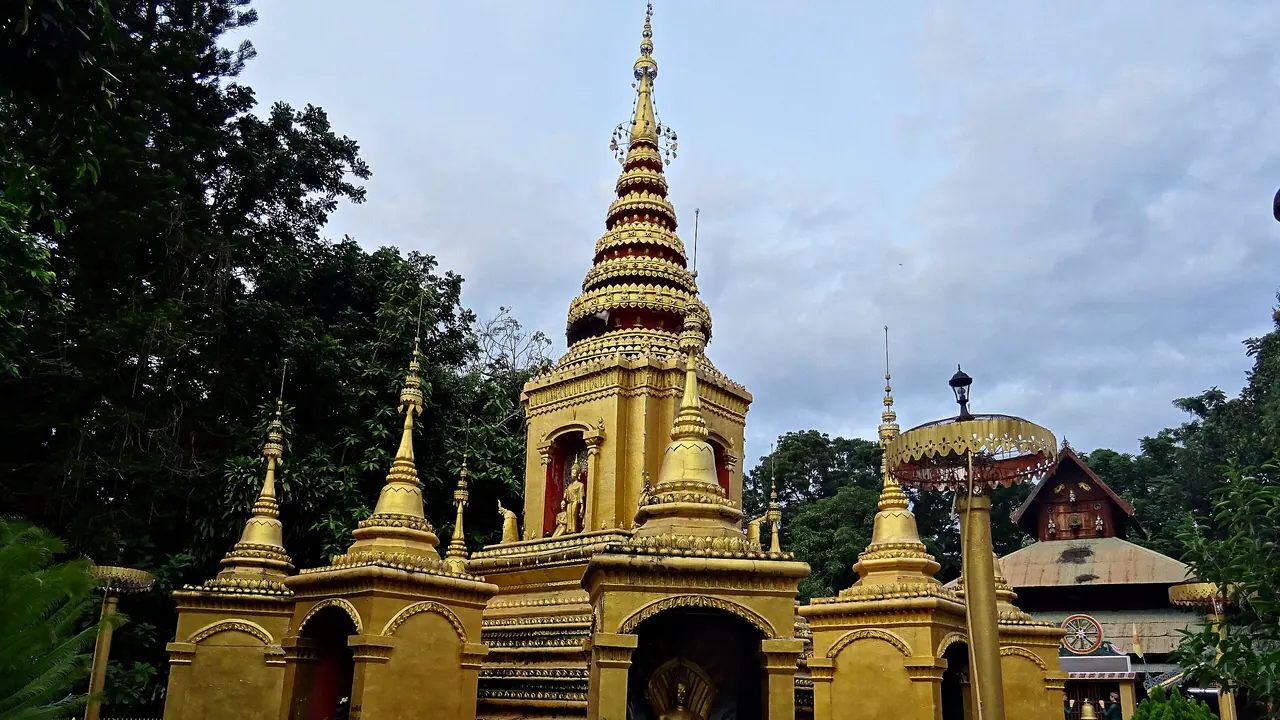
Photos: Chiang Rai by Kirandeep Singh Walia, Pexels License; Pai by Christophe95, CC BY-SA 4.0, cropped.
Chiang Rai or Pai?
Our verdict in twelve categories, each scored against the same fixed benchmark cities, and the climate month by month, so you can choose for your trip.
Choose Chiang Rai for
- culture and sights
- day trips
- food and drink
Chiang Rai suits the traveller who wants to see things as well as sit among hills. Its strange modern temples, the old Lanna town of Chiang Saen and the Golden Triangle fill several days of sightseeing, and the eating is better and more local. It is also the easier of the two with children or on a short schedule. Getting there is far gentler than the notorious winding road up to Pai, and once you arrive the outings to the Mekong, Mae Sai and Doi Mae Salong are all close enough to be back by evening.
Choose Pai for
- wellness
- nightlife
- live music and the arts
Pai is for slowing right down. It has little to visit in the usual sense, but the valley of rice fields, canyon ridges and hot springs is the whole point, and the town makes it easy to stay a week doing very little: massage, yoga, a soak in the morning, a scooter ride to a viewpoint, then a sociable night of acoustic music in the bars. Young independent travellers in no hurry will like it more than anyone on a tight itinerary.
Scoreboard
Twelve categories on one fixed scale from 0 to 100. The shaded stretch is the gap between the two.
Your match
Pick a travel style or drag the sliders, and both match scores follow your weighting.
Wins on culture and sights and day trips with your weighting.
Wins on wellness and nightlife with your weighting.
What matters to you?
Category by category
What the scores mean for a trip.
Beaches & swimming
Neither town has a beach, and neither is much better for swimming. Both sit in inland valleys a long way from the sea, so a beach stay needs its own leg of the trip down south.
The water you do get differs a little. Chiang Rai offers forest pools such as Khun Korn and reservoirs, while Pai adds the river itself, where floating downstream on an inner tube is a standard hot-season afternoon.
Food & drink
Chiang Rai is the better place to eat Northern Thai food properly. Khao soi, nam ngiao, sai ua sausage and chilli dips with sticky rice turn up at morning markets for locals as well as at the night bazaar, and the hill coffee and Doi Mae Salong oolong give its many garden cafés real local roots.
Pai's food is pleasant but tilted towards the long-staying traveller: smoothie bowls, vegan plates, pizza and espresso around a walking-street market of skewers and khao soi. The Yunnanese noodles in Santichon are its most distinctive touch, but for depth, Chiang Rai is ahead.
Culture & sights
The gap here is wide. Chiang Rai has a contemporary temple art scene found nowhere else in Thailand: the white plaster and mirrored glass of Wat Rong Khun, the sapphire Blue Temple and Baan Dam's dark teak halls, with Wat Phra Kaew and its Emerald Buddha story adding older history.
Pai offers half a day at most: the big white Buddha at Wat Phra That Mae Yen for the sunset view, a few Shan-style temples, the old wartime iron bridge and the mud-brick houses of Santichon. People visit for the valley, not the sights.
Nightlife
Pai has the more social evenings, though neither is a party town. Its bars around the walking street fill with backpackers after the night market, in bamboo gardens strung with fairy lights, and there is the odd party out of town, all with a young, gap-year crowd.
Chiang Rai is quieter and older in feel: a short strip of reggae and acoustic bars near the clock tower and beer tables at the night bazaar, with most of the town asleep by midnight. A dinner and a couple of drinks suit it better than a night out.
Nature & outdoors
Both are excellent for the outdoors, and they are broadly level; what differs is the scale. Chiang Rai spreads its landscapes over a wide region: tea terraces at Doi Mae Salong, the Doi Tung gardens, the cloud-sea sunrise at Phu Chi Fa and the Mekong at the Golden Triangle, all needing longer drives.
Pai packs its scenery into one valley you can explore by scooter in short hops: the eroded ridges of Pai Canyon, Pam Bok and Mo Paeng waterfalls, misty viewpoints such as Yun Lai, plus rafting and the river cave at Tham Lod further out. Both lose their views to smoke haze in the burning season.
Day trips
Chiang Rai is the far better base for getting out. Chiang Saen's ruined chedis on the Mekong, the Golden Triangle viewpoint and opium museum, the border market at Mae Sai and the Yunnanese tea town of Doi Mae Salong make two or three easy days of outings.
Pai is too remote for that. Apart from the hill villages around Soppong, the nearest towns are three winding hours away, so Mae Hong Son and Chiang Mai are places to move on to rather than return from in an evening.
Good for families
Chiang Rai is the easier choice with children, though neither is designed with families in mind. Singha Park, with its lakes, tea fields and grazing animals, is a proper family day out, and the bright temples and elephant sanctuaries hold younger attention.
Pai has waterfalls, farms, gentle tubing and a night market that children enjoy, but the bend-filled road up is notorious for making passengers sick, and the town's evenings belong to backpackers. It suits older, outdoorsy children better than young ones.
Getting around
Chiang Rai is the easier of the two to get around, though in both places you will need wheels for the sights. It has ride-hailing apps, tuk-tuks, songthaews, a local bus to the White Temple and regional buses from the old terminal, so you can manage without driving yourself.
In Pai there is no public transport beyond the few walkable streets of the centre. The valley is reached almost entirely by rented scooter, which is risky for beginners on the hill roads, or by hired songthaews and tours.
Shopping & style
Both are market towns, but Chiang Rai gives you more to browse. Its nightly bazaar and the longer Saturday walking street on Thanalai Road carry hill-tribe silver, textiles and carved wood, and the Doi Mae Salong oolong and local coffee are good to take home.
Pai's evening walking street is fun but repetitive, with cotton trousers, woven bags, jewellery and small art prints from stall to stall. For anything beyond that, wait for Chiang Mai.
Affordability
Both are among the cheapest places you can travel in Thailand, and on a budget there is little to choose between them. Where your money goes differs, though. In Chiang Rai the main expense is reaching sights spread across the region by driver, car or tour.
In Pai, cheap scooter rental keeps getting around inexpensive, but prices in its tourist centre run above ordinary northern towns and climb at the new year.
Live music & performing arts
Neither has a stage worth planning around, but Pai has more music. Several of its bars host acoustic, blues, reggae or jazz jams most nights, and the informal open-stage feel is part of an evening there.
Chiang Rai leans towards tradition rather than bar music: Lanna dance at the night bazaar and khantoke dinners with dancing, plus music and processions at temple festivals and Loy Krathong.
Wellness & relaxation
Pai is built around unwinding in a way Chiang Rai is not. The Tha Pai hot springs in a forest park, yoga, meditation and detox retreats lasting from a day to weeks, and days of hammocks and rice-field views make rest the main activity.
Chiang Rai is calm enough, with massage on every street, a few riverside and hill resort spas and simple soaking pools at Pong Phrabat and Mae Kachan, but here relaxation fits around sightseeing rather than replacing it. Both lose their calm in the smoky spring.
When should you go?
Pick your month. The climate figures are measured averages, not a forecast.
Chiang Rai in July
Pai in July
Daytime high, °C
Rainfall in the month, mm
Where the figures come from
Pai's temperatures are measured 64 km from the centre, at Mae Hong Son.
Pai's station stands 242 m below the city centre, so the centre is likely a little cooler than the figures say.
Pai has no rain gauge within 25 km of the centre, so its rainfall comes from a gridded climate dataset read at the city rather than from a gauge further away.
Pai's sunshine is measured 86 km from the centre, at Chiang Mai.
Temperature and rainfall are climate normals, averaged over the years shown. Chiang Rai: 1991-2020 (sunshine 1961-1990) normals, Chiang Rai (1 km from centre). Pai: 1971-2000 (sunshine 1991-2020, rainfall 1991-2020) normals, Mae Hong Son (63.7 km from centre).
Both towns are at their best from November to February, when the rains have finished, the skies are clear and mornings in the hills are cool and misty. Pai is the drier of the two at this time of year and gets just as much sun. From March both fill with smoke haze from field burning, and the heat builds: Chiang Rai peaks around 35°C in April, while Pai's valley gets hotter still at about 38°C, which makes walking around in the middle of the day hard work.
The rains arrive in May and are heaviest in July and August. Chiang Rai is the wetter of the two, with about 390mm in August against roughly 230mm in Pai, though Pai's monsoon months are the greyer and see the least sun. Green rice fields and full waterfalls are the reward, but trails turn muddy, and October is the month when both start to recover.
Which traveller are you?
For a culture and arts trip, Chiang Rai is the clear choice. The White Temple, the Blue Temple and Baan Dam alone are worth the journey, while Pai offers a hilltop Buddha, a few small temples and no museums of note.
On a relaxing and wellness trip, Pai wins. Hot springs in a forest park, yoga and meditation retreats running for days or weeks, and a town that is built around hammocks and long, unplanned afternoons make it easier to unwind than in Chiang Rai.
On a family trip with children, Chiang Rai works better. Singha Park gives children space to cycle and see animals, the colourful temples hold their attention, and there is no nauseating mountain road to reach it or a backpacker party atmosphere in the evenings.
Before you go
| Measure | Chiang Rai | Pai |
|---|---|---|
| Official language | Thai | Thai |
| Currency | Baht (THB) | Baht (THB) |
| Sockets | ABCF220 V, 50 Hz | ABCF220 V, 50 Hz |
| Driving side | Left | Left |
| Time zone | UTC+7 | UTC+7 |
| Emergency number | Police 191, ambulance 1669, fire 199 | Police 191, ambulance 1669, fire 199 |
| Elevation | 390 m | 509 m |
| Main airport | Mae Fah Luang - Chiang Rai International Airport (CEI)8 km from centre4 non-stop destinations | Chiang Mai International Airport (CNX)86 km from centre28 non-stop destinations |
By the numbers
| Measure | Chiang Rai | Pai |
|---|---|---|
| City population | 70,610 | 3,598 |
| People per km² | 1,159 | - |
| Museums within 10 km | 4 | 0 |
| UNESCO World Heritage sites within 50 km | 0 | 0 |
Where else could you go?
Every comparison below shares a destination with this one, so you can follow Chiang Rai or Pai somewhere new.
- Chiang Maivs Pai
- Chiang Maivs Chiang Rai
- Luang Prabangvs Chiang Rai
- Vientianevs Chiang Rai
- Luang Prabangvs Pai
- Vientianevs Pai