
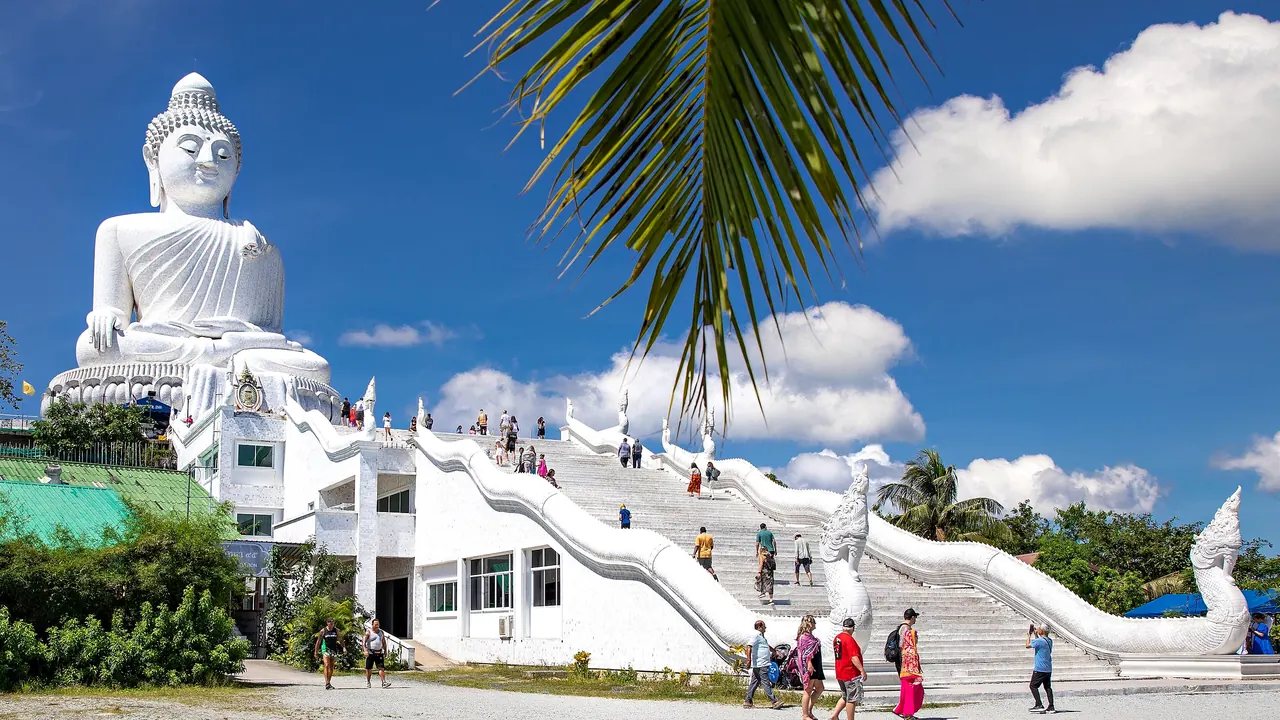
Photos: Koh Kood by Stéphane Bidouze, CC BY-SA 4.0, cropped; Phuket by Mussi Katz, CC0.
Koh Kood or Phuket?
Our verdict in twelve categories, each scored against the same fixed benchmark cities, and the climate month by month, so you can choose for your trip.
Choose Koh Kood for
Koh Kood does not lead in any category we score.
Koh Kood is for travellers who want an island with almost nothing on it but forest and bays. You stay at one resort on a quiet stretch of sand, swim, kayak up a mangrove river, eat grilled fish in a stilt village and go to bed early. It suits couples and readers with a pile of books who will accept a long journey and very little choice in return for real seclusion.
Choose Phuket for
- nightlife
- shopping
- food and drink
Phuket is the better pick for nearly everyone else. It has beaches just as good, plus a food culture of its own in the old town, Bangla Road for nights out, Phang Nga Bay and the Similans for days on the water, and resorts, spas and attractions built for families. It is busier and in places brash, but you can choose between noise and calm by picking which beach to stay on.
Scoreboard
Twelve categories on one fixed scale from 0 to 100. The shaded stretch is the gap between the two.
Your match
Pick a travel style or drag the sliders, and both match scores follow your weighting.
Has no clear advantage with the weighting you have chosen.
Wins on nightlife and shopping with your weighting.
What matters to you?
Category by category
What the scores mean for a trip.
Beaches & swimming
Both islands have soft sand and warm, clear water, so the choice comes down to mood. Koh Kood's west-coast bays, among them Klong Chao, Ao Tapao and Ao Noi, are backed by palms and jungle and have only a handful of resorts each. A bay can feel almost private, with a hammock and a kayak in place of loungers and bars. Before you book, check how far the sea pulls back at low tide in your bay, and whether its sand is free of sandflies. The bays are far apart, so in practice you swim from the one you sleep on.
Phuket lets you choose a beach to suit the day. Patong is packed with loungers, Kata and Karon are wide and relaxed, Kata Noi and Freedom Beach are small coves between headlands, and Mai Khao and Nai Yang in the north are long and empty. Because the island is compact, you can try several in one stay, and boats run out to the white sand of the Racha islands for a change of scene.
Food & drink
Phuket gives you far more to eat and much better food to plan around. Its Hokkien and Peranakan heritage gives Phuket Town a cuisine found almost nowhere else in Thailand: yellow noodles, braised pork belly, crab curry with rice noodles at breakfast and early-morning dim sum. On top of that come walking-street stalls, seafood at Rawai and a small fine-dining scene.
Koh Kood's best meals are fish, crab and squid straight off the boats in the stilt villages of Ao Salad and Ao Yai. Otherwise it is resort menus and honest Thai cooking along the main road. Because the bays are far apart, most guests end up eating where they sleep night after night.
Culture & sights
Neither island is a sightseeing destination, but Phuket at least fills a rewarding half day. The pastel Sino-Portuguese shophouses and merchants' mansions around Thalang and Dibuk roads, Wat Chalong, the Big Buddha above Chalong Bay and the museum on the 1785 Burmese siege give some sense of the island's history.
Koh Kood's cultural interest comes down to the wooden houses and piers of its stilt fishing villages and a few small temples. They are worth a wander, but not a reason to come.
Nightlife
This is one of the starkest differences on the page. Phuket has Bangla Road in Patong, a neon strip of bars, go-go bars and big clubs, loud and seedy at the edges. It also has sunset beach clubs on the west coast and live-music shophouse bars in Phuket Town if you want something calmer.
Koh Kood has none of it on purpose. An evening there means dinner and one drink at your resort's bar on the sand. Anyone hoping to go out at all should not choose it.
Nature & outdoors
Phuket's outdoors is bigger and more varied, and most of it is on the water. You can kayak through caves into lagoons among Phang Nga Bay's limestone towers, and the Similan and Racha islands offer some of Thailand's best diving, with reef sharks and rays. On land, Khao Phra Thaeo protects rainforest with gibbons.
Koh Kood feels wilder at ground level, because much of it is still forest. You can take short walks to the Klong Chao and Huang Nam Kheo waterfalls, visit giant old trees inland and paddle up a mangrove river, and its marine-park reefs to the north make for good snorkelling. Its activities are gentler and on a smaller scale.
Day trips
From Koh Kood the only real outing is a dry-season boat to flat, quiet Koh Mak, sometimes combined with sandy islets for snorkelling. The mainland is too far for a day.
Phuket offers a proper choice. You can take a boat to Phi Phi and Tonsai village, visit Koh Panyee's stilt village under its cliff in Phang Nga Bay, or spend a slower day on Koh Yao Noi. Thanks to the bridge north, Krabi and Ao Nang are also within a long day's drive.
Good for families
Phuket is much better set up for children. Big resorts at Kata, Karon and the northern beaches have lagoon pools and kids' clubs, and there are water parks, an aquarium at Cape Panwa and elephant sanctuaries for days off the sand. The catches are monsoon surf, busy roads and keeping well away from Patong.
Koh Kood can make a happy, simple week for small children who are content with calm bays, waterfall pools and a resort pool. But the long road and boat journey is tiring, there is nothing to do beyond the beach, and serious medical care means a boat back to Trat.
Getting around
Both islands are scooter-and-taxi places, but Phuket is easier to reach and move around. You fly straight onto the island, an airport bus covers the west coast, and songthaews run from Phuket Town to the beaches. Taxis and ride-hailing fill the gaps, though traffic is heavy in high season and the roads are risky on a scooter.
Koh Kood takes real effort to reach: a long trip to Trat and then about an hour or more by boat, with fewer crossings in the monsoon. Once there, you have no public transport and one hilly road with steep, sandy turns down to the bays.
Shopping & style
Koh Kood has nothing to shop for beyond minimarts for sun cream and the beachwear in resort boutiques.
Phuket covers the practical side with malls near Phuket Town and in Patong, plus tailors who make clothes in a few days. The better buys are local: batik and Peranakan-style goods in old-town shophouses, crafts at the Sunday walking street, and pearls from nearby farms.
Affordability
Neither island is a shoestring destination, and Phuket comes out slightly cheaper overall despite its reputation. Its cheap street food in Phuket Town and guesthouses on every beach give budget travellers more room, though taxis and peak-season prices at the resorts and in Patong push costs up.
On Koh Kood, the isolation is what costs you. Lodging is mostly mid-range or upmarket bungalows, meals tend to be at resort prices, and boat transfers and snorkelling trips add up. Fan bungalows and local Thai places help, but there is less choice.
Live music & performing arts
Phuket at least has evening entertainment: ladyboy cabaret revues in Patong, Thai boxing nights, a big cultural show with dancers, and cover bands in bars at Kata and Phuket Town. Even so, it has no theatre or concert life. On Koh Kood, the most you can hope for is an occasional acoustic set at a resort bar.
Wellness & relaxation
Phuket offers far more for anyone who wants treatments or a programme. Good massage is available everywhere from beach-road shopfronts to spas with pavilions over the sea, and detox, yoga, meditation and Muay Thai camps are clustered around Chalong. Mai Khao, the Laguna area and Nai Harn are the calm places to stay.
Koh Kood's strength is simply the deep quiet of jungle resorts with no traffic or nightlife. Its treatments rarely go beyond massage at open-sided beach pavilions and the spa menus at upmarket resorts.
When should you go?
Pick your month. The climate figures are measured averages, not a forecast.
Koh Kood in July
Phuket in July
Daytime high, °C
Rainfall in the month, mm
Where the figures come from
Koh Kood's temperatures are measured 39 km from the centre, at Khlong Yai.
Koh Kood has no rain gauge within 25 km of the centre, so its rainfall comes from a gridded climate dataset read at the destination rather than from a gauge further away.
Phuket's temperatures are measured 27 km from the centre, at Phuket Airport.
Temperature and rainfall are climate normals, averaged over the years shown. Koh Kood: 1971-2000 (rainfall 1991-2020) normals, Khlong Yai (38.5 km from centre). Phuket: 1991-2020 (sunshine 1961-1990, rainfall 1981-2010) normals, Phuket Airport (26.9 km from centre).
Both islands are hot all year, with daytime highs of 30°C to 34°C. Neither is ever too cool for the beach, but walking at midday is hard work in the warmest spells of March to May. The sea is warm enough to swim in every month on both. The real difference is the rain. Koh Kood dries out early: November is already fairly dry and December is its driest month, so November to February is the most reliable stretch on the west coast. Showers return in March and April, and from May the monsoon is very heavy, reaching around 777mm in August, when many places close.
Phuket's dry season starts a little later but runs on into March. November is still fairly wet, while December to March are dry and bright, with February down to 16mm and long, sunny days through the first months of the year. Its monsoon from May to October is wet and cloudier but much less extreme than Koh Kood's. The main problem then is rough surf on the west coast, not closures.
Which traveller are you?
On a beach and sun trip, both work well in the dry season. Choose Koh Kood for near-empty bays like Ao Tapao with jungle behind them. Choose Phuket for a choice of sand, from Kata's broad stretch to Nai Harn, plus boat trips to Phi Phi.
For a food and nightlife trip, Phuket wins easily. It has Hokkien noodles and crab curry in Phuket Town's shophouses, night markets, and Bangla Road running until the small hours. Koh Kood offers resort dinners, a drink on the sand and silence.
On a family trip with young children, Phuket is the easier choice. Kata, Karon and the northern beaches have gentle dry-season water, kids' clubs, water parks and an aquarium. Koh Kood's calm bays are lovely, but it has little for children to do and only basic medical care.
Before you go
| Measure | Koh Kood | Phuket |
|---|---|---|
| Official language | Thai | Thai |
| Currency | Baht (THB) | Baht (THB) |
| Sockets | ABCF220 V, 50 Hz | ABCF220 V, 50 Hz |
| Driving side | Left | Left |
| Time zone | UTC+7 | UTC+7 |
| Emergency number | Police 191, ambulance 1669, fire 199 | Police 191, ambulance 1669, fire 199 |
| Main airport | Trat Airport (TDX)1 non-stop destination | Phuket International Airport (HKT)85 non-stop destinations |
By the numbers
| Measure | Koh Kood | Phuket |
|---|---|---|
| Population | 2,000 | 77,610 |
| People per km² | 18 | 6,468 |
| Swim season, months above 21 °C | 12 months | 12 months |
Where else could you go?
Every comparison below shares a destination with this one, so you can follow Koh Kood or Phuket somewhere new.
- Koh Phi Phivs Phuket
- Koh Changvs Koh Kood
- Krabivs Phuket
- Koh Lantavs Phuket
- Koh Rongvs Koh Kood
- Koh Sametvs Koh Kood