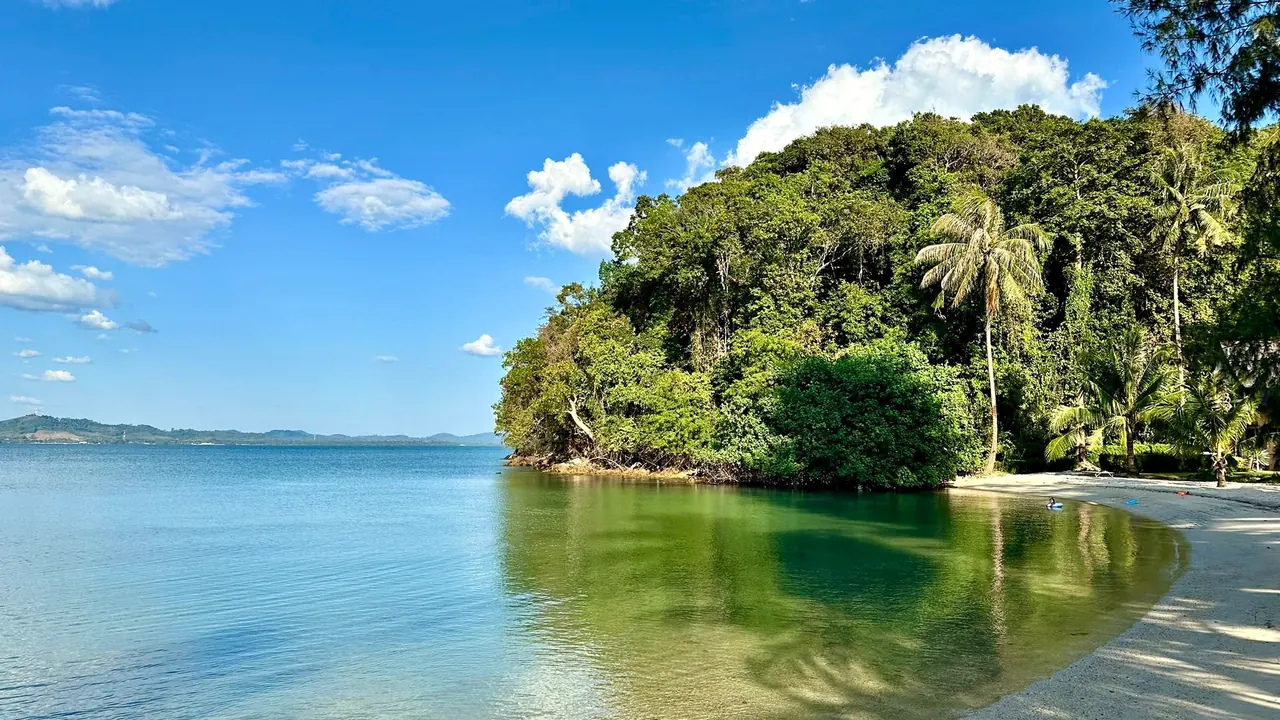
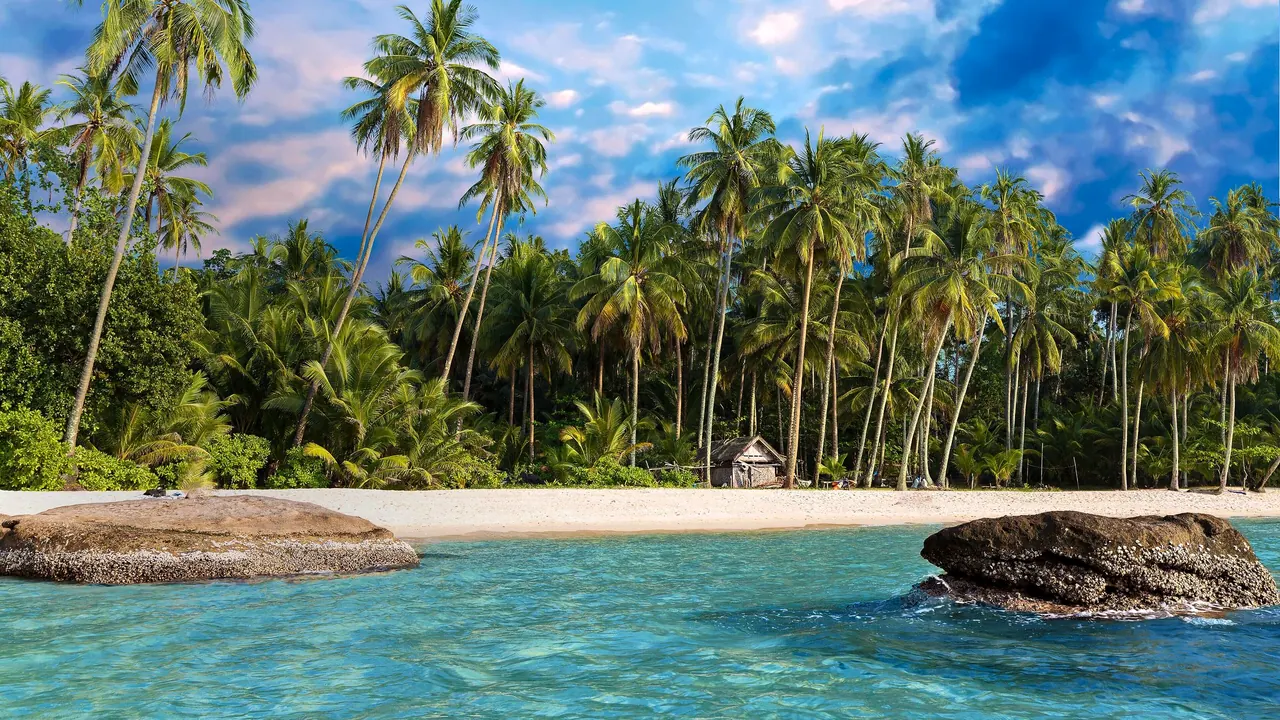
Photos: Koh Chang by Slyronit, CC BY-SA 4.0, cropped; Koh Kood by Stéphane Bidouze, CC BY-SA 4.0, cropped.
Koh Chang or Koh Kood?
Our verdict in twelve categories, each scored against the same fixed benchmark cities, and the climate month by month, so you can choose for your trip.
Choose Koh Chang for
- nightlife
- day trips
- getting around
Koh Chang is the better pick for an island trip with some movement in it. There are bars and fire shows at Lonely Beach and White Sand Beach, songthaews between the west coast beaches, guided treks into the national park hills and boat trips south through the archipelago. It is also the easier and cheaper of the two to reach and to stay on, which suits a first visit to the Thai islands or a tighter budget.
Choose Koh Kood for
- beaches
Choose Koh Kood if the beach itself is the whole point. Its bays are softer, clearer and much emptier, with only a few resorts behind each one, and evenings end with dinner and an early night. It suits couples and anyone happy to stay on one bay for a week. In return they accept a longer boat crossing and far fewer choices once they arrive.
Scoreboard
Twelve categories on one fixed scale from 0 to 100. The shaded stretch is the gap between the two.
Your match
Pick a travel style or drag the sliders, and both match scores follow your weighting.
Wins on nightlife and day trips with your weighting.
Wins on beaches with your weighting.
What matters to you?
Category by category
What the scores mean for a trip.
Beaches & swimming
Both islands have their beaches along the west coast, with water around 29°C in the dry season, so the difference lies in character. Koh Chang's string of beaches is busier and more developed, from the long resort strip of White Sand Beach to the younger crowd at Lonely Beach, with quieter swimming at Klong Prao and Kai Bae.
Koh Kood's bays, such as Klong Chao and Ao Tapao, are softer, clearer and much less built up, and that gives it the edge for a pure beach vacation: a hammock and a kayak rather than a row of beach bars. Some bays on both islands go shallow at low tide, and Koh Kood also has sandflies on a few stretches.
Food & drink
Neither island has a cooking tradition of its own. Both serve decent Thai food to visitors, and seafood is the best of it. Koh Chang gives you more choice of where to eat: open beach restaurants, small evening markets near the main beaches, and crab and prawns picked from tanks on the piers at Bang Bao and Salak Phet.
Koh Kood has fewer options. Family-run places and the stilt villages of Ao Salad and Ao Yai grill fish straight off the boats, but the bays are far apart after dark, so most guests end up eating at their own resort.
Culture & sights
Neither island is a place for sightseeing, and on both the most interesting walk is through a fishing village built on stilts over the water. Koh Chang has Bang Bao and Salak Phet, plus the inscriptions left by Thai kings on the rocks at Than Mayom waterfall. Koh Kood has Ao Yai and Ao Salad, with a few small temples and shrines. On either island, an hour or two covers it.
Nightlife
Koh Chang is the only one of the two with a night out. Lonely Beach is the backpacker end, with bucket drinks, fire shows and bars that stay open late in the busy dry-season weeks. White Sand Beach is more mixed, with sunset cushions on the sand and a string of bars along the road.
Koh Kood has none of this, by design: no clubs, no bar strip and no parties, just a drink at the resort bar. Bear in mind that even Koh Chang's scene thins out or shuts between May and October.
Nature & outdoors
Koh Chang has the bigger landscape. Its forested national park hills rise to about 740m straight from the shore. You can take guided jungle treks, visit waterfalls such as Klong Plu and Than Mayom, and kayak the mangroves at Salak Khok, and the reefs around Koh Rang are within reach by day boat.
Koh Kood feels wilder thanks to its unbroken forest and giant old trees, and paddling up the Klong Chao river from the beach is a lovely outing. But it has no real mountains or long trails, and its marine park reefs are for gentle snorkelling rather than adventure.
Day trips
Koh Chang has much more within reach. Boats run south to Koh Wai, Koh Mak and Koh Kood itself, and the short ferry puts the mainland within reach: Trat, with its canal-side shophouses and morning market, and Chanthaburi, about two hours away, with its riverside old quarter, French-style cathedral and weekend gem market.
From Koh Kood the one real outing is Koh Mak, sometimes combined with tiny islets for sand and snorkelling. The mainland is too far for a day trip, so most people simply stay on their bay.
Good for families
Both suit a family that wants a quiet beach week in the dry season. Each has warm, gentle water, resort pools and Thai staff who are relaxed with children, and neither has attractions built for them. The differences are practical. Koh Chang is easier to reach and has more to fill a day, though its steep hairpin road and the Lonely Beach party scene make parts of the island better for teenagers.
Koh Kood is calmer but more isolated. The journey is a long road trip plus a boat, supplies are limited and the island hospital is small and basic, so anything serious means a transfer to Trat. Older children may get restless after a few days.
Getting around
Both islands are reached via Trat, but Koh Chang needs only a car ferry across a narrow strait, while Koh Kood needs an hour or more by speedboat or ferry, with fewer boats in the monsoon. On Koh Chang, shared songthaews run between the west coast beaches and you can walk the length of your own beach, though the steep climbs near Lonely Beach make a scooter risky.
Koh Kood has no public transport at all. You rely on resort pick-ups, a few taxis arranged in advance, or a scooter on hilly roads with sandy turns down to the bays. The beaches are too far apart to walk between, so many guests rarely leave their own.
Shopping & style
Koh Chang has a little to browse: roadside stalls of sarongs, beachwear, sunglasses and souvenirs along the main road at White Sand Beach, and a row of shell and trinket shops on the pier at Bang Bao. Koh Kood has even less, just a few minimarts on the main road for sun cream and snacks and some beachwear in resort boutiques, with no markets or crafts at all. On either island, anything beyond the basics is better bought in Bangkok on the way through.
Affordability
Koh Chang is the cheaper island to stay on. Simple wooden bungalows near Lonely Beach and Bang Bao, local Thai restaurants and inexpensive massages make a low-cost stay realistic. Beachfront resorts, imported drinks and boat trips push the bill up, especially from December to February.
Koh Kood leans towards mid-range and upmarket stays, with a few luxury retreats. Its isolation means many meals are eaten at resort prices, and the longer boat transfer adds to the bill. A careful traveller can manage with fan bungalows and local restaurants, but the island is set up for a comfortable budget.
Live music & performing arts
On Koh Chang, live entertainment comes with the bars: fire dancers on the sand after dark, acoustic and reggae bands at Lonely Beach and White Sand Beach, and a few venues with cabaret shows. Koh Kood is quieter still, and the most you are likely to find is an occasional acoustic guitar evening at a resort bar. Theatre, concerts and traditional Thai performance are missing from both, so save that kind of evening for Bangkok.
Wellness & relaxation
Both islands are places to slow down rather than to follow a spa programme, and neither has hot springs or a bathing tradition. Koh Chang offers more choice of treatment, with massage salas on the sand, resort spas using local herbs and oils, and a few small yoga and retreat centres on the west coast. For real quiet, stay at Long Beach or Kai Bae.
On Koh Kood the quiet is everywhere, with no traffic noise or nightlife and many resorts alone on a bay or in the jungle. Treatments rarely go beyond simple massage pavilions and the spas of upmarket resorts, some with yoga.
When should you go?
Pick your month. The climate figures are measured averages, not a forecast.
Koh Chang in July
Koh Kood in July
Daytime high, °C
Rainfall in the month, mm
Where the figures come from
Koh Chang's temperatures are measured 58 km from the centre, at Chanthaburi.
Koh Chang has no rain gauge within 25 km of the centre, so its rainfall comes from a gridded climate dataset read at the destination rather than from a gauge further away.
Koh Kood's temperatures are measured 39 km from the centre, at Khlong Yai.
Koh Kood has no rain gauge within 25 km of the centre, so its rainfall comes from a gridded climate dataset read at the destination rather than from a gauge further away.
Temperature and rainfall are climate normals, averaged over the years shown. Koh Chang: 1991-2020 normals, Chanthaburi (57.7 km from centre). Koh Kood: 1971-2000 (rainfall 1991-2020) normals, Khlong Yai (38.5 km from centre).
The two islands sit in the same corner of the Gulf of Thailand and share a calendar. The dry season runs from November to April, with December the driest month on both, and the sea is warm enough to swim in all year, between about 28°C and 31°C. March and April bring the first showers and the most heat. On Koh Chang's west coast, daytime highs stay around 33°C right through the dry months, while Koh Kood's beaches run a degree or two cooler. Koh Chang's sunshine figures show the long, bright days from November to February.
From May the monsoon brings heavy rain and swell to both west coasts until October. Koh Kood gets more of it, with August close to 780mm against roughly 600mm on Koh Chang, and with fewer boats running it is the harder island to visit in the rains. Neither island is ever too cold. The limit is the afternoon heat, so walks and jungle treks are best done early in the morning.
Which traveller are you?
On a beach and sun trip, Koh Kood is the stronger choice. Its west coast bays are soft, clear and lightly built, with room to spread out even in the busiest months. Koh Chang's longest sand, White Sand Beach, is lined with resorts and restaurants.
For a food and nightlife trip, Koh Chang wins easily. Lonely Beach and White Sand Beach have bars, fire shows and late nights in the dry season, and Bang Bao has seafood straight from the tanks. Koh Kood offers a resort bar and an early bed.
On a trip on a tight budget, Koh Chang makes the money go further. Wooden bungalows near Lonely Beach and Bang Bao, local Thai restaurants and shared songthaews keep costs low. On Koh Kood the isolated bays push most stays and meals to resort prices.
Before you go
| Measure | Koh Chang | Koh Kood |
|---|---|---|
| Official language | Thai | Thai |
| Currency | Baht (THB) | Baht (THB) |
| Sockets | ABCF220 V, 50 Hz | ABCF220 V, 50 Hz |
| Driving side | Left | Left |
| Time zone | UTC+7 | UTC+7 |
| Emergency number | Police 191, ambulance 1669, fire 199 | Police 191, ambulance 1669, fire 199 |
| Main airport | Trat Airport (TDX)1 non-stop destination | Trat Airport (TDX)1 non-stop destination |
By the numbers
| Measure | Koh Chang | Koh Kood |
|---|---|---|
| Population | 5,356 | 2,000 |
| People per km² | 25 | 18 |
| Swim season, months above 21 °C | 12 months | 12 months |
Where else could you go?
Every comparison below shares a destination with this one, so you can follow Koh Chang or Koh Kood somewhere new.
- Koh Sametvs Koh Chang
- Koh Rongvs Koh Kood
- Koh Sametvs Koh Kood
- Koh Rongvs Koh Chang
- Phu Quocvs Koh Kood
- Phu Quocvs Koh Chang