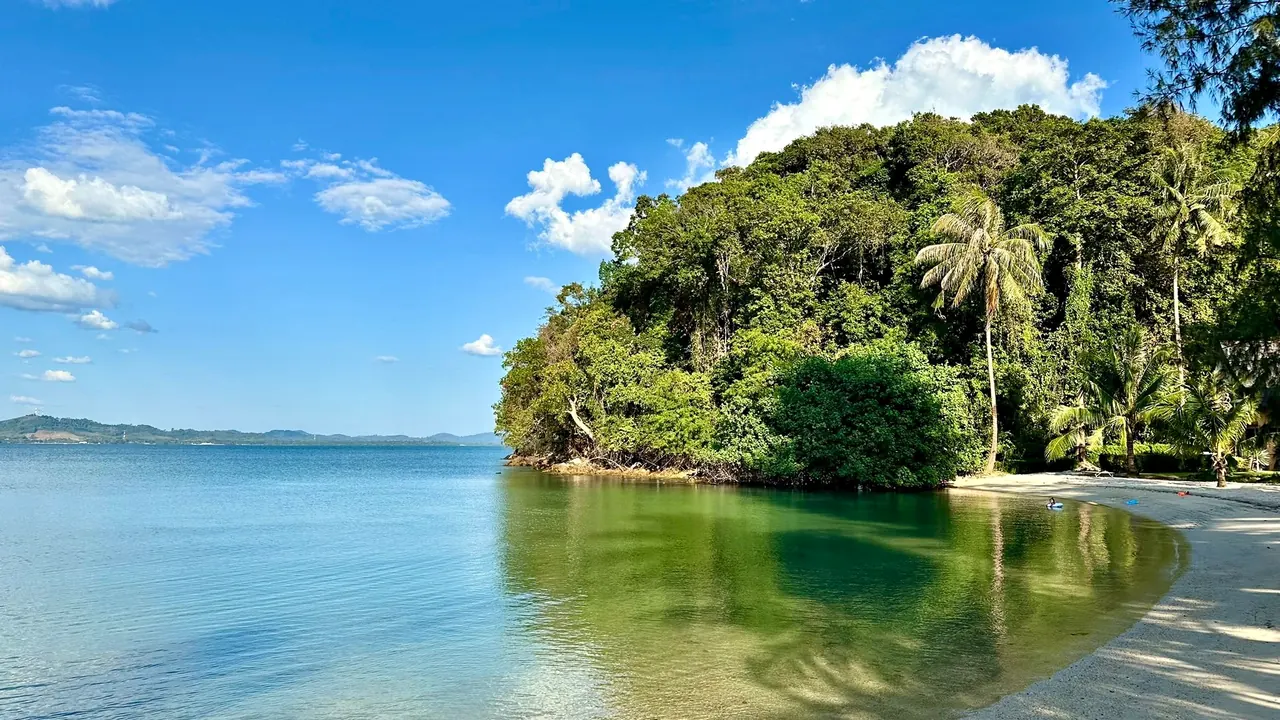
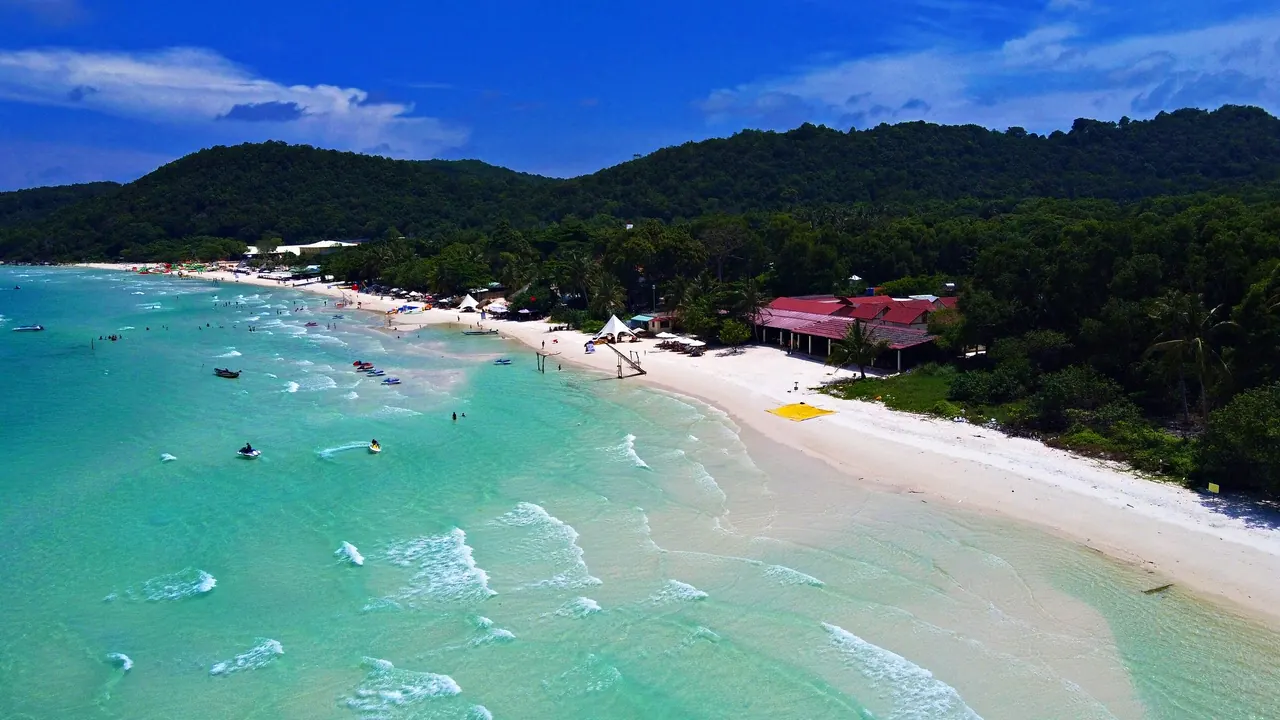
Photos: Koh Chang by Slyronit, CC BY-SA 4.0, cropped; Phu Quoc by Trantuonglam, CC BY-SA 4.0, cropped.
Koh Chang or Phu Quoc?
Our verdict in twelve categories, each scored against the same fixed benchmark cities, and the climate month by month, so you can choose for your trip.
Choose Koh Chang for
- day trips
- nature and the outdoors
- nightlife
Koh Chang is the better pick for travellers who want the island itself to be the activity. Steep jungle hills climb straight up behind the beaches, guided treks lead to waterfalls, and you can paddle the mangroves on the east coast. Boats run south to Koh Wai, Koh Mak and Koh Kood, and the old towns of Trat and Chanthaburi are within reach on the mainland. Backpackers will also find a proper party end at Lonely Beach. In return you accept a long journey with a ferry at the end, a hairpin coast road and almost nothing built for children.
Choose Phu Quoc for
- families
- food and drink
- culture and sights
Phu Quoc makes more sense for families and anyone who wants things to be easy. The airport sits beside the main beach strip, buses and ride-hailing cover the island, and a safari park, a theme park and a water park at the end of the Hon Thom cable car fill the days children get bored of sand. The food is better too: the island has its own dishes, fish sauce houses and pepper farms, and the softest sand is on the southeast coast. What you give up is wild country to explore and anywhere much to go beyond the island.
Scoreboard
Twelve categories on one fixed scale from 0 to 100. The shaded stretch is the gap between the two.
Your match
Pick a travel style or drag the sliders, and both match scores follow your weighting.
Wins on day trips and nature and the outdoors with your weighting.
Wins on families and food and drink with your weighting.
What matters to you?
Category by category
What the scores mean for a trip.
Beaches & swimming
These two are close on beaches, with Phu Quoc slightly ahead, and the difference is mostly in layout. Koh Chang's beaches line up along its west coast, from the long resort strip of White Sand Beach through quieter Klong Prao and Kai Bae to the remote Long Beach at the far south-east. The water is warm and clean but seldom very clear, and because the main beaches face the same way, the monsoon leaves you with nowhere calm to swim.
Phu Quoc has more variety. Its own Long Beach runs about 20km below Duong Dong for sunsets and beach bars, while Sao and Khem beaches in the southeast have softer white sand and pale turquoise water. Having two coasts also helps in the wet season, when the sheltered east side takes over from the rough west.
Food & drink
Phu Quoc is the better island for eating. Beyond grilled squid, scallops and live crab at the Duong Dong night market, it has dishes of its own, such as raw herring wrapped in rice paper, and you can visit the fish sauce houses and pepper farms it is known for across Vietnam.
Koh Chang's seafood is just as fresh. Choosing crab and whole fish from the tanks on the stilted piers of Bang Bao or Salak Phet is one of the island's pleasures. Otherwise the cooking is standard Thai fare for visitors, plus pizza and burgers, with no local cuisine to hunt down.
Culture & sights
Neither island is a place for sightseeing, but Phu Quoc gives you rather more to do on a rainy afternoon. The old prison near An Thoi, now a museum about the French and American wars, is genuinely affecting, and the Dinh Cau shrine and the hillside Ho Quoc Pagoda are worth a short visit.
On Koh Chang the best of it is walking the stilted fishing villages of Bang Bao and Salak Phet and seeing the royal inscriptions on the rocks at Than Mayom. A morning covers everything.
Nightlife
The two are about level after dark, but the evenings feel quite different. Koh Chang's late nights happen at Lonely Beach, with bucket drinks, fire shows and a backpacker crowd, while White Sand Beach is more mixed, with sunset cushions on the sand and a strip of roadside bars.
Phu Quoc is calmer in its bars along Long Beach and in Duong Dong, and its evening crowds go instead to the purpose-built entertainment districts at either end of the island for strolling, shows and the casino in the north. On both islands the scene thins out sharply outside the dry season.
Nature & outdoors
Koh Chang is the wilder island. Its steep, forested hills drop straight to the sea, and guided treks go up from the west coast villages to waterfalls like Klong Plu and Than Mayom, which are at their best just after the rains. Add mangrove kayaking on the east coast and day boats to the reefs at Koh Rang, and you have a good variety of outings.
Phu Quoc's outdoors is mostly on the water: snorkelling and diving trips from An Thoi, night squid fishing and sunset cruises. Its national park in the north has low hills and a few trails, and the rest of the interior is farmland. The Hon Thom cable car gives the best view of the archipelago, but nobody comes for the hiking.
Day trips
Koh Chang has more places to go. Speedboats run to the quiet, flat islands of Koh Wai and Koh Mak and out to the larger Koh Kood. On the mainland you can visit Trat for its canal-side wooden shophouses and morning market, or go further to Chanthaburi, about two hours away, for its riverside old quarter and French-style cathedral.
From Phu Quoc the choice is mostly island-hopping boats around the An Thoi archipelago. The only mainland outing is the ferry of just over an hour to the quiet border town of Ha Tien and its temple hill, so most visitors simply stay on the island.
Good for families
Phu Quoc is clearly the better island for children. The safari park and theme park in the north, the water park at the end of the Hon Thom cable car and the big resorts with kids' clubs mean there is something to do on days off the beach. The catch is that each of these is a taxi ride away.
Koh Chang suits a family happy with sand, a pool and the odd waterfall walk. Klong Prao and Kai Bae have gentle water in the dry season and the resorts are welcoming, but nothing is built for children. The long trip from Bangkok, the ferry and the steep, winding coast road also make it harder work with small children.
Getting around
Phu Quoc is the simpler island to arrive at and move around. The airport sits right beside Long Beach and Duong Dong, and electric buses run along the main spine of the island, with ride-hailing and metered taxis covering the rest. Distances are real, though, and the southeast beaches, the cable car and the safari park each take half an hour or more by road.
Koh Chang starts with a flight to Trat or a long drive from Bangkok, followed by a car ferry. Once there, a single coast road that never closes its loop in the south means Bang Bao and Salak Phet are dead ends. Songthaews shuttle along the west coast, but the steep climbs near Lonely Beach make a scooter risky for anyone but a confident rider.
Shopping & style
Neither island is worth visiting for shopping, though Phu Quoc has a few more things worth taking home. Its cultured pearls, black pepper and fish sauce are real local products, but check whether your airline allows the fish sauce in luggage. The resort districts also have rows of shops.
Koh Chang has sarongs, beachwear and souvenir stalls along the road at White Sand Beach and shell trinkets on the Bang Bao pier, and little beyond that.
Affordability
Both are good value for a tropical island and cost about the same, so the difference is in what pushes the bill up. On Koh Chang that is the beachfront resorts at White Sand Beach and Klong Prao, imported drinks, snorkelling trips and songthaew fares that add up over a stay, while simple wooden bungalows near Lonely Beach and Bang Bao stay cheap.
On Phu Quoc, guesthouses near Duong Dong and market seafood are cheap, but the theme parks, the cable car and the big resorts cost much more. Families planning to use the attractions should budget for them. Both islands charge their highest prices around the turn of the year.
Live music & performing arts
The difference here is fire dancers on the sand against drones and fireworks over the sea. Koh Chang's entertainment is informal and comes with the bars: acoustic and reggae bands at Lonely Beach and White Sand Beach, fire shows after dark and the odd cabaret.
Phu Quoc puts on large, polished shows in its resort districts, with water, lights and drones by the sea in the south and multimedia shows in the north. They are made for visitors and have nothing to do with a local music scene. Neither island has theatre, concerts or traditional performance.
Wellness & relaxation
The two are evenly matched for a slow, restful stay, and neither has hot springs or a bathing tradition. Koh Chang's calm comes from being remote. The far ends at Kai Bae and especially the south-eastern Long Beach feel cut off, and Thai massage with local herbs is on offer everywhere from beach salas to resort spas, alongside a few small yoga retreats on the west coast.
Phu Quoc is more resort-based: cheap Vietnamese massage in Duong Dong, herbal baths at the big hotel spas and yoga at some beach resorts. For real quiet, stay on the north coast at Ong Lang and Ganh Dau or near Khem Beach, away from the busy Long Beach strip.
When should you go?
Pick your month. The climate figures are measured averages, not a forecast.
Koh Chang in July
Phu Quoc in July
Daytime high, °C
Rainfall in the month, mm
Where the figures come from
Koh Chang's temperatures are measured 58 km from the centre, at Chanthaburi.
Koh Chang has no rain gauge within 25 km of the centre, so its rainfall comes from a gridded climate dataset read at the destination rather than from a gauge further away.
Temperature and rainfall are climate normals, averaged over the years shown. Koh Chang: 1991-2020 normals, Chanthaburi (57.7 km from centre). Phu Quoc: 1991-2020 normals, Phu Quoc (0.7 km from centre).
Both islands are hot all year, with daytime highs above 30°C in every month, so getting around on foot is warm work whenever you go, and April is the most draining month on each. The sea stays bath-warm on both all year round, so the choice comes down to rain. Around Koh Chang's west coast beaches the dry season runs from November to February. December is the best month, with barely 15mm of rain and the most sunshine of the year. March and April bring showers, and from May the monsoon sets in hard, peaking in August at close to 595mm, with grey, rough weeks on the beaches.
Phu Quoc's dry season is just as long but starts a month later. November is still wet at around 200mm, so the settled months are December to March, and March there is clearly drier than on Koh Chang. The rains build from April and peak in September. In the wet months Phu Quoc's sheltered east coast gives you somewhere calmer to swim, while Koh Chang's beaches all face the monsoon head on. So November favours Koh Chang and March favours Phu Quoc, and from December to February both are at their best.
Which traveller are you?
On a family trip with young children, Phu Quoc is the easier choice. Its safari park, theme park with an aquarium and the water park on Hon Thom give children real days out, and the big resorts have kids' clubs. Getting there is also far simpler than Koh Chang's ferry and hairpin road.
For an outdoors trip, Koh Chang has more to offer. Its forested national park rises steeply to about 740m, with guided jungle treks, waterfalls, mangrove kayaking at Salak Khok and boats to the reefs around Koh Rang. Phu Quoc's interior is mostly flat pepper farmland.
On a food and nightlife trip, Phu Quoc eats better, with raw herring salad, fresh fish noodle soups and its famous fish sauce and pepper. For going out the two are close, though Koh Chang's Lonely Beach has the livelier backpacker crowd and fire shows.
Before you go
| Measure | Koh Chang | Phu Quoc |
|---|---|---|
| Official language | Thai | Vietnamese |
| Currency | Baht (THB) | Dong (VND) |
| Sockets | ABCF220 V, 50 Hz | ACFG220 V, 50 Hz |
| Driving side | Left | Right |
| Time zone | UTC+7 | UTC+7 |
| Emergency number | Police 191, ambulance 1669, fire 199 | Police 113, ambulance 115, fire 114 |
| Main airport | Trat Airport (TDX)1 non-stop destination | Phú Quốc International Airport (PQC)36 non-stop destinations |
By the numbers
| Measure | Koh Chang | Phu Quoc |
|---|---|---|
| Population | 5,356 | 179,480 |
| People per km² | 25 | 305 |
| Swim season, months above 21 °C | 12 months | 12 months |
Where else could you go?
Every comparison below shares a destination with this one, so you can follow Koh Chang or Phu Quoc somewhere new.
- Koh Sametvs Koh Chang
- Koh Taovs Koh Chang
- Koh Phanganvs Koh Chang
- Koh Samuivs Koh Chang
- Koh Sametvs Phu Quoc
- Koh Samuivs Phu Quoc