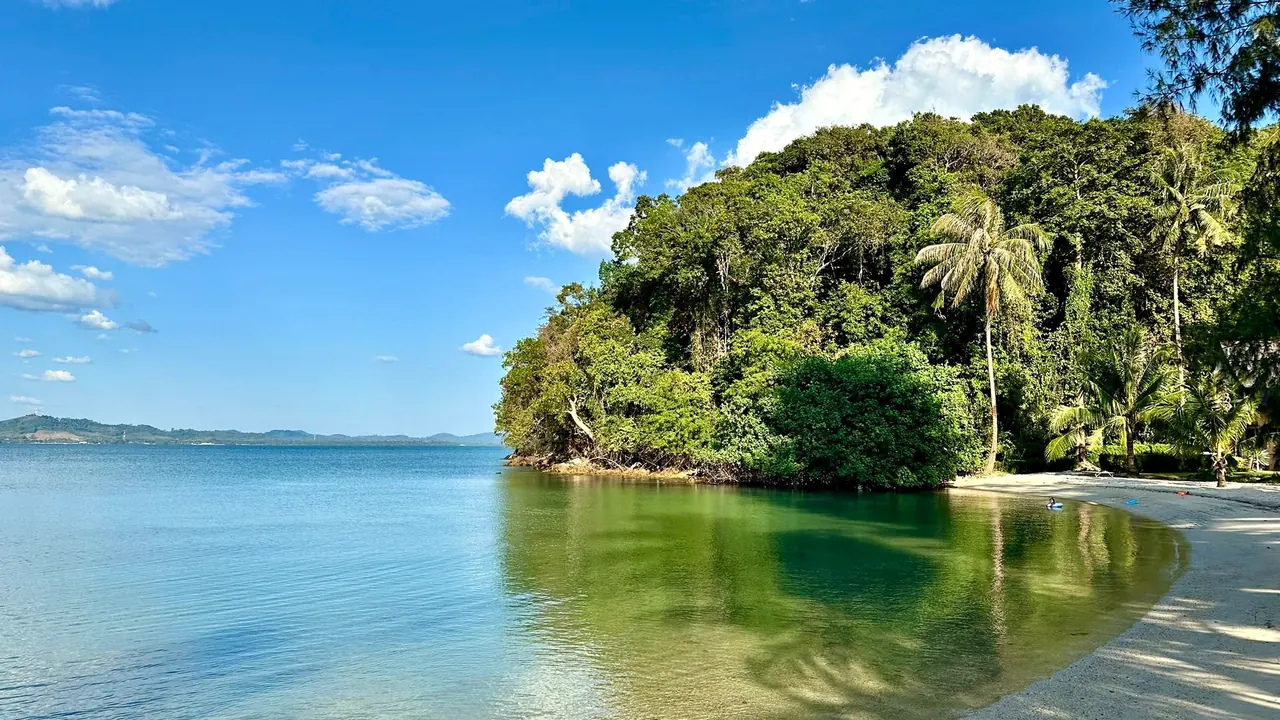
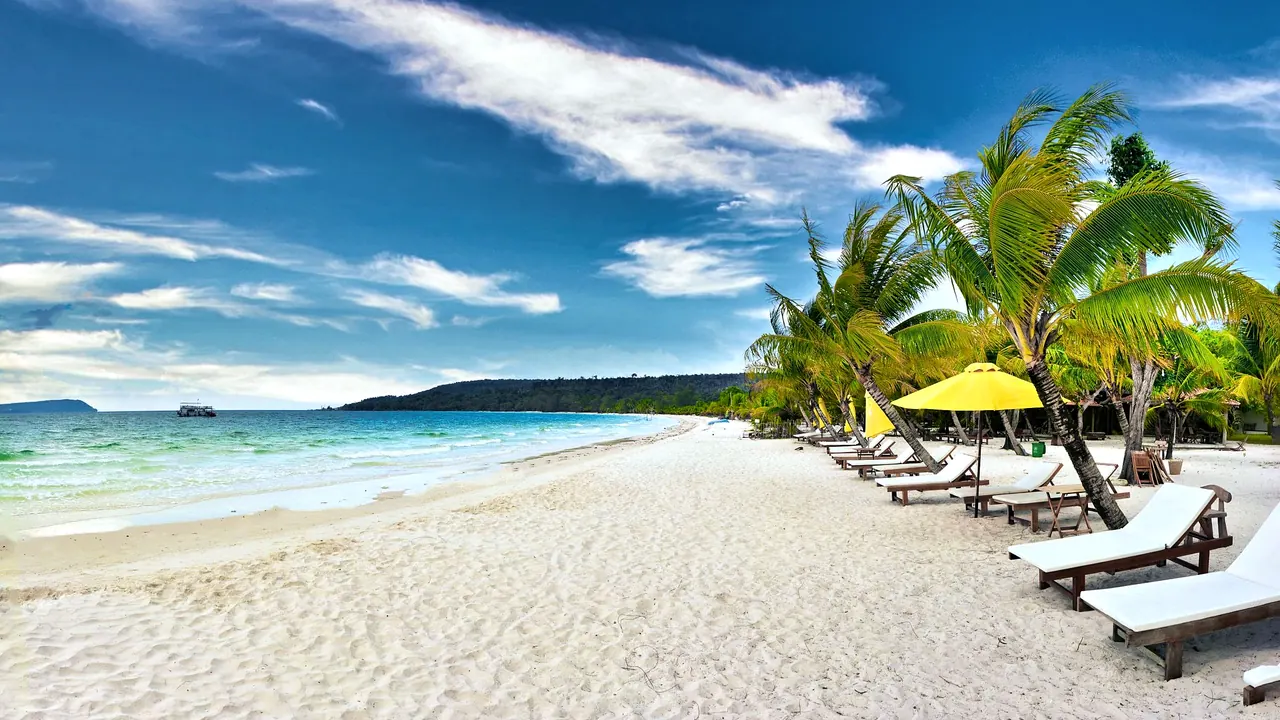
Photos: Koh Chang by Slyronit, CC BY-SA 4.0, cropped; Koh Rong by allPhoto Bangkok, Pexels License.
Koh Chang or Koh Rong?
Our verdict in twelve categories, each scored against the same fixed benchmark cities, and the climate month by month, so you can choose for your trip.
Choose Koh Chang for
- day trips
- food and drink
- wellness
Koh Chang suits travellers who want a tropical island with more to fill the days: guided jungle treks, waterfalls, seafood picked from tanks on the piers at Bang Bao, and boat trips to quieter islands further south. Getting there by road and car ferry is long but simple. It is the better pick for families and for anyone who wants massages and comfortable resorts without roughing it.
Choose Koh Rong for
- beaches
- nightlife
Choose Koh Rong if the beach itself is the whole point. The sand is finer and emptier and the island far less built up. Koh Touch has a young party scene that runs late, while Long Set and Sok San are truly quiet. In return you accept plainer food, harder travel and very little to do beyond swimming, walking and lying still.
Scoreboard
Twelve categories on one fixed scale from 0 to 100. The shaded stretch is the gap between the two.
Your match
Pick a travel style or drag the sliders, and both match scores follow your weighting.
Wins on day trips and food and drink with your weighting.
Wins on beaches and nightlife with your weighting.
What matters to you?
Category by category
What the scores mean for a trip.
Beaches & swimming
Koh Rong has the better sand, and more of it to yourself. Long Set runs for kilometres with almost nothing built on it, Sok San is quieter still, and across the channel Koh Rong Sanloem adds the long, calm curve of Saracen Bay. On moonless nights the water near shore glows with bioluminescent plankton, the island's signature.
Koh Chang's beaches are good but more developed: a row of resort strips down the west coast from busy White Sand Beach to Klong Prao and Kai Bae, with only Long Beach feeling remote. The water is clean but rarely glassy, and some bays are shallow at low tide. The sea on both islands is warm all year.
Food & drink
Neither island is a food destination, but Koh Chang eats better. Its best meals are in Bang Bao and Salak Phet, where you choose crab and whole fish from tanks on piers over the water, and evening markets near the main beaches add skewers, roti and fruit shakes.
On Koh Rong everything arrives by boat, so menus are narrower and quality less reliable. Koh Touch has backpacker staples and a few Khmer dishes such as amok and lok lak, beach grills cook the day's catch in the evenings, and elsewhere you eat at your resort.
Culture & sights
Koh Chang has a little more to look at between swims. There are the stilted piers and houses of Bang Bao and Salak Phet, a few small Buddhist temples, and the rocks at Than Mayom waterfall where visiting Thai kings left inscriptions. An hour or two covers all of it.
Koh Rong's sights are its working villages, Koh Touch and the fishing settlement of Prek Svay on the north coast, with their stilt houses and longtail boats. For temples or Khmer heritage you have to go back to the mainland.
Nightlife
Both islands run on the same backpacker formula of buckets and fire shows, but Koh Rong's version is louder and more concentrated. The whole scene is the beachfront at Koh Touch, which runs into the small hours in the dry season and has the occasional bigger beach party.
Koh Chang splits its evenings. Lonely Beach is the party end, while White Sand Beach is more mixed, with cushions on the sand at sunset and a string of roadside bars, which suits couples who want a drink more than a big night. On both islands the rest of the coast goes quiet after dinner, and the wet season empties the bars.
Nature & outdoors
Koh Chang has more wild country to explore. Steep national park forest rises to about 740m, guided treks climb from the west coast villages, several waterfalls are at their fullest in November and December, and the mangrove channels around Salak Khok are good for kayaking. Day boats run to the reefs around Koh Rang.
Koh Rong's hills are lower, with trails linking one bay to the next, a single seasonal waterfall, and hornbills and monkeys if you are lucky. The diving is better from Koh Rong Sanloem than from the main island. On both, the coral is fair rather than remarkable.
Day trips
Koh Chang gives you more reasons to leave for a day. Speedboats run south to the quiet islands of Koh Wai, Koh Mak and Koh Kood. On the mainland, Trat has canal-side shophouses and a morning market, and Chanthaburi, about two hours away, has a riverside old quarter and a large cathedral.
From Koh Rong the choice is mostly other beaches: Saracen Bay and the village of M'Pai Bay on Koh Rong Sanloem, or snorkelling tours around the smaller islets. Sihanoukville is close but has little to see, and Kampot and Kep are too far once the crossing is counted.
Good for families
Koh Chang is the easier family choice. Resorts at Klong Prao and Kai Bae have pools and family bungalows, the water is gentle in the dry season, and waterfall walks and island boat trips fill the days. The long journey from Bangkok and the hairpin bends on the coast road still take some patience.
Koh Rong asks more of parents. You face jungle paths or bumpy rides between bays, sandflies and a noisy Koh Touch, and there is only basic first aid on the island, so a doctor means a boat back to the mainland. Saracen Bay's shallow water or a quiet Sok San resort can work, but the island suits older children better than toddlers.
Getting around
Both islands take effort, but Koh Chang has a coast road, a car ferry and an airport at Trat on the mainland side. Songthaews run up and down the west coast between the beaches. The road never closes its loop in the south, and the climbs past Kai Bae are steep enough that a driver is safer than a hired scooter.
Koh Rong is around an hour by speedboat from Sihanoukville. Once there, you get about by moto taxi, pickup or water taxi, or on foot along sandy or muddy tracks, and some bays can only be reached by boat. In the rainy months rough seas can cancel crossings altogether.
Shopping & style
Koh Chang at least gives you something to browse, with roadside stalls of sarongs, sunglasses and beachwear along the main road at White Sand Beach and a row of shell and trinket shops on the pier at Bang Bao. Anything more serious waits for Bangkok. Koh Rong stops at minimarts for sunscreen and snacks and a few sarong and bracelet stalls in Koh Touch, so bring what you need from the mainland.
Affordability
Costs work out much the same on both islands: cheap at the simple end, then rising quickly as you add comfort. On Koh Chang the savings are in wooden bungalows near Lonely Beach and Bang Bao and in cheap massages, and prices peak from December to February.
On Koh Rong the dorms and fan bungalows around Koh Touch are cheap, but everything comes in by boat, so a quiet air-conditioned resort on Long Set or Sok San costs noticeably more. On both islands, transfers and local transport add up over a stay.
Live music & performing arts
Neither island has theatre or concerts, and on both the entertainment comes with the drinks. Koh Chang offers a little more: acoustic and reggae bands in the beach bars of Lonely Beach and White Sand Beach, and a few cabaret shows. On Koh Rong it rarely goes beyond the odd open mic in Koh Touch.
Wellness & relaxation
On both islands the rest comes from the slow pace rather than any spa culture, and neither has hot springs. Koh Chang goes further, with Thai massage everywhere, from simple salas on the sand to resort spas using local herbs and oils. There are a few yoga and retreat centres on the west coast, and Long Beach feels properly cut off.
Koh Rong's quiet is real on Long Set, Sok San and the far bays of Koh Rong Sanloem, where days run to hammocks and early nights, but treatments are simpler, in beach huts and a few small resort spas. Avoid staying in Koh Touch if sleep matters, because the music there goes on late.
When should you go?
Pick your month. The climate figures are measured averages, not a forecast.
Koh Chang in July
Koh Rong in July
Daytime high, °C
Rainfall in the month, mm
Where the figures come from
Koh Chang's temperatures are measured 58 km from the centre, at Chanthaburi.
Koh Chang has no rain gauge within 25 km of the centre, so its rainfall comes from a gridded climate dataset read at the destination rather than from a gauge further away.
Koh Rong has no weather station within reach, so its figures come from a gridded climate model rather than a measured record, and read a broad area rather than one spot.
Temperature and rainfall are climate normals, averaged over the years shown. Koh Chang: 1991-2020 normals, Chanthaburi (57.7 km from centre). Koh Rong: 2001-2020 normals, NASA POWER reanalysis grid, no weather station within 90 km.
Both islands follow the same calendar: a dry season from late in the year into spring, then a long monsoon from May to October. Koh Chang is the hotter of the two, with highs around 33°C in every month, so walking anywhere at midday is tiring. Its seasons are also more extreme. December is almost rainless and the sunniest month, while August brings around 595mm. November to February is its best stretch, and showers return in March and April.
Koh Rong is a few degrees cooler, near 29°C all year. November there is still unsettled, but March is drier than on Koh Chang, so December to March is its reliable window. Its monsoon is heavy but lighter at its peak than Koh Chang's. On both islands the sea is warm enough to swim in all year, but in the wet months swell makes the west coasts rough.
Which traveller are you?
For a beach and sun trip, Koh Rong has the edge. Long Set and Sok San are kilometres of fine white sand with little built on them, Saracen Bay is a short hop away, and the night water glows with plankton.
On a family trip with children, Koh Chang is the safer choice. Its resorts have pools and family bungalows, the dry-season water at Klong Prao and Kai Bae is gentle, and it avoids Koh Rong's jungle tracks, sandflies and boat ride to a doctor.
For an outdoors trip, Koh Chang offers more ground. Its national park hills rise to about 740m, with guided jungle treks, several waterfalls, mangrove kayaking and reef trips around Koh Rang. Koh Rong's trails are shorter and simply link one bay to the next.
Before you go
| Measure | Koh Chang | Koh Rong |
|---|---|---|
| Official language | Thai | Khmer |
| Currency | Baht (THB) | Riel (KHR) |
| Sockets | ABCF220 V, 50 Hz | ACG230 V, 50 Hz |
| Driving side | Left | Right |
| Time zone | UTC+7 | UTC+7 |
| Emergency number | Police 191, ambulance 1669, fire 199 | Police 117, ambulance 119, fire 118 |
| Main airport | Trat Airport (TDX)1 non-stop destination | Sihanouk International Airport (KOS)11 non-stop destinations |
| Public holidays this year | - | 21 days |
By the numbers
| Measure | Koh Chang | Koh Rong |
|---|---|---|
| Population | 5,356 | 1,100 |
| People per km² | 25 | 14 |
| Swim season, months above 21 °C | 12 months | 12 months |
Where else could you go?
Every comparison below shares a destination with this one, so you can follow Koh Chang or Koh Rong somewhere new.
- Phu Quocvs Koh Rong
- Koh Sametvs Koh Chang
- Phu Quocvs Koh Chang
- Koh Sametvs Koh Rong
- Koh Taovs Koh Chang
- Koh Phanganvs Koh Chang