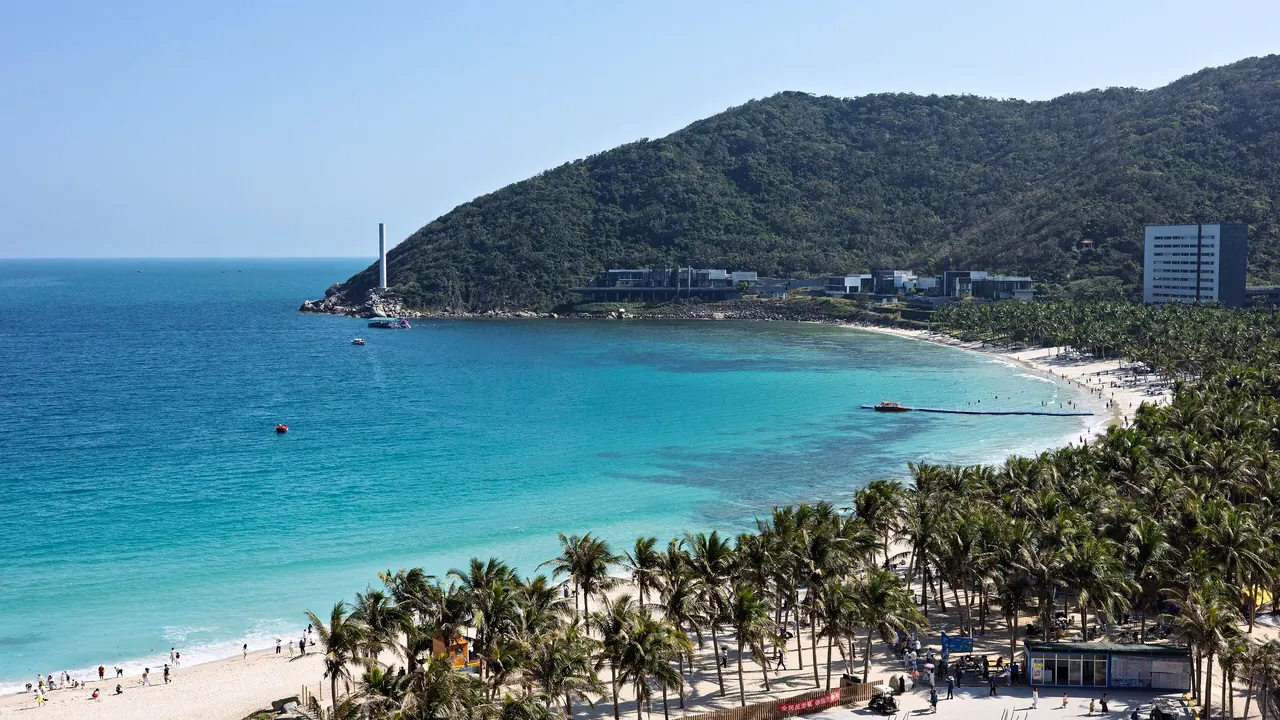
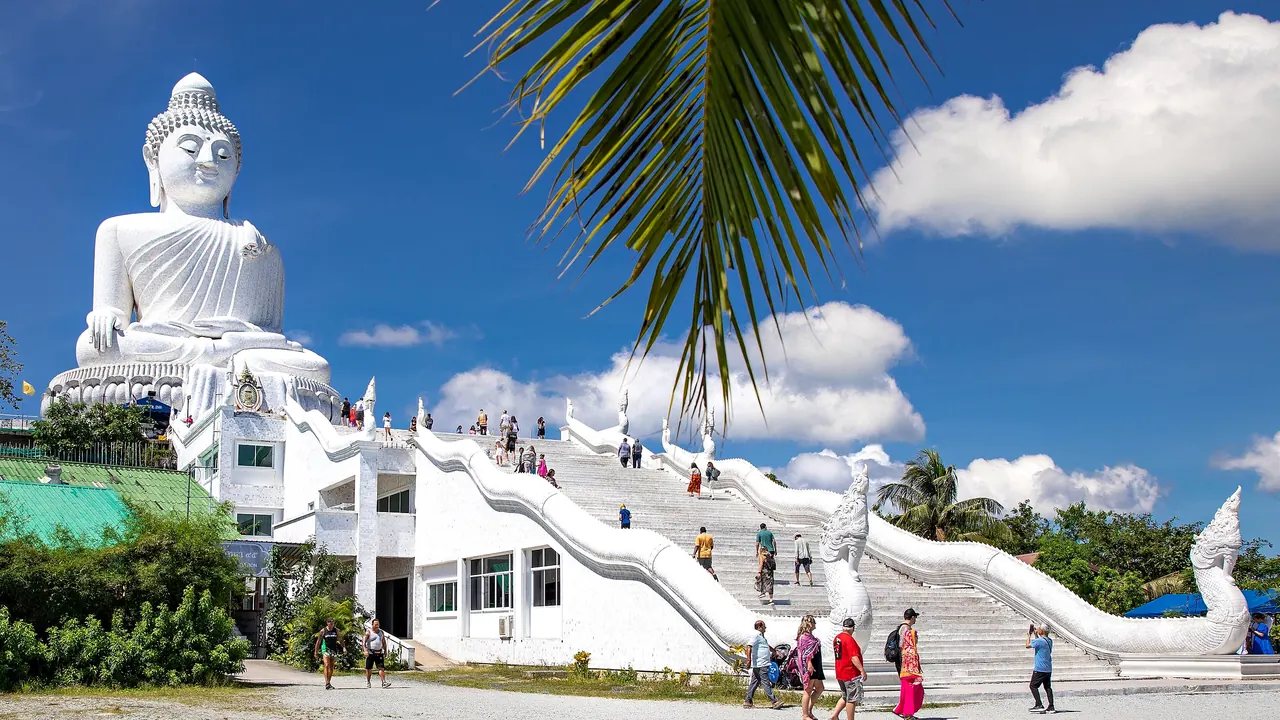
Photos: Hainan by Steven Sun, CC BY-SA 4.0, cropped; Phuket by Mussi Katz, CC0.
Hainan or Phuket?
Our verdict in twelve categories, each scored against the same fixed benchmark cities, and the climate month by month, so you can choose for your trip.
Choose Hainan for
- getting around
- shopping
Hainan suits a winter escape at an easy pace: a resort on the Sanya bays, a few days in the hill hot springs and an afternoon in the Haitang Bay duty-free complex. The high-speed railway around the coast also makes it simple to combine the beaches with Haikou's arcaded old quarter and its tea houses. It works best for travellers who find mobile payments and little English no obstacle, and who want warm, gentle weather more than heat.
Choose Phuket for
- nightlife
- nature and the outdoors
- prices
Phuket is the stronger pick for anyone who wants more from the sea and from the evenings. Phang Nga Bay's limestone towers, diving off the Similan and Racha islands, a proper eating culture in Phuket Town and Patong's all-night strip give it a range Hainan cannot match. Massage and retreat stays are found all over the island, and costs are easier to keep down if you eat locally and avoid the peak months.
Scoreboard
Twelve categories on one fixed scale from 0 to 100. The shaded stretch is the gap between the two.
Your match
Pick a travel style or drag the sliders, and both match scores follow your weighting.
Wins on getting around and shopping with your weighting.
Wins on nightlife and nature and the outdoors with your weighting.
What matters to you?
Category by category
What the scores mean for a trip.
Beaches & swimming
These are two well-matched beach islands, with Phuket a little ahead for variety and for the warmth of its water. Hainan's best sand is concentrated on the Sanya bays, with Yalong Bay's long white curve, quieter Haitang Bay and the busier town beaches at Dadonghai. In winter the sea there is noticeably cooler than Phuket's, and typhoons can close beaches in late summer.
Phuket spreads its beaches along a whole coast, from busy Patong to small coves like Kata Noi and Freedom Beach to the long, quiet northern stretches. The water is warm all year, but monsoon surf makes the west coast dangerous from May to October. Boat trips to Phi Phi and the Similans add the best sand and clearest water of all.
Food & drink
Both islands have a cuisine of their own with Chinese roots, but Phuket's is richer and easier to find. Phuket Town's Hokkien and Peranakan cooking runs from dim sum at dawn to evening markets, the fishing villages at Rawai add seafood, and a small fine-dining tier sits on top.
Hainan's food rests on a few famous dishes, above all Wenchang chicken, plus the laoba tea houses of Haikou, which have real character. In Sanya, though, eating means picking seafood at a market hall or settling for resort buffets.
Culture & sights
Neither island is a culture trip, and both put their best heritage in an old merchant quarter. Hainan's Qilou arcades in Haikou are matched by Phuket Town's Sino-Portuguese shophouses, and each island also has a giant white Buddhist statue more admired for its views than its history.
The difference is in the stories. Hainan's are about exile, told at the Five Officials Temple and the Dongpo Academy, along with the Li people of the interior. Phuket's are about tin mining and the siege of 1785, with Wat Chalong as its main temple.
Nightlife
Phuket is far ahead after dark. Bangla Road in Patong turns into a neon strip of bars and big clubs every night of the high season, beach clubs run sunset sessions, and Phuket Town has a quieter scene of shophouse cocktail and live-music bars.
On Hainan, evenings out are limited to the beach and live-band bars of Dadonghai, a few Chinese-style table-service clubs and Haikou's karaoke rooms. Most visitors end the day over seafood and a drink by the water.
Nature & outdoors
Phuket's outdoor life is built around the sea, and that is where it pulls ahead. Kayaking into the hidden lagoons of Phang Nga Bay and diving with reef sharks and rays off the Similans are experiences Hainan's crowded snorkelling off Sanya cannot match. On land, the heat keeps walks short.
Hainan is the better island for hiking. Its mountainous interior offers a day's climb up Wuzhishan and proper rainforest trails at Jianfengling and Diaoluoshan, where the air is cooler, and the volcanic country near Haikou adds a different kind of landscape.
Day trips
Phuket's outings are mostly by boat and more memorable for it: Phi Phi, the stilt village of Koh Panyee against its limestone cliff, and the slow rural life of the Koh Yao islands. Krabi is a couple of hours away by road.
Hainan's excursions run by train along the east coast, to Lingshui's floating fishing villages, Bo'ao's river mouth and Wenchang's overseas-Chinese mansions. They are pleasant breaks from the beach rather than highlights in their own right.
Good for families
Both islands do resort family vacations equally well, with calm dry-season bays, kids' clubs, water parks and aquariums. The differences are practical. Hainan's Sanya bays stay calm and shallow through the winter, but outside the hotels there is little English and almost everything is paid by phone.
Phuket's staff are famously warm with young children and getting by is simpler. However, families need to avoid the west-coast surf from May to October, stay away from Patong and be careful on roads with few pavements.
Getting around
Hainan is the easier island to move around. A high-speed railway circles the coast, linking Haikou and Sanya in about an hour and a half, though within Sanya the bays are far apart and you still need ride-hailing cars between them.
Phuket has no rail, and its songthaew buses run only from Phuket Town out to the beaches. Taxis and tuk-tuks are expensive with fixed fares, the roads are congested and scooters are risky, so most visitors stay put and book every trip.
Shopping & style
Hainan wins on shopping because of duty-free. The vast Haitang Bay complex, with smaller branches in Sanya town and Haikou, brings international luxury and electronics together in a way no Thai beach town does. Beyond it, the choice comes down to Li brocade, coffee and coconut sweets.
Phuket has more character on a smaller scale. There is the Sunday walking street in the old town, shophouse boutiques selling batik and Peranakan-style goods, and tailors who will make clothes in a few days.
Affordability
Phuket is the cheaper of the two. Street food and local restaurants in Phuket Town cost little, and there are guesthouses and mid-range hotels at every beach. Its expensive taxis and boat trips are the main exceptions.
On Hainan, the Yalong and Haitang Bay resorts are priced as international resorts and climb steeply in winter, especially around Chinese New Year. Trains and noodle shops are cheap, and staying in Haikou or coming in the hot summer brings the overall cost down.
Live music & performing arts
Neither island has a theatre, concert or live-music circuit worth planning evenings around, and both offer shows built for tourists. Hainan's most genuine performance is Qiong opera, the island's own regional form, sometimes staged at temple fairs, while Sanya puts on a large song-and-dance spectacle in a theme park.
Phuket's version is livelier but less rooted in local tradition: cabaret revues in Patong, Thai boxing nights and cover bands in the bars.
Wellness & relaxation
Phuket is the better island for a restorative stay. Thai massage is available on every beach road and in spas built over the sea, and a large retreat scene of yoga, detox and Muay Thai camps is centred on Chalong. The quiet northern beaches and Nai Harn are the places to unwind.
Hainan has what Phuket lacks: real hot springs. Qixianling has forest pools beneath jagged peaks, and Xinglong and Guantang have long-established spring resorts. Pair a few days there with a calm Haitang Bay resort for a slower, spring-based kind of rest.
When should you go?
Pick your month. The climate figures are measured averages, not a forecast.
Hainan in July
Phuket in July
Daytime high, °C
Rainfall in the month, mm
Where the figures come from
Phuket's temperatures are measured 27 km from the centre, at Phuket Airport.
Temperature and rainfall are climate normals, averaged over the years shown. Hainan: 1991-2020 normals, Yaxian (2 km from centre). Phuket: 1991-2020 (sunshine 1961-1990, rainfall 1981-2010) normals, Phuket Airport (26.9 km from centre).
On Hainan's south coast around Sanya, where most visitors stay, the dry season runs from November to April. January days reach about 24°C, warm rather than hot and good for walking. The sea is at its coolest then, still fine for swimming but noticeably fresher than Phuket's, and the north coast around Haikou runs cooler again in winter. Rain builds from May and is heaviest from July to October, at close to 300mm a month, which is also typhoon season. Summer days are hot and humid at around 31°C, and the sea is then at its warmest.
Phuket is hot in every month and its sea stays around 29°C all year, so the choice there comes down to rain rather than warmth. December to March is dry and much sunnier than Hainan's winter, and it is the easiest time for swimming. From May to October the monsoon brings heavy rain, at its worst in September and October, and rough seas on the west coast. In winter Phuket gives full beach heat while southern Hainan gives milder days. From July to October both islands are wet.
Which traveller are you?
For a food and nightlife trip, Phuket is the clear choice. Phuket Town's Hokkien noodles, crab curry for breakfast and night markets go well beyond Hainan's handful of signature dishes, and Patong, the beach clubs and the old-town bars give far more evenings out.
On a shopping trip, Hainan comes out ahead. The huge duty-free complex at Haitang Bay gathers luxury brands, cosmetics, watches and electronics in one place. Phuket's malls, tailors and walking-street stalls are useful and enjoyable, but they are not a reason to travel.
For an outdoors trip, Phuket offers more, especially on the water: sea kayaking through the caves of Phang Nga Bay, and reef diving and snorkelling around the Similan and Racha islands. Hainan's forest trails up Wuzhishan are better walking, but its sea life does not compare.
Before you go
| Measure | Hainan | Phuket |
|---|---|---|
| Official language | Putonghua | Thai |
| Currency | Yuan Renminbi (CNY) | Baht (THB) |
| Sockets | ACI220 V, 50 Hz | ABCF220 V, 50 Hz |
| Driving side | Right | Left |
| Time zone | UTC+8 | UTC+7 |
| Emergency number | Police 110, ambulance 120, fire 119 | Police 191, ambulance 1669, fire 199 |
| Main airport | Sanya Phoenix International Airport (SYX)93 non-stop destinations | Phuket International Airport (HKT)85 non-stop destinations |
| Public holidays this year | 6 days | - |
By the numbers
| Measure | Hainan | Phuket |
|---|---|---|
| Population | 9,200,000 | 77,610 |
| People per km² | - | 6,468 |
| Swim season, months above 21 °C | 12 months | 12 months |
Where else could you go?
Every comparison below shares a destination with this one, so you can follow Hainan or Phuket somewhere new.
- Koh Phi Phivs Phuket
- Krabivs Phuket
- Koh Lantavs Phuket
- Koh Lipevs Phuket
- Langkawivs Phuket
- Koh Samuivs Phuket