China
Hainan
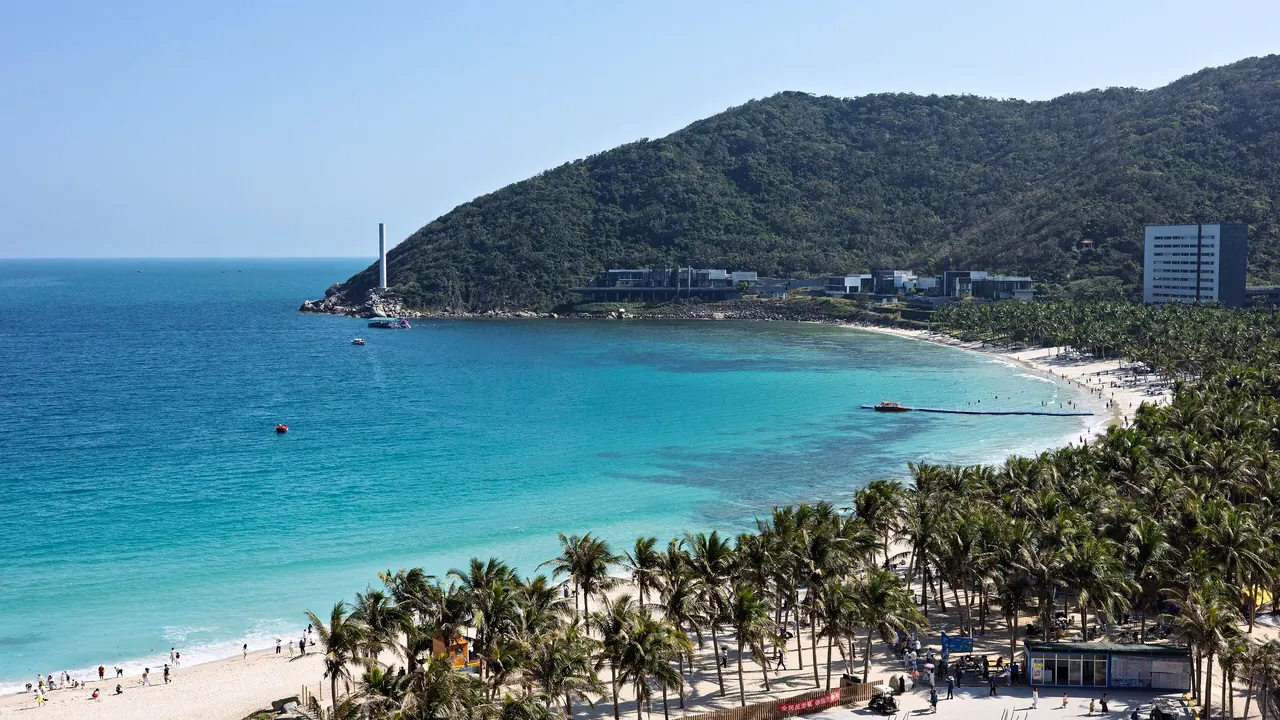
Sun Bay beach near Sanya with green hills
- Beaches84
- Wellness & relaxation70
- Families68
Photo: Steven Sun, CC BY-SA 4.0, cropped
Match
54
Every category weighted equally
- Beach & sun60
- Culture & arts47
- Food & nightlife49
- Family trip58
- Outdoors56
- Relax & unwind59
- Shopping & style52
- On a budget53
Hainan in twelve categories
Our verdict on each, scored 0 to 100 against the same fixed benchmark cities, so a score means the same thing on every page.
Beaches & swimming. Scores 84 out of 100.
Food & drink. Scores 60 out of 100.
Culture & sights. Scores 36 out of 100.
Nightlife. Scores 36 out of 100.
Nature & outdoors. Scores 62 out of 100.
Day trips. Scores 42 out of 100.
Good for families. Scores 68 out of 100.
Getting around. Scores 50 out of 100.
Shopping & style. Scores 58 out of 100.
Affordability. Scores 52 out of 100.
Live music & performing arts. Scores 24 out of 100.
Wellness & relaxation. Scores 70 out of 100.
Hainan category by category
Beaches & swimming
84Hainan is a tropical beach island, and the beaches are the main reason people come. They are best on the south coast around Sanya. Yalong Bay has a long curve of fine white sand and clear water. Haitang Bay, further east, is quieter and lined with resorts. Dadonghai and Sanya Bay are the town beaches, livelier and less polished. In winter, the main season, the sea sits around 24-26°C off Sanya and warms to about 29°C in summer. July to October is typhoon season, though, and storms can close beaches for a few days.
The north coast around Haikou is cooler in winter and the beaches there are plainer. The east coast near Wanning has rougher surf beaches, with long, empty stretches of sand in between. For calm swimming, stay on the Sanya bays, ideally away from the Chinese New Year crowds. A short boat ride takes you to the clear water around the small offshore islands.
Food & drink
60Hainan has its own cuisine, built on a few famous dishes. Wenchang chicken is poached and served with ginger and lime dips. Jiaji duck, Dongshan mutton and Hele crab complete the set. For breakfast, Hainan rice noodles come in a tangy broth with peanuts and pickles. On hot afternoons people eat qingbuliang, a coconut-milk dessert of beans, fruit and jelly. In Haikou, older men spend whole mornings in laoba tea houses over milky tea and small snacks. That old tea-house culture is the island's most characterful way to eat.
In Sanya, seafood means picking your catch at a market hall and having a nearby kitchen cook it to order. Coconuts, tropical fruit and locally grown coffee are everywhere. Beyond these, much of the resort dining is generic hotel buffet, and the depth of the eating is in Haikou more than Sanya.
Culture & sights
36Hainan was long a remote frontier and a place of exile, and its heritage is modest. The best of it is in Haikou. In the Qilou old quarter, arcaded shophouses from the early twentieth century mix Chinese and Southeast Asian styles. The Five Officials Temple honours famous exiled ministers, and the provincial museum covers the island's history and Li culture. In the northwest, Danzhou has the Dongpo Academy, linked to the poet Su Dongpo, who was exiled there.
Around Sanya the big sight is Nanshan. This large Buddhist park is built around an enormous white Guanyin statue standing in the sea, which is more spectacle than history. Li and Miao villages in the interior show the island's indigenous cultures, but most visitor versions are staged. Sightseeing is something to fit around the beach, not a reason to come.
Nightlife
36Nights out centre on Sanya. Dadonghai and the Sanya Bay seafront have beach bars, live-band bars and a few large Chinese-style clubs with table service and loud sets. Haikou has its own club district and many KTV karaoke venues, which are where locals actually go out. Most resort guests end the evening with seafood and a drink by the sea. A visitor looking for a real bar or club culture will find the choice small.
Nature & outdoors
62The interior of Hainan is mountainous and green. Wuzhishan, the Five Finger Mountain, rises to about 1,860m and can be climbed through forest in a day. The rainforest reserves at Jianfengling and Diaoluoshan have proper trails, waterfalls and cooler air. Closer to Sanya, rainforest parks have boardwalks and rope bridges, easy to reach but heavily managed. Near Haikou, an extinct volcano crater and lava-rock villages give a different, darker landscape.
On the water, Riyue Bay on the southeast coast is a real surf spot in winter. Snorkelling and diving around the small islands off Sanya are good, if crowded. The island's rare gibbons and other wildlife are almost never seen by visitors, and the coast near the resorts is more developed than wild.
Day trips
42A high-speed railway circles the island, so towns along the east coast are an easy day out from Sanya or Haikou. From Sanya, Lingshui has fishing villages built on the water and a monkey reserve on a peninsula. Wanning has surf beaches and coffee-growing Xinglong. Further up, Bo'ao is a quiet river-mouth town and Wenchang has old overseas-Chinese mansions and coconut groves. Haikou's old arcade streets can be done as a long day from the south, about two hours by train. The interior Li towns need a car. These are pleasant outings rather than destinations, and most visitors make one or two at most.
Good for families
68Hainan works best for families as a resort vacation. Yalong Bay and Haitang Bay have calm, shallow water most of the winter, and the large beach resorts there are built for children, with pools, kids' clubs and family rooms. Around Sanya there are a big aquarium and water park, a tropical wildlife park and rainforest parks with easy boardwalks. Haikou has a volcano park and a theme park. Chinese families come in large numbers, so children are welcome everywhere.
The drawbacks are practical. Little English is spoken outside the big hotels, and everyday payments run through mobile apps. The sun is strong even in winter, and Chinese New Year brings serious crowds. Families who stay in one well-chosen resort area will find it easy.
Getting around
50The high-speed railway around the coast is the island's backbone. Haikou to Sanya along the east coast takes about an hour and a half, with stops at the main towns. Within Sanya, the beach bays are separate districts spread along the coast, so getting between them means a taxi or ride-hailing car. The resort strips are not places to walk. Buses exist but are slow and signed in Chinese. The mountainous interior is easiest by hired car or driver. Most visitors stay in one bay and take cars for everything else. Setting up mobile payment before arriving saves a lot of trouble.
Shopping & style
58Duty-free shopping is a serious part of a Hainan trip, especially for visitors from mainland China. The huge duty-free complex at Haitang Bay outside Sanya gathers international luxury, cosmetics, watches and electronics under one roof. There are smaller duty-free malls in Sanya town and Haikou. Outside that, the choice narrows to markets with tropical fruit, coconut sweets, coffee, pearls of mixed quality and Li brocade, the island's traditional woven textile. There is little in the way of independent design or old shopping streets, apart from the arcades of Haikou's old quarter.
Affordability
52Hainan costs more than most of China, and the price depends on where and when you stay. The beach resorts of Yalong Bay and Haitang Bay are priced as international resorts, and rooms climb sharply in the winter high season, especially around Chinese New Year. Seafood restaurants catering to tourists can also surprise you with the bill. The rest of the trip is reasonable. Trains, ride-hailing and local noodle shops are cheap, and Haikou and the smaller east-coast towns are far cheaper places to stay. Visitors who skip the big Sanya resorts, or come in the hot, quiet summer, will find it moderately priced.
Live music & performing arts
24Performance in Hainan is mostly staged for tourists. In Sanya, a large-scale song-and-dance spectacle about the island's legends plays in a theme park. The Li cultural villages put on bamboo-pole dances and folk singing. Haikou has a provincial performing arts centre with touring concerts and shows, and Qiong opera, the island's own regional opera, is still performed occasionally in local theatres and temple fairs. There is no regular classical, jazz or live-music circuit a visitor could build evenings around.
Wellness & relaxation
70Hainan is where much of northern China goes to escape winter and slow down, and the pace of a stay reflects it. The island has real hot springs. Qixianling in the Baoting hills has open-air spring pools set in forest below jagged peaks. Xinglong near Wanning and Guantang near Qionghai have long-established spring resorts with many outdoor pools. Around Sanya, especially in Haitang Bay and Yalong Bay, the large resorts have full spas, foot massage and treatments based on traditional Chinese medicine.
The bathing here is resort-based rather than a public bathhouse tradition. For a restorative week, the best plan is a few days in the hill springs followed by a quiet beach resort, away from the town centre of Sanya.
Where to stay in Hainan
Most visitors stay on the south coast around Sanya. The choice there is between its bays, which are separate districts along the coast, linked by taxi rather than on foot. Yalong Bay has the finest sand and calm, shallow water through the winter, and its large resorts are built for children, so it suits families and pure beach days. Haitang Bay, further east, is quieter and suits a restful stay with spa days and the big duty-free complex nearby. Dadonghai and Sanya Bay are the town beaches. They are less polished and cheaper to stay in, but closer to the seafood market halls and to what nightlife the island has.
Haikou, in the north, is the base for food and character: laoba tea houses, the arcaded Qilou old quarter and a much lower bill for rooms. The beaches are plain and winters cooler, so it suits travellers more interested in eating and wandering than swimming. The east-coast towns around Wanning and Bo'ao are quiet and inexpensive, with surf at Riyue Bay and hot springs at Xinglong.
One base is enough for most trips. The coastal railway makes Haikou and the east coast easy day outings. For a second base, add a few nights in the Qixianling hill springs, reached by car, before the beach.
When should you go?
Pick a month to see what it is like. The climate figures are measured averages, not a forecast.
Hainan in July
Daytime high, °C
Rainfall in the month, mm
The whole year
Shaded against this destination’s own year: the deepest cell is its best month for that figure and the palest its weakest.
Temperature and rainfall are climate normals, averaged over the years shown. Hainan: 1991-2020 normals, Yaxian (2 km from centre).
Before you go
| Measure | Hainan |
|---|---|
| Official language | Putonghua |
| Currency | Yuan Renminbi (CNY) |
| Sockets | ACI220 V, 50 Hz |
| Driving side | Right |
| Time zone | UTC+8 |
| Emergency number | Police 110, ambulance 120, fire 119 |
| Main airport | Sanya Phoenix International Airport (SYX)93 non-stop destinations |
| Public holidays this year | 6 days |
By the numbers
| Measure | Hainan |
|---|---|
| Population | 9,200,000 |
| Swim season, months above 21 °C | 12 months |
Compare Hainan with
Every comparison with a written verdict behind it.