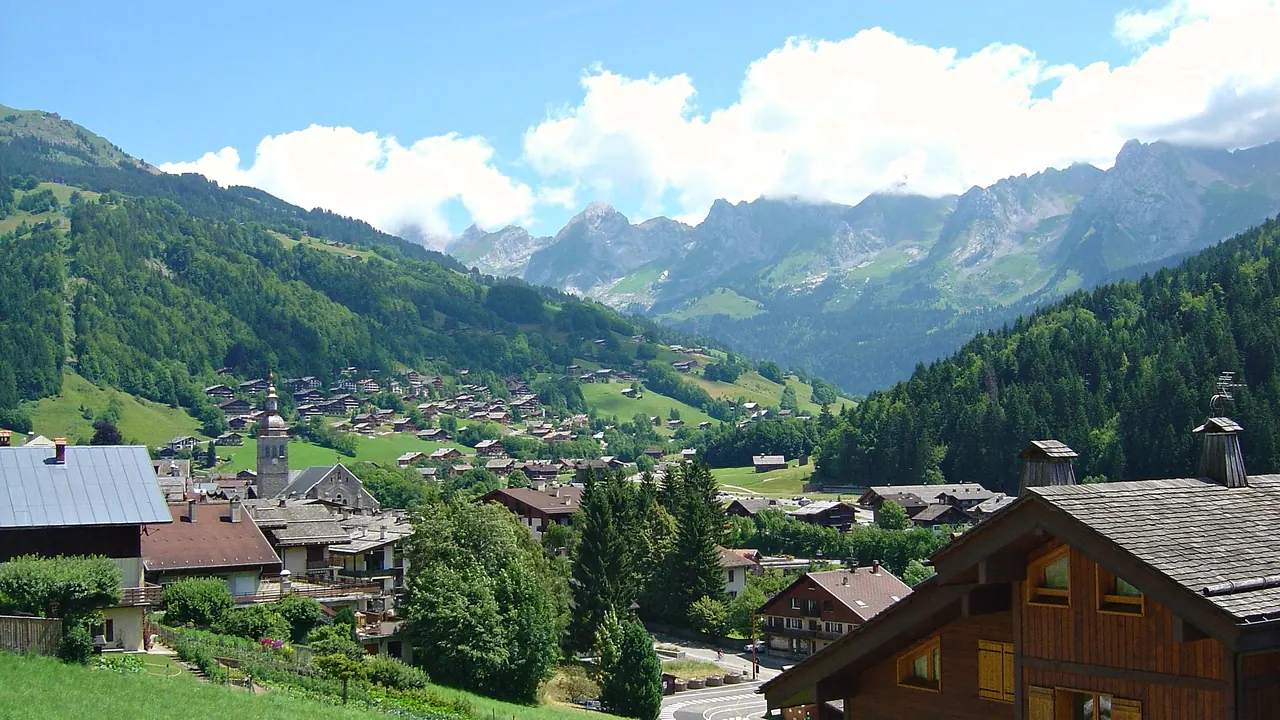
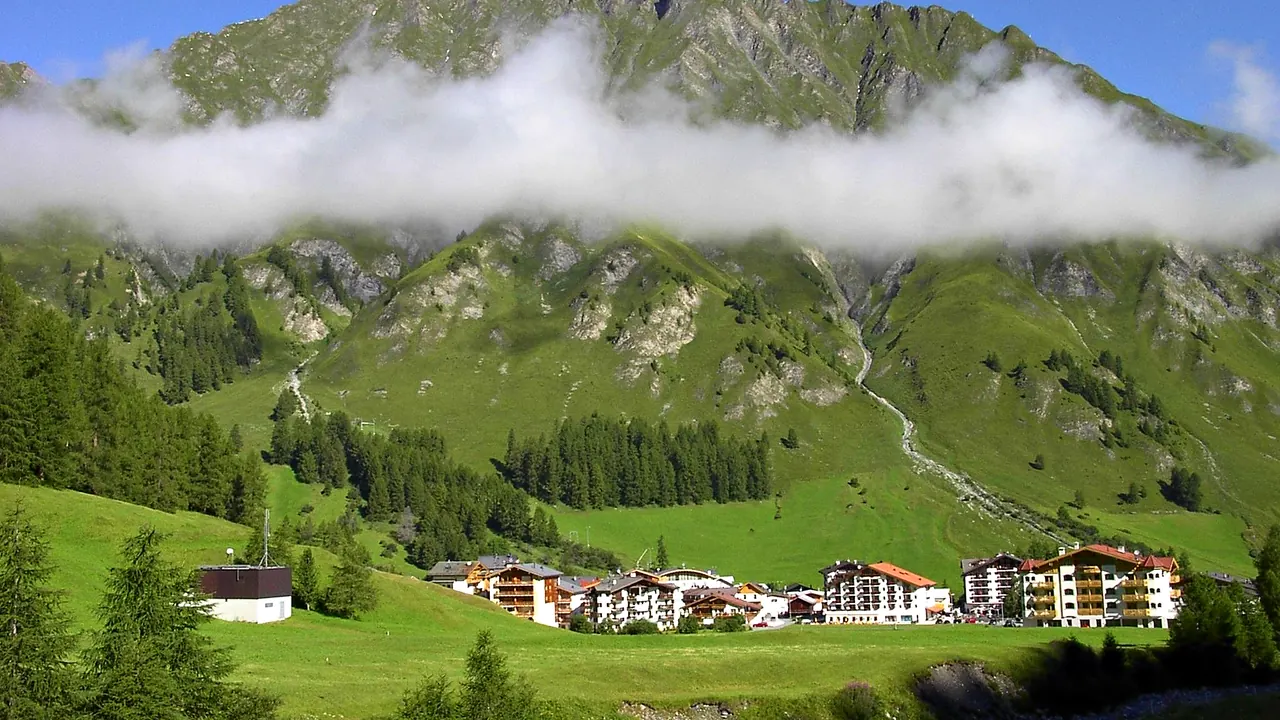
Photos: Le Grand-Bornand by Anthospace, CC BY-SA 3.0, cropped; Samnaun by Rene Nueesch, CC BY 3.0, cropped.
Le Grand-Bornand or Samnaun?
Our verdict in twelve categories, each scored against the same fixed benchmark cities, and the climate month by month, so you can choose for your trip.
Choose Le Grand-Bornand for
- beaches
- families
- prices
Le Grand-Bornand suits families and anyone who wants a friendly French mountain village with a lake and a lively town nearby. The resort is designed around children. In summer there are Reblochon farms to visit and a children's festival in August, and Lake Annecy is close enough for real swimming. It is also the easier of the two on the wallet, and Annecy and Geneva make the day trips far richer.
Choose Samnaun for
- shopping
- wellness
- nightlife
Samnaun is for the committed skier who wants high runs above the treeline on a huge cross-border ski area, with snow that lasts. Its duty-free main street is a draw of its own. It also has slightly more to do after the lifts close and better places to unwind, with hotel spas and the baths of Scuol nearby. The trade-off is Swiss prices and a remote valley at the end of a long road.
Scoreboard
Twelve categories on one fixed scale from 0 to 100. The shaded stretch is the gap between the two.
Your match
Pick a travel style or drag the sliders, and both match scores follow your weighting.
Wins on beaches and families with your weighting.
Wins on shopping and wellness with your weighting.
What matters to you?
Category by category
What the scores mean for a trip.
Beaches & swimming
Neither is a beach destination, but Le Grand-Bornand at least has real swimming within reach. Lake Annecy is a short drive down the valley through Thônes, its clear water warms to around 22°C to 24°C in July and August, and there are lawns, pontoons and small beaches at Talloires, Menthon-Saint-Bernard and Sevrier. It makes a fine afternoon out rather than part of everyday life.
Samnaun has nothing like that. Its streams and high lakes are too cold for more than a brave dip on a hot August day, so swimming means the village's indoor leisure pool or a hotel pool.
Food & drink
Neither town is a reason to travel for food, and they fall short in different ways. Le Grand-Bornand eats around Reblochon: cheese bought straight from valley farms, a weekly market, and tartiflette or croziflette with a glass of Apremont. It also has the advantage that Annecy's wider choice of restaurants is close.
In Samnaun most meals are hotel half board or lunches in mountain huts: capuns, pizokel, rösti and Tyrolean dishes. Its real distinction is drink, because the duty-free shops stock a remarkable range of wines and spirits.
Culture & sights
Both are thin on sights, and you can see either in an afternoon. Le Grand-Bornand has a little more to look at: a baroque church with an onion-domed bell tower, deep-roofed old farm chalets, and a heritage farmhouse that explains valley life and cheese-making.
In Samnaun, the history is more interesting than the buildings. The valley was so isolated that it was left outside the Swiss customs area in 1892. Beyond that there are modest chapels and a few timber farmhouses scattered among the hotels.
Nightlife
Samnaun has a little more going on after dark. Après-ski starts at the foot of the slopes, and on peak-season weekends a few hotel bars and a small club or two stay open late. The famous party resort over the ridge is reachable on skis by day but not realistically at night.
Le Grand-Bornand is quieter still. A few bars in the village and at Chinaillon fill up after skiing, there is no club, and families are in bed early. Anyone wanting a proper night out drives to Annecy.
Nature & outdoors
Both are excellent mountain bases, but the terrain differs. Le Grand-Bornand is mid-mountain country under the limestone wall of the Aravis, with peaks around 2,500m. It has open pastures and wooded runs, cross-country trails, and La Clusaz nearby. In summer it adds paragliding, Tour de France climbs such as the Col de la Colombière, and sailing on Lake Annecy.
Samnaun starts at about 1,800m and links into one of the largest ski areas in the Alps, shared with Austria's Paznaun. Its long runs above the treeline have reliable snow into spring. In summer there are border summits to hike and the Swiss National Park about an hour away, so the skier chasing scale and snow certainty will lean this way.
Day trips
Le Grand-Bornand has the stronger list of day trips. Annecy's canals, old town and lakeside castle are about 40 minutes away, Geneva is about an hour, and Chambéry and medieval Yvoire are both manageable in a day.
Samnaun's outings are villages rather than cities: the sgraffito-decorated houses of Guarda and Sent, Tarasp Castle above the Inn, and across the Reschen Pass the walled town of Glurns and the UNESCO-listed convent at Müstair. In both places you will want a car.
Good for families
Le Grand-Bornand is one of the Alps' resorts most deliberately built for children. It has snow gardens, sledging and beginner slopes at both the village and Chinaillon. In summer children can watch Reblochon being made, splash in the river and go to the August children's festival.
Samnaun works for a straightforward ski week. Nursery slopes are near the village, half board keeps mealtimes simple, and the leisure pool with slides covers a wet afternoon. Beyond that there is little aimed at children, and the long winding road in can be hard on young travellers.
Getting around
Samnaun is slightly easier once you have arrived. Its hamlets sit along one road linked by local buses, and in winter you can ski between much of it. The catch is reaching it: the valley is a dead end with no railway, and the postbus from Scuol takes over an hour.
Le Grand-Bornand's centre is walkable, and free winter shuttles reach Chinaillon and the lifts. Outside the ski season, though, the lake, trailheads and day trips all realistically need a car, because buses to Annecy are few.
Shopping & style
This is where Samnaun stands apart. As a duty-free enclave, its main street is a long run of shops selling Swiss watches, perfume, spirits, tobacco, chocolate and ski clothing, and coachloads of shoppers come over from the Tyrol. Expect international brands rather than local crafts.
Le Grand-Bornand's shops are practical, mostly gear hire and delis. The weekly market of cheese, honey and sausages is its best shopping.
Affordability
Le Grand-Bornand costs noticeably less. It is still an Alpine resort with winter prices, but it is more modest than the big high-altitude names. Self-catering apartments are the norm, and summer or the quiet weeks of January and March bring costs down further.
Samnaun charges Swiss mountain-resort prices for rooms, lift passes, ski hire and meals. Half-board deals and duty-free fuel and alcohol help, but they do not close the gap.
Live music & performing arts
Le Grand-Bornand has one real highlight in Au Bonheur des Mômes, a long-running August week when street theatre, circus and puppetry fill the village. For the rest of the year there are occasional church concerts, with Annecy and Geneva for theatre and opera.
Samnaun has no venue at all. Live music means a brass band, an après-ski singer, or the big open-air concerts on the slopes that mark the start and end of the ski season.
Wellness & relaxation
Samnaun is the better place to unwind. Most larger hotels have saunas and small spas, and the public pool has a sauna area. Under an hour away, the mineral springs and spa baths of Scuol offer a genuine bathing tradition.
Le Grand-Bornand relies on hot tubs and saunas in hotels and chalet residences. Its real restorative quality is the slow pace of the valley, with cow bells and wooden balconies, especially in early summer.
When should you go?
Pick your month. The climate figures are measured averages, not a forecast.
Le Grand-Bornand in July
Samnaun in July
Daytime high, °C
Rainfall in the month, mm
Where the figures come from
Le Grand-Bornand's temperatures are measured 45 km from the centre, at Bourg-St-Maurice.
Le Grand-Bornand has no rain gauge within 25 km of the centre, so its rainfall comes from a gridded climate dataset read at the destination rather than from a gauge further away.
Samnaun has no rain gauge within 25 km of the centre, so its rainfall comes from a gridded climate dataset read at the destination rather than from a gauge further away.
Temperature and rainfall are climate normals, averaged over the years shown. Le Grand-Bornand: 1999-2020 (rainfall 1991-2020) normals, Bourg-St-Maurice (44.7 km from centre). Samnaun: 1991-2020 normals, Passo Resia / Resia Pass (16.3 km from centre).
Le Grand-Bornand is the warmer of the two. Summer highs reach about 27°C in July, which is pleasant for walking and warm enough for swimming in Lake Annecy in July and August. Its wettest months are in late autumn and winter, peaking at around 144mm in December, while summer is a little drier. Spring and September are mild and good for hiking.
Samnaun sits much higher and stays cooler all year. Summer highs only reach about 21°C, which is good for walking but never beach weather, and winter days hover near 1°C in January. Its rain follows the opposite pattern: winter is fairly dry and summer is the wettest season, with about 118mm in July, so expect afternoon showers on summer hikes. For a cool, dry winter week Samnaun has the edge. For a warm summer in the mountains, Le Grand-Bornand is better.
Which traveller are you?
On a family trip with young children, Le Grand-Bornand is the clear choice. It has gentle slopes, snow gardens and ski schools, farm visits and an August children's festival in summer, and Lake Annecy's beaches within reach. Samnaun's leisure pool is pleasant but offers far less.
For a shopping trip, Samnaun wins easily. Its duty-free main street is lined with watches, perfume, spirits, chocolate and outdoor clothing, often below normal Swiss prices. Le Grand-Bornand has practical gear shops and a weekly market, and serious shopping means driving to Annecy.
On a tight budget, Le Grand-Bornand is far kinder. Self-catering is the norm, and summer or the quieter January and March weeks keep costs modest. Samnaun charges Swiss mountain-resort prices for hotels, passes and meals, and cheaper fuel and alcohol only soften that.
Before you go
| Measure | Le Grand-Bornand | Samnaun |
|---|---|---|
| Official language | French | French, German, Italian, Romansh |
| Currency | Euro (EUR) | Swiss Franc (CHF) |
| Sockets | CE230 V, 50 Hz | CJ230 V, 50 Hz |
| Driving side | Right | Right |
| Time zone | UTC+1, UTC+2 in summer | UTC+1, UTC+2 in summer |
| Emergency number | 112 | 112 |
| Elevation | 892 m | 1,846 m |
| Main airport | Geneva International Airport (GVA)41 km from centre150 non-stop destinations | Innsbruck Airport (INN)82 km from centre40 non-stop destinations |
| Public holidays this year | 11 days | 9 days |
By the numbers
| Measure | Le Grand-Bornand | Samnaun |
|---|---|---|
| Population | 2,050 | 773 |
| People per km² | 33 | 14 |
| Museums within 10 km | 1 | 1 |
| UNESCO World Heritage sites within 50 km | 2 | 1 |
Where else could you go?
Every comparison below shares a destination with this one, so you can follow Le Grand-Bornand or Samnaun somewhere new.
- La Clusazvs Le Grand-Bornand
- Megèvevs Le Grand-Bornand
- Flainevs Le Grand-Bornand
- Saint-Gervais-les-Bainsvs Le Grand-Bornand
- Samoënsvs Le Grand-Bornand
- Les Getsvs Le Grand-Bornand