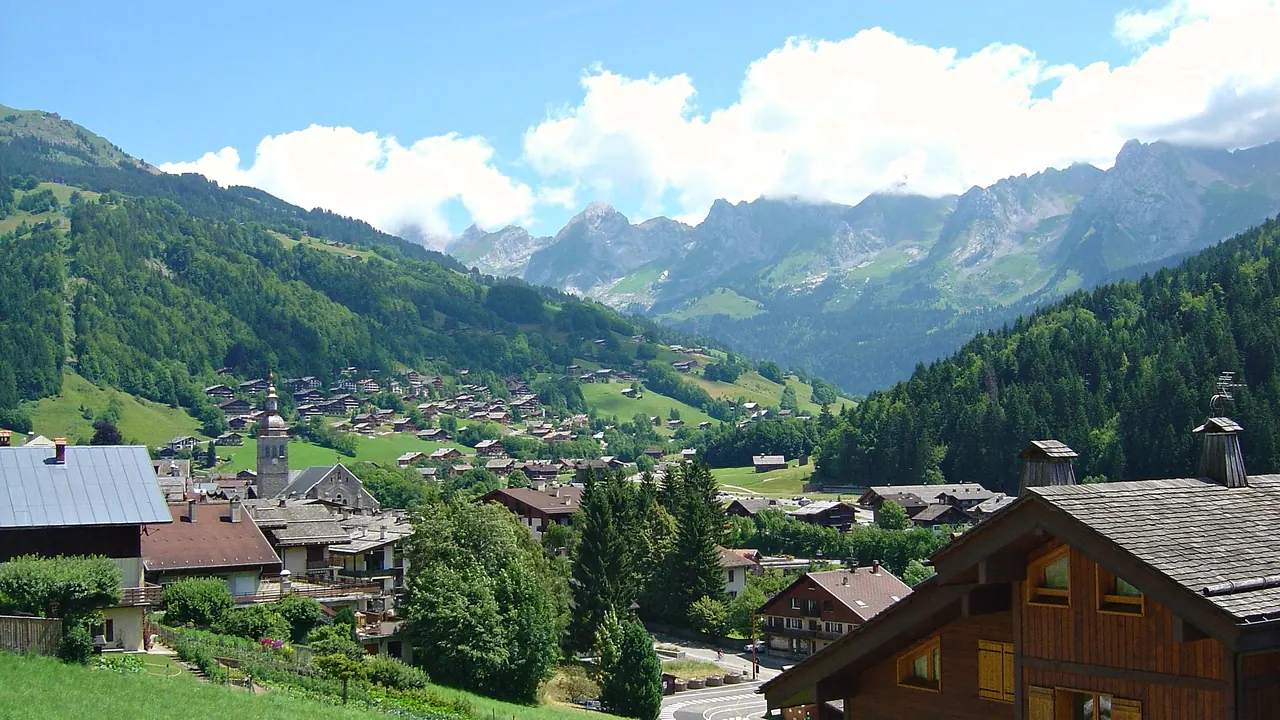
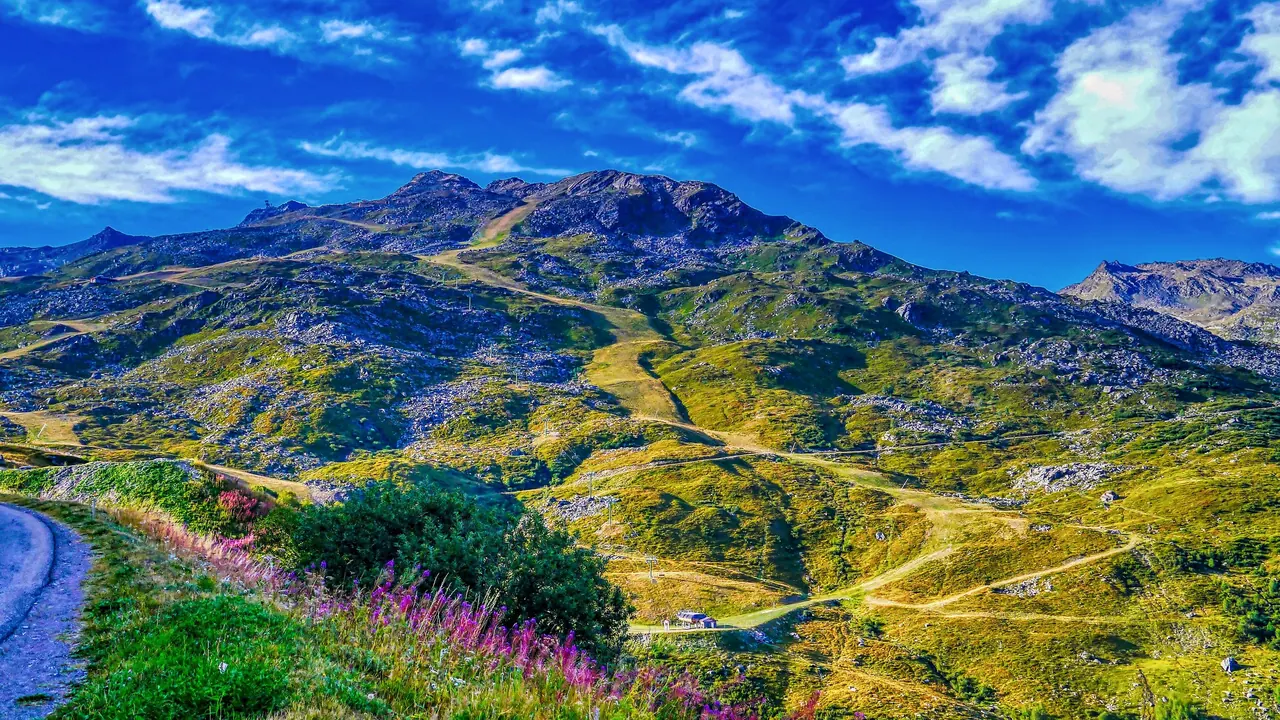
Photos: Le Grand-Bornand by Anthospace, CC BY-SA 3.0, cropped; Val Thorens by Zairon, CC BY-SA 4.0, cropped.
Le Grand-Bornand or Val Thorens?
Our verdict in twelve categories, each scored against the same fixed benchmark cities, and the climate month by month, so you can choose for your trip.
Choose Le Grand-Bornand for
- day trips
- beaches
- families
Le Grand-Bornand suits families and anyone who wants a working Alpine village rather than a purpose-built resort. You get Reblochon farms, a baroque church, wooded runs and summer pastures, and Annecy and its lake are close enough for a day out. It is the gentler and cheaper choice, and it works as well in summer as in winter.
Choose Val Thorens for
- nightlife
- getting around
- food and drink
If the trip is about skiing hard and staying out late, choose Val Thorens. Its height means reliable snow from late November into May and direct access to the whole Three Valleys, and in the evenings a young après-ski crowd fills the bars. In return you get bare high-mountain scenery, very little to do away from the snow and a bigger bill.
Scoreboard
Twelve categories on one fixed scale from 0 to 100. The shaded stretch is the gap between the two.
Your match
Pick a travel style or drag the sliders, and both match scores follow your weighting.
Wins on day trips and beaches with your weighting.
Wins on nightlife and getting around with your weighting.
What matters to you?
Category by category
What the scores mean for a trip.
Beaches & swimming
Neither place is for swimming, but Le Grand-Bornand at least has a real option. Lake Annecy is about 40 minutes down the valley, and in July and August it is clear and warm enough for an afternoon on the lawns, pontoons and small beaches at Talloires or Sevrier.
Val Thorens has nothing like that. Its glacier-fed lakes are far too cold for swimming even in summer, so a swim means the pool at the sports centre or a hotel pool.
Food & drink
Both kitchens are Savoyard at heart, with fondue, raclette and tartiflette, but Val Thorens has more range at the top end. A few upmarket hotels have gastronomic kitchens, and long lunches on slope-side terraces are part of the ski day.
Le Grand-Bornand's strength is the produce more than the restaurants. This is Reblochon country, with farms selling cheese made that morning and a weekly market, but the menus are narrower, and people who want more refined cooking drive down to Annecy.
Culture & sights
Le Grand-Bornand is a farming village where people still live and work, while Val Thorens is a ski station with no past to show. The heritage in Le Grand-Bornand is modest: a baroque church, old timber farmhouses around the valley and a small heritage centre on rural life and cheesemaking. It fills a slow afternoon, not a whole day.
Val Thorens was built in the 1970s purely for skiing, and nothing there is older than the lifts. It has no old streets, no museums and nothing to see apart from the peaks, so anyone curious about Savoyard history has to drive down to the valley.
Nightlife
Val Thorens is clearly the livelier place. In winter, après-ski starts with dancing on tables at mountain terraces as the lifts close, then moves into the village pubs and finishes in clubs that stay open until the early hours. The crowd is young, mostly students and groups of friends.
In Le Grand-Bornand an evening out means a drink in a bar in the village or at Chinaillon, then an early night, which suits its family visitors. Both go quiet in summer, Val Thorens almost completely.
Nature & outdoors
Both have superb mountains on the doorstep, but very different ones. Le Grand-Bornand is mid-mountain country under the limestone wall of the Aravis, with wooded runs, open pastures and cross-country trails. In summer there is hiking, paragliding and road cycling on Tour de France climbs such as the Col de la Colombière.
Val Thorens is high, bare and built for skiing. It is Europe's highest ski resort, with reliable snow from late November into May and lifts linked to the huge Three Valleys area, including glacier and off-piste terrain. Its summer is short and stark, with high lakes and the edge of the Vanoise national park.
Day trips
Le Grand-Bornand is far better placed for days out. Annecy, with its canals, old town and lakeside castle, is about 40 minutes away, and the same day can take in Talloires and Menthon with its castle. Geneva is about an hour away for museums and the lakefront. Chambéry, with its dukes' castle, and the medieval village of Yvoire on Lake Geneva are each about an hour and a half, so each is a full day of its own. Almost everything needs a car.
From Val Thorens most outings are on skis, to Méribel and Courchevel. Down the winding road there is little beyond Moûtiers and the medieval quarter of Conflans, and Annecy or Chambéry are about two hours each way.
Good for families
Le Grand-Bornand was built around families, and it shows. It has beginner slopes and snow gardens near the village, a small and safe centre, and summers of farm visits, river play and the August children's festival.
Val Thorens handles the practical side well, with a car-free centre, ski-in apartments and children's clubs. But the cold, the wind and the altitude can be hard on small children, and the young party crowd sets much of the tone.
Getting around
Once you arrive, Val Thorens is the easier place to get around. It is largely car-free, many apartments and hotels are ski-in, ski-out, free shuttles loop through the village and the lifts cover the whole Three Valleys. The hard part is the trip up: about an hour of hairpin bends from the station at Moûtiers.
Le Grand-Bornand's centre is easy to walk, and in winter free shuttles run to Chinaillon and the lifts. But there is no railway and few buses to Annecy, so you need a car for summer trailheads, the lake and day trips.
Shopping & style
Neither is a place to shop. Both sell ski gear, practical clothing, and cheese and charcuterie from local delis. The difference is Le Grand-Bornand's weekly market, which brings local produce and crafts into the village centre, while Val Thorens adds only small supermarkets, at high-altitude prices.
Affordability
Neither is a cheap place to ski, but Le Grand-Bornand is clearly the cheaper of the two. It is a more modest resort than the big high-altitude names, and most visitors rent an apartment or chalet and cook for themselves. Away from the school vacation weeks, in summer and in the quiet spells of January and March, costs fall a long way. The main extra cost is a car, which you need for most outings.
Val Thorens charges high-altitude prices for every part of a ski week: hotel rooms, Three Valleys lift passes, equipment hire, ski school and lunches on the slopes. School vacation weeks are the most expensive. A group that shares an apartment and does its own cooking can cut the bill a great deal, but even then the week stays expensive.
Live music & performing arts
Au Bonheur des Mômes gives Le Grand-Bornand the only real stage of the two. Every August for decades, this children's festival has filled the streets and halls for a week with street theatre, circus, puppetry and music. The rest of the year there are occasional church concerts, and Annecy and Geneva are close enough for theatre or opera.
At Val Thorens live music means cover bands and DJs in the après-ski bars, plus the odd event on the slopes during the season.
Wellness & relaxation
Both offer the same kind of wellness: hotel saunas, hot tubs and spa rooms after a day on the slopes. The real difference is the mood. Le Grand-Bornand is the calmer place to slow down, especially off-peak and in early summer, when the days are quiet apart from cow bells.
Val Thorens is built around skiing hard and late nights, so rest means a hotel spa or the spa area at the sports centre. For a real spa tradition, the old thermal town of Brides-les-Bains is about an hour away by road.
When should you go?
Pick your month. The climate figures are measured averages, not a forecast.
Le Grand-Bornand in July
Val Thorens in July
Daytime high, °C
Rainfall in the month, mm
Where the figures come from
Le Grand-Bornand's temperatures are measured 45 km from the centre, at Bourg-St-Maurice.
Le Grand-Bornand has no rain gauge within 25 km of the centre, so its rainfall comes from a gridded climate dataset read at the destination rather than from a gauge further away.
Val Thorens has no weather station within reach, so its figures come from a gridded climate model rather than a measured record, and read a broad area rather than one spot.
Temperature and rainfall are climate normals, averaged over the years shown. Le Grand-Bornand: 1999-2020 (rainfall 1991-2020) normals, Bourg-St-Maurice (44.7 km from centre). Val Thorens: 1991-2020 normals, TerraClimate 4 km grid at the town, no weather station within 90 km.
Le Grand-Bornand has two good seasons. Winter is cold enough for snow, with December the wettest month. From June to August daytime highs reach the mid-twenties, around 27°C in July, which is warm enough for hiking, cycling and an afternoon swim in Lake Annecy. Spring and autumn are mild and good for walking, though rain falls fairly evenly through the year.
Val Thorens sits much higher and is much colder. Daytime highs stay below freezing from December to March, around -3°C in January, which is what keeps the snow good well into spring. Even August reaches only about 16°C, so summer there means cool walking weather rather than warmth. November is the wettest month, with about 180mm, as the season's snow builds up.
Which traveller are you?
On a family trip with young children, Le Grand-Bornand is the easier choice. It was designed around families, with gentle slopes, snow gardens, sledging and a calm village pace. In summer there are farm visits and an August children's festival. Val Thorens's altitude and cold work against families, and so does its party crowd.
For a food and nightlife trip, Val Thorens is clearly ahead. Its après-ski goes from dancing on mountain terraces to clubs that stay open late, and its upmarket hotels have a few ambitious kitchens. Le Grand-Bornand offers excellent Reblochon and early nights.
On a trip on a tight budget, your money goes further in Le Grand-Bornand. It is more modest than the high-altitude resorts, and summer and the quieter winter weeks cost much less. Val Thorens is never a budget trip, even for a group that shares an apartment and cooks.
Before you go
| Measure | Le Grand-Bornand | Val Thorens |
|---|---|---|
| Official language | French | French |
| Currency | Euro (EUR) | Euro (EUR) |
| Sockets | CE230 V, 50 Hz | CE230 V, 50 Hz |
| Driving side | Right | Right |
| Time zone | UTC+1, UTC+2 in summer | UTC+1, UTC+2 in summer |
| Emergency number | 112 | 112 |
| Elevation | 892 m | 1,710 m |
| Main airport | Geneva International Airport (GVA)41 km from centre150 non-stop destinations | Geneva International Airport (GVA)111 km from centre150 non-stop destinations |
| Public holidays this year | 11 days | 11 days |
By the numbers
| Measure | Le Grand-Bornand | Val Thorens |
|---|---|---|
| Population | 2,050 | - |
| People per km² | 33 | - |
| Museums within 10 km | 1 | 0 |
| UNESCO World Heritage sites within 50 km | 2 | 1 |
Where else could you go?
Every comparison below shares a destination with this one, so you can follow Le Grand-Bornand or Val Thorens somewhere new.
- La Clusazvs Le Grand-Bornand
- Les Menuiresvs Val Thorens
- Méribelvs Val Thorens
- Courchevelvs Val Thorens
- Megèvevs Le Grand-Bornand
- Flainevs Le Grand-Bornand