Photos: Le Grand-Bornand by Anthospace, CC BY-SA 3.0, cropped; Wengen by Charles J. Sharp, CC BY-SA 4.0, cropped.
Le Grand-Bornand or Wengen?
Our verdict in twelve categories, each scored against the same fixed benchmark cities, and the climate month by month, so you can choose for your trip.
Choose Le Grand-Bornand for
- prices
- beaches
- families
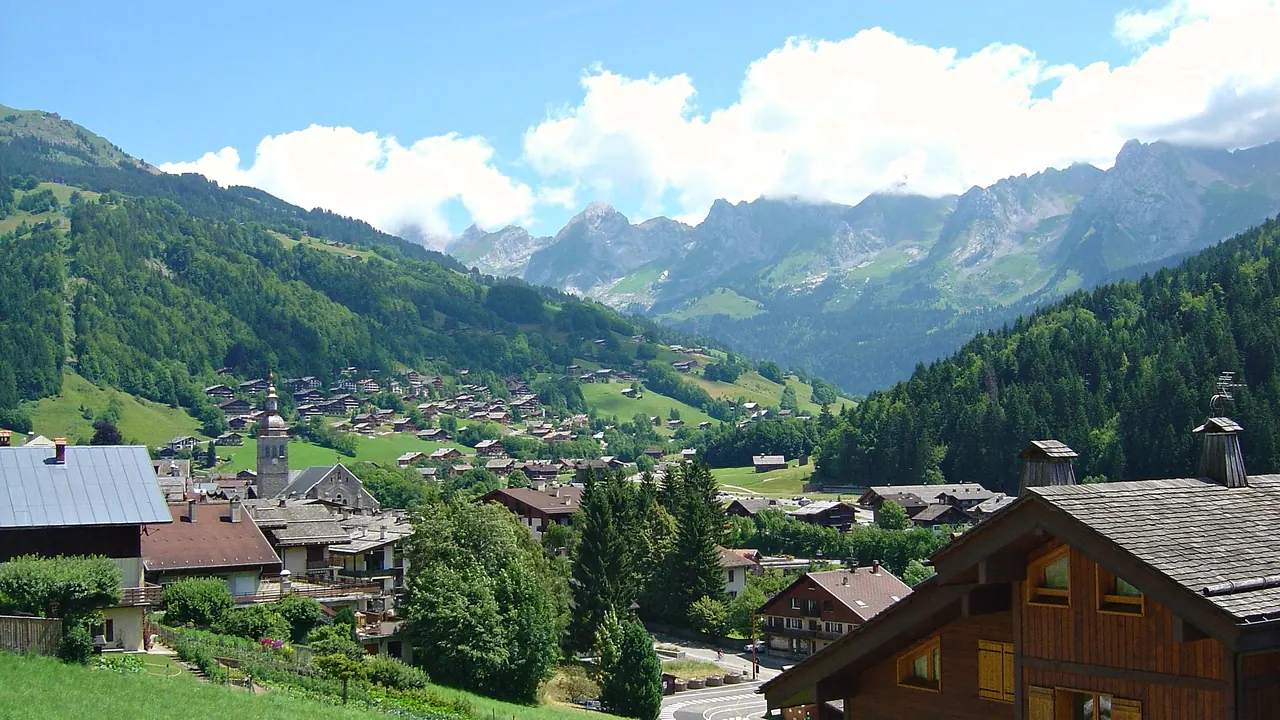
Le Grand-Bornand suits families and anyone watching costs who still wants proper mountains. The resort is built around children, with nursery slopes, farm visits and an August children's festival. Self-catering chalets and Reblochon country cooking also keep a stay far cheaper than anything in the Swiss Alps. Annecy and its lake are close enough to add a swim, an old town and better restaurants, though you will want a car.
Choose Wengen for
- getting around
- nature and the outdoors
- wellness
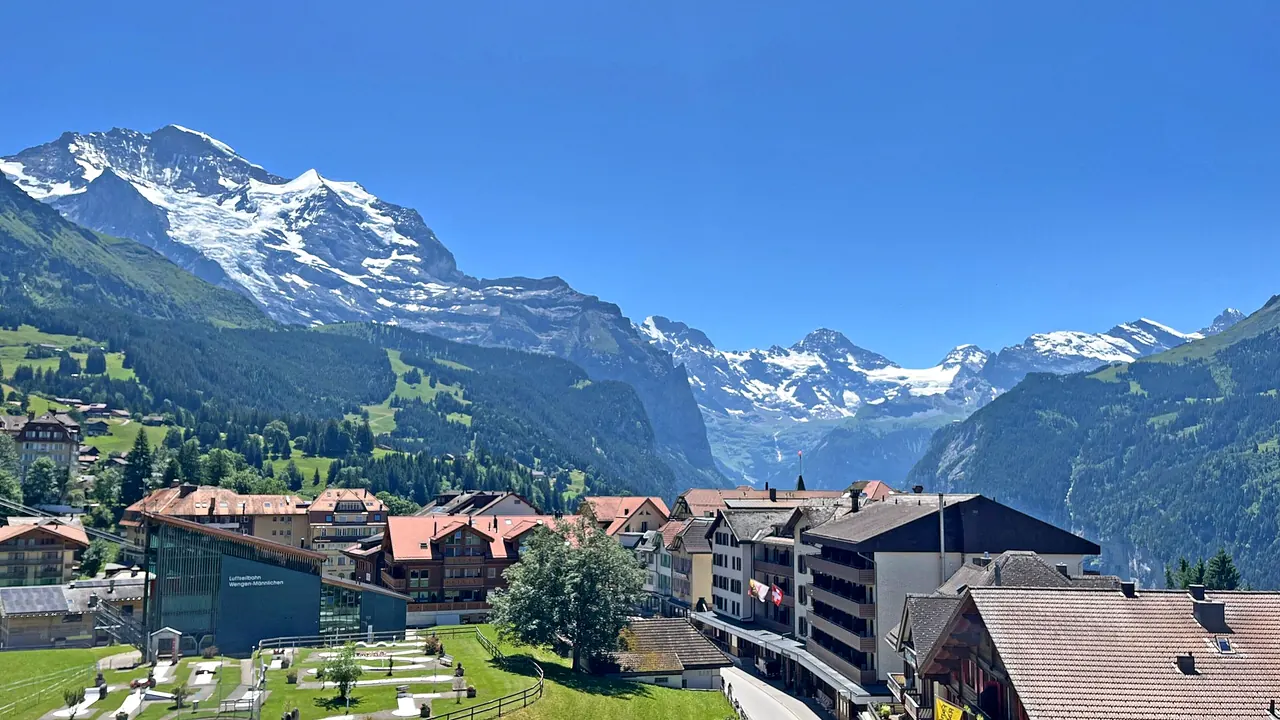
For sheer mountain scenery, Wengen is the stronger pick. It looks straight at the Eiger, Mönch and Jungfrau above the waterfalls of the Lauterbrunnen valley, and its railways and cable car take you to Kleine Scheidegg, the Männlichen ridge and the Jungfraujoch without driving. That comes at a steep price. It is one of the costliest places to stay in Europe, and there is little to do here beyond the mountains themselves.
Scoreboard
Twelve categories on one fixed scale from 0 to 100. The shaded stretch is the gap between the two.
Your match
Pick a travel style or drag the sliders, and both match scores follow your weighting.
Wins on prices and beaches with your weighting.
Wins on getting around and nature and the outdoors with your weighting.
What matters to you?
Category by category
What the scores mean for a trip.
Beaches & swimming
Neither is a swimming destination, but Le Grand-Bornand gets closer. Lake Annecy is about 40 minutes away by car, with pontoons and lawns at Talloires and Sevrier and clear water warm enough for a proper swim in high summer.
From Wengen the nearest bathing is at the lidos on Lake Thun, about an hour away by train. The water there is noticeably cooler, and going for a swim is a day out rather than part of the stay.
Food & drink
Le Grand-Bornand has the more interesting food because it sits in Reblochon country. You can buy cheese at the farms, browse a weekly market of charcuterie and mountain produce, and eat tartiflette or croziflette with a glass of Mondeuse. In Wengen, most meals are hotel half-board or mountain-hut food such as rösti, fondue and veal in cream sauce, and the Jungfrau view outshines the plate.
Both menus are narrow, and for variety you go down the valley, to Annecy from one village and to Interlaken from the other. Annecy is the shorter trip.
Culture & sights
Le Grand-Bornand's heritage is that of a farming valley: a baroque parish church with an onion-domed bell tower, old wooden chalets on stone bases, and a heritage farmhouse showing how families lived and made cheese. It is all small in scale, but it makes a pleasant afternoon's walk.
Wengen has even less to visit. Its Belle Époque hotels recall its early years as an English resort, and there is a small church and a long ski-racing history, but the real draw is the view across to the Jungfrau. From either village, museums and old towns mean a trip down the valley.
Nightlife
Both villages go to bed early, and in winter a few après-ski bars are about all there is: in the village and at Chinaillon in Le Grand-Bornand, and near the slopes in Wengen. What separates them is one weekend. The Lauberhorn downhill in January gives Wengen a proper party, while a real night out from Le Grand-Bornand means driving to Annecy.
Nature & outdoors
Both are serious mountain bases, but Wengen's mountains are on a much bigger scale. It faces the Eiger, Mönch and Jungfrau across the sheer, waterfall-lined Lauterbrunnen valley, and the railway climbs on to glacier at the Jungfraujoch.
Le Grand-Bornand is mid-mountain country under the limestone wall of the Aravis, with peaks of around 2,500m and skiing over open pastures. In summer there is hiking, paragliding and road cycling on Tour de France climbs such as the Col de la Colombière, and Lake Annecy adds sailing and paddling within an hour.
Day trips
The two are close here, and the main difference is how you travel. From Le Grand-Bornand almost everything needs a car, but Annecy's canals and lakeside castle are only 40 minutes away, and Geneva's museums are about an hour.
From Wengen, every outing starts with the rack railway down to Lauterbrunnen. From there, trains and lake steamers take you to Thun's castle, Oberhofen, Spiez and the Ballenberg open-air museum. Bern's arcaded old town makes a long but worthwhile day.
Good for families
Le Grand-Bornand is the more child-centred of the two. As well as ski schools and snow gardens, it has plenty for children in summer, from watching Reblochon being made to playing in the river, and Lake Annecy's beaches are there for a hot day.
Wengen's great advantage for families is that it has no cars, so children can roam the village safely, and the trains make the high viewpoints easy to reach. But the steep paths, buggies stuck in snow, few rainy-day options and expensive meals make it harder going.
Getting around
Wengen is the easier place to be without a car, and in fact you cannot bring one. The rack railway brings you up from Lauterbrunnen and carries on to Kleine Scheidegg and the Jungfraujoch, and a cable car rises to the Männlichen. The mountains are easy to reach; only places lower down are slow to get to.
In Le Grand-Bornand, free winter shuttles link the village, Chinaillon and the lifts, but there is no railway and few buses run to Annecy. Summer trailheads, the lake and day trips realistically mean driving, sometimes over passes that are slow in snow.
Shopping & style
Le Grand-Bornand's weekly market is the closest either village comes to shopping as a pastime. You can browse farm Reblochon, sausages, local honey and a few crafts, and the delis and gear shops cover the rest. Wengen has one short main street of ski hire, souvenir and chocolate counters and a small grocery, enough for a mountain stay. Anything more means going down to Interlaken or Bern.
Affordability
Le Grand-Bornand is an Alpine resort and school vacation weeks are not cheap there. Still, it is modest by French ski standards and self-catering keeps costs in hand. Summer and the quiet weeks of January and March are easier on the budget again.
Wengen is far more expensive. Swiss resort prices apply to rooms, meals and drinks, and the railways that make the stay worthwhile charge for every ride, the Jungfraujoch most of all. Free trails and rail passes help, but only a little.
Live music & performing arts
Le Grand-Bornand has one standout event, Au Bonheur des Mômes. For a week each August, circus, puppetry and music fill the village, and it is worth planning a family trip around it. Wengen has nothing like it, just the odd alphorn or yodelling evening in a hotel and a village brass band.
For theatre or concerts, the French village is better placed, with Annecy and Geneva both within an hour or so. From Wengen, the nearest are in Interlaken or Bern.
Wellness & relaxation
Both offer rest rather than treatment. Neither has a bathing tradition or public thermal baths, only hotel saunas, hot tubs and spa rooms. The calm is different in each. Wengen is car-free, so you hear cowbells, the cog railway and waterfalls, with the Jungfrau in front of your balcony. Le Grand-Bornand has the slower quiet of a farming valley, best off-peak and in early summer, though cars still come and go.
When should you go?
Pick your month. The climate figures are measured averages, not a forecast.
Le Grand-Bornand in July
Wengen in July
Daytime high, °C
Rainfall in the month, mm
Where the figures come from
Le Grand-Bornand's temperatures are measured 45 km from the centre, at Bourg-St-Maurice.
Le Grand-Bornand has no rain gauge within 25 km of the centre, so its rainfall comes from a gridded climate dataset read at the destination rather than from a gauge further away.
Wengen has no weather station within reach, so its figures come from a gridded climate model rather than a measured record, and read a broad area rather than one spot.
Temperature and rainfall are climate normals, averaged over the years shown. Le Grand-Bornand: 1999-2020 (rainfall 1991-2020) normals, Bourg-St-Maurice (44.7 km from centre). Wengen: 1991-2020 normals, TerraClimate 4 km grid at the town, no weather station within 90 km.
Le Grand-Bornand has a real summer. Highs reach about 27°C in July, warm enough for afternoons at Lake Annecy in July and August, while May, June and September are comfortable for hiking without the heat. Rain falls all year but is heaviest from November to January, peaking at around 144mm in December, much of it falling as snow on the slopes above the village in time for the ski season.
Wengen sits higher and stays cool all year. Summer highs are around 16°C, which is ideal for long walks but never beach weather, and from December to February daytime highs stay close to 0°C, which is good for snow. Its wettest stretch is May to August, so summer walkers should expect some cloudy days, while September is drier and a good time for clear views.
Which traveller are you?
On a family trip with young children, Le Grand-Bornand is the easier choice. It was planned around families, with snow gardens and gentle slopes in winter and cheese-farm visits, river play and an August children's festival in summer, and feeding everyone costs far less.
For an outdoors trip, Wengen has the edge. Trails leave the village for the Männlichen ridge, Kleine Scheidegg and the foot of the Eiger north face. Its ski area links with Grindelwald, and the railway reaches glacier terrain at the Jungfraujoch, which the Aravis cannot match.
On a tight budget, Le Grand-Bornand is the only realistic choice of the two. Self-catering is normal there, and summer and the quieter weeks of January and March are gentle on spending. In Wengen, hotels, meals and the mountain railways make every day expensive.
Before you go
| Measure | Le Grand-Bornand | Wengen |
|---|---|---|
| Official language | French | French, German, Italian, Romansh |
| Currency | Euro (EUR) | Swiss Franc (CHF) |
| Sockets | CE230 V, 50 Hz | CJ230 V, 50 Hz |
| Driving side | Right | Right |
| Time zone | UTC+1, UTC+2 in summer | UTC+1, UTC+2 in summer |
| Emergency number | 112 | 112 |
| Elevation | 892 m | 1,274 m |
| Main airport | Geneva International Airport (GVA)41 km from centre150 non-stop destinations | Zürich Airport (ZRH)106 km from centre226 non-stop destinations |
| Public holidays this year | 11 days | 10 days |
By the numbers
| Measure | Le Grand-Bornand | Wengen |
|---|---|---|
| Population | 2,050 | 1,116 |
| People per km² | 33 | 31 |
| Museums within 10 km | 1 | 2 |
| UNESCO World Heritage sites within 50 km | 2 | 1 |
Where else could you go?
Every comparison below shares a destination with this one, so you can follow Le Grand-Bornand or Wengen somewhere new.
- La Clusazvs Le Grand-Bornand
- Mürrenvs Wengen
- Grindelwaldvs Wengen
- Megèvevs Le Grand-Bornand
- Flainevs Le Grand-Bornand
- Saint-Gervais-les-Bainsvs Le Grand-Bornand