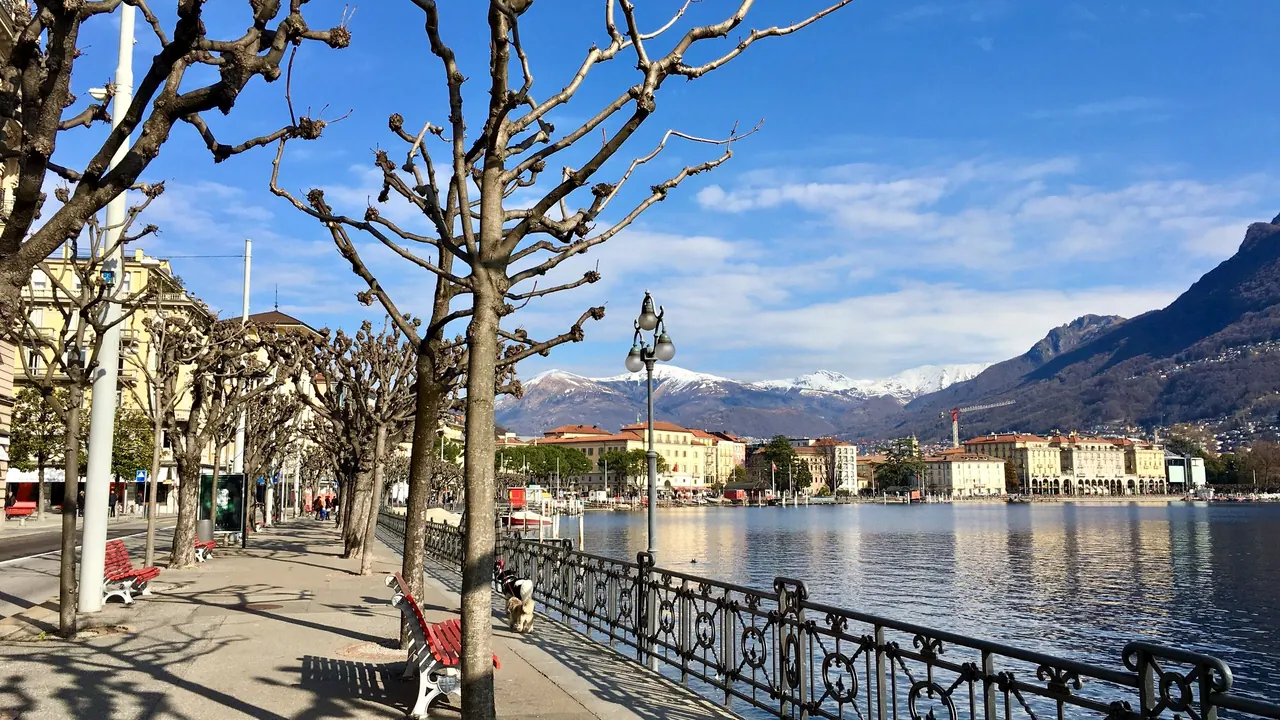
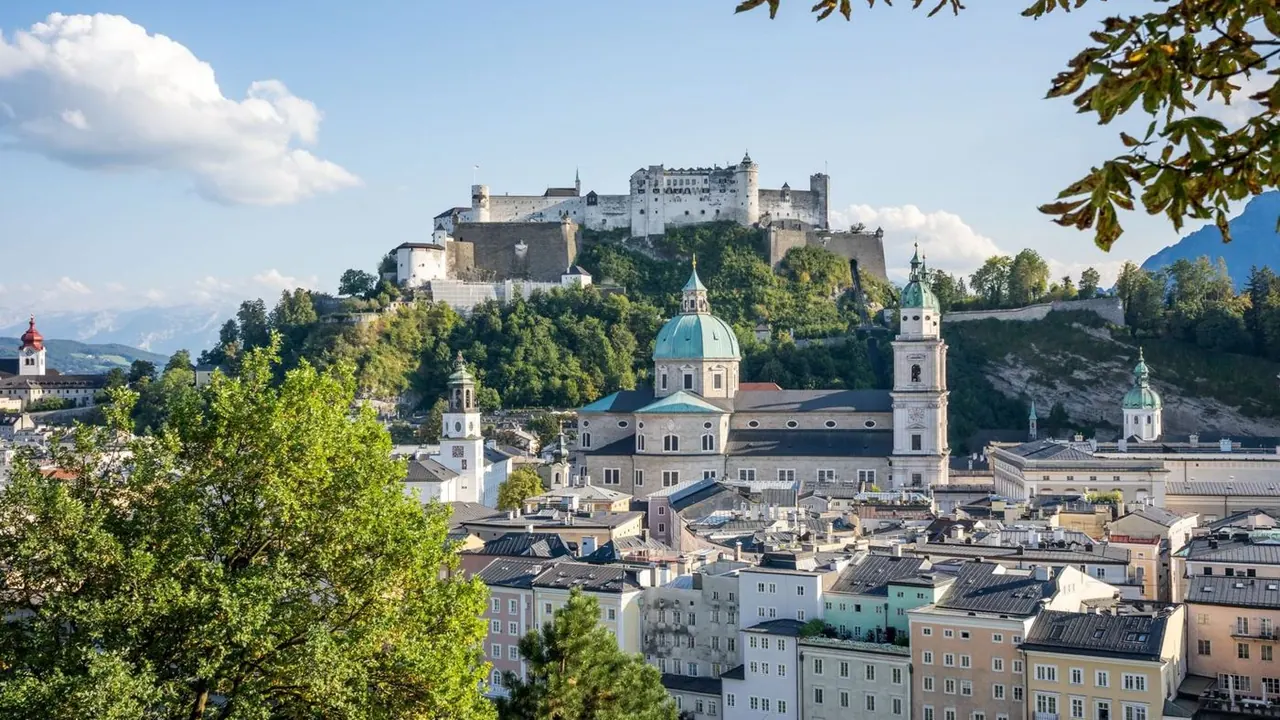
Photos: Lugano by Thomas Woodtli from Zürich, Switzerland, CC BY-SA 2.0, cropped; Salzburg by Leonhard Niederwimmer, Pexels License.
Lugano or Salzburg?
Our verdict in twelve categories, each scored against the same fixed benchmark cities, and the climate month by month, so you can choose for your trip.
Choose Lugano for
- beaches
- getting around
- day trips
Lugano suits a slow lake-and-mountain stay. You can take a funicular up Monte Brè in the morning, spend the afternoon at a lido and eat dinner in a grotto under the chestnut trees. Como, Milan and Lake Maggiore are close enough for day trips by train or boat. It is the warmer and sunnier of the two and the better one for swimming from town. It is also the more expensive, and its sights are seen in a day.
Choose Salzburg for
- live music and the arts
- culture and sights
- prices
Choose Salzburg if the trip is about what you see and hear. It has a Baroque old town under a medieval fortress, the Mozart houses and a concert or opera almost every evening, with world-class festivals on top. It also has the bigger Alpine scenery on its doorstep, more for children to do and real spa towns nearby. It costs somewhat less, though it is still not cheap.
Scoreboard
Twelve categories on one fixed scale from 0 to 100. The shaded stretch is the gap between the two.
Your match
Pick a travel style or drag the sliders, and both match scores follow your weighting.
Wins on beaches and getting around with your weighting.
Wins on live music and the arts and culture and sights with your weighting.
What matters to you?
Category by category
What the scores mean for a trip.
Beaches & swimming
Neither city has a beach, but Lugano swims from its own shore. The main lido is at the mouth of the Cassarate, there are smaller bathing spots towards Castagnola and Paradiso, and the lakeside villages have their own baths. In midsummer the water is about 23°C.
In Salzburg the Salzach is too cold and fast for swimming, so a swim means a drive of half an hour or more to Fuschlsee, Wolfgangsee or Mondsee. These are clear, lovely lakes with jetties and pebble shores, but a swim there is a separate outing, not part of an ordinary day in town.
Food & drink
Both cities eat well within a narrow range, and in both you pay a lot for it. What differs is the cooking. Lugano is Italian at heart: polenta, risotto and braised meats at granite tables in the grotti, with a glass of Ticino Merlot. Salzburg is Austrian and hearty: schnitzel, Kasnocken, the soufflé called Salzburger Nockerl, and beer from the barrel in the garden of the monastery brewery in Mülln.
Salzburg's strongest point is its old coffee houses, where coffee and cake are a ritual of their own. Lugano's escape from high prices is a meal across the Italian border. In Salzburg the better cooking is in the inns of the outer districts.
Culture & sights
Salzburg has far more to see. The UNESCO-listed Baroque centre built by the prince-archbishops has the cathedral and the Residenz all within a few minutes' walk, with the Hohensalzburg fortress on the cliff above. Add Mirabell, the Mozart houses, the rock-cut catacombs of St Peter and the Hellbrunn palace, and you have two or three full days.
Lugano's arcaded Lombard old town is pleasant but small. Its best things are single works and places: Luini's Passion fresco in Santa Maria degli Angioli, the art collection at LAC and the Hermann Hesse museum in Montagnola. One day is enough.
Nightlife
Both are quiet places at night, and for a real night out people go elsewhere: Milan from Lugano, Munich from Salzburg. In Lugano, evenings mean a smart aperitivo on the lakefront and then a long dinner. In Salzburg they mean litre mugs at long tables in the beer halls, plus a few student pubs along Rudolfskai that stay open later at weekends.
Nature & outdoors
Both are excellent bases for the outdoors, and Salzburg has slightly more variety. Its wooded ridges start right in the centre, the Untersberg cable car climbs to about 1,800m, and Berchtesgaden National Park and the Königssee are half an hour away. The big ski areas are about an hour's drive, so winter brings real snow sports.
Lugano's scenery is the lake itself, set between steep wooded mountains. You can take a funicular up Monte Brè or San Salvatore, walk the path to Gandria or hike the Lema to Tamaro ridge, and the green rivers of the Verzasca are about an hour away. The high Alps are further off.
Day trips
Lugano's day trips cross a border. Como is about half an hour away, and Milan, with its cathedral, The Last Supper and the Brera gallery, is just over an hour by train. On the Swiss side you can see the three castles of Bellinzona or continue to Locarno and Ascona on Lake Maggiore, then cross back into Italy for the palace gardens of the Borromean Islands. Almost all of this is an easy train or boat ride.
Salzburg has just as much within a day's reach, but the trips are of a different kind. Most are about salt and lakes: Hallstatt with its prehistoric mine, the salt mine and Celtic museum at Hallein, the clifftop fortress at Werfen and the old imperial spa of Bad Ischl, with Munich for a day in a big city. The quieter lake villages, such as St Wolfgang and St Gilgen, are the trips where a car makes the day much simpler.
Good for families
Salzburg has more for children. The trick fountains at Hellbrunn spray visitors in the gardens, there is a zoo next door, and Haus der Natur is a large hands-on science museum. The salt mines nearby have wooden slides for the descent and boat rides on underground lakes.
Lugano relies on its lake. Children get boat rides, lido slides, funiculars and the park of Swiss landmarks in miniature at Melide, but there is no zoo or big museum. That makes it better for younger children than for teenagers.
Getting around
Lugano is a little easier to explore without a car. The lake boats reach the waterside villages, funiculars and rack railways go up the mountains, and the Swiss rail network makes Como and Milan simple trips. The steep slope between the station and the old town is the main obstacle, and a short funicular solves it.
Salzburg's centre is flatter, largely pedestrianised and good for cycling, and trolleybuses cover the rest of the city. But the regional buses to the Salzkammergut lakes are slow, so many visitors hire a car for those trips.
Shopping & style
Shopping is limited in both cities, and they sell different things. Lugano's Via Nassa is a street of Swiss watchmakers, jewellers and Italian fashion houses under the arcades, and there is a large designer outlet towards Mendrisio. Salzburg has little luxury but has its own crafts: made-to-measure dirndls and loden jackets, wooden toys, and in Advent one of the oldest Christmas markets in the region on Domplatz.
Affordability
Both are expensive, but Lugano is clearly the more expensive. There, hotels, meals, wine, boats and mountain railways all cost Swiss prices. The free regional transport that comes with a hotel stay helps only a little, and many visitors save by eating on the Italian side.
Salzburg gives you more ways to save. You can stay across the river or in the suburbs, use the city card for transport and most sights, and eat in the outer beer halls and inns. Just avoid the summer festival and the Advent weeks, when rooms become much more expensive.
Live music & performing arts
This is where Salzburg is strongest. Every summer the Salzburg Festival fills the Felsenreitschule, a riding school carved into the cliff, and the festival halls with top opera and orchestras, and Jedermann is performed outdoors in front of the cathedral. Mozart Week and the Easter Festival add more seasons, and the Mozarteum, the Landestheater and the Marionette Theatre perform all year.
Lugano's music is mostly at LAC, home of the Orchestra della Svizzera italiana. In summer there are free jazz concerts on Piazza della Riforma, and for opera people go to La Scala in Milan.
Wellness & relaxation
Neither city has hot springs of its own, but Salzburg has a real bathing culture close by. In the city park, the Paracelsus Bad has saunas and a pool looking out on the Kapuzinerberg. The brine spa town of Bad Reichenhall is twenty minutes away, and the radon springs of Gastein are about an hour and a half away.
Lugano's calm comes from its pace instead: the palm-lined shore, long grotto lunches and quiet hours in Parco Ciani. For spa treatments you go to the lakeside hotels or the large pool and sauna complex near Rivera.
When should you go?
Pick your month. The climate figures are measured averages, not a forecast.
Lugano in July
Salzburg in July
Daytime high, °C
Rainfall in the month, mm
Temperature and rainfall are climate normals, averaged over the years shown. Lugano: 1991-2020 normals, Lugano (1.2 km from centre). Salzburg: 1991-2020 normals, Salzburg (3.4 km from centre).
Lugano is the warmer city all year. It reaches 27°C in July and August, against 25°C in Salzburg, and its winters are milder and much sunnier. That makes December to March in Lugano good for walking the lakefront in the sun, while Salzburg's winter days stay near freezing and snow often reaches the town. In both places the lakes are warm enough for swimming only from June to early September.
The rain falls at different times. Lugano is wet from April all the way through November, with the most rain in May and again in autumn. Its driest months are in winter. Salzburg has most of its rain in summer, close to 170mm in June and in August, and then becomes noticeably drier in September and October, a good time for its ridges and lakes. Lugano's summers are sunnier but also humid, so spring and early autumn are the better months for hiking there.
Which traveller are you?
For a beach and sun trip, Lugano is the better choice. It is warmer and sunnier in summer, and you can swim right in town at the lidos along its own lake. Salzburg's river is too cold for swimming, so a swim there means a trip out to the Salzkammergut.
On a culture and arts trip, Salzburg is far ahead. Its UNESCO-listed old town, the Hohensalzburg fortress and the Mozart houses fill two or three days, and opera and concerts run all year, at festival level in summer. Lugano's sights take about a day.
On a trip with a tight budget, Salzburg is the easier of the two, although neither is cheap. A city card covers transport and most sights, and the beer halls and suburban inns are reasonably priced. In Lugano everything costs Swiss prices, and there is no cheap way to stay.
Before you go
| Measure | Lugano | Salzburg |
|---|---|---|
| Official language | French, German, Italian, Romansh | German, Austrian Sign Language |
| Currency | Swiss Franc (CHF) | Euro (EUR) |
| Sockets | CJ230 V, 50 Hz | CF230 V, 50 Hz |
| Driving side | Right | Right |
| Time zone | UTC+1, UTC+2 in summer | UTC+1, UTC+2 in summer |
| Emergency number | 112 | 112 |
| Elevation | 283 m | 424 m |
| Main airport | Milan Malpensa International Airport (MXP)46 km from centre208 non-stop destinations | Salzburg Airport (SZG)3 km from centre64 non-stop destinations |
| Public holidays this year | 15 days | 16 days |
By the numbers
| Measure | Lugano | Salzburg |
|---|---|---|
| City population | 63,495 | 155,021 |
| People per km² | 837 | 2,360 |
| Museums within 10 km | 17 | 38 |
| UNESCO World Heritage sites within 50 km | 5 | 3 |
Where else could you go?
Every comparison below shares a destination with this one, so you can follow Lugano or Salzburg somewhere new.