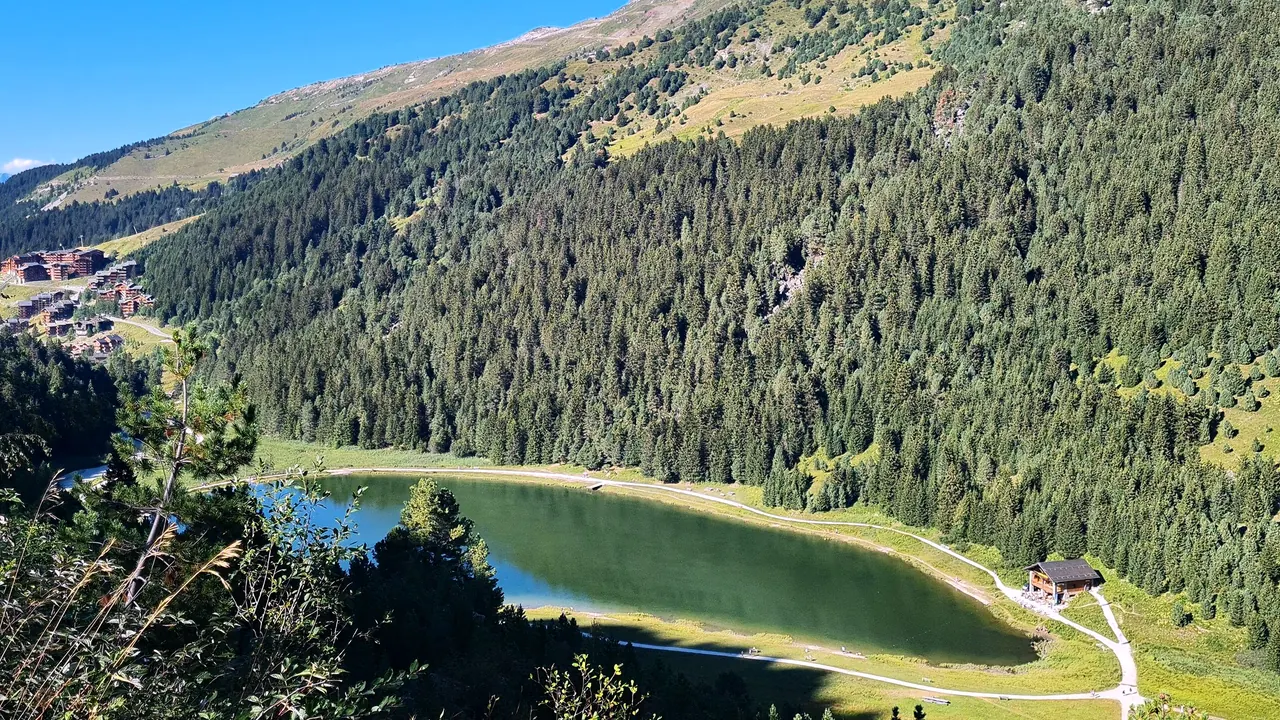
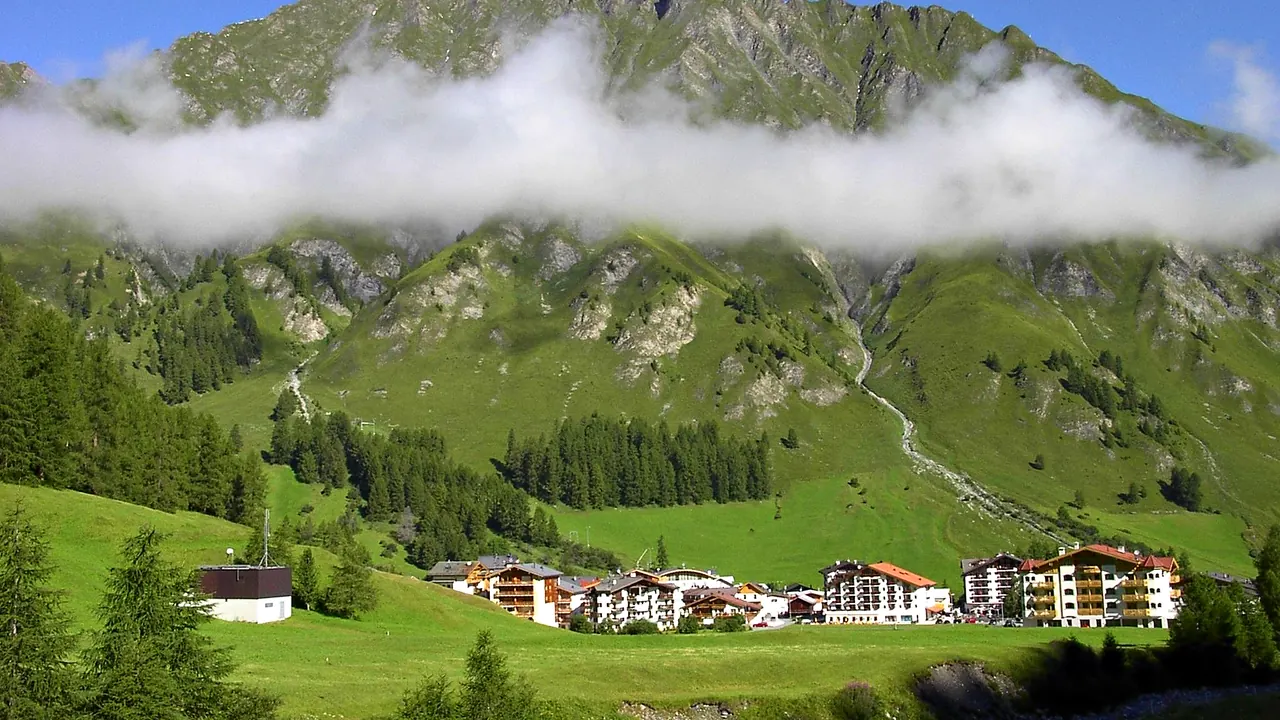
Photos: Méribel by Augustin Cléchet, CC BY-SA 3.0, cropped; Samnaun by Rene Nueesch, CC BY 3.0, cropped.
Méribel or Samnaun?
Our verdict in twelve categories, each scored against the same fixed benchmark cities, and the climate month by month, so you can choose for your trip.
Choose Méribel for
- nightlife
- families
- food and drink
Méribel is the stronger pick for a ski week where the evenings matter as much as the slopes. It sits in the middle of the 3 Vallées, so every lift opens onto more terrain, and it has the livelier après-ski, the wider choice of mountain restaurants and the better set-up for children, with snow gardens, chalet childcare and the Olympic Park. You pay for all of this, and you share it with plenty of other people.
Choose Samnaun for
- shopping
- prices
Samnaun suits skiers who would rather have quiet. Its cross-border ski area is huge, the valley empties out early in the evening, and its duty-free status turns the main street into a shopping trip of its own, whether for watches, perfume or a case of wine. The remoteness is the price of that calm, because the valley is a dead end reached by a long road.
Scoreboard
Twelve categories on one fixed scale from 0 to 100. The shaded stretch is the gap between the two.
Your match
Pick a travel style or drag the sliders, and both match scores follow your weighting.
Wins on nightlife and families with your weighting.
Wins on shopping and prices with your weighting.
What matters to you?
Category by category
What the scores mean for a trip.
Beaches & swimming
You won't swim outdoors in either place. Méribel's swimming happens in the Olympic Park pool, and its mountain lakes are for walking around, so a real lake swim means driving more than an hour to the big lakes of Savoie. In Samnaun the village leisure pool takes that role, and the only open-water option is a brief, cold dip in a stream or tarn on a hot August afternoon.
Food & drink
Méribel eats better. Its mountain restaurants range from rustic huts serving croûtes to white-tablecloth terraces with long wine lists, evenings bring fondue, tartiflette and Beaufort, and the hotels and the wider 3 Vallées have some serious gastronomic tables. It is all expensive, though, and a lot of the cooking happens privately in catered chalets.
In Samnaun most meals are half board in your hotel or at a hut on the slopes: capuns, pizokel, rösti and Tyrolean dishes from over the border. The interesting part is the drink. Duty-free shelves full of spirits and wine make the valley a better place to buy a bottle than to book a dinner.
Culture & sights
Neither resort is a place for sightseeing, and in both the setting is the main attraction. Méribel was laid out as a ski resort between the wars, and its timber and stone chalets, built to a strict local style, make it look more unified than most French resorts. It also keeps a little heritage from the 1992 Winter Games, and the older hamlets lie further down the valley.
What Samnaun offers is a story rather than a sight. The valley was so cut off that it was left outside the Swiss customs area in 1892, which is how it became duty-free, and its modest chapels and surviving timber farmhouses stand among the hotels.
Nightlife
Méribel has a real après-ski scene. The party starts at mountain bars as the lifts close, moves down into village pubs with a strong British crowd, and on busy weeks a couple of late bars and a small club run into the early hours. It is still one cluster of venues, and it goes very quiet outside winter.
Samnaun winds down early, with a few hotel bars and a club or two on peak weekends. The famous party town of Ischgl is part of the same ski area, but once the lifts stop it is a long drive away through Austria, so it is not a realistic place for a night out.
Nature & outdoors
Both give you very large ski areas, and Méribel's is larger still. Being in the middle of the 3 Vallées puts Courchevel, Val Thorens and Les Menuires within reach on skis, across terrain that runs from cruising pistes to steep couloirs. In summer the Tueda reserve and the Vanoise National Park bring ibex, marmots and lift-served mountain biking.
Samnaun links to Austria's Paznaun valley and has long runs above the treeline, served by the double-decker cable car from Ravaisch. Its strength is space and emptiness: border trails to cols and summits, routes into the Tyrol, and the Swiss National Park about an hour away.
Day trips
You need a car in both cases, and the choice of trips is about as wide in each. They differ in kind. From Méribel, after the winding descent to Moûtiers, you reach real towns: Annecy with its canals and lake, the ducal castle at Chambéry, the spa town of Aix-les-Bains, plus the cheese cooperative of the Beaufort valley.
Samnaun's outings are smaller and older. The painted sgraffito villages of the Lower Engadine and Tarasp Castle are under an hour away, and over the Reschen Pass lie walled Glurns, Marienberg abbey and the UNESCO-listed convent at Müstair. Three countries are within a day's drive.
Good for families
Méribel is better organised for children. Snow gardens, ski schools that take very young children, and childcare in many chalets let parents ski, while the Olympic Park's ice rink and pool, sledging and dog-sledding fill the days off. The catch is the steep, icy roads between chalets and lifts.
Samnaun is gentler but offers less. Nursery slopes sit close to the village and half board keeps meals simple, but apart from the leisure pool with its slides there is little else for children. The long, winding road in can also be hard on anyone prone to car sickness.
Getting around
Inside each resort it is easy to manage without a car, though the layouts differ. Méribel climbs a steep hillside, so free shuttles and lifts do the work, and the Olympe gondola drops down to Brides-les-Bains. Samnaun's hamlets line one road along the valley floor, and Dorf and Compatsch are small enough to walk around.
Getting there is harder in both. Méribel's nearest station is Moûtiers, about half an hour below. Samnaun has no railway at all, and the postbus from Scuol takes more than an hour.
Shopping & style
Here Samnaun has the clear lead, because shopping is half the reason it is famous. Its duty-free main street sells perfume, Swiss watches, jewellery, chocolate, spirits and outdoor clothing, often below normal prices, and coaches bring day shoppers over from the Tyrol. It is mostly international brands, though, not local craft.
Méribel's shops are practical: ski hire, technical gear, some boutiques with chalet-style homeware, and delicatessens selling Beaufort and sausages to take home.
Affordability
Both are expensive, and neither is a budget trip. Méribel is at the very top of Alpine prices for chalets, lift passes and meals on the mountain, so the usual ways to save are self-catering in Mottaret or staying down in Brides-les-Bains, or coming in the cheaper summer. Samnaun charges Swiss resort prices, but its rooms are a little gentler than the fashionable resorts, half board helps, and duty-free fuel and drink take something off the total.
Live music & performing arts
Neither valley has a stage, so live music means whatever the après-ski bars put on. In Méribel that means cover bands, DJs and the occasional festival weekend, and the nearest opera or theatre is in Chambéry or Annecy. Samnaun's highlight is the big open-air concerts on the slopes at the opening and close of the ski season, which are worth planning a trip around.
Wellness & relaxation
Both valleys offer about the same amount of rest, but of different kinds. Méribel has hot tubs and saunas in its chalets, plus a real thermal tradition just a gondola ride below at Brides-les-Bains, though the winter rhythm of early lifts and late après-ski means you have to look for the quiet.
Samnaun is calm by nature, with clear air and quiet evenings, and its hotel saunas cover the usual post-ski unwinding. For mineral springs you go to Scuol, under an hour away.
When should you go?
Pick your month. The climate figures are measured averages, not a forecast.
Méribel in July
Samnaun in July
Daytime high, °C
Rainfall in the month, mm
Where the figures come from
Méribel has no weather station within reach, so its figures come from a gridded climate model rather than a measured record, and read a broad area rather than one spot.
Samnaun has no rain gauge within 25 km of the centre, so its rainfall comes from a gridded climate dataset read at the destination rather than from a gauge further away.
Temperature and rainfall are climate normals, averaged over the years shown. Méribel: 1991-2020 normals, TerraClimate 4 km grid at the town, no weather station within 90 km. Samnaun: 1991-2020 normals, Passo Resia / Resia Pass (16.3 km from centre).
Both are winter destinations first, with daytime highs of only a degree or two in January and snow lying long into spring. The big difference is when the weather comes in. Méribel gets its heaviest precipitation in late autumn and winter, with around 150mm in November, which tops up the snow but brings more grey days in the ski season. Samnaun is noticeably drier in winter, with its lowest totals in February, so a midwinter week there is more likely to be crisp and clear.
In summer the pattern turns around. July and August reach about 20°C in both valleys, which is good walking weather, but Samnaun is then at its wettest, with afternoon showers likely, while Méribel is at its driest in July. For hiking and biking, Méribel's high summer and Samnaun's September are the safer choices. Neither place is ever too hot to walk, and neither is warm enough for swimming outdoors.
Which traveller are you?
For a food and nightlife trip, Méribel is the clear choice. You get terrace lunches on the pistes, Savoyard dinners and a few ambitious hotel kitchens, followed by table-dancing après-ski and late bars. Samnaun's half-board dining rooms are mostly closed by late evening.
On a shopping trip, Samnaun has the advantage. As a duty-free enclave, its main street is lined with watches, jewellery, perfume, chocolate and spirits, often below normal Swiss prices. Méribel offers ski gear, a few boutiques and delicatessen cheese, and not much more.
On a family trip with children, Méribel is better equipped. Ski schools take children young, many chalets offer childcare, and the Olympic Park has an ice rink and a pool for days off the slopes. Samnaun is safe and gentle, but there is less to do once you leave the snow.
Before you go
| Measure | Méribel | Samnaun |
|---|---|---|
| Official language | French | French, German, Italian, Romansh |
| Currency | Euro (EUR) | Swiss Franc (CHF) |
| Sockets | CE230 V, 50 Hz | CJ230 V, 50 Hz |
| Driving side | Right | Right |
| Time zone | UTC+1, UTC+2 in summer | UTC+1, UTC+2 in summer |
| Emergency number | 112 | 112 |
| Elevation | 1,447 m | 1,846 m |
| Main airport | Geneva International Airport (GVA)100 km from centre150 non-stop destinations | Innsbruck Airport (INN)82 km from centre40 non-stop destinations |
| Public holidays this year | 11 days | 9 days |
By the numbers
| Measure | Méribel | Samnaun |
|---|---|---|
| Population | - | 773 |
| People per km² | - | 14 |
| Museums within 10 km | 0 | 1 |
| UNESCO World Heritage sites within 50 km | 0 | 1 |
Where else could you go?
Every comparison below shares a destination with this one, so you can follow Méribel or Samnaun somewhere new.
- Courchevelvs Méribel
- Les Menuiresvs Méribel
- Val Thorensvs Méribel
- La Plagnevs Méribel
- Les Arcsvs Méribel
- Tignesvs Méribel