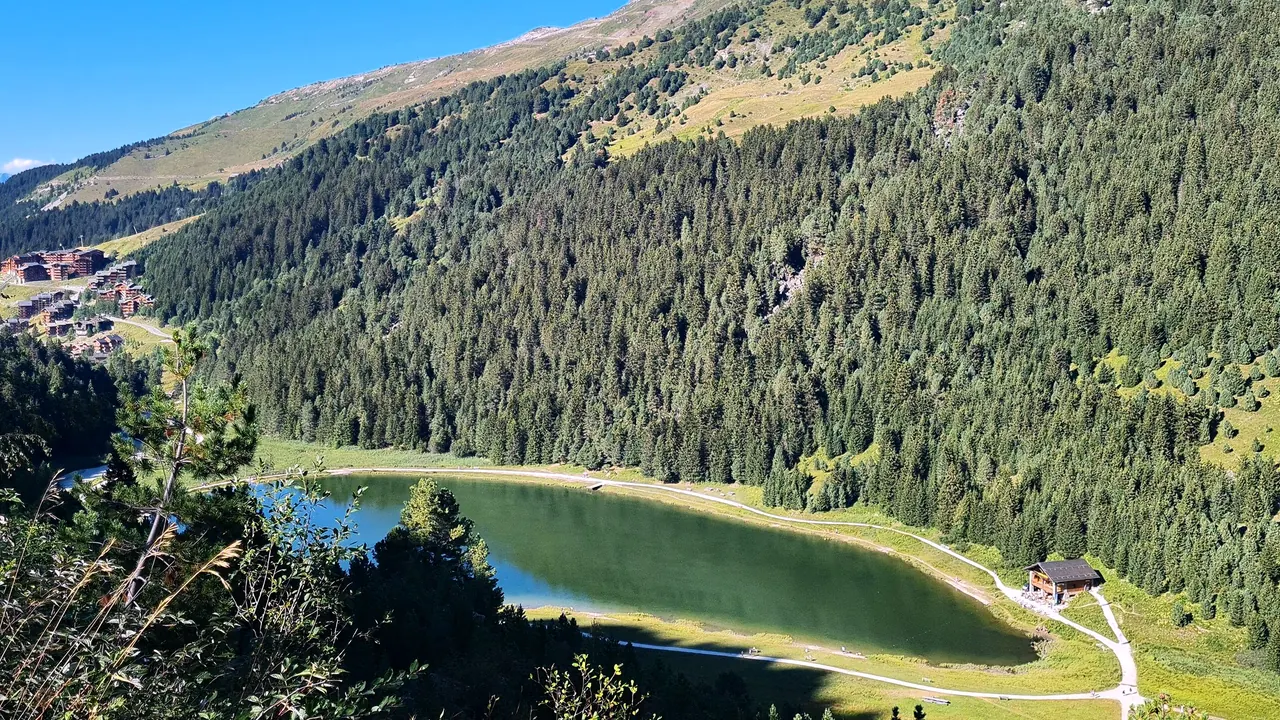
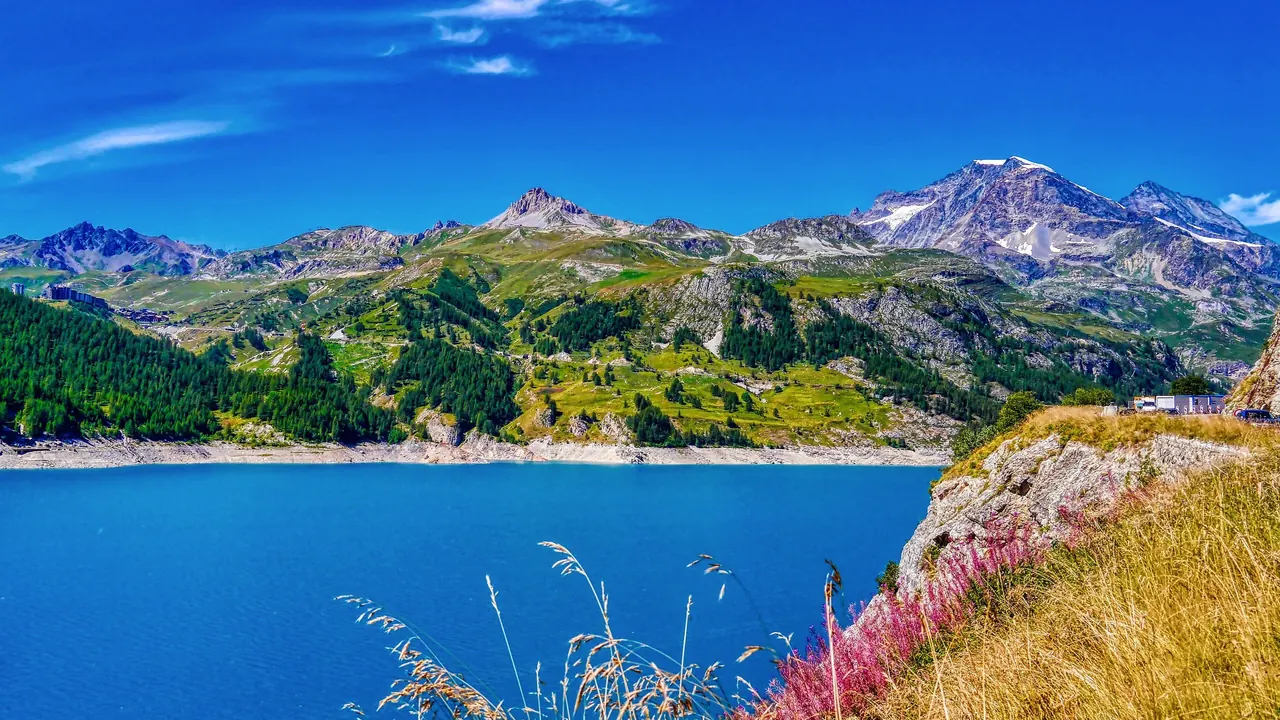
Photos: Méribel by Augustin Cléchet, CC BY-SA 3.0, cropped; Tignes by Zairon, CC BY-SA 4.0, cropped.
Méribel or Tignes?
Our verdict in twelve categories, each scored against the same fixed benchmark cities, and the climate month by month, so you can choose for your trip.
Choose Méribel for
- day trips
- wellness
- food and drink
Méribel suits skiers who want the full sweep of the 3 Vallées and a bit more comfort around it. The chalet village is better looking, lunches on the mountain range from rustic huts to white-tablecloth terraces, and the gondola down to the thermal spa at Brides-les-Bains makes rest days easy. It is also the better base for a drive out to Annecy or Chambéry. Couples and families who want catered chalets and polish will feel at home here.
Choose Tignes for
- beaches
- prices
- getting around
Tignes is for people who care most about height and snow. The resort sits higher, the Grande Motte glacier extends the season into autumn and early summer, and many apartments let you ski from the door. Self-catering is the norm, so the bill is easier to manage, and a summer visit adds a lake you can actually swim in, if briefly. Expect functional buildings rather than charm.
Scoreboard
Twelve categories on one fixed scale from 0 to 100. The shaded stretch is the gap between the two.
Your match
Pick a travel style or drag the sliders, and both match scores follow your weighting.
Too close to call, 2 points apart
Wins on day trips and wellness with your weighting.
Wins on beaches and prices with your weighting.
What matters to you?
Category by category
What the scores mean for a trip.
Beaches & swimming
Neither resort has a beach, but Tignes at least offers an outdoor swim. In July and August a supervised bathing area opens on the Lac de Tignes, with a small sandy shore, although the snowmelt water makes it a quick, cold dip. Most people swim in the aquatic centre by the lake, which has slides and a lagoon pool.
In Méribel, swimming means the pool at the Olympic Park or a hotel pool. The lakes up in the Tueda reserve are for walking around, not bathing, and a proper lake swim means driving more than an hour to the big lakes of Savoie.
Food & drink
Both serve the same Savoyard cheese dishes, but Méribel has more range at the top end. Its mountain restaurants run from huts serving croûtes and omelettes to polished terraces with long wine lists, and a few hotels in the 3 Vallées have serious gastronomic kitchens.
Tignes adds pizzerias, burger places and crêperies in Le Lac and Val Claret, but menus repeat from place to place. Its best food is the Beaufort, Reblochon and charcuterie in the delicatessens. Neither has a market culture, and both have far fewer places open outside the season.
Culture & sights
Méribel's village is its main sight. It was laid out from the 1930s in a strict timber-and-stone chalet style, so it holds together better than most French resorts and is pleasant to walk through. It adds a small chapel, some Olympic heritage from the Winter Games and old hamlets lower in the valley.
Tignes went up a generation later as functional apartment blocks, after the Chevril dam flooded the old valley village in 1952. The story of that drowned village is the heritage, recalled by the giant mural on the dam wall, and a few chapels in Les Brévières and Les Boisses complete the list.
Nightlife
Après-ski is lively in both, and the difference is in the crowd and where it gathers. Méribel's party starts with dancing on tables at the mountain bars as the lifts close, then moves to one cluster of village pubs with a strong British crowd and a small club for late nights.
Tignes is split between Val Claret and Le Lac. Seasonal workers and groups of young British, Scandinavian and French skiers keep it loud, and the drinks are beer and shots in ski boots. Families can stay away from the noise in the lower hamlets. Both are very quiet in summer.
Nature & outdoors
The 3 Vallées network is what sets Méribel apart. From the middle of it you can ski over to Courchevel or Val Thorens and back in a day, on everything from wide cruising runs to steep couloirs. In summer the arolla pine forest and lake of the Tueda reserve, lift-served mountain biking and golf take over.
Tignes trades that sheer spread for height. Its pistes climb to the Grande Motte glacier at nearly 3,500m, the lifts link with Val d'Isère, and skiing starts in autumn on the glacier. Each resort opens onto the Vanoise National Park, where ibex and marmots are easy to spot on the summer trails.
Day trips
Méribel is the better base for getting out of the mountains. Once you are down the winding road to Moûtiers, Annecy's old town and lake, the ducal castle at Chambéry, Aix-les-Bains on Lac du Bourget and medieval Conflans are all within about two hours.
Tignes is at the head of a long valley, so most outings take longer. Val d'Isère is a short bus ride away, and Bourg-Saint-Maurice, Conflans and Beaufort make a reasonable day by car. Its one real extra is summer, when the Little St Bernard Pass opens the way to Roman Aosta in Italy.
Good for families
Méribel lets parents ski on their own, since many chalets offer childcare, and the Olympic Park's ice rink and pool, plus sledging, dog-sledding and snowshoe outings, fill the days off the slopes. The catch is the hillside layout, with steep, icy roads between chalets and lifts.
In Tignes the beginner areas sit right beside Le Lac and Val Claret, and many apartments are ski-in, ski-out, so nobody carries small skis through the streets. The altitude and cold can tire very young children, though, and off the snow there is little beyond the pool and the lake.
Getting around
You won't need a car in either resort, since free shuttles and the lifts handle most journeys. In Méribel the village climbs a steep hillside and many chalets are a bus ride from the centre. Its best link is the Olympe gondola down to Brides-les-Bains.
Tignes is a string of small villages, each small enough to walk around, and in winter many guests ski from door to door. Arriving takes longer here: the station at Bourg-Saint-Maurice is about forty minutes below, compared with half an hour from Moûtiers to Méribel.
Shopping & style
Shopping in both is mostly ski hire and outdoor gear, and the best things to take home are the cheese and sausages from the delicatessens. Méribel adds a few smart boutiques selling ski wear and chalet-style homeware. Tignes has more supermarkets for self-caterers, plus local mountain honey.
Affordability
Both are expensive, but Tignes is easier to bring down to a reasonable level. Self-catering apartments make up much of the resort, the early and late season weeks cost noticeably less, and summer brings lower lodging prices and free activities by the lake.
Méribel is at the very top of the Alpine range, with catered chalets, lift passes and mountain lunches all priced to match. The usual savings are an apartment in Mottaret or a bed down in Brides-les-Bains. In both, eating out stays at resort prices all year.
Live music & performing arts
Neither has a theatre or a concert programme. Live music in both means bands and DJs in the après-ski bars, plus the occasional outdoor concert at resort events. For opera or classical music, Méribel has the slightly easier drive to the stages of Chambéry and Annecy, though it is still a long trip from either.
Wellness & relaxation
Méribel is better for rest days. Its strongest asset is the Olympe gondola straight down to Brides-les-Bains, a long-established thermal spa town that takes day visitors. Hot tubs and treatment rooms are also standard in many of its chalets.
Tignes has a good spa in its aquatic centre, with a hammam and massage, but no thermal waters of its own, and Brides is about an hour away by road. In both resorts winter is brisk, and the quieter summer weeks suit a slow stay better.
When should you go?
Pick your month. The climate figures are measured averages, not a forecast.
Méribel in July
Tignes in July
Daytime high, °C
Rainfall in the month, mm
Where the figures come from
Méribel has no weather station within reach, so its figures come from a gridded climate model rather than a measured record, and read a broad area rather than one spot.
Tignes has no weather station within reach, so its figures come from a gridded climate model rather than a measured record, and read a broad area rather than one spot.
Temperature and rainfall are climate normals, averaged over the years shown. Méribel: 1991-2020 normals, TerraClimate 4 km grid at the town, no weather station within 90 km. Tignes: 2001-2020 normals, NASA POWER reanalysis grid, no weather station within 90 km.
Both resorts are at their best in the snow months, roughly December to April, but Tignes is noticeably colder. Méribel's daytime highs hover around 1°C in midwinter, while Tignes stays below freezing from December to February, falling to -4°C in January. That cold keeps the snow in good condition at Tignes, but it makes waiting for buses and walking between villages harder going. Méribel is also the wetter of the two all year, most of all in November and December, when it gets as much as 153mm, falling as snow on the slopes.
In summer both turn mild rather than warm. Méribel reaches about 20°C in August and Tignes about 18°C in July, which is pleasant for hiking and biking but never beach weather. The best weeks for walking in either are July to early September. Tignes stays drier through the summer, which counts on long days on the high trails.
Which traveller are you?
On a relaxing and wellness trip, Méribel is the better choice. Chalets and hotels often have hot tubs and treatment rooms, the Olympic Park has a wellness area, and a gondola runs straight down to the thermal spa town of Brides-les-Bains.
For a trip on a tight budget, Tignes is easier to manage. Much of the resort is self-catering apartments, early and late season weeks are cheaper, and summer brings free activities around the lake. Méribel stays at the very top of Alpine prices.
For skiers chasing snow outside the main winter, Tignes has something Méribel cannot match. The Grande Motte glacier opens the season in autumn and keeps some skiing going into early summer, high above a resort that already sits at 2,100m.
Before you go
| Measure | Méribel | Tignes |
|---|---|---|
| Official language | French | French |
| Currency | Euro (EUR) | Euro (EUR) |
| Sockets | CE230 V, 50 Hz | CE230 V, 50 Hz |
| Driving side | Right | Right |
| Time zone | UTC+1, UTC+2 in summer | UTC+1, UTC+2 in summer |
| Emergency number | 112 | 112 |
| Elevation | 1,447 m | 1,440 m |
| Main airport | Geneva International Airport (GVA)100 km from centre150 non-stop destinations | Geneva International Airport (GVA)105 km from centre150 non-stop destinations |
| Public holidays this year | 11 days | 11 days |
By the numbers
| Measure | Méribel | Tignes |
|---|---|---|
| Population | - | 1,919 |
| People per km² | - | 24 |
| Museums within 10 km | 0 | 0 |
| UNESCO World Heritage sites within 50 km | 0 | 0 |
Where else could you go?
Every comparison below shares a destination with this one, so you can follow Méribel or Tignes somewhere new.
- Courchevelvs Méribel
- Val d'Isèrevs Tignes
- Les Menuiresvs Méribel
- Val Thorensvs Méribel
- Les Arcsvs Tignes
- La Plagnevs Méribel