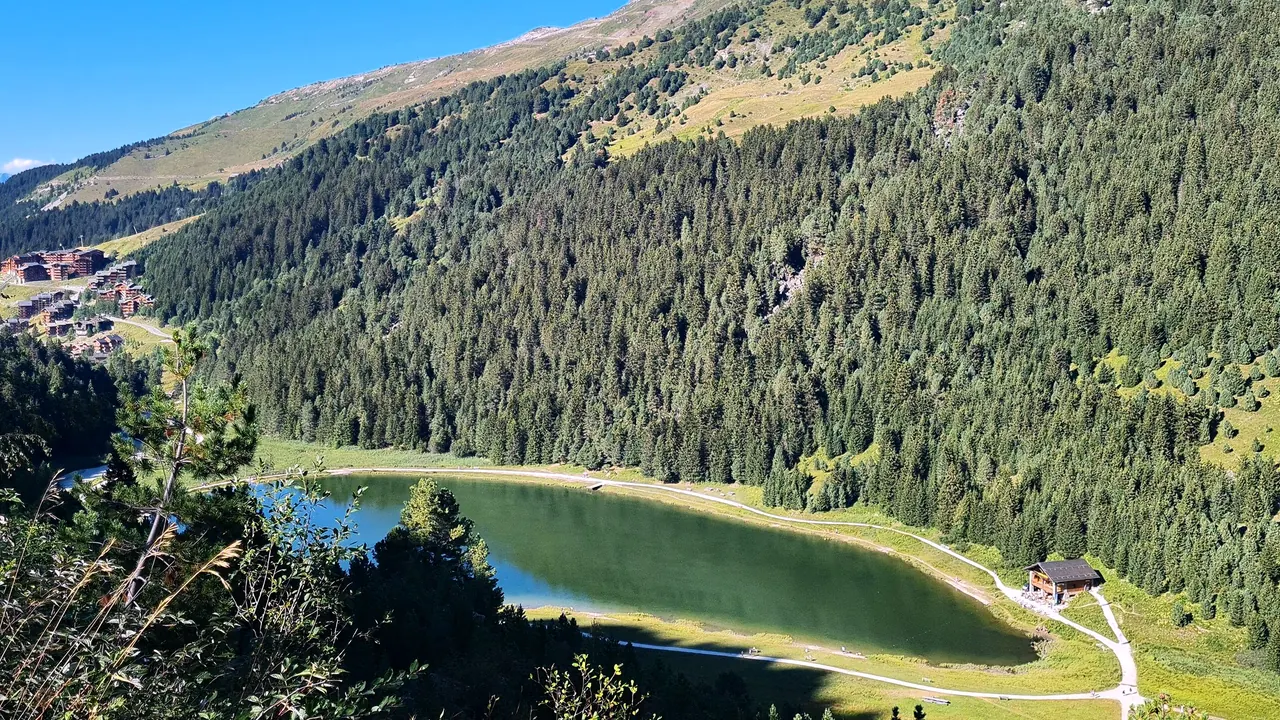
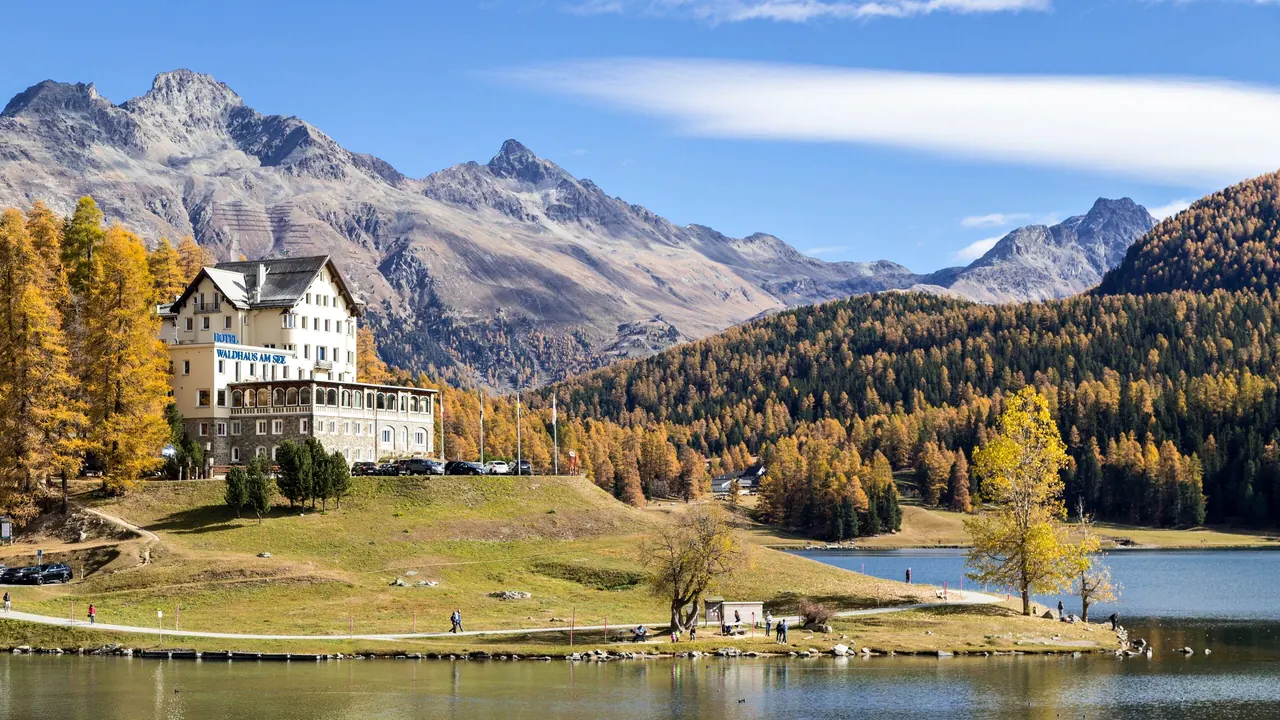
Photos: Méribel by Augustin Cléchet, CC BY-SA 3.0, cropped; St. Moritz by JoachimKohler-HB, CC BY-SA 4.0, cropped.
Méribel or St. Moritz?
Our verdict in twelve categories, each scored against the same fixed benchmark cities, and the climate month by month, so you can choose for your trip.
Choose Méribel for
- nightlife
- families
- prices
Méribel is the better pick for a ski week built around the pistes and the evening that follows them. It sits at the centre of the 3 Vallées, so you can ski to Courchevel and Val Thorens without taking your skis off. The après-ski is loud and sociable, and families get ski schools, snow gardens and chalet childcare. It is very expensive too, but there are more ways to trim the bill, such as self-catering in Mottaret or staying down at Brides-les-Bains.
Choose St. Moritz for
- shopping
- getting around
- culture and sights
St. Moritz suits a quieter, more polished mountain stay. The Engadine is sunny and dry, with lakes and cross-country trails across the valley floor. Trains and buses run everywhere, so you never need a car. Grand hotel spas, serious restaurants and luxury boutiques fill the hours off the snow, and the Segantini Museum and the summer music festivals give it more culture than a French ski village. Expect the bill to be even higher than in Méribel.
Scoreboard
Twelve categories on one fixed scale from 0 to 100. The shaded stretch is the gap between the two.
Your match
Pick a travel style or drag the sliders, and both match scores follow your weighting.
Wins on nightlife and families with your weighting.
Wins on shopping and getting around with your weighting.
What matters to you?
Category by category
What the scores mean for a trip.
Beaches & swimming
Neither town is a place to swim, and both rely on pools. In Méribel that means the pool at the Olympic Park or a hotel pool. The lakes are for walking around, and a proper lake swim means driving more than an hour to the big lakes of Savoie.
St. Moritz has one more option. Lej da Staz, a forest lake a short walk from town, has a lawn and a bathing area. Its water reaches about 20°C in a warm July, and only for a few weeks of the year.
Food & drink
St. Moritz has slightly better food, mostly at the top end. Its grand hotels hold a remarkable number of serious kitchens, and Engadine dishes such as capuns, pizzoccheri and nut tart give the local cooking its own character. Méribel's evenings are fondue, raclette and tartiflette, with a few ambitious hotel restaurants, and a lot of the cooking happens privately in catered chalets.
Lunch on the slopes is good in both, on sunny terraces at Corviglia or at Méribel's piste-side huts. Neither town has street food or markets, and both lose many kitchens out of season.
Culture & sights
Neither is a culture destination, but St. Moritz has more to see. The Segantini Museum, with its great Alpine triptych, the painted farmhouse rooms of the Engadin Museum and the leaning medieval tower fill a good afternoon. It also has the history of being where Alpine winter tourism began, and it hosted the Winter Olympics twice.
In Méribel the main sight is the village itself, a well-kept collection of timber and stone chalets. Add a small chapel and some leftovers from the 1992 Games, and that is about it.
Nightlife
Méribel is the livelier place to go out. The party starts on the slopes as the lifts close, with dancing on tables at the mountain bars, then moves to village pubs with a strong British crowd and on to a late bar or a small club.
In St. Moritz, evenings mean champagne in grand hotel bars and a couple of exclusive clubs that are hard to get into. It is glamorous rather than wild. In both towns nightlife is a winter thing, and things are quiet once the season ends.
Nature & outdoors
Both are superb mountain destinations, but the landscapes are different. Méribel's big draw is sheer size. You can ski across the whole of the 3 Vallées on linked lifts, from cruising runs to steep couloirs. In summer the Tueda reserve, with its arolla pine forest, leads into the Vanoise National Park, and lift-served mountain-bike trails cover the slopes.
St. Moritz is a wide, sunny valley of lakes and larch forest. Downhill skiing is split across Corviglia, Corvatsch and Diavolezza, and the valley floor has some of the best cross-country trails in the Alps. In summer you can walk to the Morteratsch glacier, and the afternoon wind on Lake Silvaplana draws kitesurfers.
Day trips
There is about the same amount to see on day trips from each, but you travel differently. From Méribel you drive down the winding road to Moûtiers and on to Annecy's canals, the ducal castle at Chambéry, Conflans and Aix-les-Bains. That is a real change of scene, but snow on the roads slows every journey in winter.
St. Moritz has the train. The UNESCO-listed Bernina line runs over the pass to Tirano in Italy, and buses reach Soglio and the sgraffito houses of Guarda and Zuoz. The trips are lovely, but they lead to villages rather than towns.
Good for families
Méribel is better set up for children who ski. Ski schools take them young, there are snow gardens, and many chalets offer childcare. The Olympic Park's rink and pool fill days off the slopes. Its downside is the hillside layout, with steep, icy roads between chalets and lifts.
St. Moritz is safe and tidy, with nursery slopes on Corviglia and skating on natural ice. Still, it feels like an adult luxury resort, and families with toddlers often stay in quieter villages along the valley instead.
Getting around
St. Moritz is much easier to get to and around. The Rhaetian Railway stops by the lake, and trains and buses link the whole Upper Engadine. There are escalators and a lift up from the station to the hillside centre of Dorf.
Méribel's lifts and free shuttle buses work well within the 3 Vallées, and the Olympe gondola runs down to Brides-les-Bains. The nearest station is in Moûtiers, though, so arrival means a transfer, and exploring beyond the valley means hiring a car.
Shopping & style
St. Moritz has proper shopping, and luxury dominates it. Top fashion, watch and jewellery houses line the streets around Via Serlas, alongside furriers and shops selling Engadine linen and woodwork. In Méribel, shopping means ski hire, technical gear, a few ski-wear boutiques and delicatessens selling Beaufort cheese to take home.
Affordability
Both are among the most expensive mountain resorts in Europe, but St. Moritz costs more. Even a coffee there is priced for a wealthy winter crowd. Méribel is very expensive in the weeks when European schools are off, but self-catering in Mottaret or staying in Brides-les-Bains brings the bill down more.
Summer is cheaper in both. In St. Moritz many hotels include local lifts and transport in the room, which helps a little.
Live music & performing arts
St. Moritz offers more, though only at certain times of year. A long-running summer jazz festival, chamber concerts in valley churches during the Engadin Festival and a winter classical series in hotel ballrooms all bring good musicians. Méribel has cover bands and DJs in the après-ski bars, and for anything classical you drive to Chambéry or Annecy.
Wellness & relaxation
St. Moritz began as a spa town, and it shows. St. Moritz Bad still offers treatments with its iron-rich spring water and peat, the grand hotel spas have indoor-outdoor pools facing the peaks, and Scuol's thermal baths are a train ride away.
Méribel's chalets have saunas and hot tubs, and the gondola down to the thermal spa town of Brides-les-Bains is an easy outing. Both are calmest in summer and autumn rather than in high winter.
When should you go?
Pick your month. The climate figures are measured averages, not a forecast.
Méribel in July
St. Moritz in July
Daytime high, °C
Rainfall in the month, mm
Where the figures come from
Méribel has no weather station within reach, so its figures come from a gridded climate model rather than a measured record, and read a broad area rather than one spot.
St. Moritz has no rain gauge within 25 km of the centre, so its rainfall comes from a gridded climate dataset read at the destination rather than from a gauge further away.
Temperature and rainfall are climate normals, averaged over the years shown. Méribel: 1991-2020 normals, TerraClimate 4 km grid at the town, no weather station within 90 km. St. Moritz: 2015-2025 (rainfall 1991-2020) normals, Samedan (5.5 km from centre).
The two towns are at similar heights and have almost the same temperatures. Daytime highs are around freezing in midwinter, a mild 20°C or so in July and August, and cool again by October. The real difference is the weather. Méribel gets steady precipitation all year and is wettest in late autumn and early winter, with about 150mm in November. That means plenty of snow but also more grey days. St. Moritz has dry, clear winters, with only about 42mm in February, and its wet season is summer, when afternoon showers are common.
For bright skiing weather St. Moritz has the edge from January to March. Méribel's high slopes keep their snow cover well into spring. In summer both are good for walking. Méribel's July and August are slightly drier, while St. Moritz's wettest month is August. Neither is ever too hot to walk around, and neither is ever warm enough for a beach trip.
Which traveller are you?
On a family trip with young children, go to Méribel in winter. Everything there is built around the snow, and summer has much less for small children. Stay in a chalet near a lift base and use the free shuttles for the rest. St. Moritz suits older children better.
For a culture and arts trip, choose St. Moritz. The Segantini Museum and the Engadin Museum fill an afternoon, and its summer jazz festival and Engadin Festival concerts bring real musicians. Méribel has no museums or stages, and anything comparable means driving to Chambéry.
On a shopping trip, choose St. Moritz and go in the winter season, when every boutique is open. Some close once the season ends. Stay in Dorf, close to the shops, and spend the mornings on the slopes at Corviglia. In Méribel, shopping goes little further than buying gear.
Before you go
| Measure | Méribel | St. Moritz |
|---|---|---|
| Official language | French | French, German, Italian, Romansh |
| Currency | Euro (EUR) | Swiss Franc (CHF) |
| Sockets | CE230 V, 50 Hz | CJ230 V, 50 Hz |
| Driving side | Right | Right |
| Time zone | UTC+1, UTC+2 in summer | UTC+1, UTC+2 in summer |
| Emergency number | 112 | 112 |
| Elevation | 1,447 m | 1,822 m |
| Main airport | Geneva International Airport (GVA)100 km from centre150 non-stop destinations | Zürich Airport (ZRH)145 km from centre226 non-stop destinations |
| Public holidays this year | 11 days | 9 days |
By the numbers
| Measure | Méribel | St. Moritz |
|---|---|---|
| Population | - | 5,027 |
| People per km² | - | 175 |
| Museums within 10 km | 0 | 7 |
| UNESCO World Heritage sites within 50 km | 0 | 2 |
Where else could you go?
Every comparison below shares a destination with this one, so you can follow Méribel or St. Moritz somewhere new.
- Courchevelvs Méribel
- Les Menuiresvs Méribel
- Val Thorensvs Méribel
- La Plagnevs Méribel
- Les Arcsvs Méribel
- Tignesvs Méribel