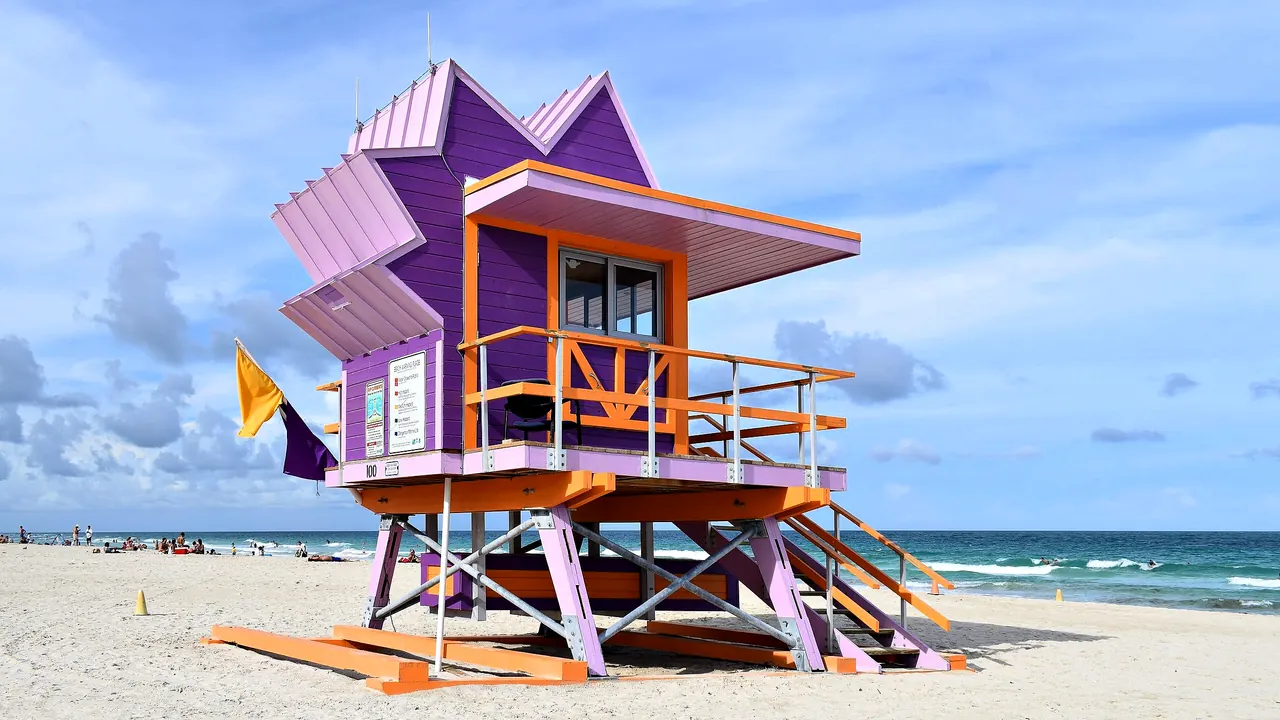

Photos: Miami Beach by Radomianin, CC BY-SA 4.0, cropped; New Orleans by Bernard Spragg, CC0.
Miami Beach or New Orleans?
Our verdict in twelve categories, each scored against the same fixed benchmark cities, and the climate month by month, so you can choose for your trip.
Choose Miami Beach for
- beaches
- wellness
- nature and the outdoors
Miami Beach is the one for a warm-sea vacation, above all in winter. You get kilometres of pale sand, gentle water and calm resort stretches in Mid-Beach for slow days, with South Beach's clubs and Art Deco streets close by when you want company. It costs a lot, and the food and sights are thinner, so it suits travellers who judge a trip by their hours on the beach and by the pool.
Choose New Orleans for
- live music and the arts
- food and drink
- prices
If you travel to eat, listen and wander, pick New Orleans. Creole and Cajun cooking, live jazz and brass bands every night of the year, and the iron balconies and hidden courtyards of the French Quarter give it a character the island can't match. It is also easier on the wallet. There is no beach and not much rest, so come for the streets and the music, not for a sun lounger.
Scoreboard
Twelve categories on one fixed scale from 0 to 100. The shaded stretch is the gap between the two.
Your match
Pick a travel style or drag the sliders, and both match scores follow your weighting.
Wins on beaches and wellness with your weighting.
Wins on live music and the arts and food and drink with your weighting.
What matters to you?
Category by category
What the scores mean for a trip.
Beaches & swimming
Here the two cities could hardly be further apart. Miami Beach is about 11km of pale sand along the Atlantic. You can choose the crowds of South Beach, the resort stretch of Mid-Beach or the space of North Beach, and the water is warm enough to swim all year.
New Orleans sits on a working river and a lake that people walk and sail beside rather than swim in. The closest sand is on the Mississippi Gulf Coast, well over an hour away, where the water is shallow and brownish. If the sea matters to you at all, Miami Beach is the answer.
Food & drink
New Orleans is one of the few American cities with a cuisine all its own. Creole dining rooms in the French Quarter have served the same dishes for more than a century, and neighbourhood po'boy shops in Mid-City feed the locals. Crawfish boils in spring, beignets near Jackson Square and the Sazerac all belong to the place. The cooking is rich, though, and there is little beyond that one tradition.
Miami Beach has good Latin American cooking: Cuban sandwiches and cafecito from takeaway windows, and stone crabs in winter. Much of its eating out is upscale hotel dining, however, and the menus on Ocean Drive are aimed at passing tourists. For real character you often have to cross the causeway to Little Havana.
Culture & sights
The French Quarter gives New Orleans a rare thing in the United States: a whole colonial town to walk through. It has Jackson Square, St. Louis Cathedral and the Cabildo, where Louisiana passed to the United States in 1803. Add the oak-shaded mansions of the Garden District, the above-ground tombs and the National WWII Museum, and the city fills several days.
Miami Beach has one great sight, the pastel 1930s hotels of the Art Deco Historic District, which are easy to see on foot along Ocean Drive and Collins Avenue. After that come the Wolfsonian, the Bass and the Holocaust Memorial, and the larger museums are across the bay on the mainland.
Nightlife
Both cities are famous for staying out late, but the nights feel very different. In Miami Beach the night is club-driven and glamorous. Guest DJs play until dawn, pool parties start in the afternoon and dress codes, door policies and table service are normal. For something quieter, go to Sunset Harbour.
New Orleans is street-level and sociable. There is no closing time, you can carry a drink along the street, and a night drifts from Frenchmen Street to Bywater dives and old corner bars. Bourbon Street is the loud neon end of it. Big dance clubs barely feature.
Nature & outdoors
Miami Beach has more to do outdoors, and most of it happens on the water. You can paddleboard on the bay, dive on offshore reefs and wrecks, explore the keys of Biscayne National Park or paddle through the mangroves at Oleta River. The Everglades, with airboats and wading birds, are about an hour away.
New Orleans has swamp country: cypress bayous where boat tours pass alligators, and boardwalks in the Barataria Preserve. In town there are the old live oaks and lagoons of City Park and the walk along the levee. Neither city has hills, and in both the summer heat restricts outdoor life to early mornings.
Day trips
From Miami Beach the outings follow the coast and its money. Across the bay are the Italianate villa and gardens of Vizcaya and the Mediterranean Revival streets of Coral Gables. Fort Lauderdale's canals and the Palm Beach mansions lie to the north, and Key Largo, the first of the Florida Keys, is about an hour and a half to the south. Key West is too far for a day, and there is little older heritage within reach.
From New Orleans the outings lead into history. The River Road runs upstream to the sugar plantations, where Oak Alley has its avenue of oaks and the Whitney tells the story of the people enslaved there. Baton Rouge adds its Art Deco capitol, Bay St. Louis and Ocean Springs make a gentle day on the Gulf, and the Cajun dance-hall towns are at the edge of a day's range. From either city you need a car or a tour.
Good for families
For families the two come out roughly level, for opposite reasons. Miami Beach's draw is the shore itself: gentle, warm water with lifeguards along its whole length, and quiet resort pools in Mid-Beach and North Beach. The zoo, the science museum and the animal parks are all on the mainland.
New Orleans has no beach, but it has more attractions built for children. Audubon Zoo, the riverfront aquarium and City Park's carousel and children's museum are all here, along with streetcar rides and paddle steamers. Both cities have a party district to avoid at night and summers that are hard on young children.
Getting around
In both cities the centre is flat and easy to walk. South Beach is compact, free trolleys run north along Collins Avenue and the beachwalk is good for cycling. Leaving the island is the hard part: there is no rail, and buses get stuck on the causeways.
New Orleans has its streetcars. The historic green cars of the St. Charles line are a pleasure to ride, but they are slow, and the buses are thin. Ride-hailing fills the gaps, especially at night and for trips to the airport.
Shopping & style
Miami Beach shops for labels. At Bal Harbour, at the northern tip of the island, an open-air mall gathers the big European fashion and jewellery houses. Lincoln Road, the palm-shaded pedestrian mall laid out by Morris Lapidus, is a pleasant evening stroll past international chains. There are no real markets, and local crafts are rare.
New Orleans is the place for antiques and independent shops. Royal Street's dealers sell chandeliers, estate jewellery and old Louisiana furniture, Magazine Street runs for miles past boutiques and vintage shops, and the French Market has hot sauces, pralines and Carnival masks. Designer flagships are few, and near Bourbon Street the choice comes down to T-shirts and souvenirs.
Affordability
New Orleans is clearly the cheaper of the two. Po'boys, neighbourhood bars and the streetcar keep daily costs moderate, and much of the best of the city, from street musicians to walking the Quarter, is free. Rooms are the big expense, especially on Mardi Gras and festival weekends.
Miami Beach is costly almost everywhere. Resort fees, parking, service charges and South Beach cocktails all push the bill up. Side-street hotels, North Beach and the summer storm season bring prices down, and the beach itself is free.
Live music & performing arts
Live music is the main reason many people visit New Orleans. Jazz, brass bands, funk, Cajun and zydeco play every night along Frenchmen Street and in the bars of Tremé, and Sunday second-line parades move through the neighbourhoods. Jazz Fest is the high point in spring. Opera and orchestral music are a small part of the scene.
Miami Beach's arts are more formal and more seasonal. The New World Symphony plays in its Gehry hall and sometimes projects concerts onto the outside wall for audiences on the lawn. Miami City Ballet is based on the island, and the season runs from autumn to spring. In the clubs, music mostly means DJs rather than bands.
Wellness & relaxation
Miami Beach is the better place to unwind. Large resort spas with saunas, steam rooms and plunge pools are easy to find, there is sunrise yoga on the sand, and the stretch from Mid-Beach towards Surfside is made for slow pool days, well away from the noise of South Beach.
New Orleans offers little more than hotel day spas. Its form of rest is a slow pace: quiet mornings in a courtyard guesthouse, a streetcar ride under the oaks of St. Charles Avenue and long afternoons in City Park.
When should you go?
Pick your month. The climate figures are measured averages, not a forecast.
Miami Beach in July
New Orleans in July
Daytime high, °C
Rainfall in the month, mm
Temperature and rainfall are climate normals, averaged over the years shown. Miami Beach: 1991-2020 normals, Miami International Airport (18.8 km from centre). New Orleans: 1991-2020 normals, New Orleans Airport (2.7 km from centre).
Miami Beach is at its best from November to April. Days run from about 25°C to 29°C, the sea stays warm enough to swim right through winter and rain is fairly light. The wet season starts in May, and heavy afternoon storms bring rainfall to about 267mm in June. Summer highs of 33°C push walking into the early morning, although the sea is at its warmest then.
New Orleans has no real beach season, and its rain is spread across the whole year, so no month is truly dry. Winter is cool, around 17°C in January. That is pleasant for walking the Quarter, but the Gulf water is cold. Spring and the stretch from October into November are the best times to be out in the streets, either side of a summer as hot and sticky as Miami Beach's. In winter the island is much warmer. From late spring to early autumn the two are equally humid.
Which traveller are you?
On a beach and sun trip, choose Miami Beach without hesitation. Its whole Atlantic shore is wide sand with warm, usually calm water and lifeguards. In New Orleans, swimming mostly means a hotel pool, and the nearest Gulf sand is more than an hour's drive away.
For a food and nightlife trip, New Orleans is the better choice. You get gumbo, po'boys and oysters, cocktails that were invented in its bars and nights that move on foot from bar to bar with no closing time. In Miami Beach, going out means expensive clubs and dinners aimed at tourists.
On a culture and arts trip, New Orleans offers more. The French Quarter, the mansions of the Garden District, the old cemeteries and live jazz every night fill several days. Miami Beach has its Art Deco district and a good symphony, but most of the museums are on the mainland.
Before you go
| Measure | Miami Beach | New Orleans |
|---|---|---|
| Currency | US Dollar (USD) | US Dollar (USD) |
| Sockets | AB120 V, 60 Hz | AB120 V, 60 Hz |
| Driving side | Right | Right |
| Time zone | UTC-5, UTC-4 in summer | UTC-6, UTC-5 in summer |
| Emergency number | 911 | 911 |
| Elevation | 1 m | -2 m |
| Main airport | Miami International Airport (MIA)16 km from centre198 non-stop destinations | Louis Armstrong New Orleans International Airport (MSY)18 km from centre51 non-stop destinations |
| Public holidays this year | 11 days | 14 days |
By the numbers
| Measure | Miami Beach | New Orleans |
|---|---|---|
| City population | 82,890 | 383,997 |
| People per km² | 2,109 | 423 |
| Museums within 10 km | 14 | 16 |
| UNESCO World Heritage sites within 50 km | 0 | 0 |
| Swim season, months above 21 °C | 12 months | 7 months |
Where else could you go?
Every comparison below shares a destination with this one, so you can follow Miami Beach or New Orleans somewhere new.