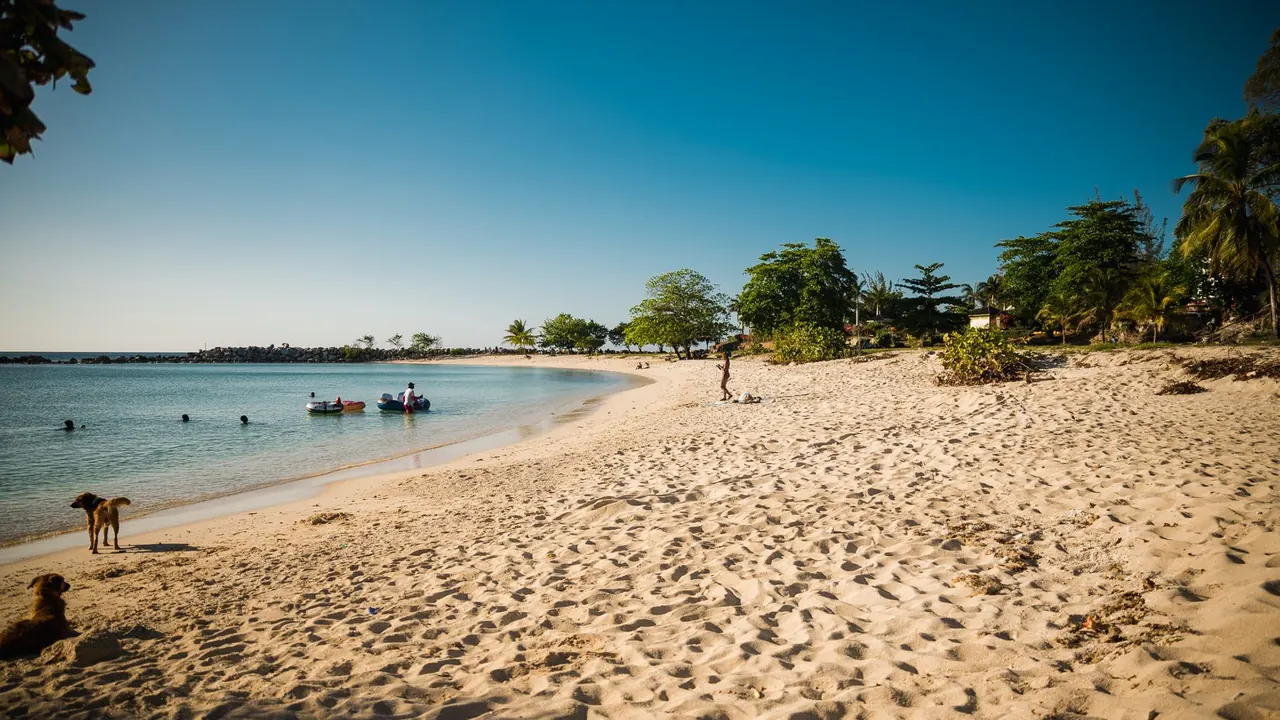
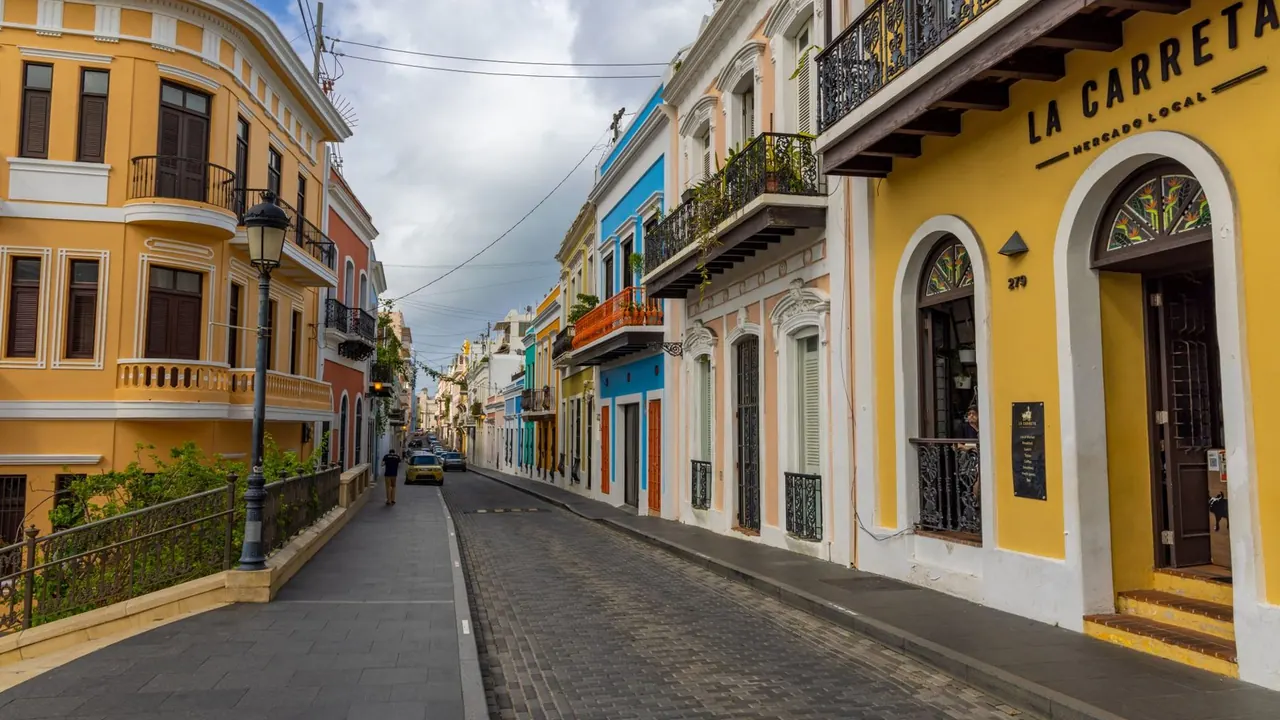
Photos: Montego Bay by Dre Dawkcide, Pexels License; San Juan by Mohan Nannapaneni, Pexels License.
Montego Bay or San Juan?
Our verdict in twelve categories, each scored against the same fixed benchmark cities, and the climate month by month, so you can choose for your trip.
Choose Montego Bay for
- wellness
Montego Bay suits the traveller who wants the hotel to be the trip: a resort on sheltered sand at Rose Hall or Ironshore, warm calm water inside the reef, a spa and the bar close by, and maybe one excursion to Negril or the Martha Brae. It is a place for switching off, especially for couples in adults-only resorts. Anyone hoping for a town to explore will find little in it, and getting around without a driver is hard work.
Choose San Juan for
- culture and sights
- nightlife
- shopping
San Juan is the better choice for a vacation that mixes beach days with a real city. Old San Juan's forts and cobbled streets, the food and late nights of Santurce, salsa and bomba, and El Yunque within an hour give you far more to do once you leave the sand. The beaches are just as good, and the city is easier to manage on your own, with taxis, ride-hailing and familiar US standards.
Scoreboard
Twelve categories on one fixed scale from 0 to 100. The shaded stretch is the gap between the two.
Your match
Pick a travel style or drag the sliders, and both match scores follow your weighting.
Wins on wellness with your weighting.
Wins on culture and sights and nightlife with your weighting.
What matters to you?
Category by category
What the scores mean for a trip.
Beaches & swimming
These two are equally good for a beach vacation, and both have reefs that keep the water calm. The difference lies in what the sand is like. Montego Bay's town beaches, led by the small historic curve of Doctor's Cave on the Hip Strip, are short, so most visitors spend their days on the private sand of a resort, and a long open beach means the drive to Negril.
San Juan has its beaches inside the city. Isla Verde is a long stretch protected by a reef, and Escambrón's sheltered bay sits a short way from the old town. The catch is that parts of Condado and the coast towards Piñones have rough surf and currents, so it pays to choose a lifeguarded balneario. Luquillo is a shorter trip out than Negril.
Food & drink
Montego Bay's best food is simple and very good: pork and chicken smoked over pimento wood at jerk pits, patties, ackee and saltfish, and fish from beach shacks. Beyond that the choice is thin, and on an all-inclusive package many meals end up at the resort buffet.
San Juan has more depth. Mofongo, roast pork and fried snacks run from the kiosks of Piñones to the stalls of Guavate in the hills, and the restaurants around La Placita, in Santurce and in Condado give you ambitious cooking on nights when you want more than a roadside plate.
Culture & sights
Montego Bay's sights take a day at most. Rose Hall and Greenwood great houses tell the plantation story, and Sam Sharpe Square remembers the 1831 rebellion, but there are no major museums, and history lovers do better in nearby Falmouth.
San Juan has one of the great colonial townscapes of the Americas. El Morro and San Cristóbal, the city walls and La Fortaleza make up a World Heritage site, and the cathedral holds the tomb of Ponce de León. Add the art museum and the murals of Santurce, and the city fills two or three full days of sightseeing.
Nightlife
San Juan has the far stronger night out. From Thursday to Saturday, crowds spill across La Placita's square until the early hours, Calle San Sebastián in the old town mixes dive bars with salsa and reggaeton dance floors, and Condado adds casinos and clubs.
Montego Bay's evenings centre on the open-air bars of the Hip Strip, which serve mostly visitors and cruise passengers. The local dancehall street parties have more energy, but they are best done with someone who knows them, and many resort guests never leave the hotel bar.
Nature & outdoors
Both suit an active trip, but San Juan offers more and on a bigger scale. El Yunque's rainforest trails and waterfalls are under an hour away, Laguna Grande glows on night kayak trips, and the Piñones mangroves are good for cycling and paddling, with winter surf on the north coast.
Montego Bay's outdoors centres on the sea, with snorkelling and diving in its marine park, and on gentle guided outings: bamboo rafts on the Martha Brae, zip lines in the hills and hand-fed hummingbirds at Rocklands. Cockpit Country's caves offer rougher walking with a guide.
Day trips
There is about as much to do on a day out from either city, but the trips differ. From Montego Bay, Georgian Falmouth is close, Negril offers sunsets and cliffs, and Nine Mile and the Appleton rum estate draw Bob Marley fans and rum lovers. Slow, winding roads mean most people go by tour bus.
From San Juan, Ponce's plaza and art museum are a mountain drive away, the Cataño distillery is a short ferry ride, and Loíza is the place for bomba. Culebra and Vieques have superb beaches but deserve a night rather than a day.
Good for families
San Juan is the easier city with children. El Morro's tunnels and cannons and the kite-flying lawn outside give a real outing, Escambrón and Luquillo are gentle beach days, and English, US-style pharmacies and supermarkets make the practical side simple.
In Montego Bay, family life happens inside the resort, with kids' clubs, waterslides and warm shallow water. Outside, the chaotic traffic, missing pavements and persistent vendors mean most families leave only on organised trips, such as glass-bottom boats or river rafting.
Getting around
Neither city is easy without wheels, but San Juan is less hard work. You can explore Old San Juan on foot, despite its hills and uneven cobbles, and ride-hailing links it to Condado and Isla Verde. A hire car on decent highways opens up the rest of the island.
Montego Bay's one advantage is that the airport sits right by the Hip Strip. Beyond that, resorts are spread kilometres along a coast without pavements, route taxis are baffling for visitors, and most people rely on tourist taxis with fares agreed in advance, or on hotel shuttles.
Shopping & style
Shopping in Montego Bay comes down to a craft market and duty-free counters. You haggle at the Harbour Street market for carvings and straw work, or buy rum and jewellery near the cruise port. The best things to take home are the ones you can eat, such as Blue Mountain coffee and jerk seasoning.
San Juan has far more range, from Plaza Las Américas, one of the largest malls in the Caribbean, to the designer boutiques on Ashford Avenue. Among the souvenir shops of the old town you can find carved santos, vejigante masks and guayaberas, though few people would make the trip to shop.
Affordability
Both cost about the same, and neither is cheap, but the money works differently. In Montego Bay, resorts priced for North Americans, expensive taxis and excursions make an all-inclusive package the most predictable option, with roadside jerk and patties as the cheap escape.
San Juan charges US mainland prices, plus tips and taxes, in its tourist districts. Kiosks, stalls and the low entry fee for the forts help, but hiring a car to see the island adds up. Rooms are cheaper in summer and autumn.
Live music & performing arts
San Juan has the broader stage. Salsa bands play nightly in the old town and Santurce, open bomba sessions let visitors join the drumming, and the Centro de Bellas Artes, home of the symphony orchestra, hosts the long-running Casals Festival as well as theatre and dance.
Montego Bay is a reggae town and little else. Reggae Sumfest makes it a world music destination for one week each summer, but the rest of the year means cover bands on the Hip Strip and resort shows.
Wellness & relaxation
Neither has a bathing tradition of its own, and in both wellness means resort spas, so the two come out about level. Montego Bay leans more towards quiet, with its many adults-only resorts, open-air treatment pavilions by the sea and massages on the beach.
San Juan's spas in Condado and Isla Verde, along with yoga in the beach districts, are pleasant, but the city around them is loud, especially at weekends. Real calm there means heading out to the countryside or the offshore islands.
When should you go?
Pick your month. The climate figures are measured averages, not a forecast.
Montego Bay in July
San Juan in July
Daytime high, °C
Rainfall in the month, mm
Temperature and rainfall are climate normals, averaged over the years shown. Montego Bay: 1991-2020 normals, Montego Bay / Sangster (3.7 km from centre). San Juan: 1991-2020 normals, San Juan / Int., Puerto Rico (12.8 km from centre).
Both cities are hot and the sea is warm enough to swim in every month, so beach weather is never the problem. In Montego Bay, late winter and early spring are the best time to go. February is the driest month, with about 36mm of rain, and the heat is still comfortable. The rain picks up in May and again from September to November. Midsummer is the hottest stretch, with highs around 34°C in July and August, which is better weather for a sunbed than for a walk through town.
San Juan is slightly cooler for most of the year, usually by about a degree, which makes the old town's hills a little easier on foot, though by October both cities are equally hot. Its dry, sunny window is narrower: February and March are the best months, and April is already wetter there, at about 115mm. The wet season also lasts longer than in Montego Bay, running from July to a peak of about 178mm in November, and late autumn and early winter are noticeably less sunny.
Which traveller are you?
On a relaxing and wellness trip, Montego Bay has a slight edge. Arrival is quick, with the airport right on the Hip Strip, and the warm water inside the reef is easy to float in for hours. In San Juan, the forts, bars and day trips tend to fill a slow week.
On a culture and arts trip, San Juan wins easily. Old San Juan's UNESCO-listed forts, its cathedral and colonial streets, the island art museum in Santurce, and salsa, bomba and a symphony orchestra add up to far more than Montego Bay's two great houses.
For a food and nightlife trip, San Juan is the place. Mofongo at the Piñones kiosks, roast pork in Guavate and chef-led restaurants in Santurce beat Montego Bay's narrower menu of jerk and patties, and La Placita's weekend street crowds stay out later than the Hip Strip.
Before you go
| Measure | Montego Bay | San Juan |
|---|---|---|
| Official language | English, Jamaican Patois | Spanish, English |
| Currency | Jamaican Dollar (JMD) | US Dollar (USD) |
| Sockets | AB116 V, 50 Hz | AB120 V, 60 Hz |
| Driving side | Left | Right |
| Time zone | UTC-5 | UTC-4 |
| Emergency number | Police 110/112/119/911, ambulance 110, fire 110 | 911 |
| Elevation | 19 m | 3 m |
| Main airport | Sangster International Airport (MBJ)4 km from centre48 non-stop destinations | Luis Munoz Marin International Airport (SJU)12 km from centre59 non-stop destinations |
| Public holidays this year | 10 days | 21 days |
By the numbers
| Measure | Montego Bay | San Juan |
|---|---|---|
| City population | 123,994 | 342,259 |
| People per km² | - | 2,847 |
| Museums within 10 km | 0 | 18 |
| UNESCO World Heritage sites within 50 km | 0 | 1 |
| Swim season, months above 21 °C | 12 months | 12 months |
Where else could you go?
Every comparison below shares a destination with this one, so you can follow Montego Bay or San Juan somewhere new.