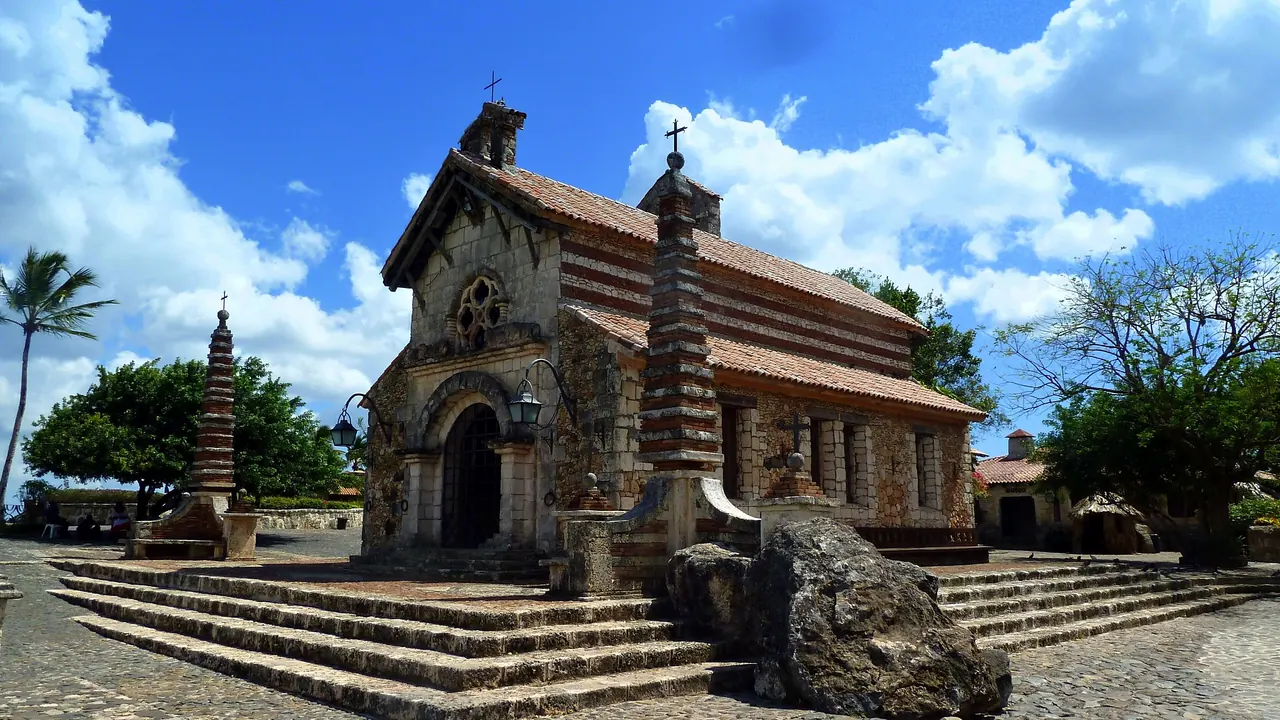
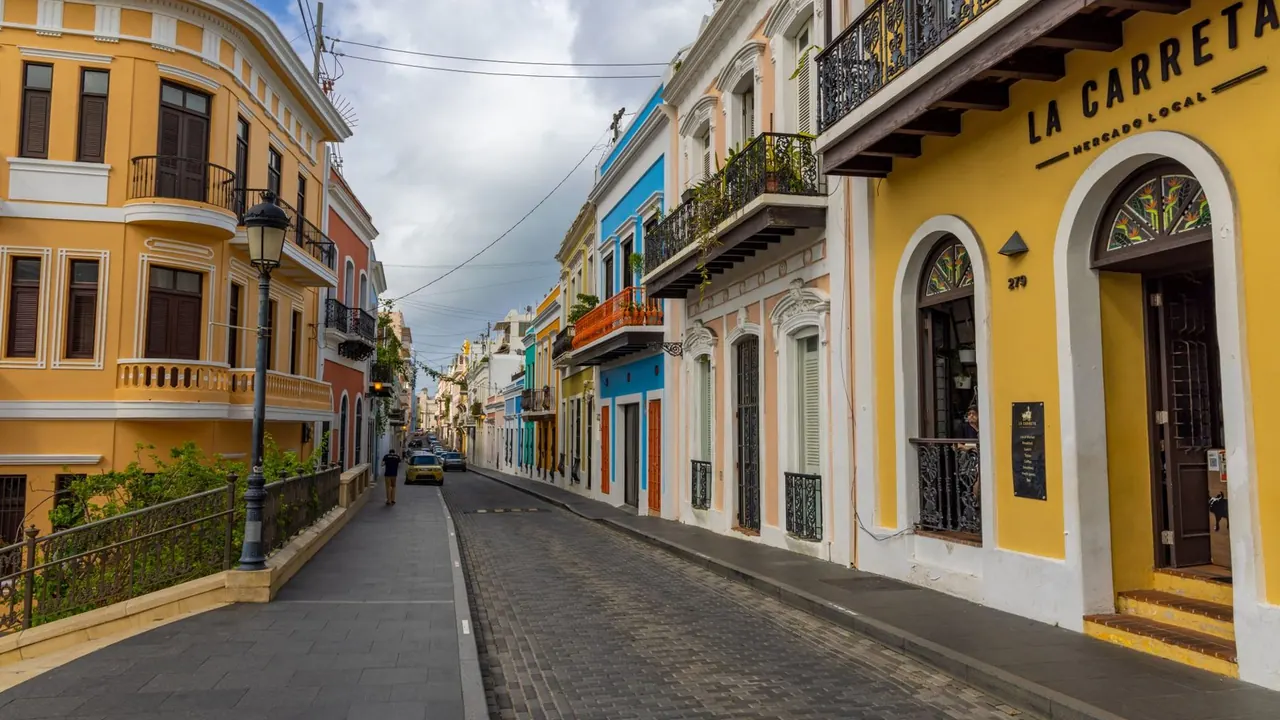
Photos: La Romana by Edgar El, CC BY 3.0, cropped; San Juan by Mohan Nannapaneni, Pexels License.
La Romana or San Juan?
Our verdict in twelve categories, each scored against the same fixed benchmark cities, and the climate month by month, so you can choose for your trip.
Choose La Romana for
- prices
- wellness
La Romana suits a beach vacation with the hotel as your base. You stay along the calm, reef-sheltered shore at Bayahibe and Dominicus, take a boat out to Saona or Catalina, dive the reef walls, and spend your evenings at the resort. It is drier in winter and generally cheaper. The trade-off is that there is very little to see, eat or do in the town itself.
Choose San Juan for
- culture and sights
- nightlife
- live music and the arts
San Juan is a proper city that happens to have good beaches. The walled old town, the forts, the salsa and bomba, and the late weekend crowds at La Placita give your days and nights a lot more to do. El Yunque and the glowing lagoon near Fajardo widen the outdoors beyond the sea. Choose it if you want a city with a beach rather than a beach with a hotel, and expect higher prices for it.
Scoreboard
Twelve categories on one fixed scale from 0 to 100. The shaded stretch is the gap between the two.
Your match
Pick a travel style or drag the sliders, and both match scores follow your weighting.
Wins on prices and wellness with your weighting.
Wins on culture and sights and nightlife with your weighting.
What matters to you?
Category by category
What the scores mean for a trip.
Beaches & swimming
For beaches the two are evenly matched, but they work in very different ways. La Romana's own waterfront is a working river mouth, so you stay along the calm, pale sand of Bayahibe and Dominicus a short drive east. The best days are spent on boats: snorkelling off Catalina, and the starfish sandbars of Saona, which get crowded at midday.
San Juan has its beaches right in the city. You can walk from a Condado or Isla Verde hotel onto the sand, and El Escambrón is minutes from the old town. The open Atlantic is rougher here, though, with strong currents in places, so it pays to use the lifeguarded balnearios or drive out to Luquillo for calm water.
Food & drink
San Juan is far more rewarding for eating out. Puerto Rican cooking gives you mofongo, alcapurrias and slow-roasted pork. There are kiosks along the Piñones shore, roast-pork stalls up in Guavate, and chef-led restaurants in Santurce and Condado, with mountain-grown coffee to finish.
La Romana's cooking is honest Dominican fare: rice and beans, sancocho, and fried fish with tostones at the Bayahibe grills. Most visitors eat at their all-inclusive, though, and the scene beyond that is thin.
Culture & sights
For sightseeing, La Romana has one place and a short list. Altos de Chavón is a handsome stone village built in the late twentieth century as a copy of an old Mediterranean hill town, high above the river gorge, and its small museum of Taíno pottery and ceremonial objects is worth an hour. Add the central park and the Santa Rosa de Lima church in town, and a single morning covers it.
Old San Juan is the genuine article. Its pastel colonial houses on blue-cobbled streets go back nearly five centuries, and the El Morro and San Cristóbal forts, the city walls and La Fortaleza together form a World Heritage site you can walk in a day. The cathedral holds Ponce de León's tomb, and with the island art at the Museo de Arte de Puerto Rico in Santurce, the sights fill a couple of unhurried days.
Nightlife
After dark the gap is wide. San Juan goes out late from Thursday to Saturday, with crowds drinking in the street at La Placita, salsa and reggaeton along Calle San Sebastián, and casinos and clubs in Condado and Isla Verde.
La Romana's nights are local and low-key: beer and bachata outside a colmado, the odd weekend discoteca, and a few marina and beach bars that go quiet by late evening. Most visitors stay in for the hotel show.
Nature & outdoors
San Juan gives you more range. El Yunque's rainforest trails and waterfalls are under an hour away, and near Fajardo you can kayak at night through Laguna Grande's glowing water. There are also mangroves at Piñones and winter surf along the north coast.
La Romana's landscape is flat, dry coastal forest, so its strength is the water. Bayahibe is one of the Dominican Republic's main dive centres, with wrecks, reef walls and an underwater museum of sunken cannons, and Parque Nacional del Este adds mangroves and frigatebirds. On land, though, there is little to hike.
Day trips
Day trips are equally good from both, and one contrast stands out. La Romana's best outing is to the Ciudad Colonial of Santo Domingo, about an hour and a half away, which supplies the old-city history the town itself lacks. The Taíno rock art at Cueva de las Maravillas and the basilica at Higüey are closer.
From San Juan, the trips add variety rather than history. Ponce has its plaza and art museum, Loíza is the home of bomba, and the rum distillery at Cataño is a short ferry ride away. Culebra and Vieques are better saved for an overnight stay.
Good for families
Both work well with children, in different styles. La Romana is a resort-based family stay: kids' clubs, pools and shallow, calm water at Dominicus, plus the starfish sandbar at Saona as the big outing. Outside the hotels there is very little for children, and families tend to stay put.
San Juan gives children more to explore, from El Morro's tunnels and cannons and kites on the lawn outside to the short paved trails at El Yunque. English is widely spoken and US standards make daily life easy. The steep cobbles are harder going with a pushchair.
Getting around
Neither is easy without wheels, but San Juan is the simpler of the two. Its old town is compact enough to walk, and ride-hailing makes the short hops to Condado and Isla Verde straightforward, though you will still want a car or a tour for the island.
La Romana is a string of separate places along a coastal highway. Visitors depend on hotel transfers, taxis and excursion pick-ups, only Bayahibe village can be walked, and the roads are poorly lit after dark.
Shopping & style
San Juan gives you more choice: Plaza Las Américas, a short run of designer shops on Ashford Avenue, and carved santos, vejigante masks and guayaberas in the old town.
La Romana's shopping is narrow but distinctive. Hand-rolled cigars from the town's own factories are the thing to buy, along with larimar and amber jewellery at Altos de Chavón.
Affordability
La Romana is the cheaper of the two. A mid-range all-inclusive in Bayahibe or Dominicus is fairly priced for the Caribbean, and if you live locally in town it costs very little. Boat trips and taxis are where your spending climbs.
San Juan runs at US mainland prices. Beachfront rooms are expensive in winter, and restaurant bills come with tips and taxes added, so the kiosks and roadside stalls are where you save.
Live music & performing arts
San Juan has a real performance life. You can join an open bomba session, dance to a salsa band in Santurce, hear the Puerto Rico Symphony at the Centro de Bellas Artes, or catch the long-running Casals Festival.
La Romana has no season to plan around. The one exception is the occasional big concert at the Altos de Chavón amphitheatre above the river gorge, which makes a striking setting if you happen to be there for one.
Wellness & relaxation
Neither city has a spa tradition of its own, and in both places the resort hotels carry the offer. What differs is the setting. La Romana is the calmer place to switch off, with days that slip into a swim-and-siesta rhythm, and Bayahibe goes quiet once the day boats leave.
San Juan has more yoga around its beach districts, but outside the hotels it is a loud city of traffic and music, and for real quiet you have to travel out to the countryside or the small islands.
When should you go?
Pick your month. The climate figures are measured averages, not a forecast.
La Romana in July
San Juan in July
Daytime high, °C
Rainfall in the month, mm
Where the figures come from
La Romana's temperatures are measured 65 km from the centre, at Punta Cana.
La Romana has no rain gauge within 25 km of the centre, so its rainfall comes from a gridded climate dataset read at the city rather than from a gauge further away.
Temperature and rainfall are climate normals, averaged over the years shown. La Romana: 1993-2020 (rainfall 1991-2020) normals, Punta Cana (65.4 km from centre). San Juan: 1991-2020 normals, San Juan / Int., Puerto Rico (12.8 km from centre).
Both cities are hot all year. Daytime highs run from about 29°C in winter to 32°C from June to October, and the sea is warm enough for a long swim in every month. Where they differ is rain. La Romana has a real dry season from December to April, with February the driest at about 27mm, before showers build through the summer to a wet peak in September and October. San Juan, on the Atlantic coast, is wetter all year round. Even its driest months get regular showers, and November is its wettest at about 178mm.
For a winter or early spring trip, La Romana gives the more reliable run of dry beach days. San Juan is at its sunniest around March and April, which is also the best time to walk the old town before the summer heat makes midday on the cobbles hard going. From August to November both are at their wettest, with San Juan wetter still.
Which traveller are you?
On a culture and arts trip, San Juan is the clear choice. Old San Juan's forts, cathedral and colonial streets fill a couple of days, with a symphony orchestra and salsa bands in the evenings. La Romana has only the recreated village of Altos de Chavón.
For a food and nightlife trip, San Juan wins easily. You get mofongo from the seaside kiosks, roast pork at Guavate and chef-led restaurants in Santurce, then late street drinking at La Placita. In La Romana, most nights end at the hotel bar.
On a trip on a tight budget, La Romana goes further. Its mid-range all-inclusives are fairly priced, and eating at comedores costs very little, though boat trips add up. San Juan charges US mainland prices, with tips and taxes on top.
Before you go
| Measure | La Romana | San Juan |
|---|---|---|
| Official language | Spanish | Spanish, English |
| Currency | Dominican Peso (DOP) | US Dollar (USD) |
| Sockets | AB110 V, 60 Hz | AB120 V, 60 Hz |
| Driving side | Right | Right |
| Time zone | UTC-4 | UTC-4 |
| Emergency number | 911 | 911 |
| Elevation | 10 m | 3 m |
| Main airport | Casa De Campo International Airport (LRM)7 km from centre13 non-stop destinations | Luis Munoz Marin International Airport (SJU)12 km from centre59 non-stop destinations |
| Public holidays this year | 13 days | 21 days |
By the numbers
| Measure | La Romana | San Juan |
|---|---|---|
| City population | 139,238 | 342,259 |
| People per km² | 512 | 2,847 |
| Museums within 10 km | 0 | 18 |
| UNESCO World Heritage sites within 50 km | 0 | 1 |
| Swim season, months above 21 °C | 12 months | 12 months |
Where else could you go?
Every comparison below shares a destination with this one, so you can follow La Romana or San Juan somewhere new.