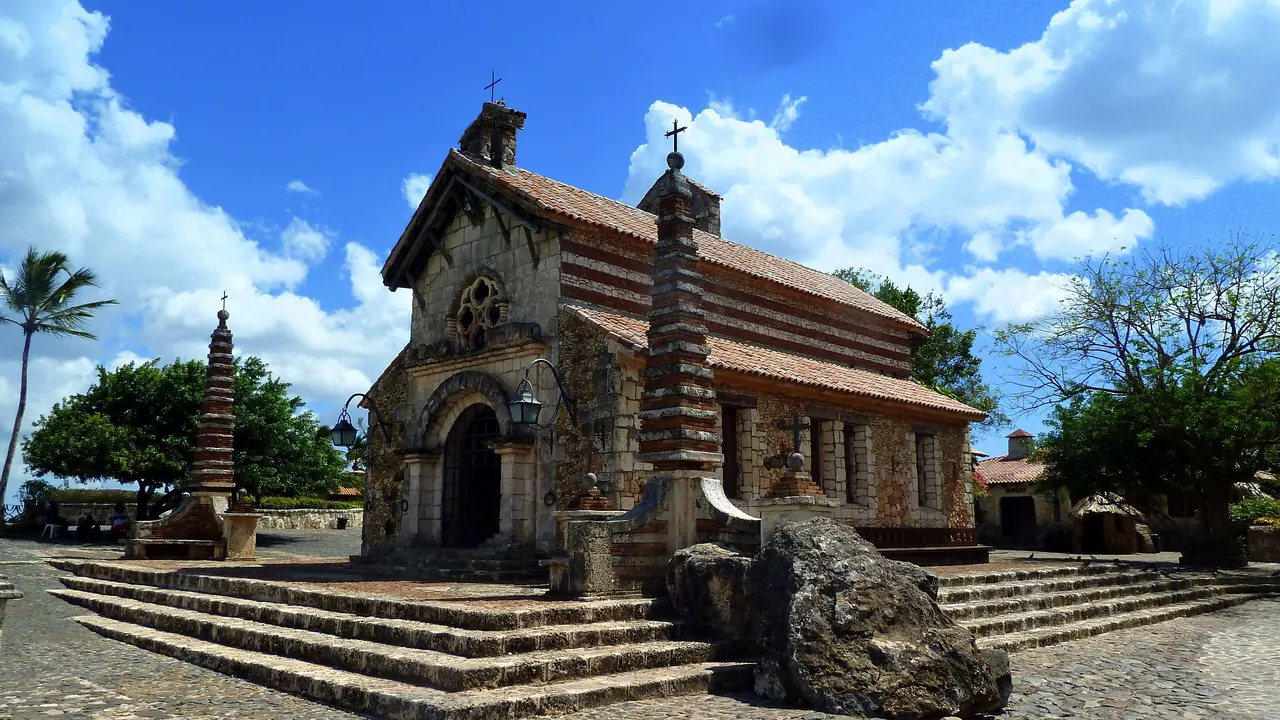
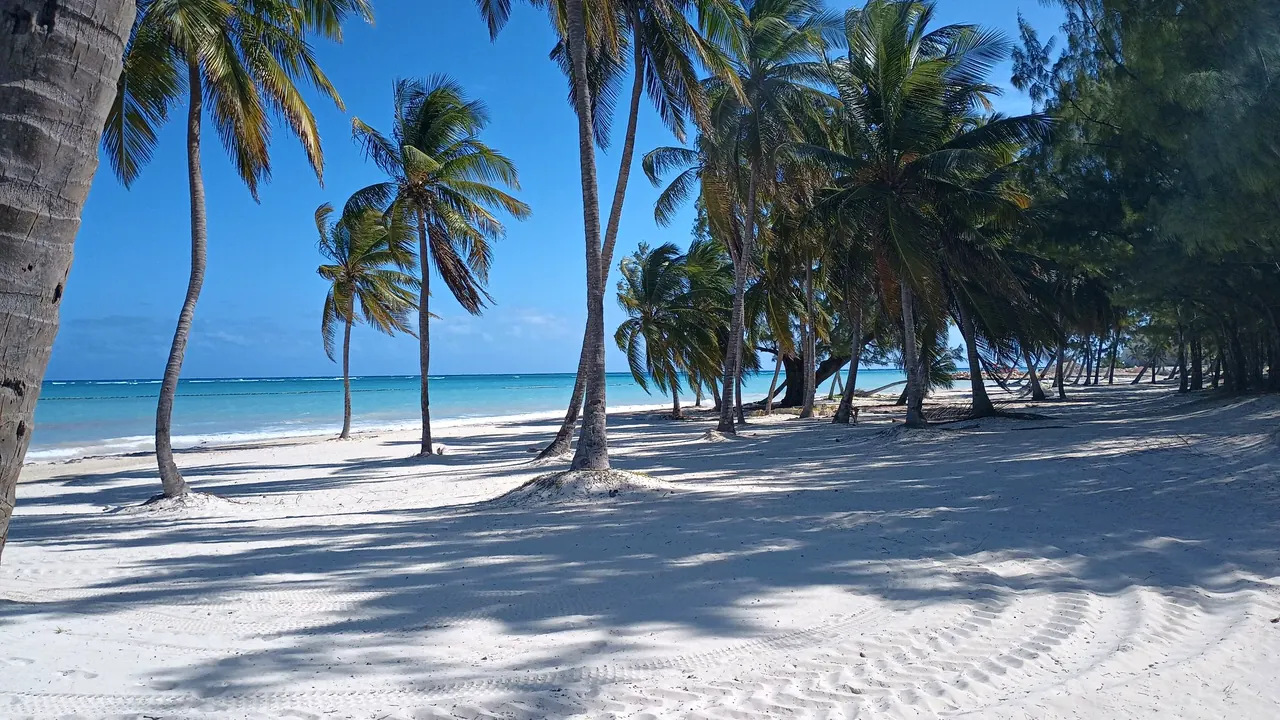
Photos: La Romana by Edgar El, CC BY 3.0, cropped; Punta Cana by Mary Mark Ockerbloom, CC0.
La Romana or Punta Cana?
Our verdict in twelve categories, each scored against the same fixed benchmark cities, and the climate month by month, so you can choose for your trip.
Choose La Romana for
- day trips
- culture and sights
- nature and the outdoors
La Romana suits travellers who want a beach base with more to do around it. Bayahibe's calm water and dive sites, Altos de Chavón above the river gorge and Santo Domingo's colonial quarter within an easy drive give a week some variety. The town's comedores and colmados feel more Dominican than anything along the resort coast, and costs stay a little lower for anyone willing to step outside the hotel.
Choose Punta Cana for
- families
- beaches
- nightlife
For a vacation built around the sand itself, Punta Cana is the stronger pick. Its long, reef-calmed coast lets you choose your beach, from sociable Bávaro to polished Juanillo or the surf at Macao, and its family resorts, spas and big Bávaro nights make an all-inclusive week easy. The trade-off is that history and heritage are a long road trip away.
Scoreboard
Twelve categories on one fixed scale from 0 to 100. The shaded stretch is the gap between the two.
Your match
Pick a travel style or drag the sliders, and both match scores follow your weighting.
Too close to call, 2 points apart
Wins on day trips and culture and sights with your weighting.
Wins on families and beaches with your weighting.
What matters to you?
Category by category
What the scores mean for a trip.
Beaches & swimming
Punta Cana makes the better beach vacation because it is built on the sand: around 50km of reef-calmed coast with a choice of mood, from resort-lined Bávaro to quieter Juanillo and the wilder, surf-washed shore at Macao. In some summers sargassum washes up, though the resorts rake it away.
La Romana's town has no beach of its own, so visitors stay east at Bayahibe and Dominicus, where the pale sand and clear, gentle water are excellent but cover a much shorter stretch. Its strength is the boats: Catalina's snorkelling is a short crossing away, and the Saona trips leave from Bayahibe, right on its doorstep.
Food & drink
Neither is a food destination, and both share the same Dominican staples of rice, beans, stewed meat, sancocho and fried fish with tostones. La Romana comes out a little ahead because it is a working town, where the comedores and colmados belong to daily life, and Bayahibe's waterfront grills cook the day's catch simply.
In Punta Cana nearly every meal is a resort buffet or a themed à la carte room, and Dominican cooking is found mainly at the stands used by hotel workers. The grills of Bávaro and the Cap Cana marina serve lobster, but to visitors rather than locals.
Culture & sights
La Romana at least fills a morning. Altos de Chavón is a 20th-century recreation of a Mediterranean hill village above the river gorge, with a church, student galleries and a regional museum strong on Taíno pottery, and the old sugar town adds a central park and a church. Punta Cana has no old town and no museums, only craft displays and resort chapels. In both, real history means a day in Santo Domingo, which is far closer from La Romana.
Nightlife
Punta Cana has the bigger nights out. Bávaro has large party-show clubs with acrobats, a club inside a limestone cave and open-air bars playing bachata and reggaeton late, all built for visitors and reached by taxi.
Going out in La Romana is smaller and more local: beer outside a colmado with merengue at full volume, a discoteca filling up at weekends, and a few marina and Bayahibe bars that are quiet by late evening. It suits anyone curious about a Dominican Saturday night, less so a group set on a big night.
Nature & outdoors
Both are flat coasts where the outdoors is mostly on the water, and both reach Parque Nacional del Este and Saona. La Romana has the edge for divers and snorkellers: Bayahibe is one of the country's main dive centres, with reef walls, wrecks and an underwater museum of sunken cannons, and Catalina's wall is close by. Kayaking the Chavón gorge and the park's trails to Taíno caves add something on land.
Punta Cana leans more towards sport, with kitesurfing at Cabeza de Toro and deep-sea fishing for marlin. On land it has the lagoon trails of the Indigenous Eyes reserve and the Hoyo Azul sinkhole at Cap Cana.
Day trips
Location gives La Romana the advantage. Santo Domingo's colonial quarter is about an hour and a half away, against two and a half hours each way from Punta Cana, so it makes a comfortable day rather than a long haul. The Cueva de las Maravillas with its Taíno rock art and the sugar-boom streets of San Pedro de Macorís are also close.
From Punta Cana, Higüey's basilica is the nearest outing. Altos de Chavón is a little over an hour away, which is to say it is one of La Romana's own sights.
Good for families
Punta Cana is the more complete family choice. Many resorts are designed around children, with splash parks, waterslides and family suites, and beyond them there are adventure parks, zip lines and dolphin and sea-lion encounters, though every outing needs a taxi or a tour.
La Romana works for a family who mainly want calm, shallow water at Bayahibe and Dominicus and a good kids' club, and the gated resort adds horses and quiet roads. Apart from the Saona starfish trip, there is little laid on for children outside the hotels.
Getting around
La Romana is a little easier to manage without wheels. Bayahibe village is small enough to wander on foot, and the town, the big resort and the beaches all lie along one coastal highway, though with fields and scrub between them. Inside the gated resort, guests get about by golf cart. For anything further, transfers, taxis and tour pickups do the work, and a hire car means assertive drivers and unlit roads after dark.
Punta Cana has no centre to stroll. Its resorts sit behind gates and long driveways along about 50km of road with few pavements, so almost every outing starts with a taxi, a transfer or a tour pickup. The sand makes up for some of this, since you can follow it for miles between hotels, and the guaguas between Bávaro and Higüey serve the adventurous.
Shopping & style
Shopping is thin in both and covers the same island specialities: larimar, amber and hand-rolled cigars. La Romana's cigars carry more weight, since it is a cigar-making town, and its jewellery shops sit at Altos de Chavón and the marina. Punta Cana offers more range for resort wear and labels in its open-air malls at Bávaro and Cap Cana, plus beach craft stalls where haggling is expected.
Affordability
La Romana is a little kinder on the wallet. Its town is cheap for anyone happy to eat in comedores and ride guaguas, and the Bayahibe and Dominicus all-inclusives are fairly priced, although the big gated resort is firmly luxury.
Punta Cana is priced above the rest of the country, with fixed tourist taxi fares and resort-area restaurants, though packages booked with flights can be good value and the Los Corales apartment hotels help on a tight budget. On both coasts, the boat excursions push the bill up.
Live music & performing arts
Neither has a theatre or concert season, and the difference is one of kind. La Romana has the open-air amphitheatre at Altos de Chavón, which hosts occasional concerts by major Latin and international artists in a dramatic setting above the gorge. Punta Cana has more regular light entertainment, with glossy acrobatic and tribute shows in Bávaro. In both, the live merengue and bachata are the genuine part.
Wellness & relaxation
Punta Cana has the deeper spa offer. Most large resorts have hydrotherapy circuits and seaside massage cabanas, treatments use local cacao, coffee and coconut, and the adults-only resorts give real quiet.
La Romana's spas are fewer and more uneven, concentrated in the gated resort and the bigger hotels. What it offers instead is Bayahibe's slow village pace once the day boats have gone.
When should you go?
Pick your month. The climate figures are measured averages, not a forecast.
La Romana in July
Punta Cana in July
Daytime high, °C
Rainfall in the month, mm
Where the figures come from
La Romana's temperatures are measured 65 km from the centre, at Punta Cana.
La Romana has no rain gauge within 25 km of the centre, so its rainfall comes from a gridded climate dataset read at the destination rather than from a gauge further away.
Temperature and rainfall are climate normals, averaged over the years shown. La Romana: 1993-2020 (rainfall 1991-2020) normals, Punta Cana (65.4 km from centre). Punta Cana: 1993-2020 (rainfall 1991-2020) normals, Punta Cana (0.9 km from centre).
The heat is the same on both coasts: about 29°C by day in January, rising to 32°C from June to October. The sea stays warm enough to swim all year, so any month works for the beach. From June the midday heat makes walking hard, so a cooler winter month suits a sightseeing day in Santo Domingo better.
The rain is where they differ. La Romana has a clear dry season from January to April, and its wet months come later, with the heaviest rain from August to October, peaking around 141mm in September. Punta Cana's rain is spread more evenly, so its winter is noticeably damper than La Romana's, and its wettest spell runs from September into October at around 130mm. For the most reliably dry weather, late winter and early spring in La Romana are the pick of either coast.
Which traveller are you?
For a culture and arts trip, La Romana is the better base. Altos de Chavón and its museum of Taíno objects sit just outside town, and Santo Domingo's colonial quarter is close enough for a relaxed day, while Punta Cana has no historic sights of its own.
On a family trip with young children, Punta Cana makes life easier. Its resorts are built around children, with waterslides, splash parks and kids' clubs, the beaches shelve gently, and adventure parks are nearby. La Romana has calm water but little for children outside the hotels.
On an outdoors trip, especially one built around diving, La Romana comes out ahead. Bayahibe is one of the country's main dive centres, with reef walls, wrecks and sunken cannons, and the national park and Chavón gorge are close. Punta Cana leans more towards kitesurfing and fishing.
Before you go
| Measure | La Romana | Punta Cana |
|---|---|---|
| Official language | Spanish | Spanish |
| Currency | Dominican Peso (DOP) | Dominican Peso (DOP) |
| Sockets | AB110 V, 60 Hz | AB110 V, 60 Hz |
| Driving side | Right | Right |
| Time zone | UTC-4 | UTC-4 |
| Emergency number | 911 | 911 |
| Elevation | 10 m | 28 m |
| Main airport | Casa De Campo International Airport (LRM)7 km from centre12 non-stop destinations | Punta Cana International Airport (PUJ)1 km from centre93 non-stop destinations |
| Public holidays this year | 13 days | 13 days |
By the numbers
| Measure | La Romana | Punta Cana |
|---|---|---|
| Population | 139,238 | 138,919 |
| People per km² | 512 | 292 |
| Museums within 10 km | 0 | 0 |
| UNESCO World Heritage sites within 50 km | 0 | 0 |
| Swim season, months above 21 °C | 12 months | 12 months |
Where else could you go?
Every comparison below shares a destination with this one, so you can follow La Romana or Punta Cana somewhere new.
- Santo Domingovs La Romana
- Santo Domingovs Punta Cana
- Puerto Platavs La Romana
- San Juanvs Punta Cana
- Puerto Platavs Punta Cana
- San Juanvs La Romana