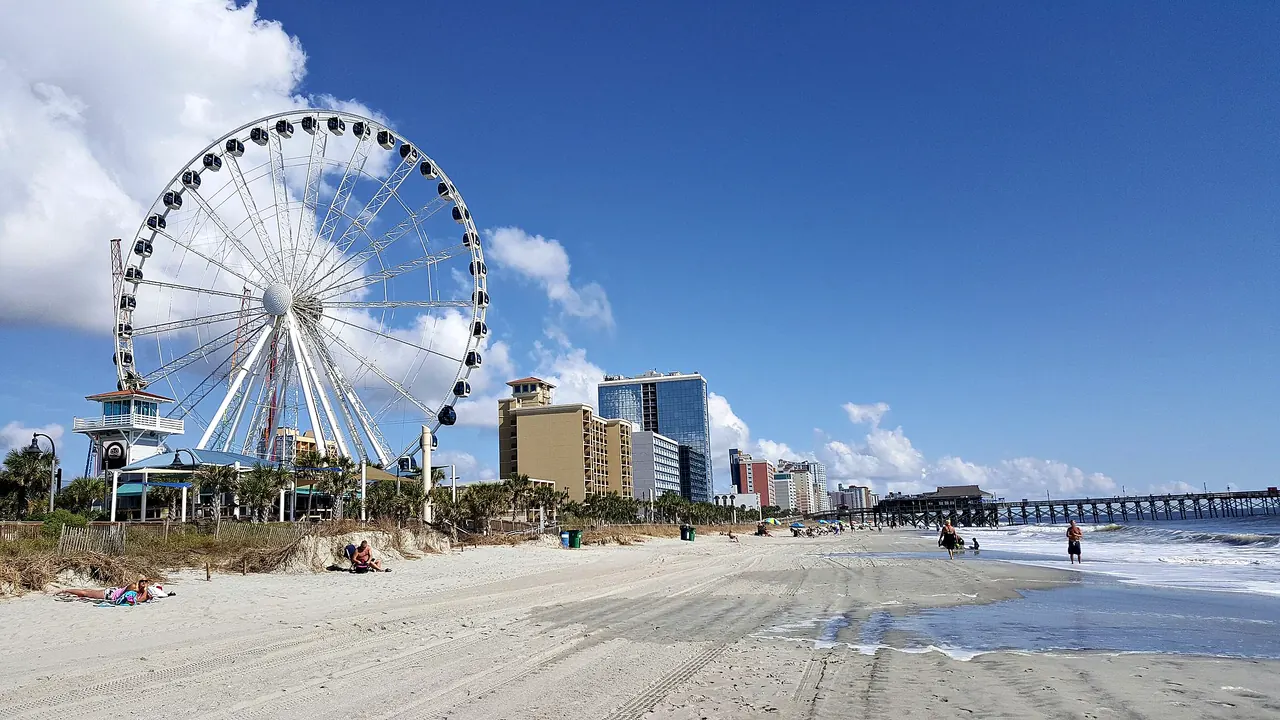
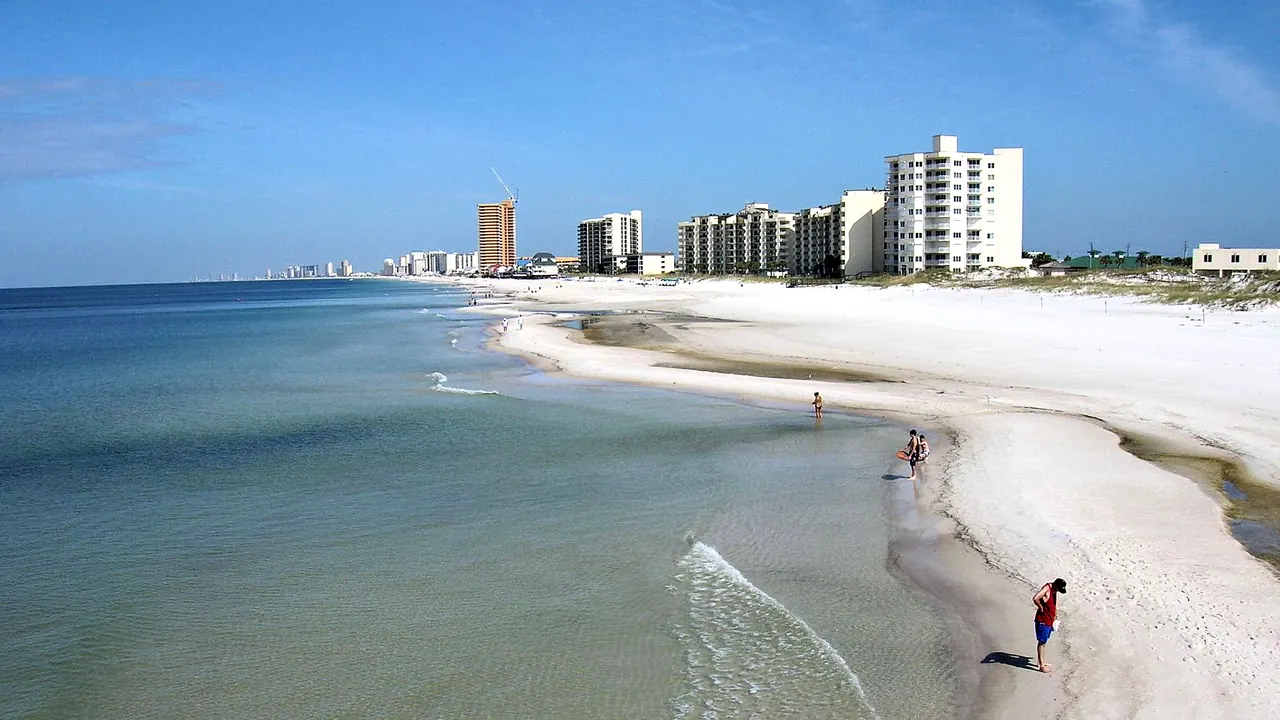
Photos: Myrtle Beach by The ed17, CC BY-SA 4.0, cropped; Panama City Beach by j.s. clark/ "Image by jsclark.net.", CC BY-SA 2.0, cropped.
Myrtle Beach or Panama City Beach?
Our verdict in twelve categories, each scored against the same fixed benchmark cities, and the climate month by month, so you can choose for your trip.
Choose Myrtle Beach for
- nightlife
- live music and the arts
- shopping
Myrtle Beach is the better pick for a classic family beach vacation with more to fill the evenings. It has the longer shoreline, more attractions for children, more variety theatres and boardwalk bars, and Charleston's old streets within a day's drive, so a week has some range beyond the sand. It also tends to cost a little less.
Choose Panama City Beach for
- nature and the outdoors
- beaches
Choose Panama City Beach if the water itself is what you are after. The Gulf sand is whiter and the sea clearer. St. Andrews State Park has snorkelling, dunes and the boat to Shell Island, and divers can explore wrecks offshore, which gives the trip an outdoor side that Myrtle Beach can't match. There is less to do once the sun goes down.
Scoreboard
Twelve categories on one fixed scale from 0 to 100. The shaded stretch is the gap between the two.
Your match
Pick a travel style or drag the sliders, and both match scores follow your weighting.
Wins on nightlife and live music and the arts with your weighting.
Wins on nature and the outdoors and beaches with your weighting.
What matters to you?
Category by category
What the scores mean for a trip.
Beaches & swimming
Both towns are built around the sand, and either will do for a beach vacation. The difference is in the look and feel. Myrtle Beach is on the Atlantic and has sheer length: about 100km of pale, flat sand along the Grand Strand, with greenish water, small waves and calmer dune-backed stretches at Surfside, Garden City and the state parks to the south.
Panama City Beach has a shorter shoreline, but it is the more striking of the two, with powder-white quartz sand and clear green Gulf water on calm days. It also has the sheltered lagoon at St. Andrews State Park and boat trips to the undeveloped sands of Shell Island. The catch is rip currents, so keep a close eye on the beach flags.
Food & drink
Neither town is a place to travel for food, and in both the main strip is mostly chains, buffets and themed restaurants. The difference is in the seafood on the edges. Myrtle Beach has the waterfront restaurants of Murrells Inlet, Calabash-style fried seafood just over the North Carolina line, and Lowcountry dishes such as shrimp and grits and she-crab soup, which give it some regional flavour.
Panama City Beach sticks to Gulf seafood: blackened grouper, shrimp baskets and oysters from the bays, eaten on dockside decks and at open-air shacks. A few kitchens near the lagoon and at the quieter western end cook with more care.
Culture & sights
Neither town is somewhere to go for history, but Myrtle Beach has a little more to fill a day. Brookgreen Gardens, on a former rice plantation, sets American figurative sculpture among live oaks and tells the story of the people enslaved there. Next door, in Huntington Beach State Park, is Atalaya, a Moorish-style winter house from the 1930s.
Panama City Beach has the small Man in the Sea Museum, about diving history, and the older streets of the St. Andrews district across the bay. For anything more you need a longer drive.
Nightlife
Myrtle Beach offers more of a night out. Around the boardwalk there are rooftop decks and beach bars, the big entertainment complexes have a cluster of dance clubs that stay open late, and North Myrtle Beach keeps the shag alive in long-standing clubs on Main Street.
Panama City Beach has no real club scene. Evenings mean tiki huts, frozen drinks at sunset and decks over the sand around Pier Park and the lagoon, and outside summer the town is quiet by mid-evening. Spring break makes some weeks rowdy in both.
Nature & outdoors
Both towns sit on flat coastal plain, but Panama City Beach makes more of the water. St. Andrews State Park pairs tall white dunes with a snorkelling lagoon, and Camp Helen State Park borders a rare coastal dune lake. Offshore, divers can explore artificial reefs and wrecks.
Myrtle Beach's strengths are on land and in the marshes. Huntington Beach State Park has marsh boardwalks for birdwatching and alligators in its lagoon, the cypress swamps of the Waccamaw River are good for kayaking, and dozens of golf courses line the Grand Strand.
Day trips
Myrtle Beach has the best single outing of the two in Charleston, about two hours south, with its antebellum streets, harbour forts and plantations. Closer to town are Georgetown's old waterfront and rice-culture museum, and to the north are Wilmington's riverfront and Southport.
From Panama City Beach the best trip runs along Scenic Highway 30A to the planned pastel towns of Seaside, WaterColor and Rosemary Beach. To the east is the old oyster port of Apalachicola, and Pensacola is at the limit of a day out. You need a car for all of these, from either town.
Good for families
Both towns are built for families, but Myrtle Beach has more for children to do. There is a large aquarium, a seaside amusement park with an old wooden roller coaster, water parks, the observation wheel on the boardwalk and themed mini-golf everywhere, and resort hotels have lazy rivers and kiddie pools.
Panama City Beach covers the basics well, with a water park, a marine park with dolphin shows, a small zoo and the calm St. Andrews lagoon for first snorkels. There is less variety, though, and rip currents mean children need closer watching in the sea. In both towns, avoid the spring break weeks.
Getting around
Getting around is hard work in both towns, and you need a car for almost everything. Myrtle Beach spreads along roughly 100km of highway with sparse buses, though the blocks around the boardwalk are easy on foot and some visitors use bicycles or golf carts. Panama City Beach is a 43km strip along one main road, with a slow trolley-bus and patchy pavements, and in both towns summer traffic crawls and the sand makes the best walk.
Shopping & style
Myrtle Beach has more choice. Bargain hunters have two big outlet centres, waterfront complexes mix shops with attractions, and The Market Common, on the old air force base, feels more like a town centre. The sweetgrass baskets sold along the coast road to the south are a rare local craft.
In Panama City Beach, shopping means the chain stores of Pier Park and the beachwear warehouses with shark-mouth entrances. For anything more individual, drive to the boutiques of the 30A towns.
Affordability
Myrtle Beach is usually the cheaper of the two, because it has so many motels, hotels and condos, and oceanfront rooms can be remarkably cheap outside summer. Panama City Beach costs a little more overall, although long winter stays there are especially good value. In both, a kitchen helps keep costs down, you need a car, and meals and attractions cost what they do anywhere in America, so timing matters most: avoid July in Myrtle Beach, and spring break and peak summer on the beachfront in Panama City Beach.
Live music & performing arts
Myrtle Beach has a real trade in shows. Large theatres stage country, gospel and pop revues, comedy and Christmas shows, there are dinner shows with knights or pirates, and touring country and rock acts play the main entertainment complex.
Panama City Beach has little beyond cover bands on beach-bar decks and summer concerts at the shopping centre. Across the bay, Panama City's restored historic theatre has a modest season of touring shows and local productions. Neither town has opera, an orchestra or serious drama.
Wellness & relaxation
Neither town has a bathing tradition, and in both, wellness comes down to resort spas and choosing the right season. In Myrtle Beach the quiet corner is the southern end around Pawleys Island in spring and autumn. Panama City Beach's beach empties from autumn to spring, when long sunset walks on the white sand set a much slower pace.
When should you go?
Pick your month. The climate figures are measured averages, not a forecast.
Myrtle Beach in July
Panama City Beach in July
Daytime high, °C
Rainfall in the month, mm
Where the figures come from
Myrtle Beach has no rain gauge within 25 km of the centre, so its rainfall comes from a gridded climate dataset read at the city rather than from a gauge further away.
Panama City Beach has no rain gauge within 25 km of the centre, so its rainfall comes from a gridded climate dataset read at the city rather than from a gauge further away.
Temperature and rainfall are climate normals, averaged over the years shown. Myrtle Beach: 1971-2000 (rainfall 1991-2020) normals, Myrtle Beach Air Force Base (5.5 km from centre). Panama City Beach: 1971-2000 (rainfall 1991-2020) normals, Tyndall Air Force Base (24.6 km from centre).
Both are warm-season beach towns, but Panama City Beach has the longer season at both ends of the year. In Myrtle Beach the Atlantic is comfortable for long swims from June to September, reaching about 28°C at its warmest. The Gulf off Panama City Beach is already pleasant in late May and stays warm through October, touching 29°C. High summer is hot and humid for walking in both towns, and it is also the wettest time of year. August brings about 187mm of rain in Myrtle Beach, and Panama City Beach is wetter still.
Spring and autumn are the better seasons for walking, golf and nature trails: April, May and October in Myrtle Beach, and March, April, October and November in Panama City Beach. Winter is when they differ most. Myrtle Beach drops to daytime highs of about 12°C in January, which means coats on the beach, while Panama City Beach stays milder at around 16°C. That makes it the more pleasant winter escape of the two, although neither sea is warm enough to swim in at that time of year.
Which traveller are you?
On a family trip with young children, Myrtle Beach makes a long week easier. Its small waves need less watching than the Gulf's rip currents, and there is enough to do off the sand that children rarely repeat a day.
For an outdoors trip centred on the sea, Panama City Beach is the stronger base. Its clearer water makes snorkelling and diving worthwhile, while Myrtle Beach's greenish Atlantic pushes active days inland, towards marshes, rivers and golf.
On a food and nightlife trip, Myrtle Beach gives you more evenings worth going out for. Nights can run late instead of ending with a sunset drink, and its seafood has more regional character.
Before you go
| Measure | Myrtle Beach | Panama City Beach |
|---|---|---|
| Currency | US Dollar (USD) | US Dollar (USD) |
| Sockets | AB120 V, 60 Hz | AB120 V, 60 Hz |
| Driving side | Right | Right |
| Time zone | UTC-5, UTC-4 in summer | UTC-6, UTC-5 in summer |
| Emergency number | 911 | 911 |
| Elevation | 8 m | 3 m |
| Main airport | Myrtle Beach International Airport (MYR)5 km from centre60 non-stop destinations | Northwest Florida Beaches International Airport (ECP)20 km from centre19 non-stop destinations |
| Public holidays this year | 12 days | 11 days |
By the numbers
| Measure | Myrtle Beach | Panama City Beach |
|---|---|---|
| City population | 35,682 | 18,094 |
| People per km² | 591 | 375 |
| Museums within 10 km | 2 | 0 |
| UNESCO World Heritage sites within 50 km | 0 | 0 |
| Swim season, months above 21 °C | 6 months | 7 months |
Where else could you go?
Every comparison below shares a destination with this one, so you can follow Myrtle Beach or Panama City Beach somewhere new.
- Destinvs Panama City Beach
- Wilmingtonvs Myrtle Beach
- Pensacolavs Panama City Beach
- Charlestonvs Myrtle Beach
- Orange Beachvs Panama City Beach
- Gulf Shoresvs Panama City Beach